The Fool upright meaning
Before Waite, the Fool had no number to speak of. Wikipedia notes that decks older than the Waite-Smith deck almost always left him unnumbered and apart from the other trumps. A few exceptions exist: the 15th-century Sola Busca labeled him 0, and some 18th-century Belgian decks labeled him XXII. In French and Italian he was Le Mat and Il Matto, which Wikipedia glosses as "the madman".
Today the card reads as a beginning. All four sites we compared (Biddy Tarot, Labyrinthos, The Tarot Guide and tarot.com) read the card as a new beginning. The common thread is trust: the Fool acts before the evidence is in.
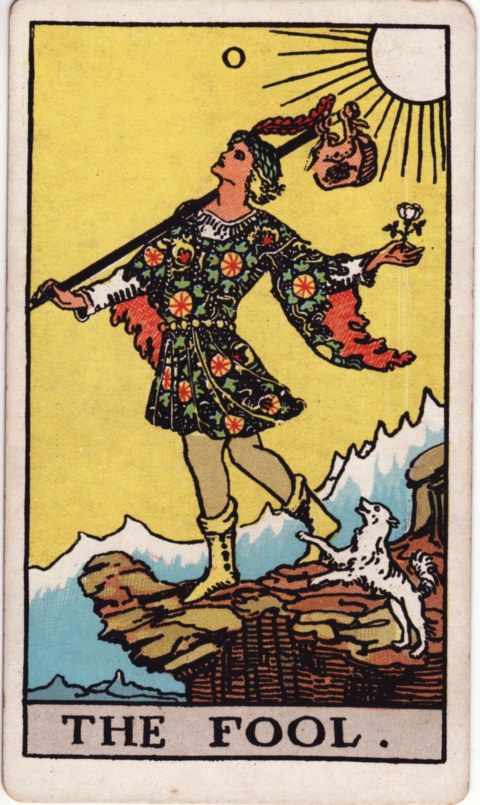
In a reading that usually means a move made on nerve rather than on a finished plan, such as a new job, a different city, or a first date with someone you cannot predict. The picture shows the cost: he looks at the sky, and the cliff is one step away.
The Fool reversed
Turned upside down, the Fool shows a start that has gone wrong in one of two directions: too much haste, or none at all.
Waite's reversed list is "Negligence, absence, distribution, carelessness, apathy, nullity, vanity." Most of it describes someone not paying attention. "Distribution" is an odd word to modern ears; Waite gives no gloss for it, so we leave it as he printed it. Tarot.com adds the opposite reading: being afraid to start.
So ask which one you are. If you plan to quit a job with no savings and no second option, the card points at the cliff. If your plan has been ready for a year and you keep adding one more step, the same card points at the other side.
Is The Fool a yes or no card?
| Position | Answer |
|---|---|
| Upright | Yes |
| Reversed | Not yet, or no |
Can a card about leaping answer a yes or no question? The sites we checked say it can. Tarot.com answers yes, Tarot Atlas calls the upright card a strong yes, and Zenith Align gives a conditional yes when it is reversed.
Our reading: upright is a yes to questions about starting something, such as applying, moving or asking. For questions about safety or money it comes with a condition, because Book T, the Golden Dawn's tarot manuscript, reads the card as folly when the question is material. Reversed is not yet, or no: the start is not ready, or you are rushing it.
The old texts give no yes or no ruling. Read our answer as the mood of the draw, and look at the next card before you act.
The Fool in love
Single and curious
The Fool describes openness more than a person. Tarot.com reads it as a nudge to flirt with the idea of love again, and The Tarot Guide reads an impulsive, carefree romance. We would say: accept the invitation, and keep your eyes open while you do.
In a relationship
Together, the card asks for play: a spontaneous trip, a plan that is not planned. The shadow is lightness without commitment. The Tarot Guide ties the card to "lack of commitment", so a Fool in a question about the future of a relationship is worth a direct conversation. Drawn reversed about a partner, Labyrinthos reads that "you or a lover may be a bit too immature right now", and The Tarot Guide says the relationship "may be exciting but may involve some risky behaviour". In a new relationship we read the reversed card as not yet: ask where things are going before you treat the card as a verdict on the other person.
The Fool as feelings for someone
Read as their feelings, the Fool is someone excited and not yet sure. Tarot.com says they might still be "figuring out if they're chasing love or running from commitment". Reversed, the interest is there but the follow-through is thin.
The Fool as work and money
Zero is the one number among the trumps that stands for nothing yet, and at work that reads as a blank page: a first job, a change of field, a project with no history. Tarot.com calls it a positive sign and a time "to follow a gut feeling instead of a five-year plan".
Book T adds a warning for material questions, where the card means "folly, stupidity, eccentricity, or even mania". Read that as a prompt to check the numbers before you hand in your notice. Reversed, the card fits an offer accepted without reading it, or a project you cannot bring yourself to start.
The Fool as advice and as a person
Take the first step that is small enough to undo, and take it this week. You need to trust the next step, and the rest of the route can stay unclear.
As a person, the Fool is someone new to something: eager, unplanned, perhaps unreliable. Book T gives the card Air and reads it, in spiritual questions, as "idea, thought", so we also read this person as someone with more ideas than plans. The dog in the picture is part of the advice. Labyrinthos reads its bark as a warning, so bring along someone who will tell you when the edge is near.
Symbolism of the Rider–Waite–Smith card
- The cliff edge. He stops at the brink of a precipice, "among the great heights of the world" in Waite's words. Waite adds that the edge "has no terror" for him.
- The white rose. He holds a rose in one hand. Wikipedia reads the white rose as freedom from baser desires; Biddy Tarot reads it as purity and innocence.
- The wand and wallet. Over his right shoulder hangs "a wallet curiously embroidered" on a costly wand. He carries one bundle, which tells you how little he plans to need.
- The dog. A small white dog leaps at his heels. Waite says only that "his dog is still bounding"; readers see a companion, a loyal friend or a warning bark.
- The sun. The sun shines behind him. Waite writes that it "knows whence he came, whither he is going", so the morning light is on his back.
- The mountains. Mountains fill the background. Biddy Tarot reads them as challenges still to come, which he is ignoring for now.
What the oldest sources say
“Folly, mania, extravagance, intoxication, delirium, frenzy, bewrayment. Reversed: Negligence, absence, distribution, carelessness, apathy, nullity, vanity.”
“If the question refers to spiritual matters, the Fool means idea, thought, spirituality, that which endeavours to transcend Earth. But if question is material, it means folly, stupidity, eccentricity, or even mania.”
Waite's list for the upright card starts with the word "Folly" and contains no beginning, no trust and no leap. Those readings come from the picture and the zero. In Part II of the same book he describes the figure kindly, as "the spirit in search of experience", so the divinatory list and the picture pull in different directions inside one book. Waite also gives the Fool the number 0 yet discusses him, per Wikipedia, between Judgment (20) and The World (21).
Book T splits the card by the kind of question. For a spiritual one the Fool is idea and thought; for a material one, folly. Waite's first word matches the material half. The spiritual half is the one modern sites kept, and they tend to drop the warning that came with it.
The Fool and Air: the card's element
| Number | 0, Major Arcana |
|---|---|
| Element | Air |
| Signs of air | ♊︎ Gemini, ♎︎ Libra, ♒︎ Aquarius |
| Hebrew letter | Aleph א |
| Golden Dawn title | The Spirit of Aether |
Attributions from Book T (Golden Dawn, c. 1892; printed 1912).
In Book T the Fool belongs to an element, not a sign: Air. Its Hebrew letter is Aleph and its title is "The Spirit of Aether". That fits Book T's own reading of the card in spiritual questions: "idea, thought".
Air covers three signs, Gemini, Libra and Aquarius, and each sign has three ten-degree slices with a numbered card. That hands the Fool nine minor cards, the Two through the Ten of Swords. Every numbered Sword belongs to the Fool's element, from Peace Restored to Ruin.
The 9 minor arcana cards of the air signs
Book T gives each air sign three numbered cards, one per ten degrees; all of them are Swords.
| Part of the zodiac | Card | Book T title | Planet |
|---|---|---|---|
| 0° to 10° Gemini | Eight of Swords | Lord of Shortened Force | Jupiter |
| 10° to 20° Gemini | Nine of Swords | Lord of Despair and Cruelty | Mars |
| 20° to 30° Gemini | Ten of Swords | Lord of Ruin | the Sun |
| 0° to 10° Libra | Two of Swords | Lord of Peace Restored | Moon |
| 10° to 20° Libra | Three of Swords | Lord of Sorrow | Saturn |
| 20° to 30° Libra | Four of Swords | Lord of Rest from Strife | Jupiter |
| 0° to 10° Aquarius | Five of Swords | Lord of Defeat | Venus |
| 10° to 20° Aquarius | Six of Swords | Lord of Earned Success | Mercury |
| 20° to 30° Aquarius | Seven of Swords | Lord of Unstable Effort | Moon |
Today 3 of the ten planets are in air signs: Venus in Libra, Uranus in Gemini, Pluto in Aquarius.
Because the Fool has no sign, there is no single sign to look up in your chart. What you can check is how much air you have. In our table of 35,064 dates, 7.6% had no planet at all in an air sign. The check below counts yours.
How much air is in your birth chart?
Enter your birth date. We count how many of the ten planets were in the air signs (Gemini, Libra, Aquarius) that day.
Example below: February 10, 1996, Eastern time. Enter your own date above.
Air signs in your chart: 3 of 10 (+1 depends on birth time)
On February 10, 1996 (Eastern time): Sun in Aquarius, Mars in Aquarius, Uranus in Aquarius. Moon changed signs that day, so the birth time decides. Exactly 3 of 10 happens on 22.8% of dates from 1930 to 2025; the average is 2.41.
- ☉ Sun: ♒︎ Aquarius
- ☽ Moon: Libra or Scorpio
- ☿ Mercury: ♑︎ Capricorn
- ♀ Venus: ♈︎ Aries
- ♂ Mars: ♒︎ Aquarius
- ♃ Jupiter: ♑︎ Capricorn
- ♄ Saturn: ♓︎ Pisces
- ♅ Uranus: ♒︎ Aquarius
- ♆ Neptune: ♑︎ Capricorn
- ♇ Pluto: ♐︎ Sagittarius
Every planet, angle and house from your birth time: birth chart calculator.
Questions about The Fool
Is the Fool card 0 or 22?
Zero in the Waite-Smith deck. Older decks mostly left him unnumbered, and a few labeled him 0 or XXII.
Is the Fool a good tarot card?
Upright, yes: all four modern sites we compared read it as a hopeful start. Waite's own list is harsher, beginning with "Folly", so the card is good news about courage and a caution about planning.
What does the Fool mean as a person?
Someone new to a situation: curious, spontaneous, and sometimes careless. Air is the card's element in Book T, and an airy person tends to run on ideas.
What does the Fool reversed mean in love?
Hesitation or recklessness. One of you may be afraid to start, or may start things without meaning to finish them. Waite's reversed list includes "carelessness" and "apathy".
Is the Fool the first tarot card?
In most modern decks, yes, with the number 0. In older decks and tarot card games he sits outside the sequence, and in some games he is the highest trump.
Which element belongs to the Fool?
Book T gives him the element Air, with no single sign. Zenith Align lists Uranus for him; Book T does not.
Why do people get a Fool tarot tattoo?
Neither Waite nor Book T says anything about tattoos. People who choose it usually take the card's own message, a fresh start or a leap of trust, and the dog and cliff are the usual picture.
Sources
- Astronomy Engine: the open-source ephemeris library behind our planet positions, dates and statistics
- A. E. Waite, The Pictorial Key to the Tarot (1911), Wikisource: the divinatory meanings we quote, upright and reversed
- Book T (Golden Dawn), as printed in The Equinox I:8, 1912: the zodiac sign, Hebrew letter, title and short meaning of each card
- Wikimedia Commons: Rider–Waite–Smith tarot deck: Pamela Colman Smith's 1910 card drawings, public domain
- How we create our readings: our own calculation of sign dates, positions and the 1930 to 2025 statistics
Next to The Fool
In the Major Arcana: The Fool (0) → The Magician (1).
All 22 cards with their signs and planets: tarot card meanings.
Air on this site: air signs · the four elements · Gemini zodiac sign · Libra zodiac sign · Aquarius zodiac sign · your full birth chart.
Written by The Zodiac Atlas editorial team with the help of AI and edited by a person. Quotations are from Waite's Pictorial Key to the Tarot and the Golden Dawn's Book T, both in the public domain; the card picture is a 1910 printing of Pamela Colman Smith's drawing for the 1909 deck. Sign dates and planet positions come from the astronomy-engine ephemeris (tropical zodiac). Tarot and astrology are symbolic traditions; they do not predict events.