Is The Tower always a bad card?
Is The Tower always a bad card? The oldest source leans that way. Waite's list starts "Misery, distress" and he adds "It is a card in particular of unforeseen catastrophe." Modern guides keep the shock and give it a purpose. Labyrinthos says the event the card marks "does not have to be something terrible, like a disaster or a great loss".
The Golden Dawn's manuscript hands the card to the planet Mars, and its short meaning starts on the active side: "Ambition, fighting, war, courage, or destruction, danger, fall, ruin." Courage and ambition stand in the same line as ruin, so the card can describe a fight as well as a fall.
A bad outcome is not fixed. The Tarot Guide writes "not every Tower event denotes tragedy", and with positive cards around it the card can mean a big change, "like going to live in another country".
The Tower reversed
Waite's text gives the reversed Tower two parts: "According to one account, the same in a lesser degree; also oppression, imprisonment, tyranny." The first says the upright trouble comes back smaller. The second moves from a building that falls to a person held down. That step is our observation, and Waite offers no gloss.
Today the reversal is read in several ways: a delay, a resisted change, or the aftermath. Labyrinthos gives "averting disaster, delaying the inevitable, resisting change". Biddy Tarot splits the card in two: upright, the change is often outside you, while "with The Tower Reversed, you are instigating the change".
Ask who started the break. If it is coming at you and you are bracing, the delay readings apply. If you are the one taking something apart, Biddy Tarot's reading fits better.
Is The Tower a yes or no card?
| Position | Answer |
|---|---|
| Upright | No |
| Reversed | No, or not yet |
Count the votes on the upright card: three sites, three no's. Tarot.com's verdict is blunt: "the answer is NO." Zenithalign scores both the upright and the reversed card No, and TarotAtlas calls the upright card a no, love and feelings questions included.
Reversed is a no for another reason. Zenithalign describes a catastrophe averted narrowly, or a collapse delayed that must still occur. A delayed collapse is still a collapse, so for the flipped card we answer no, or not yet.
The old texts set no yes or no values, so these verdicts come from the sites. One Tarot.com line suits a yes or no reading: "Let the dust settle before deciding what comes next."
The Tower in love: breakup, relationship, single, feelings
Does The Tower mean a breakup?
Picture a couple with the same argument for a year, and one sentence in the kitchen ends it for good. That is our example, and it does not always end the relationship. Tarot.com says it "could be a breakup, a betrayal, or just a jarring truth". Labyrinthos lists "breakup, weak relationships ending, foundational shift in view of love". A breakup is one reading; both sites also name a shift in how you see the relationship.
In a relationship
The Tarot Guide puts the weight on how a couple handles the hit: to get through a Tower event you need to "maintain open and honest communication". A relationship that survives may come out with "a more solid and honest foundation". For the reversed card, the same site advises against going "back to the way it was previously".
Single
With no partner in the picture, the card turns to your beliefs about love. Tarot.com says it might reflect "a pattern or belief about love that's being shattered". The Tarot Guide goes after a cause: you may face "an uncomfortable revelation about why you are single".
The Tower as feelings
For what someone feels about you, Labyrinthos says the card reveals "a storm of emotions" and a person "overwhelmed by the intensity of their feelings". Reversed, the same site reads someone who is "beginning to find clarity" after upheaval. The card names turmoil and leaves the decision open.
The Tower as work and money
Tarot.com calls it "the email you didn't see coming" and lists "sudden job changes, leadership shake-ups, or projects collapsing overnight", and Labyrinthos gives "sudden job loss, workplace disruption, workplace chaos". We make no money predictions; a card is not a substitute for a financial adviser.
Upside down, the sites describe a collapse that did not reach you. The Tarot Guide has you "managing to hold onto your job in difficult circumstances", and Labyrinthos lists "surviving layoffs".
The Tower as advice and as a person
The Devil sits just before The Tower, and Waite allows that "there is a sense in which the catastrophe is a reflection from the previous card", then adds that it is "more correctly a question of analogy". Labyrinthos says the falling people "perhaps signal the same figures we see chained in the Devil card earlier". Tarot.com's advice is blunt: "Stop trying to patch the cracks." Ask which crack you keep patching.
People also ask what The Tower is as a person. The sites we read describe events and say little about personality, so this is our reading. Tarot.com opens its page with "You are the one to serve as a catalyst for change." On that line, the person is the one who says the true thing aloud, or who stops propping up a plan that cannot carry its weight.
Symbolism of the Rider–Waite–Smith card
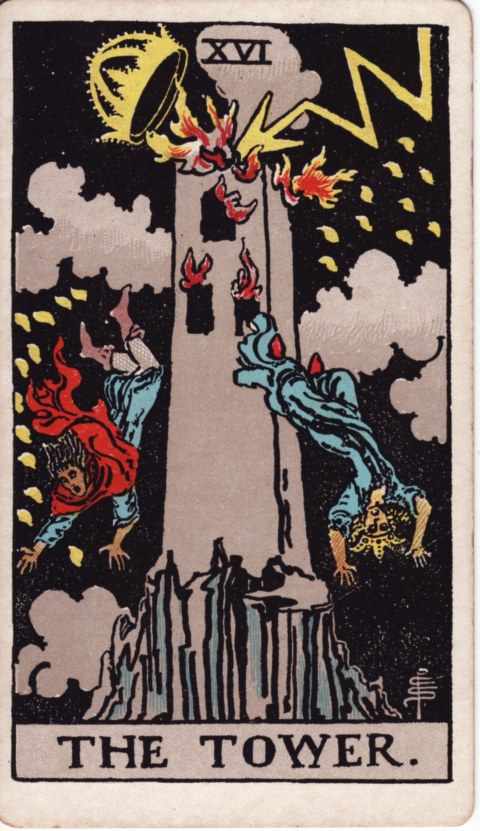
- The tower. Biddy Tarot describes "a tall tower perched on the top of a rocky mountain" and reads it as ambitions and goals made on false premises.
- The crown. Lightning knocks it off the top. Biddy Tarot says the bolt "enters via the top of the building and knocks off the crown".
- The two falling figures. Waite calls them "the two persons who are the living sufferers" and explains: "The one is the literal word made void and the other its false interpretation."
- The flames. Wikipedia says Pamela Colman Smith used "small tongues of fire in the shape of Hebrew yod letters" in place of the Marseilles balls. Biddy Tarot counts "22 flames".
Why the Golden Dawn called The Tower the Blasted Tower
“Misery, distress, indigence, adversity, calamity, disgrace, deception, ruin. It is a card in particular of unforeseen catastrophe. Reversed: According to one account, the same in a lesser degree; also oppression, imprisonment, tyranny.”
“Ambition, fighting, war, courage, or destruction, danger, fall, ruin.”
Book T numbers the card 16 and calls it "The Blasted Tower", with the title "The Lord of the Hosts of the Mighty", the letter Peh and the planet Mars. Waite opens with "Occult explanations attached to this card are meagre and mostly disconcerting." He leans toward "a House of Doctrine", adds "a House of Falsehood", and quotes "except the Lord build the house, they labour in vain that build it".
Waite also turns down a famous reading: "I see nothing to warrant Papus in supposing that it is literally the fall of Adam". Wikipedia says the card "may be a reference to the biblical story of the Tower of Babel"; Waite's notes never mention Babel. The same article says the Visconti-Sforza deck "do not contain it", and that in some Belgian tarots and in the deck of Jacques Viéville the card is called "La Foudre", with a tree struck by lightning.
The Tower and Mars: the card's planet
| Number | 16 (XVI), Major Arcana |
|---|---|
| Planet | Mars |
| Signs Mars rules | ♈︎ Aries, ♏︎ Scorpio |
| Hebrew letter | Peh פ |
| Golden Dawn title | The Lord of the Hosts of the Mighty |
| Name and number in Book T | The Blasted Tower, 16 |
Attributions from Book T (Golden Dawn, c. 1892; printed 1912).
A reader who looks for The Tower's zodiac sign will not find one. Book T assigns a planet, Mars, and no sign. Mars also rules Aries and Scorpio, the signs of The Emperor and Death, so those three cards share a planet.
Mars governs six slices of ten degrees: the Two of Wands at Aries 0°, the Nine of Swords at Gemini 10°, the Seven of Wands at Leo 20°, the Five of Cups at Scorpio 0°, the Three of Pentacles at Capricorn 10° and the Ten of Cups at Pisces 20°. Book T says Mars gets one more than the other planets "because the long cold of the winter requires a great energy to overcome it".
The 6 minor arcana cards ruled by Mars
In Book T, Mars rules one ten-degree slice (a decan) in 6 signs; each slice has its numbered card.
| Part of the zodiac | Card | Book T title |
|---|---|---|
| 0° to 10° Aries | Two of Wands | Lord of Dominion |
| 10° to 20° Gemini | Nine of Swords | Lord of Despair and Cruelty |
| 20° to 30° Leo | Seven of Wands | Lord of Valour |
| 0° to 10° Scorpio | Five of Cups | Lord of Loss in Pleasure |
| 10° to 20° Capricorn | Three of Pentacles | Lord of Material Works |
| 20° to 30° Pisces | Ten of Cups | Lord of Perfected Success |
Today Mars is in Leo at 15°. It enters Virgo on November 25 (US Eastern date).
Across the noon-UTC dates we tested, 1930 through 2025, Mars sat in the Sun's own sign on 13.7%, so for most people the Tower's planet lies in another sign. Mars crossed into a new sign during one day on only 1.9%, which means birth time rarely matters. The tool below gives the sign, degree and minor card for your date.
Where was Mars when you were born?
Enter your birth date. We show Mars's sign and degree that day, whether it was retrograde, and which of its Book T minor cards that degree falls in.
Example below: September 16, 1986, Eastern time. Enter your own date above.
♂ Mars on September 16, 1986: ♑︎ Capricorn, 19°
Eastern time. Your Mars sign: Mars in Capricorn. Mars is in Capricorn on 7.1% of dates from 1930 to 2025. It was moving direct that day; Mars is retrograde on 9.5% of dates. Your Sun was in Virgo, so Mars sat in a different sign, as on 86.3% of dates.
In the Golden Dawn's decan scheme, your Mars falls in the Three of Pentacles (Book T: "Lord of Material Works", 10° to 20° Capricorn, ruled by Mars). That slice is ruled by Mars itself: one of the 6 cards in the table above.
Every planet, angle and house from your birth time: birth chart calculator.
Questions about The Tower
Which number is The Tower in the deck?
Sixteen (XVI), right behind The Devil and ahead of The Star. Book T numbers it 16 as well.
What planet or sign is The Tower?
Mars, with the Hebrew letter Peh, per the Golden Dawn papers. It has no sign. Mars rules Aries and Scorpio.
Does The Tower mean yes or no?
A no, upright, on all three sites we checked: Tarot.com, Zenithalign and TarotAtlas. Zenithalign gives the reversed card a No too.
Is The Tower good for relationships?
It describes a truth or a break that alters your view of the relationship or of yourself. Tarot.com lists a breakup but also "just a jarring truth".
What does The Tower reversed mean?
Waite lists "the same in a lesser degree; also oppression, imprisonment, tyranny". Modern sites read a collapse that is resisted or delayed.
Is The Tower the worst card in the deck?
The Tarot Guide says it is the card "you really need to brace yourself for", while Labyrinthos says the event "does not have to be something terrible". We do not rank cards.
Is The Tower the Tower of Babel?
Wikipedia says it "may be a reference to the biblical story of the Tower of Babel". Waite's notes on the card do not mention Babel.
Sources
- Astronomy Engine: the open-source ephemeris library behind our planet positions, dates and statistics
- A. E. Waite, The Pictorial Key to the Tarot (1911), Wikisource: the divinatory meanings we quote, upright and reversed
- Book T (Golden Dawn), as printed in The Equinox I:8, 1912: the zodiac sign, Hebrew letter, title and short meaning of each card
- Wikimedia Commons: Rider–Waite–Smith tarot deck: Pamela Colman Smith's 1910 card drawings, public domain
- How we create our readings: our own calculation of sign dates, positions and the 1930 to 2025 statistics
Next to The Tower
In the Major Arcana: The Devil (15) ← The Tower (16) → The Star (17).
Mars on this site: Mars sign calculator · Mars in Aries · Mars in Taurus · Mars in Gemini · Mars in Cancer · Mars in Leo · Mars in Virgo · Mars in Libra · Mars in Scorpio · Mars in Sagittarius · Mars in Capricorn · Mars in Aquarius · Mars in Pisces · your full birth chart.
All 22 cards with their signs and planets: tarot card meanings.
Written by The Zodiac Atlas editorial team with the help of AI and edited by a person. Quotations are from Waite's Pictorial Key to the Tarot and the Golden Dawn's Book T, both in the public domain; the card picture is a 1910 printing of Pamela Colman Smith's drawing for the 1909 deck. Sign dates and planet positions come from the astronomy-engine ephemeris (tropical zodiac). Tarot and astrology are symbolic traditions; they do not predict events.