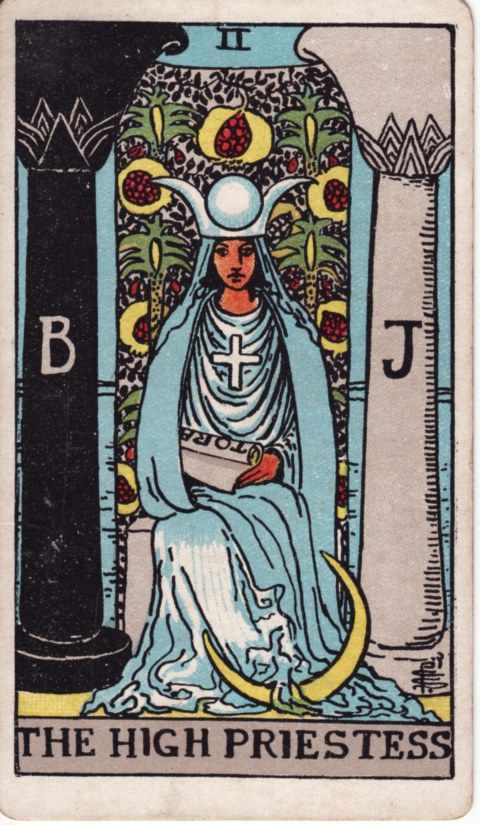
The High Priestess upright meaning
The High Priestess is the card of the question that has no answer yet. Waite lists "Secrets, mystery, the future as yet unrevealed", then adds "silence, tenacity" and "wisdom, science". Nothing in that list tells you to act.
Modern sites read the same picture as intuition. Biddy Tarot, Labyrinthos and tarot.com all give it that word, and tarot.com adds that she is "not interested in small talk". The shared advice is to slow down, notice what is not being said, and keep your own counsel until you know more.
Waite also says who she is in a reading: "the woman who interests the Querent, if male; the Querent herself, if female". So she can be a person, and the person can be you.
The High Priestess reversed
You pull the card, tell a friend, and the friend says what you already suspected. That is the reversed High Priestess: the hunch was there, and it was easier to ignore it. Tarot.com puts it this way: your inner voice "might be on mute or drowned out by fear, distractions, or denial".
Waite goes a different way with the reversal: "Passion, moral or physical ardour, conceit, surface knowledge." The still woman becomes a loud one, and what looks like wisdom is only a thin layer of it. Wikipedia reads the reversal as secrecy and disconnection from intuition.
Two checks help. Are you knowing something and not acting on it? Or are you confident about a subject you have only skimmed? The card fits both, and your own answer will tell you which.
Is The High Priestess a yes or no card?
| Position | Answer |
|---|---|
| Upright | Not yet, or wait |
| Reversed | No |
Can a card built on mystery give a yes or no? The sites we checked cannot agree. Tarot.com says NO, Zenith Align calls the upright card a conditional yes and the reversed one a no, and Tarot Atlas calls the answer "a bit unclear".
Our reading sits closest to Waite's wording, "the future as yet unrevealed": the upright card means not yet. The thing you ask about has not shown itself, so ask again later, or ask a better question. We do not count it as a plain no, because nothing in the card refuses.
Reversed is a no, in the sense that you are not ready to hear the answer or you are making it up as you go. Treat this as a mood, not a verdict: the old books never used a yes or no method.
The High Priestess in love
As feelings: what are they not saying?
Read as feelings, she is a person with depth who is not saying everything. Tarot.com reads a strong connection still unfolding, with the advice not to pry. Reversed, the feeling may be strong but unspoken, or you may be reading more into silence than is there.
Single, and quiet about it
Alone, the card suggests a quiet stretch. Use it to learn what you want. For a man asking, The Tarot Guide sees infatuation with someone hard to reach, which is one more reason to keep your own head clear.
Secret or hidden love
She is the card of what is kept private: an undeclared crush, a relationship nobody knows about, a feeling you have not said. Tarot.com notes that holding back is not necessarily shady. Ask whether the secret protects the bond or avoids a conversation.
In a relationship
Together, she shows depth that has not found words yet. Tarot.com advises listening to what is not being said, and asking yourself why if you are the one holding back. Reversed, something unspoken has become a wall.
The High Priestess as work and money
Should you speak up in the meeting or watch first? The High Priestess says watch. Tarot.com reads the card at work as observation over action: research, listen, notice shifts on the team. It fits a probation period, a negotiation not yet opened, or confidential information.
The Tarot Guide adds creativity and study, and suggests a good teacher for students. Reversed, the card fits an inner no that you override, or claims of expertise that rest on a first glance. In money questions we would keep it plain: she counsels discretion.
The High Priestess as advice and as a person
Unlike the Magician before her, who acts, she waits. Biddy Tarot makes the contrast, calling him the guardian of the conscious mind and her the guardian of the subconscious. After a Magician, take the step; after her, hold the step until you know more.
Practical forms of waiting: sleep on it, write down what you notice, say less. As a person she is private, observant and hard to read, a good listener who tells you little about herself. Book T pairs her with the Moon, so mood may shift from week to week.
Symbolism of the Rider–Waite–Smith card
- The pillars. She sits between a black pillar and a white one marked B and J. Waite calls them "the white and black pillars--J. and B.--of the mystic Temple".
- The veil. Behind her hangs the veil of the Temple, "embroidered with palms and pomegranates" in Waite's words.
- The scroll. The scroll in her hands carries the word Tora, "the Greater Law, the Secret Law". It is partly covered, "to shew that some things are implied and some spoken".
- The crescent. A lunar crescent lies at her feet, and a horned diadem with a globe sits on her head. This is the Moon of Book T in the picture.
- The cross. A large solar cross is on her breast. Wikipedia reads it as the balance of the four elements.
- The water. Wikipedia notes a body of water further behind her, likely the sea. Waite does not describe it in his text for this card.
What the oldest sources say
“Secrets, mystery, the future as yet unrevealed; the woman who interests the Querent, if male; the Querent herself, if female; silence, tenacity; mystery, wisdom, science. Reversed: Passion, moral or physical ardour, conceit, surface knowledge.”
“Change, alternation, increase and decrease, fluctuation; whether for good or evil depends on the dignity.”
Old decks did not call her a priestess. Wikipedia says the second trump was La Papesse, the Popess, crowned with a papal tiara in the Tarot de Marseille, and possibly a reference to the legend of Pope Joan. In the Visconti-Sforza deck, the figure has been identified as Sister Manfreda, a nun said to have been elected pope by the Guglielmite sect of Lombardy.
Waite's deck replaced the Popess with a priestess, and Wikipedia says he dismissed the Pope Joan idea. Book T gives the card Gimel, the Moon, and a short meaning that is not about intuition at all: "Change, alternation, increase and decrease, fluctuation". That fits the phases of the Moon better than a still woman, and it suits a reading about a situation that keeps shifting.
The High Priestess and the Moon: the card's planet
| Number | 2 (II), Major Arcana |
|---|---|
| Planet | the Moon |
| Signs the Moon rules | ♋︎ Cancer |
| Hebrew letter | Gimel ג |
| Golden Dawn title | The Priestess of the Silver Star |
Attributions from Book T (Golden Dawn, c. 1892; printed 1912).
In Book T the second trump belongs to the Moon, not to a sign. Her letter is Gimel and her title is "The Priestess of the Silver Star". Waite puts a lunar crescent at her feet, so the picture and the attribution agree, and Wikipedia names the Moon as her primary astrological link as well.
The Moon rules a ten-degree slice in five signs. They are the Six of Pentacles in Taurus, the Four of Cups in Cancer, the Two of Swords in Libra, the Nine of Wands in Sagittarius, and the Seven of Swords in Aquarius. Libra's card is named Peace Restored, and the Aquarius one Unstable Effort, so the changeable planet owns both calm and unease.
The 5 minor arcana cards ruled by the Moon
In Book T, the Moon rules one ten-degree slice (a decan) in 5 signs; each slice has its numbered card.
| Part of the zodiac | Card | Book T title |
|---|---|---|
| 10° to 20° Taurus | Six of Pentacles | Lord of Material Success |
| 20° to 30° Cancer | Four of Cups | Lord of Blended Pleasure |
| 0° to 10° Libra | Two of Swords | Lord of Peace Restored |
| 10° to 20° Sagittarius | Nine of Wands | Lord of Great Strength |
| 20° to 30° Aquarius | Seven of Swords | Lord of Unstable Effort |
Today the Moon is in Aries at 26°. It enters Taurus around October 25 at 7 PM EDT.
The Moon is the fastest body in the chart. In our own table it changed signs on 43.9% of the dates, which is why a birth date without a time often gives two possible Moon signs. The check below gives the Moon's sign and degree on your date, plus the minor card for it.
Where was the Moon when you were born?
Enter your birth date. We show the Moon's sign and degree that day, whether it was retrograde, and which of its Book T minor cards that degree falls in.
Example below: March 6, 1990, Eastern time. Enter your own date above.
☽ The Moon on March 6, 1990: ♋︎ Cancer, 12°–25°
Eastern time. Your Moon sign: Moon in Cancer. The Moon is in Cancer on 8.4% of dates from 1930 to 2025.
The Moon crossed a decan line that day: the Three of Cups (Book T: "Lord of Abundance", 10° to 20° Cancer, ruled by Mercury) or the Four of Cups (Book T: "Lord of Blended Pleasure", 20° to 30° Cancer, ruled by the Moon), depending on the birth time.
Every planet, angle and house from your birth time: birth chart calculator.
Questions about The High Priestess
What number is the High Priestess in tarot?
Two. She is card II, after the Magician (I) and before the Empress (III).
Is the High Priestess a yes or no card?
The sites disagree: tarot.com says no, Zenith Align a conditional yes upright. We read upright as not yet.
What does the High Priestess mean as feelings?
A deep feeling that is not spoken aloud. They may be waiting, watching, or unsure how to put it into words.
What does the High Priestess reversed mean?
An ignored hunch, secrecy, or knowledge that is only on the surface. Waite's reversed list is "Passion, moral or physical ardour, conceit, surface knowledge."
Which planet goes with the High Priestess?
In Book T she belongs to the Moon, not to a sign. Wikipedia says the same.
What do the letters B and J mean?
They stand for the pillars Boaz and Jachin of Solomon's Temple, black and white, with the veil between them.
Why choose a High Priestess tattoo?
People pick it for intuition, privacy or the Moon. The crescent and the two pillars are the usual picture.
Sources
- Astronomy Engine: the open-source ephemeris library behind our planet positions, dates and statistics
- A. E. Waite, The Pictorial Key to the Tarot (1911), Wikisource: the divinatory meanings we quote, upright and reversed
- Book T (Golden Dawn), as printed in The Equinox I:8, 1912: the zodiac sign, Hebrew letter, title and short meaning of each card
- Wikimedia Commons: Rider–Waite–Smith tarot deck: Pamela Colman Smith's 1910 card drawings, public domain
- How we create our readings: our own calculation of sign dates, positions and the 1930 to 2025 statistics
Next to The High Priestess
In the Major Arcana: The Magician (1) ← The High Priestess (2) → The Empress (3).
Moon on this site: Moon sign calculator · Moon in Aries · Moon in Taurus · Moon in Gemini · Moon in Cancer · Moon in Leo · Moon in Virgo · Moon in Libra · Moon in Scorpio · Moon in Sagittarius · Moon in Capricorn · Moon in Aquarius · Moon in Pisces · your full birth chart.
All 22 cards with their signs and planets: tarot card meanings.
Written by The Zodiac Atlas editorial team with the help of AI and edited by a person. Quotations are from Waite's Pictorial Key to the Tarot and the Golden Dawn's Book T, both in the public domain; the card picture is a 1910 printing of Pamela Colman Smith's drawing for the 1909 deck. Sign dates and planet positions come from the astronomy-engine ephemeris (tropical zodiac). Tarot and astrology are symbolic traditions; they do not predict events.