The Empress upright meaning
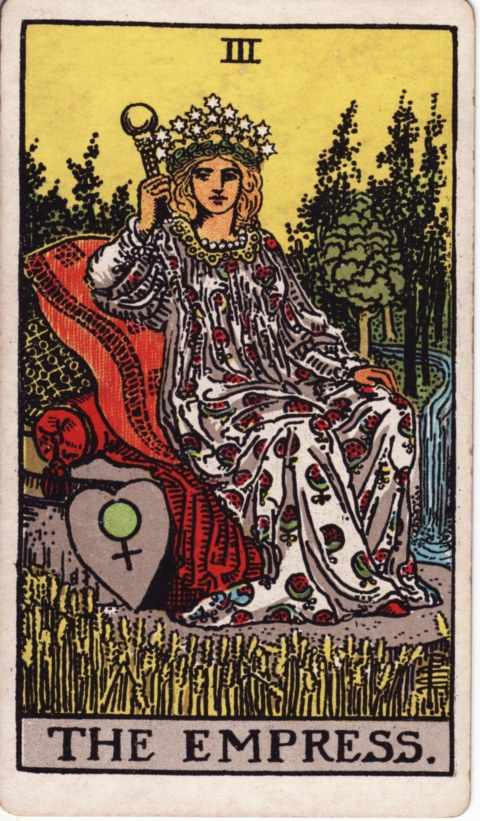
Think of a kitchen garden in late summer, the work done weeks ago and the beans now ripe: that is the Empress. Waite puts a field of corn ripening in front of her and a fall of water behind, and her list begins "Fruitfulness, action, initiative, length of days".
Book T reads her more softly: "Beauty, happiness, pleasure, success." Modern sites agree with Book T more than with the second half of Waite. Biddy Tarot says abundance, Labyrinthos says nurturing, creativity and beauty, and tarot.com calls her a season of growth.
Her list does not stop at the nice words. Waite ends it with "also difficulty, doubt, ignorance" and with "the unknown, clandestine".
The Empress reversed
Does a reversed Empress mean something is wrong? Not always, and Waite's own reversed list is the best evidence. It reads "Light, truth, the unravelling of involved matters, public rejoicings", which is a happy list, followed by "according to another reading, vacillation".
Modern sites read the reversal as growth that stalls. Labyrinthos names insecurity, smothering and lack of progress. Tarot.com adds giving too much and getting little back, and creative blocks. Both are about the same thing: the care is going out and none is coming in.
Ask whom the nurture is for. If you have been looking after everyone else, the reversed card points at you. If you have been hovering over someone who needs room, it points at that instead.
Is The Empress a yes or no card?
| Position | Answer |
|---|---|
| Upright | Yes |
| Reversed | Yes, with a condition |
The Empress is a yes, with fewer caveats than most cards. Tarot.com says yes, and Zenith Align's verdict on the upright card is an "emphatic, fertile yes". Tarot Atlas says the meaning flips with the position of the card, which fits our table below: a clear yes upright and a conditional one reversed.
Reversed is a conditional yes: the answer holds, but something has to be fed or fixed first. Zenith Align reaches the same reading.
The yes concerns growth and comfort, such as a plan, a home or a creative project. It does not cover questions of speed. The yes or no method is a modern habit; the old texts do not use it.
The Empress in love
The Empress in love and pregnancy readings
The Tarot Guide calls her "one of the strongest pregnancy cards", and Google suggests the question "is the empress pregnant tarot". Traditions read her as fertility, but a card is not a pregnancy test. If you wonder about one, a pharmacy test and a doctor will answer it, and the Empress can only describe how you feel about the idea.
In a relationship
As a partner she is affection that is shown: meals, touch, a home both people like. The Tarot Guide reads a committed relationship becoming deeper and more loving. Reversed, one of you is overgiving, or the care has turned into control.
Single, and open to love
Tarot.com reads magnetism and says you do not need to chase. We would add a limit to that: the card describes how you carry yourself, with comfort in your body and room in your day, and it says nothing about a particular person arriving.
The Empress as feelings from a partner
Read as feelings, she is warm, generous, physical and fond. They want to look after you, and to be looked after. Reversed, the affection is there but tangled with jealousy or neediness.
Astrology side of the same question: your Venus sign, the planet of this card, and zodiac compatibility by birth date.
The Empress as work and money
Compare her to the Emperor after her. He builds a structure; she grows what is inside it. At work that makes the Empress a card for creative projects, teams, and anything that needs patience more than pressure. The Tarot Guide reads it as a good sign for creative fields.
Reversed, it fits burnout from over-giving, a project starved of attention, or a boss who hovers. We would leave money out of it: the card describes comfort and growth, and does not forecast income.
A useful test at work is to ask what you are tending and who tends it back. If the answer to the second half is nobody, the reversed card is worth taking seriously, whatever position it landed in.
The Empress as advice and as a person
Feed what you want to grow, and rest what is tired. That covers a plant, a project and a person, and it covers you. Biddy Tarot recommends time in nature and time with the senses, such as good food, music or touch.
As a person, she is generous, creative, sensual and often a parent or a person who acts like one. Venus, the planet the Golden Dawn gave her, rules attraction and taste, so she usually has an eye for beauty. She also tends to know what everyone else at the table needs.
Symbolism of the Rider–Waite–Smith card
- The crown. Her diadem is "of twelve stars, gathered in a cluster". Readers link twelve to the signs or the months.
- The Venus shield. Waite writes that "the symbol of Venus is on the shield which rests near her". It matches Book T, which gives the card to Venus.
- The field of corn. Ripe grain stands in front of her. It is the harvest in the picture, and the reason many readers call her the card of abundance.
- The waterfall. Water falls behind her among the trees. Waite mentions "a fall of water" and nothing else about it.
- The sceptre. The sceptre is "surmounted by the globe of this world". She rules the physical world and not heaven: Waite says "she is not Regina coeli".
- The pomegranate robe. Biddy Tarot reads the pomegranates on her gown as fertility. Wikipedia says the Venus emblem, the waterfall and the vegetation were added by Waite and the other occultists, and older Empresses carry an eagle shield.
What the oldest sources say
“Fruitfulness, action, initiative, length of days; the unknown, clandestine; also difficulty, doubt, ignorance. Reversed: Light, truth, the unravelling of involved matters, public rejoicings; according to another reading, vacillation.”
“Beauty, happiness, pleasure, success. But with very bad dignity it means luxury, dissipation.”
Waite calls her "the inferior Garden of Eden, the Earthly Paradise", and also "the fruitful mother of thousands". He adds that she is "above all things universal fecundity and the outer sense of the Word". The word he uses for the card is fecundity, so the fertility reading is old. It is not a rule for pregnancy questions, and he does not write about them.
Book T is plainer: "Beauty, happiness, pleasure, success. But with very bad dignity it means luxury, dissipation." In Book T "dignity" means the cards around it, so the warning is about company: next to very bad cards, pleasure turns into excess.
The Empress and Venus: the card's planet
| Number | 3 (III), Major Arcana |
|---|---|
| Planet | Venus |
| Signs Venus rules | ♉︎ Taurus, ♎︎ Libra |
| Hebrew letter | Dalet ד |
| Golden Dawn title | The Daughter of the Mighty Ones |
Attributions from Book T (Golden Dawn, c. 1892; printed 1912).
In Book T the Empress is the card of Venus, while the Hierophant, two cards later, gets Taurus, the sign Venus rules. Her letter is Dalet and her title is "The Daughter of the Mighty Ones". Venus rules attraction, pleasure and taste, which suits the card's list.
Venus rules five ten-degree slices of the zodiac in Book T: the Four of Wands in Aries, the Two of Cups in Cancer, the Nine of Pentacles in Virgo, the Seven of Cups in Scorpio, and the Five of Swords in Aquarius. The Two of Cups is called Love and the Seven of Cups Illusionary Success, so the planet of pleasure covers its risks too.
The 5 minor arcana cards ruled by Venus
In Book T, Venus rules one ten-degree slice (a decan) in 5 signs; each slice has its numbered card.
| Part of the zodiac | Card | Book T title |
|---|---|---|
| 20° to 30° Aries | Four of Wands | Lord of Perfected Work |
| 0° to 10° Cancer | Two of Cups | Lord of Love |
| 10° to 20° Virgo | Nine of Pentacles | Lord of Material Gain |
| 20° to 30° Scorpio | Seven of Cups | Lord of Illusionary Success |
| 0° to 10° Aquarius | Five of Swords | Lord of Defeat |
Today Venus is in Libra at 29°, moving retrograde. It enters Scorpio on December 4 (US Eastern date).
Venus stays within 47.2 degrees of the Sun, so it is often in a neighboring sign. In our own table it shares the Sun's sign on 23.7% of the dates and is retrograde on 7.2%. Use the check below for Venus's sign and degree on your date, and the card it lands on.
Where was Venus when you were born?
Enter your birth date. We show Venus's sign and degree that day, whether it was retrograde, and which of its Book T minor cards that degree falls in.
Example below: October 30, 1987, Eastern time. Enter your own date above.
♀ Venus on October 30, 1987: ♏︎ Scorpio, 24°–25°
Eastern time. Your Venus sign: Venus in Scorpio. Venus is in Scorpio on 9.6% of dates from 1930 to 2025. It was moving direct that day; Venus is retrograde on 7.2% of dates. Venus was in the same sign as your Sun, as on 23.7% of dates.
In the Golden Dawn's decan scheme, your Venus falls in the Seven of Cups (Book T: "Lord of Illusionary Success", 20° to 30° Scorpio, ruled by Venus). That slice is ruled by Venus itself: one of the 5 cards in the table above.
Every planet, angle and house from your birth time: birth chart calculator.
Questions about The Empress
What number is the Empress in tarot?
Three. She is card III, after the High Priestess (II) and before the Emperor (IV).
Is the Empress a pregnancy card?
Some sites call her one, and the tradition does read her as fertility. A card is not a pregnancy test; if you suspect a pregnancy, take a test and see a doctor.
Is the Empress a yes or no card?
Upright, yes. Reversed, a conditional yes: something needs care first.
Which person does the Empress describe?
A warm, generous, creative person who looks after others and enjoys comfort. Book T gives the card to Venus, so taste and affection are part of the picture.
Which planet does the Empress belong to?
Venus, the planet, with no single sign in Book T.
What does the Empress reversed mean?
Overgiving, smothering, neglect or a creative block. Waite's reversed list is cheerful, though: "Light, truth, the unravelling of involved matters, public rejoicings."
What do people mean by an Empress tattoo?
An Empress tattoo tends to stand for motherhood, creativity or abundance. The twelve-star crown and the wheat field are the usual picture.
Sources
- Astronomy Engine: the open-source ephemeris library behind our planet positions, dates and statistics
- A. E. Waite, The Pictorial Key to the Tarot (1911), Wikisource: the divinatory meanings we quote, upright and reversed
- Book T (Golden Dawn), as printed in The Equinox I:8, 1912: the zodiac sign, Hebrew letter, title and short meaning of each card
- Wikimedia Commons: Rider–Waite–Smith tarot deck: Pamela Colman Smith's 1910 card drawings, public domain
- How we create our readings: our own calculation of sign dates, positions and the 1930 to 2025 statistics
Next to The Empress
In the Major Arcana: The High Priestess (2) ← The Empress (3) → The Emperor (4).
Venus on this site: Venus sign calculator · Venus in Aries · Venus in Taurus · Venus in Gemini · Venus in Cancer · Venus in Leo · Venus in Virgo · Venus in Libra · Venus in Scorpio · Venus in Sagittarius · Venus in Capricorn · Venus in Aquarius · Venus in Pisces · your full birth chart.
All 22 cards with their signs and planets: tarot card meanings.
Written by The Zodiac Atlas editorial team with the help of AI and edited by a person. Quotations are from Waite's Pictorial Key to the Tarot and the Golden Dawn's Book T, both in the public domain; the card picture is a 1910 printing of Pamela Colman Smith's drawing for the 1909 deck. Sign dates and planet positions come from the astronomy-engine ephemeris (tropical zodiac). Tarot and astrology are symbolic traditions; they do not predict events.