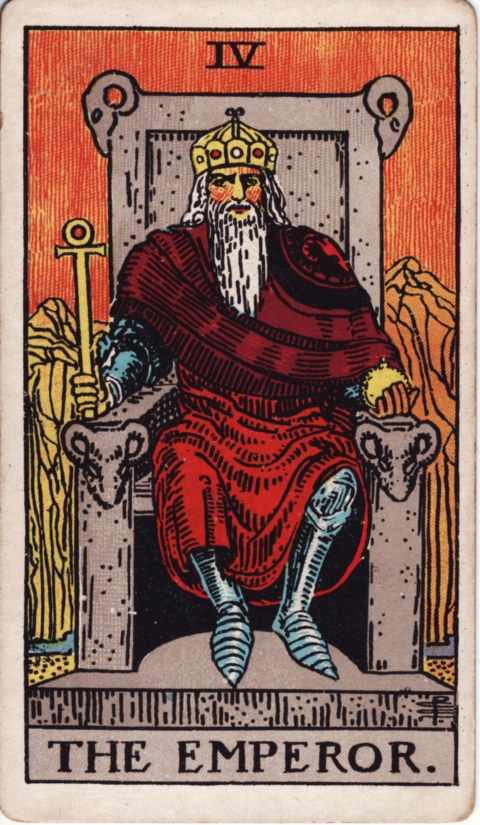
What does The Emperor tarot card mean?
The Emperor means authority used to build something that lasts. In a reading he appears as a person, a plan or a rule that holds under pressure: the one who sets the schedule, keeps the accounts, draws the line. Waite's upright list opens with "Stability, power, protection, realization" and closes with "authority and will".
The Golden Dawn put it more bluntly. The order's Book T gives the card five words: "War, conquest, victory, strife, ambition." Current sites kept the authority and dropped the battlefield. The father is the common image on three leading sites, and Tarot.com calls the same energy "boss energy."
Waite added a twist in his picture notes. Besides worldly royalty, he says, the figure stands for "the higher kingship, occupying the intellectual throne", a "lordship of thought rather than of the animal world". So the card can be a ruler who commands, or a mind that has decided how things will be run.
The Emperor reversed
Waite's own list for the reversed Emperor reads "Benevolence, compassion, credit; also confusion to enemies, obstruction, immaturity." That is gentler than anything on a current site, and the word tyrant appears nowhere in it.
The harder reading came later. Biddy Tarot gives "excessive control", Labyrinthos opens its reversed keywords with "tyrant", and Tarot.com says "control issues, power struggles". Biddy Tarot and Tarot.com also describe the opposite case, a person with too little structure, who avoids the responsibility the card describes.
Use the question to choose between the two. If it concerns someone with power over you, read domineering. If it concerns you, read unfinished: the plan never written, the rule you keep breaking. Waite's "immaturity" fits that second case better than "tyrant" does.
Is The Emperor a yes or no card?
| Position | Answer |
|---|---|
| Upright | Yes |
| Reversed | Maybe, if the control is shared |
Take a question about applying for a team lead role, answered by The Emperor. Upright, the answer is yes, with the condition built into the card: have the plan ready before you step forward. Tarot.com and Zenithalign both answer yes outright, and TarotAtlas calls the card "more a positive sign" in a reading.
Reversed is where they split. Zenithalign says no. TarotAtlas calls the card "more a positive sign" overall and sees a chance to make things work "even when the card is in reverse". We read it as a maybe: Waite's reversed card is benevolent, yet the Book T list for the card includes "strife".
Neither Waite nor Book T hands out yes or no verdicts, so the table above is our shorthand for the card's tone.
The Emperor in love
In a relationship
The Emperor describes the partner who holds things up: pays the bill on time, remembers the plan, stays when it gets hard. Tarot.com calls him "the person who shows up, shows consistency, and wants to build something." The question he puts to a couple is whether one of you has started making every decision.
Emperor tarot as feelings
Read as someone's feelings, the card points to steadiness over sweetness. The person is serious about you and protective, and may be poor at saying so. Reversed, the feeling is real but comes out as control: checking in too often, deciding for you, or going cold behind the armor.
If you are single
Alone, you may be looking at what you want, a partner with a backbone, or at what you bring: a life organized enough to share. It also suggests saying what you want early, in plain words, instead of hoping it gets guessed.
An older partner?
The Tarot Guide reads the card as "an older man you are romantically involved with". Waite says nothing about age. His Emperor is "a crowned monarch" and "a great person", which point to rank. Age is one possible reading and nothing more.
Astrology side of the same question: Aries compatibility with every sign · Aries in love.
The Emperor in career and money
The Emperor is the leadership and planning card. It shows a manager, a founder, or the moment you take on the part of a project that nobody owns. Tarot.com files it under leading "with clarity, strategy, and structure", and that is a fair summary of the upright card at a desk.
Reversed at work, it runs two ways: a boss who micromanages, or an empty chair where a decision-maker should sit. On money questions the card favors systems, such as a written budget and one named owner for each task. It says nothing about how any job or investment will turn out.
The Emperor as advice and as a person
Say you have been putting off a hard conversation with a landlord, a coworker or a sibling. The Emperor asks you to settle the terms before you walk in: what you accept, what you refuse, and what you do if the answer is no.
Cast as a person, he plans, protects and sets rules, and may find it hard to ask for help. Book T links the card to Aries, which is why astrology-minded readers often give that person a direct, quick-to-act manner.
Symbolism of the Rider–Waite–Smith card
- The ram heads. Waite's notes place rams' heads on the arms of the throne. Wikipedia says they stand for Aries, and that they were added in later decks such as the Rider-Waite.
- The sceptre. Waite gives him "a form of the Crux ansata for his sceptre", a cross with a loop on top. Biddy Tarot and Tarot.com both call it the ankh, the Egyptian sign of life.
- The globe. In his left hand he holds a globe. Waite calls the whole figure "the power of this world".
- The stone seat. Some versions seat him on a cubic stone. Waite says this "confuses some of the issues", and his own card keeps the throne.
- Red robe and armor. Biddy Tarot reads the red robe as power and passion, and the armor under it as protection from threat and from feeling exposed.
- The mountains. Bare peaks stand behind the throne. Labyrinthos reads them as ambition for greater heights; Biddy Tarot adds a small river below them as a hint of softness.
What Waite and the Golden Dawn wrote about The Emperor
“Stability, power, protection, realization; a great person; aid, reason, conviction; also authority and will. Reversed: Benevolence, compassion, credit; also confusion to enemies, obstruction, immaturity.”
“War, conquest, victory, strife, ambition.”
The Golden Dawn did not file The Emperor under fatherhood. Book T, the Golden Dawn's teaching text on the tarot, gives the card Aries and one short list: "War, conquest, victory, strife, ambition." It titles the card "Sun of the Morning, chief among the Mighty". Aries belongs to Mars, so the list reads as a soldier's portrait.
Waite pulled the card back toward government. He wrote that this card and the Empress "do not precisely represent the condition of married life, though this state is implied", and he called the Emperor "the virile power, to which the Empress responds". Wikipedia notes the Emperor has been in tarot decks since the 15th century, with the ram heads added later.
The Emperor and Aries: the card's zodiac sign
| Number | 4 (IV), Major Arcana |
|---|---|
| Zodiac sign | ♈︎ Aries |
| Ruling planet of the sign | Mars |
| Element | Fire |
| Hebrew letter | Heh ה |
| Golden Dawn title | Sun of the Morning, chief among the Mighty |
Attributions from Book T (Golden Dawn, c. 1892; printed 1912).
Put the card beside its sign and the match is easy to see: ram heads on the throne, a red robe, armor. Aries is a cardinal fire sign ruled by Mars; Book T pairs the card with the letter Heh. It also names the card "Sun of the Morning", which fits a sign that sits at the start of the zodiac.
Book T splits Aries into three ten-degree parts, each with a Wands card: the Two of Wands (Dominion, under Mars), the Three (Established Strength, under the Sun) and the Four (Perfected Work, under Venus). In Book T the card of Mars itself is The Tower; The Emperor belongs to the sign Mars rules.
The three Aries cards of the minor arcana
| Part of Aries | Card | Book T title | Planet |
|---|---|---|---|
| 0° to 10° | Two of Wands | Lord of Dominion | Mars |
| 10° to 20° | Three of Wands | Lord of Established Strength | the Sun |
| 20° to 30° | Four of Wands | Lord of Perfected Work | Venus |
Next Aries season: the Sun enters Aries on March 20, 4:24 p.m. EDT and stays until April 20, 3:17 a.m. EDT (2027, US Eastern time).
A birth date can put Aries in your chart without making it your Sun sign, since any of ten planets may have stood there. Of the 35,064 dates from 1930 to 2025 in our count, 49.1% have one or more of the ten planets in Aries. The check below reads your own date.
Where is Aries in your birth chart?
Enter your birth date. We show which of the ten planets were in Aries that day; add the time if a planet changed signs.
Example below: April 2, 1988, Eastern time. Enter your own date above.
♈︎ Aries in your chart: 1 of 10
On April 2, 1988 (Eastern time): Sun in Aries.
- ☉ Sun: ♈︎ Aries
- ☽ Moon: ♎︎ Libra
- ☿ Mercury: ♓︎ Pisces
- ♀ Venus: ♉︎ Taurus
- ♂ Mars: ♑︎ Capricorn
- ♃ Jupiter: ♉︎ Taurus
- ♄ Saturn: ♑︎ Capricorn
- ♅ Uranus: ♑︎ Capricorn
- ♆ Neptune: ♑︎ Capricorn
- ♇ Pluto: ♏︎ Scorpio
Your Sun is in Aries, so Aries is your zodiac sign and, in the Golden Dawn scheme, this card is your sign's card. Aries zodiac sign: dates, traits, love.
Every planet, angle and house from your birth time: birth chart calculator.
Questions about The Emperor
What number is The Emperor in tarot?
Four (IV). It follows The Empress (III) and comes before The Hierophant (V).
What zodiac sign and planet is The Emperor?
Aries, in the Golden Dawn system, and Aries is ruled by Mars. The card's Hebrew letter in Book T is Heh.
What is The Emperor holding in tarot?
Waite describes a sceptre shaped like the Crux ansata, an ankh-style cross, and a globe in the left hand.
What does The Emperor mean reversed as a person?
Waite's list is benevolence, compassion and credit, with immaturity at the end. Current sites describe someone controlling and rigid, or someone who avoids leading. Which one fits depends on who the person is in your question.
Is The Emperor a yes or no card?
A yes when upright: Tarot.com and Zenithalign say yes, and TarotAtlas calls it "more a positive sign". Reversed they split, since Zenithalign says no and TarotAtlas leans positive, so we call it a maybe.
Is The Emperor a pregnancy card?
Pregnancy appears in neither Waite's list nor Book T for this card. For that question, a test or a doctor is the answer.
How do The Emperor and The Empress differ?
Waite calls him "the virile power, to which the Empress responds". In Book T she is the planet Venus, and he is the sign Aries.
Sources
- Astronomy Engine: the open-source ephemeris library behind our planet positions, dates and statistics
- A. E. Waite, The Pictorial Key to the Tarot (1911), Wikisource: the divinatory meanings we quote, upright and reversed
- Book T (Golden Dawn), as printed in The Equinox I:8, 1912: the zodiac sign, Hebrew letter, title and short meaning of each card
- Wikimedia Commons: Rider–Waite–Smith tarot deck: Pamela Colman Smith's 1910 card drawings, public domain
- How we create our readings: our own calculation of sign dates, positions and the 1930 to 2025 statistics
Next to The Emperor
In the Major Arcana: The Empress (3) ← The Emperor (4) → The Hierophant (5).
Aries on this site: Aries zodiac sign · Aries rising · Mercury in Aries · Venus in Aries · your full birth chart.
All 22 cards with their signs and planets: tarot card meanings.
Written by The Zodiac Atlas editorial team with the help of AI and edited by a person. Quotations are from Waite's Pictorial Key to the Tarot and the Golden Dawn's Book T, both in the public domain; the card picture is a 1910 printing of Pamela Colman Smith's drawing for the 1909 deck. Sign dates and planet positions come from the astronomy-engine ephemeris (tropical zodiac). Tarot and astrology are symbolic traditions; they do not predict events.