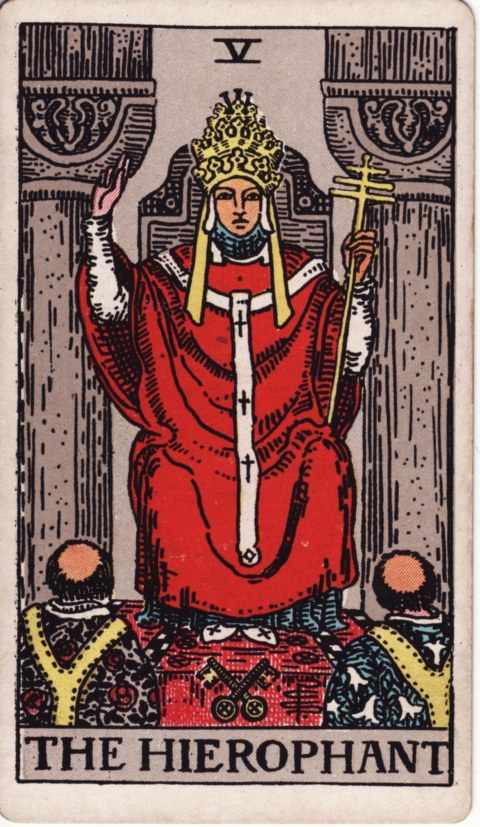
The Hierophant upright meaning
Before this card was called the Hierophant, it was the Pope. Wikipedia credits the new name to Antoine Court de Gébelin, who wanted to remove Christian imagery from the French tarot pack because he mistakenly believed the cards had a pre-Christian origin. The evidence, Wikipedia adds, places the invention of tarot in northern Italy in the first half of the 15th century.
Waite's upright list begins "Marriage, alliance, captivity, servitude" and goes on with "by another account, mercy and goodness; inspiration; the man to whom the Querent has recourse." That last phrase says what the card does in a reading: it is the person you go to when you need an answer from someone who has been trained to give it.
Current sites read it as tradition. Conformity sits in the keyword lists at Biddy Tarot, Labyrinthos and The Tarot Guide, beside institutions, education and shared belief. Waite himself warns that the card's meanings "have suffered woeful admixture from nearly all hands", so these modern lists are a long way from his page.
The Hierophant reversed: what does it mean?
Imagine a person raised in a congregation, a family business or a profession, who realizes at 30 that they follow its rules because nobody ever asked them to choose. That is the situation reversed Hierophant fits best on current sites. Biddy Tarot gives "Personal beliefs, freedom, challenging the status quo", and Labyrinthos lists rebellion and non-conformity.
Waite's reversed list sounds nothing like that. It runs "Society, good understanding, concord, over-kindness, weakness." For him the upside-down card was agreeable to a fault: a group that gets along, a person too ready to please. Both readings fit the same picture.
To choose between them, ask who is leaving whom. If you are stepping away from a rule, read freedom. If you are staying only to keep the peace, read Waite's over-kindness.
Is The Hierophant a yes or no card?
| Position | Answer |
|---|---|
| Upright | Yes |
| Reversed | Yes, if you choose it yourself |
Compare it with The Lovers, the next card in the deck. The Lovers asks you to choose; The Hierophant asks whether the answer is already written down, in a contract, a rulebook, a teacher's advice. If it is, the card says yes.
On the upright card, Tarot.com, Zenithalign and TarotAtlas agree. Zenithalign gives the reversed card a "conditional yes", while TarotAtlas lists the upright card as a yes "usually". We follow them: upright yes, reversed yes with a condition attached, usually that you do it your own way and not by habit.
Neither Waite nor Book T (the Golden Dawn's tarot papers) sets yes or no meanings for the cards. Treat the table as shorthand for the card's tone.
The Hierophant in love and marriage
Marriage, commitment and weddings
Waite's first word for the card is "Marriage", and "alliance" follows. The Tarot Guide calls it the "marriage and commitment card of the Major Arcana". Tarot.com reads a relationship "possibly ready to go official". The picture adds the ceremony: a robed figure, two kneeling ministers, a blessing. It points to a bond that is made in public and kept by rules both people accept.
In a relationship
An upright Hierophant between two people asks whether you share the same rules: about money, family, faith, children, holidays. Tarot.com ends its love reading with a test worth borrowing: are you "growing together … or just following a script?" Waite's list also holds "captivity, servitude", which describes a commitment kept only out of duty.
If you are single
When you are single, it points to a person whose values are settled and visible, or to your own wish for that kind of partner. Tarot.com adds a warning that applies to both sides: make sure they are not "married to dogma". Waite's "the man to whom the Querent has recourse" also suggests asking a trusted friend or mentor about the match.
What does the Hierophant mean for their feelings?
Seen as their feelings, the card shows respect and a serious intent. The person sees the relationship as something to build with proper steps. Reversed, the feeling is the same but the form is off: they may be unsure about the label.
Astrology side of the same question: Taurus compatibility with every sign · Taurus in love.
The Hierophant as work and money
Take a new hire who is assigned a senior colleague on the first day. That is The Hierophant at work: mentorship, training, a certificate, an exam, a profession with a recognized route. Tarot.com lists "going back to school, pursuing a certification" and The Tarot Guide adds team projects and established institutions.
Reversed, the card fits a person who has outgrown the firm's way of doing things, or a workplace whose rules nobody explains. It gives no pay or promotion forecasts, and a money reading with this card says only that a recognized, rule-bound route is in play.
The Hierophant as advice and as a person
Find the person or the text that has already solved your problem, and learn it as written before you change it. A new tradesperson, student or parent gains more from a good teacher than from improvising.
Cast as a person, he is a teacher, a minister, a mentor or anyone who guards a tradition, and in Waite's words "the man to whom the Querent has recourse". Taurus is the card's sign in Book T, and astrology fans tend to add a steady, slow-to-change temperament.
Symbolism of the Rider–Waite–Smith card
- The triple crown and sceptre. Waite: he "wears the triple crown" and holds "a sceptre terminating in the triple cross". Biddy Tarot reads the three tiers as three worlds, the conscious, subconscious and superconscious.
- The two pillars. He sits between two pillars, "but they are not those of the Temple which is guarded by the High Priestess." Hers is the hidden doctrine; his is the open one.
- The raised hand. His right hand gives the sign Waite calls "that of esotericism, distinguishing between the manifest and concealed part of doctrine". Biddy Tarot counts two fingers up and two down.
- The crossed keys. At his feet lie "the crossed keys". Waite quotes the commentator Grand Orient, who calls him "the power of the keys, exoteric orthodox doctrine".
- The two ministers. Two priestly ministers in albs kneel before him. Biddy Tarot reads them as initiates entering the group and taking up their roles.
What the oldest sources say
“Marriage, alliance, captivity, servitude; by another account, mercy and goodness; inspiration; the man to whom the Querent has recourse. Reversed: Society, good understanding, concord, over-kindness, weakness.”
“Divine wisdom, manifestation, explanation, teaching, occult force voluntarily invoked.”
Waite's picture notes say the figure "has been usually called the Pope, which is a particular application of the more general office that he symbolizes." Book T titles the card "The Magus of the Eternal" and gives the meaning "Divine wisdom, manifestation, explanation, teaching, occult force voluntarily invoked." Of those words, "teaching" is the one current sites still use. Marriage is not in the Golden Dawn's list at all.
Waite narrowed the figure on purpose. He wrote that the Hierophant "is the ruling power of external religion, as the High Priestess is the prevailing genius of the esoteric, withdrawn power." He also lists what the card is not: philosophy (outside theology), inspiration, and religion itself, "although he is a mode of its expression". So the card is the visible institution only.
The Hierophant and Taurus: the card's zodiac sign
| Number | 5 (V), Major Arcana |
|---|---|
| Zodiac sign | ♉︎ Taurus |
| Ruling planet of the sign | Venus |
| Element | Earth |
| Hebrew letter | Vau ו |
| Golden Dawn title | The Magus of the Eternal |
Attributions from Book T (Golden Dawn, c. 1892; printed 1912).
Venus links this card to The Empress, and the Golden Dawn kept them apart anyway. The Empress is the planet Venus itself. The Hierophant is the sign Taurus, which Venus rules, with the Hebrew letter Vau. Taurus is an earth sign ruled by Venus.
Book T gives Taurus three Pentacles cards, a ten-degree slice each: the Five (Material Trouble, under Mercury), the Six (Material Success, under the Moon) and the Seven (Success Unfulfilled, under Saturn). Waite calls the Hierophant "the order and the head of the recognized hierarchy". The Taurus cards are all about material things, and the titles run from trouble through success to success unfulfilled.
The three Taurus cards of the minor arcana
| Part of Taurus | Card | Book T title | Planet |
|---|---|---|---|
| 0° to 10° | Five of Pentacles | Lord of Material Trouble | Mercury |
| 10° to 20° | Six of Pentacles | Lord of Material Success | Moon |
| 20° to 30° | Seven of Pentacles | Lord of Success Unfulfilled | Saturn |
Next Taurus season: the Sun enters Taurus on April 20, 3:17 a.m. EDT and stays until May 21, 2:17 a.m. EDT (2027, US Eastern time).
Taurus may sit in your chart even if your Sun is elsewhere, because any of ten planets can have stood there on your birth date. In our count of every date from 1930 to 2025, 46% have a planet in Taurus, a bit less than half. Enter your date below to see which.
Where is Taurus in your birth chart?
Enter your birth date. We show which of the ten planets were in Taurus that day; add the time if a planet changed signs.
Example below: May 5, 1992, Eastern time. Enter your own date above.
♉︎ Taurus in your chart: 2 of 10
On May 5, 1992 (Eastern time): Sun in Taurus, Venus in Taurus.
- ☉ Sun: ♉︎ Taurus
- ☽ Moon: ♊︎ Gemini
- ☿ Mercury: ♈︎ Aries
- ♀ Venus: ♉︎ Taurus
- ♂ Mars: Pisces or Aries
- ♃ Jupiter: ♍︎ Virgo
- ♄ Saturn: ♒︎ Aquarius
- ♅ Uranus: ♑︎ Capricorn
- ♆ Neptune: ♑︎ Capricorn
- ♇ Pluto: ♏︎ Scorpio
Your Sun is in Taurus, so Taurus is your zodiac sign and, in the Golden Dawn scheme, this card is your sign's card. Taurus zodiac sign: dates, traits, love.
Every planet, angle and house from your birth time: birth chart calculator.
Questions about The Hierophant
What number is The Hierophant in tarot?
Five. Its numeral is V, between The Emperor (IV) and The Lovers (VI).
What zodiac sign is The Hierophant?
Taurus, as Book T has it. Taurus is an earth sign ruled by Venus, with Vau as the Hebrew letter.
Why is it called The Hierophant and also The Pope?
The older decks used Pope. Wikipedia says the name Hierophant came from Antoine Court de Gébelin, who took it from the chief priest of the Eleusinian Mysteries.
What does The Hierophant reversed mean in love?
Current sites read it as a relationship that has outgrown its script, or a partner who resists convention. Waite's reversed words are "good understanding, concord, over-kindness", so check whether the problem is rebellion or too much peacekeeping.
Is The Hierophant a yes or no card?
Yes when upright, according to all three yes or no pages we found. Zenithalign makes the reversed card a conditional yes, and we follow that.
Does The Hierophant mean marriage?
It is the first word in Waite's list, and The Tarot Guide calls it the marriage and commitment card. No card sets a wedding date, so read it as the theme of the question.
Hierophant or High Priestess: which is public and which is hidden?
Waite makes the Hierophant "the ruling power of external religion" and the High Priestess the "esoteric, withdrawn power". One teaches in public; the other keeps the hidden doctrine.
Sources
- Astronomy Engine: the open-source ephemeris library behind our planet positions, dates and statistics
- A. E. Waite, The Pictorial Key to the Tarot (1911), Wikisource: the divinatory meanings we quote, upright and reversed
- Book T (Golden Dawn), as printed in The Equinox I:8, 1912: the zodiac sign, Hebrew letter, title and short meaning of each card
- Wikimedia Commons: Rider–Waite–Smith tarot deck: Pamela Colman Smith's 1910 card drawings, public domain
- How we create our readings: our own calculation of sign dates, positions and the 1930 to 2025 statistics
Next to The Hierophant
In the Major Arcana: The Emperor (4) ← The Hierophant (5) → The Lovers (6).
Taurus on this site: Taurus zodiac sign · Taurus rising · Mercury in Taurus · Venus in Taurus · your full birth chart.
All 22 cards with their signs and planets: tarot card meanings.
Written by The Zodiac Atlas editorial team with the help of AI and edited by a person. Quotations are from Waite's Pictorial Key to the Tarot and the Golden Dawn's Book T, both in the public domain; the card picture is a 1910 printing of Pamela Colman Smith's drawing for the 1909 deck. Sign dates and planet positions come from the astronomy-engine ephemeris (tropical zodiac). Tarot and astrology are symbolic traditions; they do not predict events.