
What does the fate line mean in palm reading?
Palmists read it for the outward course of a life: work, position, money, and the turns that change them. Cheiro, the society palmist of the 1890s, wrote that the line "undoubtedly appears to indicate at least the main events of one's career". Benham read it the same way and said what it does not show: "health difficulties are not read" from it.
The older name is the line of Saturn, because it runs toward the middle finger, the finger of Saturn. Benham explained that earlier palmists called it the line of fate because a smooth career looks like luck. In his own view most people with a good line owed it "to brains, health, energy, ambition", and he looked on the line for the "harvest periods" when things come easier.
So the line is read as a timeline of work and circumstance. A mark on it gets an age from its place on the line, the same way marks on the life line do, only counted from the other end.
What if you have no fate line?
Nothing bad. This line is often faint, broken or missing, and many palms show only a trace of it. Older palmists read a missing line as "a negative existence". Benham rejected that: he found the line absent "in the hands of many successful people", most of them people who had started with little and built their own way.
His reading of such a hand is a person "who must depend upon himself entirely", whose results come from their own effort. Cheiro put it more briefly: "There are some who appear to have no Fate, and others who seem to carve their Destiny from day to day." Modern guides we checked, such as The Palm Reading and Asttrolok, read it the same way, as a self-directed path that may change course more than once.
A faint line is not the same as none. Cheiro read a fate line that is "extremely faint or just barely traced" as a person who does not believe in fate and makes their own way, and with a clear head line he expected such people to "win success by their mentality alone". So when the fate line is faint or missing, the head line carries more of the reading. A line can also appear only higher up, or only on one hand. Modern guides count it among the lines that change most over the years, so look at both hands and look again later.
Mark your own fate line
Look at your palm in good daylight with the hand relaxed and slightly cupped, which makes faint lines easier to see. Pick the hand, then set where your line starts and where it stops. Add each break, island, branch or joining line you can see and slide it to its place; tap the diagram to drop a mark there. Each mark gets its age on Benham's scale and its reading.
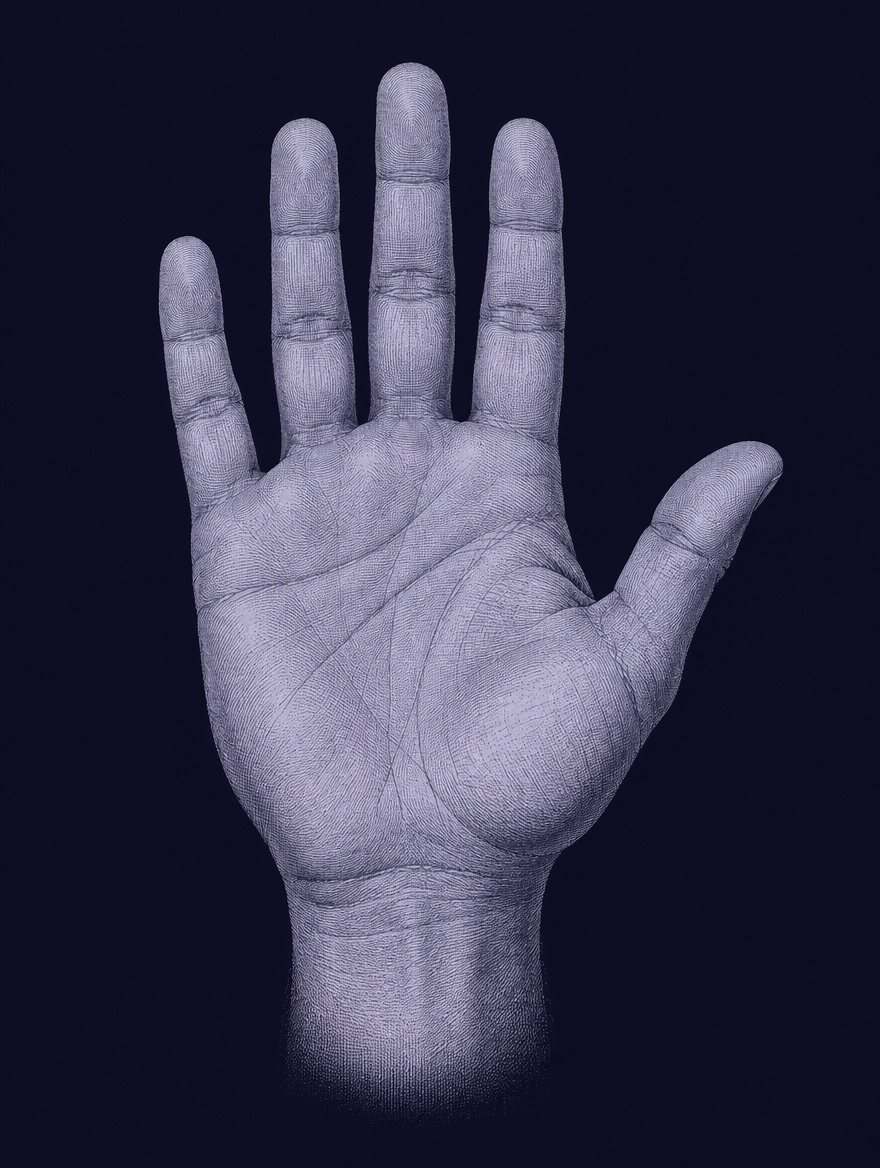
An engraved palm, not your own hand. Ages follow Benham's 1900 scale, read from the wrist up: 0 at the wrist, 30 where the line crosses the head line, 45 at the heart line, 70 under the middle finger. The dotted lines are the head and heart lines.
It goes under the diagram so you can line the two up. The photo stays in this browser tab. It is not uploaded or saved anywhere, and it disappears when you close the page.
Your fate line, mark by mark
No marks added yet. Below is the reading of the line itself; add a break, an island or a branch to see its age.
- Start: From the wrist
- A line that rises straight up from the wrist through the center of the palm. Cheiro read it, when the line of the Sun is also well marked, as a career that luck and talent both help along. Benham read a line that starts in the center of the base of the palm and runs to Saturn as success won "largely by his own efforts".
- Depth: Deep and clear
- Benham called a deep, clear line "the most favorable line to possess". Cheiro added that a good one "should not be too heavily marked, but just clear and distinct".
- End: Reaches the middle finger
- A full-length line on Benham's scale, up to the Mount of Saturn under the middle finger. He read the last stretch as the later years of work, and a deep line on the mount as a comfortable old age.
- Crossings
- Your line crosses the head line at 30 and the heart line at 45 on this scale. Benham called the years between them, 30 to 45, "the formative financial period in life", when most people start steering their own work.
Right hand. Cheiro read the right hand for what you have made of your life and the left for what you were born with. Modern guides read the dominant hand as the active one, so if you are left-handed, swap the two.
Each mark here is read on its own, the way the old textbooks list them one by one. Putting them together is the part this page cannot do: which mark matters most, whether the other hand agrees, and whether the life, head and heart lines show something at the same age. Benham read the lines against each other "to see whether events marked on them fit", which is a palm reader's work, done on the whole hand.
How to read age on the fate line
Palmists read this line from the bottom up: the part near the wrist is childhood, and the line ages as it climbs toward the middle finger. That is the opposite direction to the life line, which is read from the top down. Benham gave the scale in The Laws of Scientific Hand Reading (1900): "Age on the line of Saturn is read from the bottom upward, the space from the rascette to Head line covering the years from o to 30, from line of Head (normally placed) to line of Heart 30 to 45, and from line of Heart to finger of Saturn 45 to 70 years."
| Age | Share of the line's length, from the wrist |
|---|---|
| 0 | 0% (start, at the wrist crease (rascette)) |
| 5 | 11% |
| 10 | 22% |
| 15 | 33% |
| 20 | 44% |
| 25 | 55% |
| 30 | 66% (where the fate line crosses the head line) |
| 45 | 77% (where it crosses the heart line) |
| 55 | 86% |
| 70 | 100% (the end, at the base of the middle finger) |
Benham's three stretches, after "Age as Indicated on the Lines": 0 to 30 below the head line, 30 to 45 between the head and heart lines, 45 to 70 above the heart line. The shares are measured on the engraved palm of our diagram; on your hand the crossings sit wherever your head and heart lines cross.
Within each stretch the years are spread evenly along the line, as Benham did on the life line. The stretch between the head and heart lines is short on most hands, so fifteen years fit into a small space there, and a mark in it can be read only roughly.
Benham added a warning of his own: when the head or heart line sits unusually high or low, "do not rely on the space between them as covering the ages from 30 to 45" and measure the whole line instead. Our diagram uses the crossings of the engraved hand, so on your own palm treat every age as a stretch of a few years.
Other systems put the crossings elsewhere. Cheiro divided it into periods of seven years on a printed plate, and Purple Garden, one of the modern guides we checked, puts the head line crossing at 35 and the heart line at 53. The same mark can read a few years apart from one book to the next.
Where does the fate line start?
Cheiro listed four starting points: "from and out of the Line of Life, straight up from the wrist, from the Mount of the Moon, or from the middle of the palm." Benham saw the same range and wrote that the line always "runs through the centre of the palm" toward the middle finger, whatever its source.
From the wrist. A line that rises straight up the center of the palm. Cheiro read it, when the line of the Sun is also well marked, as a career that luck and talent both help along.
From the life line. Cheiro read a fate line growing out of the life line as success "made by personal effort and merit", often after early years shaped by family plans. The point where it leaves the life line was, to him, the year the person "asserted his independence".
From the Mount of the Moon. A line that starts low on the little-finger side and curves in. Cheiro read it as a more eventful path that depends on other people; Benham read it as success helped along by someone else, often a partner, "either by good advice or by rendering financial aid".
From the middle of the palm or higher. When the line only appears higher up, Benham read the years before it as a time of finding your feet, and wrote that "his best period will begin at the time the line starts". In his words, "The higher in the hand the line starts, the later in life will be the period of easiest sailing."
Broken, double and other fate line marks
The old textbooks list these marks one by one, and date each by its place on the line. Below are Cheiro's and Benham's readings, with the darker readings of the old books left out.
Broken fate line
A gap in the line. Benham read a break, when the line picks up again in a new direction, as "an entire change in the course of a subject's life-work", dated by where the gap falls. Modern guides read it the same way, as a change of job, home or direction. Benham judged each break by how wide it is and whether it is "repaired" by an overlap, a sister line or a square.
Break with overlapping ends
The line stops and starts again beside itself, so for a short stretch there are two lines. Cheiro wrote that such a break "is not always a bad sign to have, provided that one side begins before the other ends", and read it as a complete change of position. If the new line runs good and straight, he read the change as a step up that begins where the new line starts.
Double fate line
Two lines running up the palm side by side. Cheiro read a clear double line, especially when the two lean toward different fingers, as "two careers" carried on at once, "one perhaps as a hobby and the other as the principal career". Benham read a line running alongside the fate line as a sister line that supports it for as long as it lasts.
Island on the fate line
A small loop where the line splits and rejoins. Benham read it as "a period of financial difficulty, lasting the length of the island", and argued against the older reading of it as infidelity after looking at hundreds of hands. Where the line runs clean after the loop, the hard stretch is read as over.
Lines crossing the fate line
Short bars across the line. Benham read them as obstacles at that age. Faint bars that pass over the line without cutting it were "annoying interferences"; deep bars that cut it through weigh more.
Lines joining the fate line
A line that comes in from the side and merges with the main one. Benham read it as an event or person that becomes part of your life at that age, helpful when the main line looks stronger afterward. He judged it by its source: from the Mount of the Moon, someone from outside; from the thumb side, close family. Cheiro usually read it as marriage at the age the two lines meet.
Branches rising from the fate line
Small lines that climb from it toward the fingers. Benham read them as the stretches of life "filled with hope and ambition". Cheiro read a branch by the finger it heads for: toward the index finger, responsibility and command; toward the ring finger, success in public life; toward the little finger, success in science or business.
Square on the fate line
Four small lines that box in part of the line. Cheiro called the square the Mark of Preservation, and on this line he read it as "preservation from loss" at that age.
Wavy or chained fate line
Benham read a wavy line as "a constantly changing course", and a chained one as harder going for the years the chain covers. A deep, clear line was to him "the most favorable line to possess", while Cheiro preferred one that is "not too heavily marked, but just clear and distinct".
Where the fate line ends, and a short fate line
A full-length line runs up to the Mount of Saturn under the middle finger. Benham found that in "a large number of hands" it stops somewhere below, and he did not take that as a bad sign: the line follows the years of most active work, so it is often missing in later life.
A short line covers fewer years on the scale. Benham read a line that runs clearly up to the head line and stops there as an easy stretch up to about thirty, with later results coming from effort. Of every line that stops, he wrote that "the future is as they make it". The point where yours ends is a place on a scale, not a date for anything.
The line can also bend away from the middle finger. Cheiro read the whole effort of such a life as "tinged" with the quality of the mount it heads for, and Benham, who allowed it to end only on Saturn or on Jupiter, read the Jupiter ending as success driven by "great ambition".
Fate line on the left or right hand
Read both. Benham wrote, "Use both hands with the Saturn line", and found the line clearer on the left hand than on the right in most of the hands he read. Cheiro's rule was that the left hand shows what you were born with and the right shows what you have made of it.
Both wrote for right-handed readers. Modern guides read the dominant hand as the active one, so a left-handed person swaps the two. A line on one hand and not the other is read as a plan that changed along the way.
The fate line, the Mount of Saturn and Saturn in astrology
The line runs toward the Mount of Saturn, the pad at the base of the middle finger. Cheiro read that mount for "prudence, quiet determination, the study of serious sombre things", and Benham called the Saturn finger "the balance-wheel to the character". Palmistry took the planet names from astrology, where Saturn stands for work, structure, limits and time; see what Saturn means in a birth chart.
The ages line up in one place. Benham put the head line crossing at 30 and called the years from 30 to 45 "the formative financial period in life". Astrologers time the first Saturn return at about 29, when Saturn comes back to where it was at your birth. The two systems got there separately, and both mark the start of the thirties as a turn in working life.
What Cheiro and Benham wrote about the fate line
Both books are in the public domain and free to read online. Cheiro (William John Warner, 1866 to 1936) wrote Palmistry for All (1916); his chapter "The Line of Destiny or Fate" lists the starts, branches and breaks quoted here. William G. Benham's The Laws of Scientific Hand Reading (1900) has the age scale and a long chapter on "The Line of Saturn", in which he argues against several of the gloomier readings of older books.
“Age on the line of Saturn is read from the bottom upward, the space from the rascette to Head line covering the years from o to 30, from line of Head (normally placed) to line of Heart 30 to 45, and from line of Heart to finger of Saturn 45 to 70 years.”
“As the result of my observation, I read hands in which no Saturn line is seen as belonging to a subject who must depend upon himself entirely; who should not trust to luck or fortunate circumstances.”
Benham quotes are from the transcriptions linked ("The Line of Saturn"); the printed book is scanned at archive.org. Cheiro quotes are from the Project Gutenberg edition, chapter "The Line of Destiny or Fate".
Questions about the fate line
Is it bad to have no fate line?
No. It is common, and Benham, who drew the age scale on this page, found it missing in the hands of many successful people. He read a hand without one as a life that depends on your own effort.
What does a broken fate line mean?
In the tradition, a break marks a change of work or direction at that age. A break whose ends overlap is read as the mildest kind, and Cheiro read it as a step up when the new line runs straight.
How do you read age on the fate line?
From the wrist up. On Benham's scale the wrist is 0, the crossing with the head line 30, the crossing with the heart line 45 and the base of the middle finger 70. Read any age as give or take a few years.
What if my fate line is short?
A short line covers fewer years on the scale. Benham found many of these lines stopping below the middle finger and read the years after the line as yours to shape by effort; the end of the line is not a date.
What does a double fate line mean?
Cheiro read two clear lines as two careers running at once, one perhaps a hobby and the other the main work. Benham read a line running beside the fate line as a supporting sister line.
Where does the fate line start?
At the wrist, from the life line, from the Mount of the Moon on the little-finger side, or higher up in the middle of the palm. Each start has its own reading; see the section on starts above.
Which hand should I read for the fate line?
Both. Cheiro read the left hand for what you were born with and the right for what you made of it, and left-handed readers usually swap them. Benham found the line clearer on the left hand in most people.
Can the fate line change or appear later?
Modern guides say it is one of the lines that change most. A line that starts higher up was read by Benham as a best period beginning at that age, so it is worth looking at your hands again in a few years.
Sources
- Cheiro, Palmistry for All (1916), Project Gutenberg: the line readings we quote and the right and left hand rule
- William G. Benham, The Laws of Scientific Hand Reading (1900), scan on archive.org: the age scale on our palm diagram and the mark readings
- How we create our readings: how we write pages and check every quotation against the source
Other lines and the planets behind them
The fate line crosses the other main lines: see the life line, read from the top down with the same kind of age diagram, and all the lines and mounts on one palm map. Before the lines, palmists look at the shape of the whole hand; you can measure yours for its hand type. The middle finger and its mount belong to Saturn; your own Saturn by sign and house is in the birth chart calculator, and the Saturn return calculator shows when Saturn comes back to its birth place.
The line it crosses at 45, the heart line, is read for love and feelings, with its own diagram.
At 30 it crosses the head line, read for the way you think and decide.
Cheiro dated marriages on the fate line, where fine influence lines join it, and checked them against the marriage lines on the edge of the hand.
Written by The Zodiac Atlas editorial team with the help of AI and edited by a person. Readings are quoted or summarized from Cheiro's Palmistry for All (1916) and Benham's The Laws of Scientific Hand Reading (1900), both in the public domain; modern readings are credited to the guide they come from. The palm under the diagram is an engraving, not a photo of a real hand. Palmistry is a symbolic tradition. It does not predict events, and nothing on this page is financial or career advice.