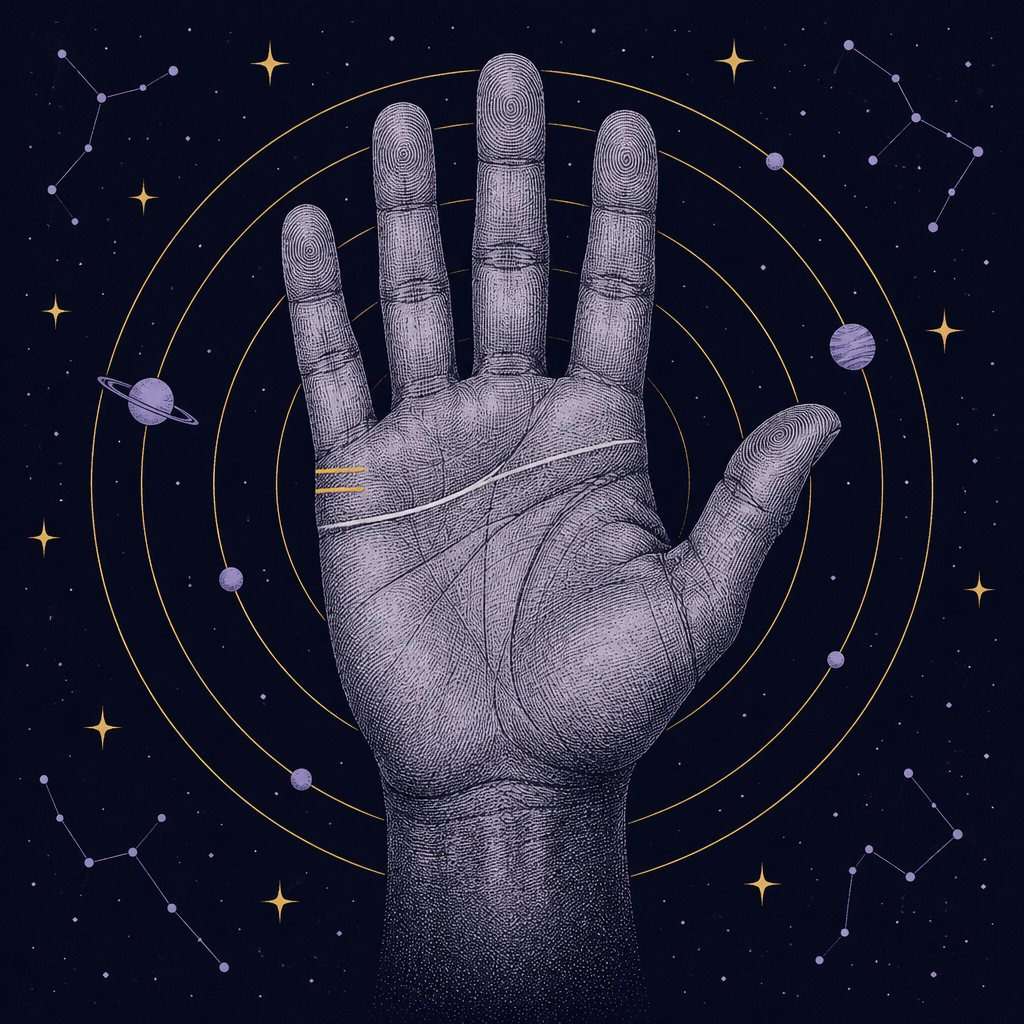
What do the marriage lines mean in palm reading?
Older palmists read these lines as marriages. Benham, writing in 1900, kept the old name next to his own and explained why he did not trust it: "Using “marriage” with the lines of Affection is misleading because it does not mean a legal marriage contract. These lines show when the subject has loved as fondly, as if he were married."
So a line is read as an attachment strong enough to leave a mark. Benham thought it took "a profound impression made on the subject by an affection" before a line would be strong, and that "the more impressions and affections he had, the more of these lines of Affection will be seen in the hand." A long engagement, a first love that shaped you, a partner you never married: in this reading, any of them can show.
Cheiro, the society palmist whose 1916 handbook is still widely quoted, kept the word marriage for clear, well-formed lines and read the short ones as deep affection (more under long or short). Modern guides go further in the same direction. mypalms.ai lists "the number of marriage lines tells you how many times you will marry" as a myth: "The lines indicate significant emotional bonds, not legal marriages."
Where is the marriage line on your hand?
Hold your hand palm up and look at the outer edge, the side opposite the thumb. Find the end of the heart line where it meets that edge. The marriage lines sit above it, on the narrow strip of skin between the heart line and the crease at the base of the little finger. Cheiro put them "on the side of the Mount under the fourth finger", and Benham said they "run from the percussion toward the inside of the palm", percussion being the old word for the outer edge of the hand.
They are short, often fine, and easy to miss. Curl your fingers slightly toward the palm so the skin folds, turn the edge of your hand toward a window, and look from the side. Some lines stay on the very edge; others run onto the pad under the little finger, and a few go further into the palm. Benham noted that they can even start "at the back cutting around into the Mount of Mercury".
Do not mix them up with the heart line itself, the long crease just below them, which is read for how you love. The marriage lines are the small marks above its end.
How many marriage lines do you have?
Count only the lines you can clearly see. Benham read the count as the number of strong attachments, and he looked at how deep each line was before he looked at how many there were.
One line
Benham: "If only a single line is seen, there will be but one deep affection." A single deep line is read as one bond that mattered more than any other, which does not have to mean one relationship for life.
Two marriage lines
Two clear lines are read as two deep attachments. To see which one mattered more, Benham looked for "the longest and deepest line". If two lines of the same depth lie close together, he read it as loving two people "equally well at the same time". palmyst.com is direct about the common worry: "Having two marriage lines doesn’t necessarily mean you will marry twice."
Three or more lines
Many lines, to Benham, meant someone "susceptible in affairs of the heart, more or less seriously so as the lines are strong or weak". He read the highest line as the most recent one.
Mark your own marriage lines
Look at the edge of your palm under the little finger and add one line for each crease you see. For each line, set how high it sits between the heart line and the little finger and how far it runs into the palm, then pick how it looks and any fork, curve or break. Each line gets its own reading below the diagram.
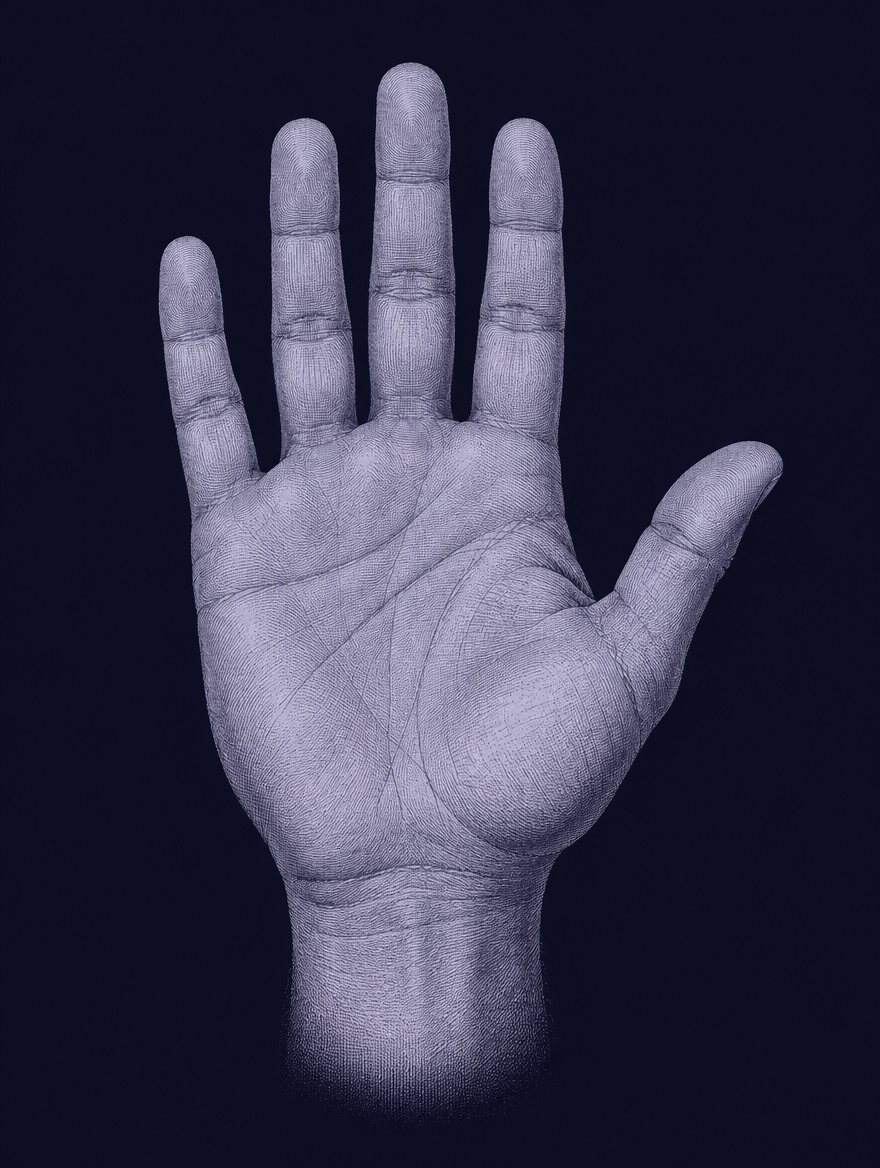
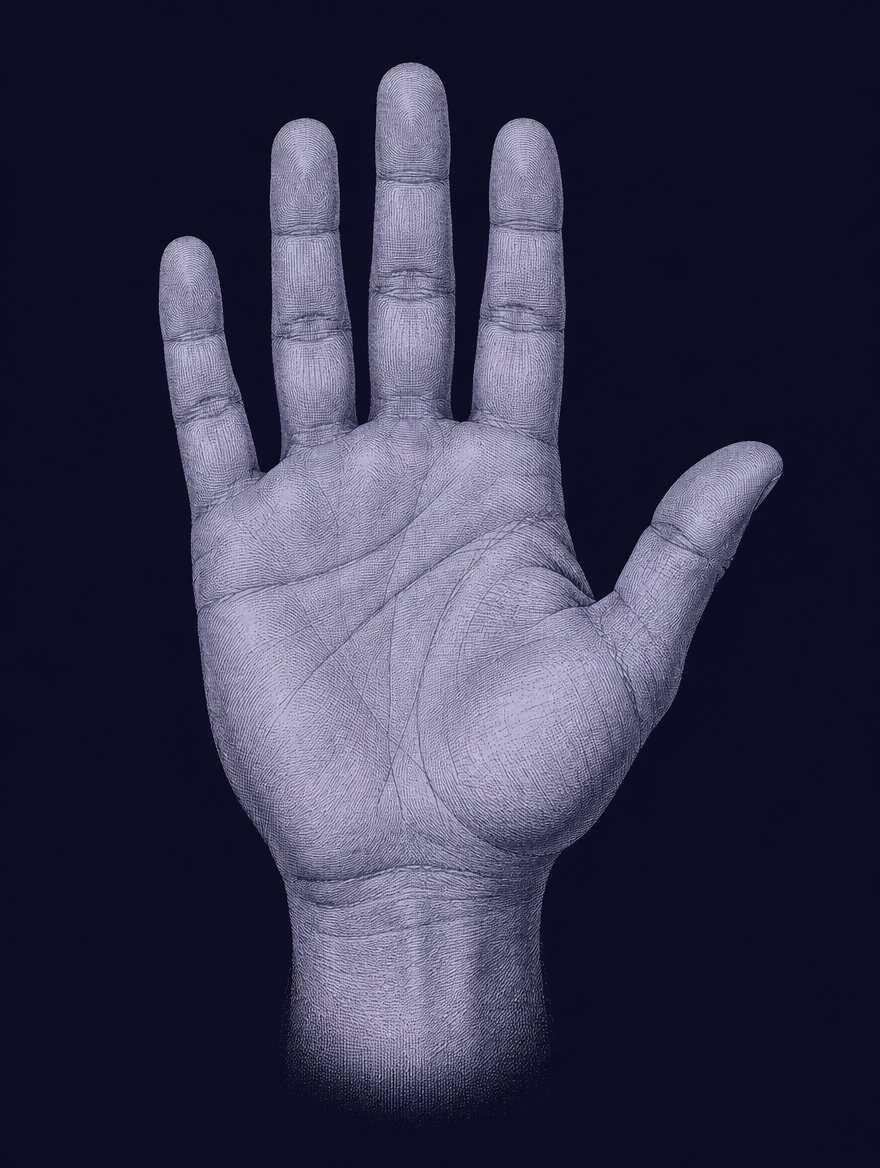
A close-up of an engraved palm, not your own hand: the outer edge under the little finger, between the heart line (lower dashes) and the base of the little finger (upper dashes). The small picture shows where this is on the whole palm. Ages follow Benham's 1900 scale for these lines: the heart line is the bottom, 36 is halfway up, 70 is at the top.
It goes under the diagram so you can line the two up. The photo stays in this browser tab. It is not uploaded or saved anywhere, and it disappears when you close the page.
The diagram shows where to look; the readings for each kind of line are in the sections below.
Your marriage lines, one by one
No lines marked yet. Add one line for each short crease you can see on the edge of your palm, then set how high it sits and how far it runs. If you see none at all, read the section on having no marriage lines below.
Right hand. Cheiro compared the two: the left showing "the inherited tendencies, the right the developed or cultivated qualities". Modern guides read the dominant hand as the active one, so if you are left-handed, swap the two.
Each line here is read on its own, the way Cheiro and Benham list them. Benham warned that read alone, "as a hard-and-fast indication of marriage, they will lead to constant error", and he read them with the heart line, the Mount of Venus and the type of the whole hand. Putting your lines together is a palm reader's work, done on the whole hand.
Marriage line age: reading the height
Benham gave these lines their own age scale, measured up the edge of the hand rather than along the line: "Use the Heart line as a lower mark, and the top of the Mount of Mercury as the upper. This space must be subdivided into the average years of life, bringing the middle of the Mount at 36, and the top at 70 years." A line below the middle belongs to the years before 36, and a line above it to the years after.
He called the result approximate, "accurate enough for all general purposes", and said it "can, however, be still further subdivided". Our diagram does the subdividing evenly: from the heart line up to the middle runs from childhood to 36, and from the middle up to the base of the little finger runs from 36 to 70. That even split is ours, not his.
| Where the line sits | Age on Benham's scale |
|---|---|
| Right at the heart line | the start of the scale: childhood and early youth |
| A quarter of the way up | about 18 |
| Halfway between the heart line and the little finger | 36, the middle of the mount |
| Three quarters of the way up | about 53 |
| Just under the base of the little finger | 70, the top of the mount |
After Benham, "How to Read the Affection Lines". The quarter points are our even split of his two halves.
Cheiro gave no scale for these lines. He only wrote that "when the deep line is found lying close to the line of Heart, the marriage will take place early in life", and dated marriages by other lines on the hand. Modern guides read height the same way round: thepalmreading.com, numerologist.com and centreofexcellence.com all put lines near the heart line earlier in life and lines near the little finger later.
The length of a line is a different measure: Benham read the height for when an attachment began and the length for how long it lasted.
Long or short, deep or faint
Look at two things on each line: how far it runs in from the edge, and how deep and clear it is next to the other lines on your hand. The diagram gives each of your lines its full reading.
A long marriage line
A line that crosses the pad under the little finger, or runs past it into the palm, was read by Benham as a long-lasting attachment: "The longer the line of Affection, the longer the affection continues."
A short marriage line
A short mark on the very edge of the hand. Cheiro read the short ones as "deep affection, or marriage contemplated, but never entered into". thepalmreading.com reads a short line as relationships that are "meaningful but briefer" or a person who keeps some independence in a partnership, and adds: "It is not a warning sign."
Deep and clear, or thin and faint
Benham read deep, well-cut lines as deep, lasting affection and judged thin ones only against the other lines on the same hand: thin by comparison meant love that is not the whole of a life. A line that starts thin and gets deeper was, to him, a bond that grew stronger with time.
Forked marriage line
A fork is a line that splits into two, or two short lines that join into one. Which end the fork is at changes the reading.
A fork at the start
Two short lines at the edge of the hand that run together into one. Benham read it as an affection of unusual strength, two currents joined into one.
A fork at the end
The line splits in two toward the palm. Benham read it as an attachment that loosens with time, and a narrow fork, with the branches close together, as the milder case: "the estrangement is not so serious as if it diverge greatly." mypalms.ai reads it as "growing apart or growing into different roles within the same partnership".
A marriage line that curves up or down
Most marriage lines run straight in from the edge of the hand, which Cheiro read as the happy form. A curve at the end is read separately.
Curving up toward the little finger
Cheiro read it as someone unlikely to marry; thepalmreading.com reads the same curve as contentment in independence, a person whose life does not turn on a partner.
Curving down toward the heart line
We leave out the old readings of this curve, the gloomiest in the books. Modern guides read a bond that cools or keeps some emotional distance. thepalmreading.com, writing about both curves: "Neither is inherently bad — both describe a relationship style, not a verdict."
Island, break or square on the marriage line
Small marks on these lines are read for the stretch of the attachment where they sit, and Benham always looked for signs of repair before he read them. Add a mark on the diagram for its full reading.
An island
A small loop where the line splits and joins again: an unhappy stretch in the attachment, which, numerologist.com adds, does not have to mean it ends.
A break
A gap in the line: an attachment interrupted. Benham looked first for repair: ends that overlap, or a square around the gap.
A square around a break
Read by Benham as an attachment that recovers.
Small branches rising
Fine lines that rise from a marriage line toward the little finger were read by Benham as an attachment that lifts a person up: "the affection will be a benefit to him". Fine upright lines just above the marriage line are a different set, read as children lines (below).
No marriage lines on your hand?
It happens, and it is not a forecast of being alone. Benham: "In some hands, there are none of these lines. In others, many are seen." He tied it to how a person takes attachment, not to whether they marry: "Some people see marriage as performing any ordinary routine of daily life. Such persons will have no Marriage lines." People who "sink their whole life and soul into a union", in his words, have deep ones.
Modern guides say the same in their own way. wikiHow says that not having one "doesn't necessarily mean you won't fall in love or get married", and mypalms.ai: "The absence of a visible marriage line is not a sentence." Look again in good light with the fingers curled before deciding there are none; these are among the faintest lines on the hand.
Children lines above the marriage line
Cheiro also read the tiny upright lines just above a marriage line: "The Lines relating to children are those finely marked upright lines found immediately above the Line of Marriage", counted "from the outside of the hand in towards the palm". He admitted that "in many cases it is necessary to employ a magnifying glass in order to see them."
We do not count them, and the diagram has no children marks. There is no evidence that these creases predict children, and even guides that describe them, like numerologist.com, say their number "does not necessarily correspond precisely to the number of biological children".
Which hand is the marriage line read on?
Read both. Cheiro compared the two hands, "the left showing the inherited tendencies, the right the developed or cultivated qualities". wikiHow mentions two traditions: in one, "the right hand is read for women, and the left hand is read for men"; in the other, both hands are read, the left for the potential you were born with and the right for what you did with it.
Most modern guides read the dominant hand first. thepalmreading.com: "Read your dominant hand first — the hand you write with — because palmistry treats it as the record of your active, lived relationship life." If you are left-handed, read the old rule the other way round. Lines that differ between the two hands are read as a change over time.
The Mount of Mercury and the Mount of Venus
The marriage lines lie on the side of the Mount of Mercury, the pad under the little finger, named, like all the mounts, after a planet. Cheiro read the mount itself for the mind: "quickness of brain, wit, thought, eloquence". Your own Mercury by sign is on Mercury signs.
Benham read the marriage lines together with the Mount of Venus at the base of the thumb: "In all cases the lines of Affection should be read in combination with Influence lines on the Mount of Venus." The planet of love by sign is on Venus signs. If your question is about one particular person, a palm cannot compare two people; astrology has its own way to do that, on zodiac compatibility.
What Cheiro and Benham wrote about marriage lines
Both books are in the public domain. Cheiro's Palmistry for All (1916) has a chapter called "Signs Relating to Marriage" and a short one on children lines. Benham's The Laws of Scientific Hand Reading (1900) has three sections on the lines of Affection, with the age scale used on our diagram. Both books also read these lines for a partner's health and for how a marriage would end. We leave those readings out: a crease on the hand cannot tell that, and Benham himself warned readers that "the goal of palmistry is to give a client a better knowledge of himself."
Benham quotes are from the transcriptions linked ("Affection Lines", "How to Read the Affection Lines", its second part); the printed book is scanned at archive.org. Cheiro quotes are from the Project Gutenberg edition. Modern readings are credited to the guide they come from.
Questions about marriage lines
Which hand is the marriage line on?
On both, and palmists compare the two. More in which hand to read.
What do two marriage lines mean?
Two deep attachments, in Benham's reading, not two weddings. See how many lines.
What if I have three marriage lines?
A heart that is easily moved, in Benham's reading; the deepest line is the strongest bond. See how many lines.
Can the marriage line predict when I will marry?
No. Benham dated attachments by the height of the line, roughly, and warned against reading these lines alone as a sign of marriage. See age by height.
What does a forked marriage line mean?
At the start, a strong attachment; at the end, one that loosens, milder when the fork is narrow. See forked line.
What does it mean if I have no marriage line?
It is not a forecast of being alone. More in if you have none.
Is the marriage line the same as the love line?
No. The love line usually means the heart line; the marriage lines are the short marks above its end.
Can marriage lines change?
Palmists say the fine lines do, and wikiHow suggests reading them again over the years. Comparing the two hands is the old way to see a change.
Sources
- Cheiro, Palmistry for All (1916), Project Gutenberg: the line readings we quote and the right and left hand rule
- William G. Benham, The Laws of Scientific Hand Reading (1900), scan on archive.org: the age scale on our palm diagram and the mark readings
- How we create our readings: how we write pages and check every quotation against the source
The main lines and the planets behind them
The marriage lines sit just above the end of the heart line, the crease read for how you love, and Benham used that line as the bottom of their age scale. The main lines have their own diagrams too: the head line, the life line and the fate line. All of them, and the seven mounts, are on the palm map.
Written by The Zodiac Atlas editorial team with the help of AI and edited by a person. Readings are quoted or summarized from Cheiro's Palmistry for All (1916) and Benham's The Laws of Scientific Hand Reading (1900), both in the public domain; modern readings are credited to the guide they come from. The palm under the diagram is an engraving, not a photo of a real hand. Palmistry is a symbolic tradition. It does not predict whether or when you will marry, how many partners or children you will have, or anything about anyone's health, and nothing on this page is relationship advice.