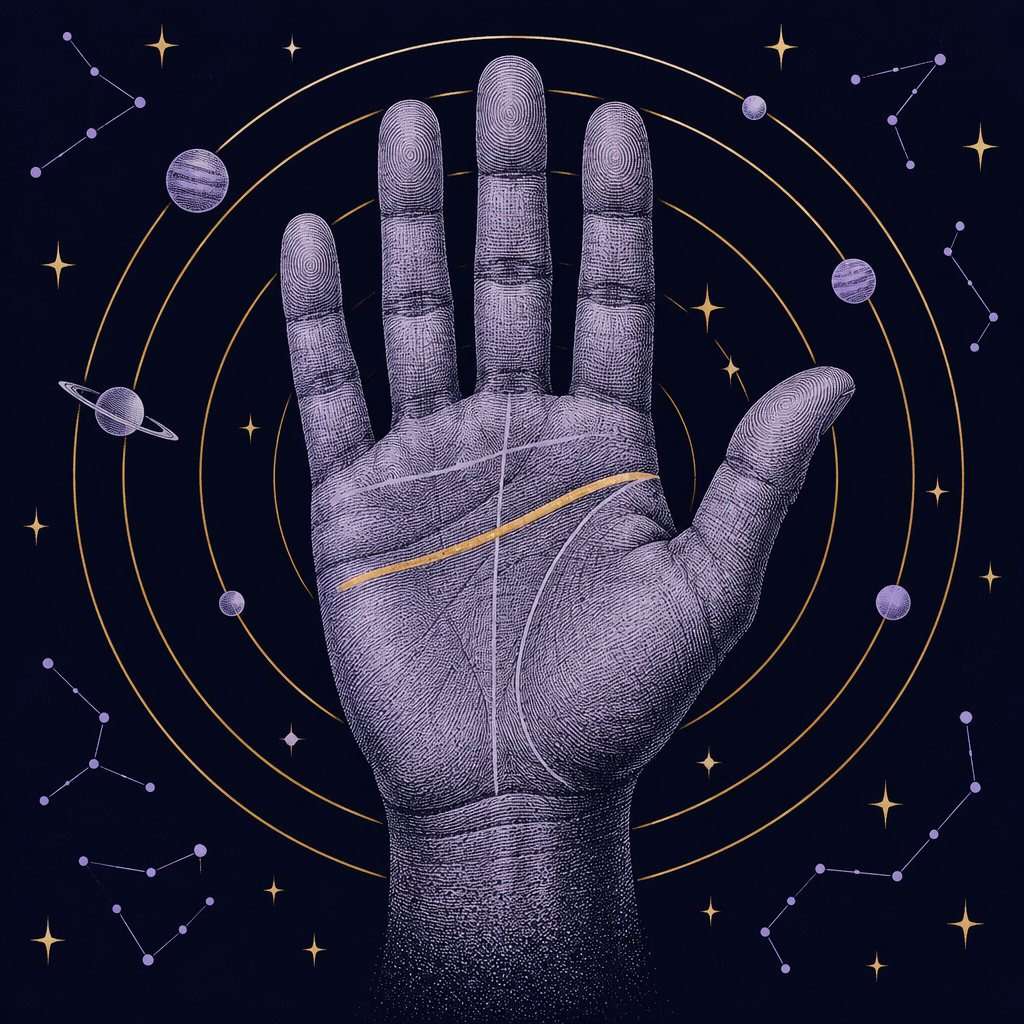
What does the head line mean in palm reading?
William Benham, whose Laws of Scientific Hand Reading (1900) is the other old textbook palmists still quote, listed what the line shows: the "amount of mentality", the "kind of mentality", the "power of mental concentration" and the "ability to exert self-control". He read its length for how much thinking a person does and its depth for how steady that thinking is: "The length of the line shows the quantity, the depth and clearness shows the quality."
Cheiro put it first among the lines. "A Line of Head is like the needle in the compass," he wrote, and he looked at it before anything else, because a strong sign elsewhere on the hand meant little to him without a mind able to use it.
Both men read it as a style. A short or faint line was, to them, a different way of thinking, and modern guides say the same in plainer words: the line describes a thinking style, not intelligence.
Straight or sloping: where your head line goes
Look at where the line heads once it leaves the thumb side. Most lines dip a little toward the outer edge of the palm, the Mount of the Moon near the wrist; some run level, a few drop steeply. Here is each shape in short; set yours on the diagram below for the full reading in both books' words.
Straight across the palm
A level line ending on the upper Mount of Mars, under the little finger. Benham called this ending the place where "practical common-sense ideas prevail": steady thinking that is hard to talk out of a decision.
A gentle slope toward the Moon
The most common shape: imagination you use when it helps and put away when it does not. Benham threw out the old fear about sloping lines and found them on most sensible, practical people.
A steep dip into the Mount of the Moon
The line curves far down toward the wrist: imagination leads. Benham saw the deepest dips on writers of fiction and poetry, and a line long enough to reach the Moon is never, to him, a sign of a weak mind.
Rising toward the heart line
Now and then the line bends up toward the heart line above it. Benham read the rise as feeling steering thought: "the heart is a stronger factor than the head" for the years where the line climbs.
Mark your own head line
Look at your palm in daylight with the hand relaxed. Pick the hand, then set where your line starts above the thumb, where it goes and how it looks, and add a fork or a second line if you have one. Add a break, an island or a branch you can see and slide it to its place, or tap the line on the diagram. Each mark gets its age on Benham's scale and its reading.
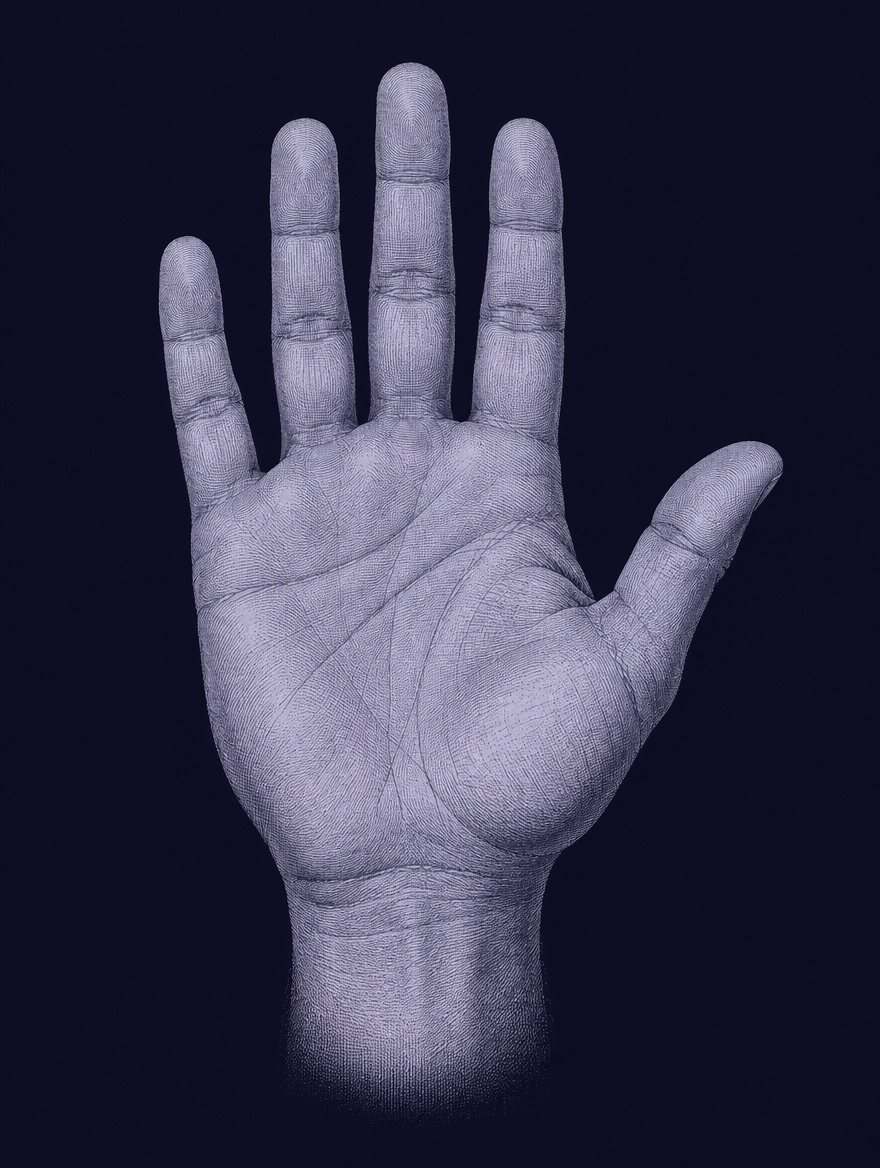
An engraved palm, not your own hand. Ages follow Benham's 1900 scale for the head line: 0 under the middle of the index finger's mount, 36 halfway across, 70 at the outer edge of the palm, read by which part of the palm each point lies under. The faint curve below is the start of the life line.
It goes under the diagram so you can line the two up. The photo stays in this browser tab. It is not uploaded or saved anywhere, and it disappears when you close the page.
Your head line, mark by mark
No marks added yet. Below is the reading of the line itself; add a break, an island or a branch to see its age. Your line, as set, reaches about 47 on Benham's scale.
- Start: Separate from the life line
- A small gap between the head line and the life line where they start. Cheiro called a narrow gap "an excellent mark to have, giving independence of thought, quickness of judgment, and a certain mental daring". Benham read it the same way, as self-reliance: someone who "can plan well" and "is guided by his own judgment". Both warned that a very wide gap tips into rashness.
- Direction: Curves gently toward the Moon
- The line slopes down toward the Mount of the Moon at the outer edge of the palm, the way it does on most hands. Cheiro read a gentle curve as "distinct control over the imagination": you use imagination "when he wishes to do so instead of being controlled by it". Benham found this slope "on the hands of most sensible, self-contained, practical persons" and called imagination "an essential qualification for writers, speakers, and linguists".
- Depth: Deep and clear
- Benham took the deep, well-cut head line as the standard. His list for it was great mental power, good self-control, "fixedness of purpose" and a good memory. Such people "do not always make up their minds as quickly, but weigh and consider carefully", then stick to the decision.
- Fork or double: One line, no fork
- A single head line is the usual form. Cheiro even preferred it: he found "one clear Line of Head well marked on the hand" a more successful sign than two.
Right hand. Cheiro compared the two: the left showing "the inherited tendencies, the right the developed or cultivated qualities". Modern guides read the dominant hand as the active one, so if you are left-handed, swap the two.
Each mark here is read on its own, the way the old textbooks list them one by one. Putting them together is the part this page cannot do: which mark matters most, whether the other hand agrees, and whether the heart and life lines show something at the same age. Benham dated the head line "to see whether events marked on them fit into conditions seen on the Life line", which is a palm reader's work, done on the whole hand.
Where it starts: joined to the life line or separate
Both old books read the start of the line as a separate question, and Cheiro called it, together with the ending, "the great keynote" of the whole subject. The diagram gives the full reading of the start you pick.
Joined to the life line
The two lines leave the edge of the palm together, the most common start. Cheiro read a careful, sensitive person; Benham read the point where the lines part as the age a person began to think for themselves, rarely later than about 12.
Separate from the life line
A small gap between the two: independence of thought and quick judgment for Cheiro, self-reliance for Benham. Both said the gap should be small: a very wide one, to them, tipped confidence into haste.
Starting under the index finger
The line begins higher, on the Mount of Jupiter: a sign of leadership for Benham, and for Cheiro, when it starts close to the life line, "one of the most brilliant marks of all".
Can you read age on the head line?
Benham did, on the same scale he used for the heart line. He measured along "an imaginary line beginning in the middle of the Mount of Jupiter and running across the hand to the percussion", the outer edge of the palm, and laid out on it "the periods of 6, 12, 18, 24, 30, 36, 43, 51, 60, and 70". The line is dated from its start above the thumb: 0 under the middle of the index finger's mount, 36 halfway across, 70 at the outer edge. In his words, the start of the line "registers the early years of life".
| Age | Under which finger, on our diagram |
|---|---|
| 0 | the index finger (start: the middle of the mount under the index finger) |
| 6 | the index finger |
| 12 | the middle finger |
| 18 | the middle finger |
| 24 | the middle finger |
| 30 | the middle finger |
| 36 | the ring finger (halfway across the palm) |
| 43 | the ring finger |
| 51 | the ring finger |
| 60 | the little finger |
| 70 | the little finger (the outer edge of the palm) |
Benham's divisions, after "Age as Indicated on the Lines". The fingers are those of the engraved palm under our diagram; on your hand, look at which finger each part of your line sits under. Most lines end under the ring or little finger and never reach 70.
Cheiro gave his own split for this line, by fingers: "the first 21 years" under the index finger, then the years until 42, 49 to 63 under the ring finger and 70 onward under the little finger. It runs close to Benham's at the start and drifts later toward the edge of the palm, so the two disagree by several years under the ring finger. Our diagram follows Benham, the only one of the two who marked the divisions on a scale.
Benham read every age on these lines as a span of a few years, to be checked against the life line. Read the ages here the same way.
Long or short head line
Benham read length as quantity: "The long Head line per se shows abundant mentality and the short line less of it." He also warned that length has to be judged against the size of the hand and the other lines.
Modern guides have moved away from reading a short line as less thinking. Numerologist.com reads a line that ends around the middle of the palm as "a quick, decisive mind" and a long one as an "exhaustive thinker"; astroyogi.com and mypalms.ai both state outright that a short head line does not mean low intelligence. We follow them on this: a short line is read as a fast decider who acts on a conclusion, a long one as someone who follows an idea to its end.
Forked head line, the writer's fork and the double line
Two of the most searched shapes are about one line turning into two. They are read differently.
Forked head line (writer's fork)
The line splits near its end into a short Y, one branch level and one sloping toward the Moon. The name "writer's fork" comes from modern guides; the old books just call it a fork. Benham read the practical and the imaginative side working together, and the deeper branch as the side that wins. Cheiro added one caution: when both branches are equal, a person may weigh the two sides too long, and his advice was to "act according to first impulse".
Double head line (two lines)
Two separate head lines, one above the other, each with its own start. Cheiro found them as rare as a single crease right across the palm and read a dual mentality, a mind able to run two lives at once. He often saw one of the pair joined to the life line and the other rising from the Mount of Jupiter, and still preferred one clear line.
Split head line
People also search for this one, and the phrase covers two things: a fork at the end, read above, or a small branch splitting off along the way, read in the next section.
Broken head line, islands and other marks
The old textbooks list these one by one and date each by its place on the line. Benham read most of them two ways, as health or as character; we give the reading for character and leave the medical readings out. Below is each mark in short. Add it on the diagram to get its age and the full reading.
Broken head line
A gap in the line: for Benham, "a mental jar at the time of the break", and the line after it shows how well the jolt was taken. Astroyogi.com reads a clean break as a big change in the way a person thinks, often after a turn in life or work.
An island
A small loop where the line splits and rejoins: a tired or overloaded stretch for the years it covers, lighter when the line runs deep and clear after it.
Branches rising
Small lines that climb toward the fingers, read as better signs than falling ones and by the finger they head for: ambition under the index finger, study under the middle finger.
Branches falling
Small lines that drop toward the wrist: a turn toward imagination for Cheiro, a spell of discouragement for Benham.
Lines crossing it
Short bars cutting across the line: worries at the age they cross, if the bar is a separate line and not a branch.
A square
Four small lines boxing in part of the line, read as protection; a box around a break, as a repair.
One line instead of two: when the head and heart lines merge
Some hands have a single crease right across the palm where the head and heart lines would be. Medicine calls it a single transverse palmar crease and finds it in a small share of people; the older name, "simian line", is now avoided. Benham thought that "in 99% of cases, such a single line is the Head line and it is the Heart line which is absent", so he read it for thinking. Cheiro read it as unusual intensity and told readers to look at where it lies: across the middle of the palm, more thinking; higher up near the fingers, more feeling.
The heart line page has the full reading and the figures: one line across the palm.
What if you can't find your head line?
Almost every hand has one. Benham called it "seldom absent" and said he had "but once seen the Head line entirely absent". When it seems to be missing, it is usually one of three things: a single crease across the palm doing the work of both lines (see above), a faint line that shows better in side light with the fingers slightly bent, or a short line that stops in the middle of the palm.
The old readings of a truly absent line are harsh, and we leave them out. A faint or short line is read for its start, direction and marks like any other.
Left or right hand
Read both. Cheiro's rule was "the left showing the inherited tendencies, the right the developed or cultivated qualities". A line that is faint on the left and strong and clear on the right was, to him, a person who "has cultivated and developed his own mentality". Benham read the same change in length: short in the left hand and long in the right meant the subject "has developed his mentality".
Both wrote for right-handed readers. Modern guides read the dominant hand as the one that shows the mind you have built, so if you are left-handed, swap them; numerologist.com puts it as "the mind you were born with" on one hand and the mind "built through experience" on the other.
The Moon, Mercury and the other mounts
The line is read by the mount it heads for. A slope toward the lower outer edge of the palm points at the Mount of the Moon, which Benham called "the seat of imagination" and Cheiro read for "imaginative faculties, the emotional artistic temperament, romance". A level line ends on the upper Mount of Mars, which Cheiro tied to the mind rather than the body.
The little finger and its mount belong to Mercury, the planet of thought and speech in astrology. Cheiro read the mount for "quickness of brain, wit, thought, eloquence" and said it "should always be considered with the kind of Line of Head". The line starts near the index finger, the Mount of Jupiter. In a birth chart, how you think is read from your Mercury sign; your planets by sign are in the birth chart calculator.
What Cheiro and Benham wrote
Both books are in the public domain. Cheiro's Palmistry for All (1916) opens with this line, which he called "the most important sign that can be found in the hand", and gives the three starts, the slope, the double line and the finger-by-finger ages quoted here. Benham's The Laws of Scientific Hand Reading (1900) has the age scale and a long chapter on the line, where he reads each mark both as health and as character. We quote the character side and leave the medical readings out: palmistry is a tradition, not a way to check a brain.
Benham quotes are from the transcriptions linked ("Head Line Drooping to Luna", "The Color and Defects of the Head line"); the printed book is scanned at archive.org. Cheiro quotes are from the Project Gutenberg edition. Modern readings are credited to the guide they come from.
Questions about the head line
What does a straight head line mean?
Practical, steady thinking. More in straight or sloping.
What does a sloping head line mean?
Imagination: kept in hand on a gentle slope, in charge on a steep one. More in straight or sloping.
What is the writer's fork?
A fork at the end of the line, read as practical and imaginative at once. See forks and double lines.
Is a double head line rare?
Yes, as rare as a single crease across the palm, in Cheiro's experience. See forks and double lines.
What does it mean if it is joined to my life line?
A careful, sensitive start, and the most common one. See where it starts.
Does a short head line mean low intelligence?
No. Modern guides read it as a quick, decisive mind. See long or short.
What does a broken head line mean?
In Benham's reading, a jolt to the way you think at the age of the break. See breaks and other marks.
Which hand should I read?
Both. See left or right hand.
Sources
- Cheiro, Palmistry for All (1916), Project Gutenberg: the line readings we quote and the right and left hand rule
- William G. Benham, The Laws of Scientific Hand Reading (1900), scan on archive.org: the age scale on our palm diagram and the mark readings
- How we create our readings: how we write pages and check every quotation against the source
Other lines and the planets behind them
This line is dated on the same scale as the heart line just above it, and the old books read the two together: one for thinking, one for feeling. The other main lines have their own diagrams: the life line, which the head line often starts from, and the fate line, which crosses it at about 30 on its own scale. All four lines and the seven mounts are on the palm map.
Above the heart line, on the edge of the hand under the little finger, sit the marriage lines, read for close attachments rather than for thinking.
Written by The Zodiac Atlas editorial team with the help of AI and edited by a person. Readings are quoted or summarized from Cheiro's Palmistry for All (1916) and Benham's The Laws of Scientific Hand Reading (1900), both in the public domain; modern readings are credited to the guide they come from. The palm under the diagram is an engraving, not a photo of a real hand. Palmistry is a symbolic tradition. It does not measure intelligence, predict events or say anything about the health of your brain, and nothing on this page is medical or career advice.