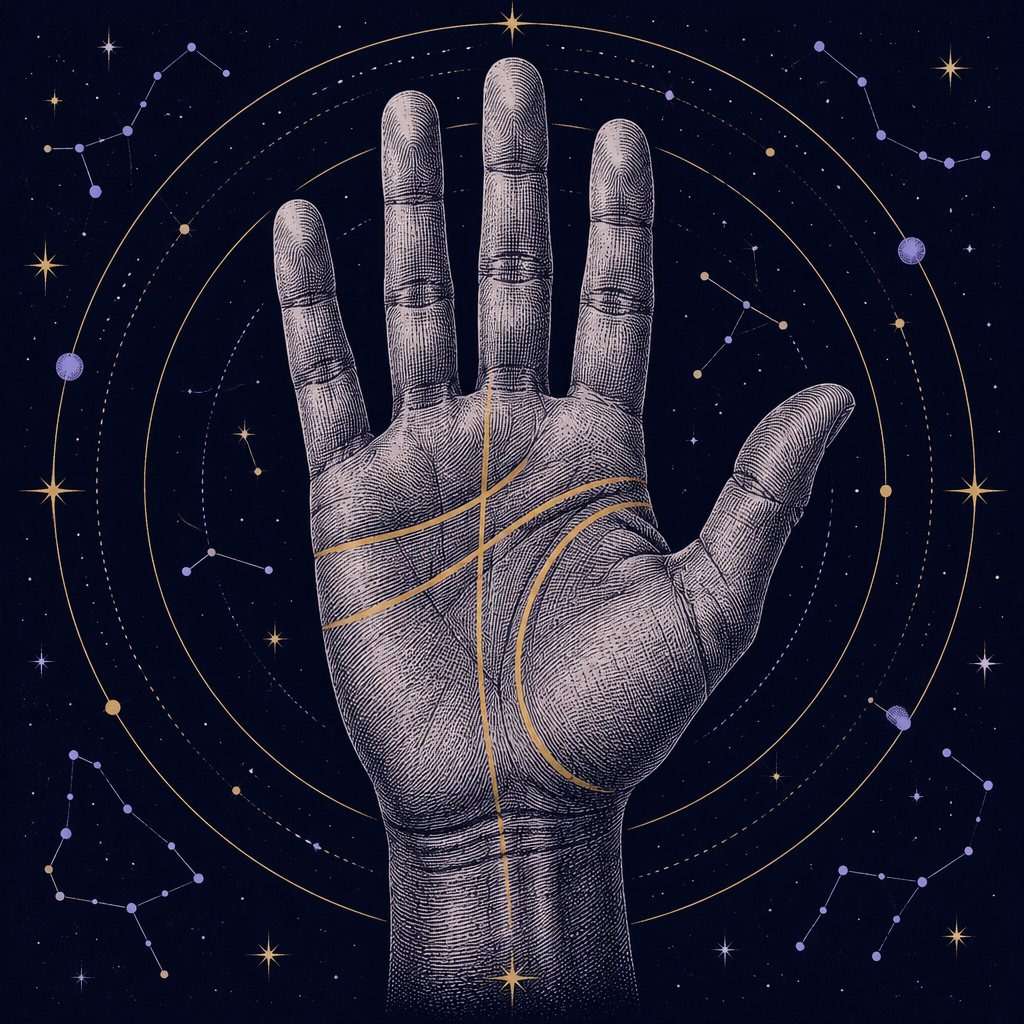
Find each line and mount on your palm
Hold your hand next to the screen, palm up. Tap a line or a mount on the drawing, or pick it from the list, to see where it runs and how the old textbooks read it.
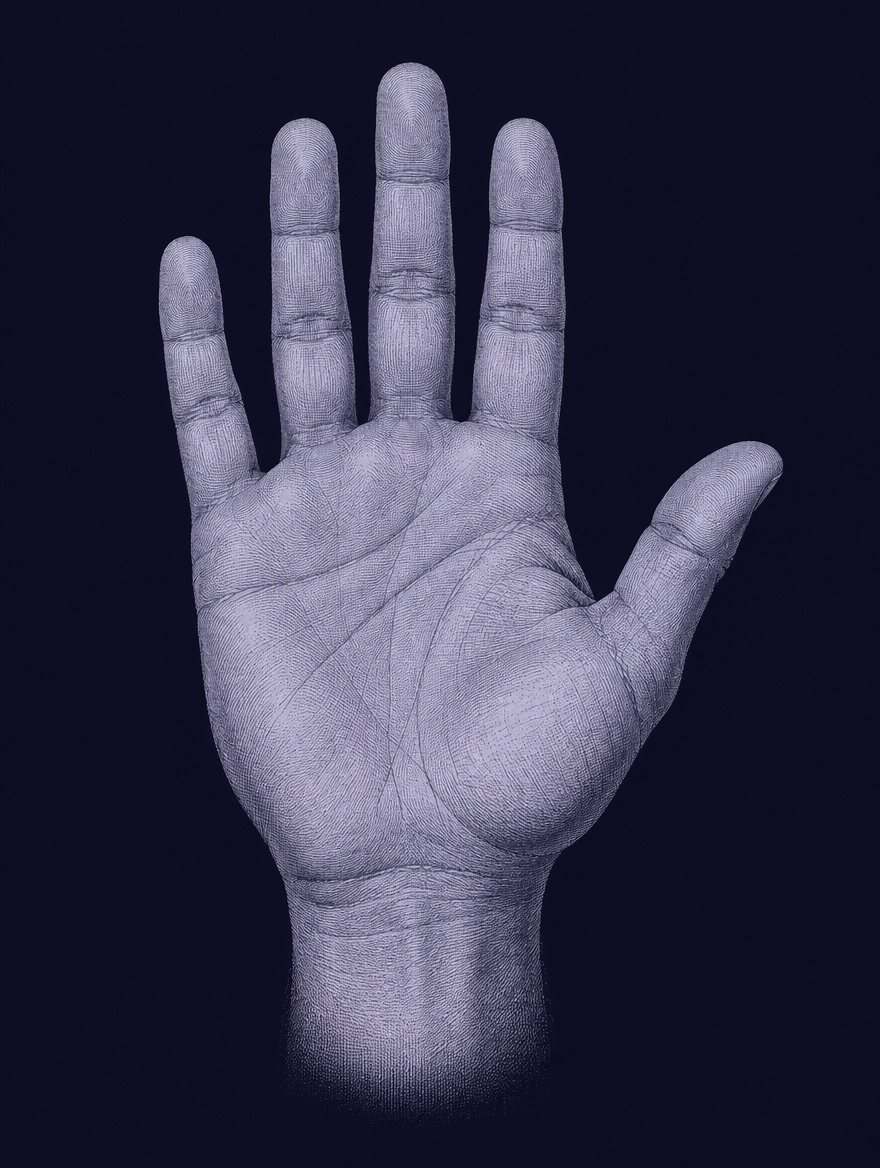
An engraved right palm, thumb on the right, as you see your own right hand with the palm up.
Tap a line or a mount on the palm, or pick one below.
The four main lines
The seven mounts
Every line and mount is described in the sections below: the four main lines and the seven mounts.
What is palm reading?
Palmists read three things: the creases of the palm (the lines), the fleshy pads under the fingers and along the edges (the mounts), and the shape of the hand and fingers. Cheiro, the society palmist of the 1890s, called the study of lines cheiromancy and the study of shape cheirognomy, and wrote that a student who knows both is "doubly armed".
The practice is old and widespread. Wikipedia traces it across the Eurasian landmass, from India and China to Persia and Greece; the Catholic Church suppressed it in the 16th century, and it came back in the 19th. Cheiro read the palms of Mark Twain, Oscar Wilde and Thomas Edison, and in 1900 William G. Benham published The Laws of Scientific Hand Reading, an attempt to give the old rules a system.
On this site we quote those two books, both now in the public domain, and say which reading comes from which author. Where modern guides read a line differently, we say so.
Which hand do you read in palm reading?
Read both and compare them. Cheiro's rule was that the left hand shows the tendencies you were born with and the right shows what you did with them; a mark on the left alone "will never bear fruit or come to any result" unless the right hand has it too. Benham put it in two words: the left is the passive hand, the right the active one.
Both men wrote for right-handed readers. Modern guides, Allure's and the Old Farmer's Almanac's among them, read the dominant hand as the active one, so if you are left-handed, swap the two. Some guides read women's hands the other way round; Cheiro's chapter on the two hands gives one rule for everyone.
The four main lines in palmistry
Nearly every hand has a heart, head and life line: Benham wrote that he had seen the head line missing only once. The fate line is the fourth main line, and on many hands it is faint, broken or absent. Each line is read for its length, depth, curve and the marks along it.
Smaller lines are read too. The best known are the marriage lines: short creases on the edge of the hand under the little finger, above the end of the heart line, which Benham called lines of Affection.
- Heart line
The crease closest to the fingers, from the edge of the palm under the little finger toward the index or middle finger. It does not touch the life line.
Cheiro read it for "the affectionate disposition". A heart line that rises between the first and second fingers gave, in his words, "a calmer but a very deep nature" in love.
- Head line
The crease below the heart line. It starts on the thumb side, usually joined to the life line at first (Cheiro found it joined more often than separate), and runs across the palm.
Cheiro called it the most important line on the hand, "like the needle in the compass". He read a line that lies straight across the palm as determination, and one that curves down toward the Mount of the Moon as imagination.
- Life line
The curve around the fleshy base of the thumb, from above the thumb toward the wrist.
Read for energy and stamina, and for the big turns of a life, dated by where they fall along the line. Its length does not predict how long you live.
- Fate line
The vertical line up the middle of the palm toward the middle finger. On many hands it is faint or missing.
Cheiro read it for "the main events of one's career". A fate line that rises out of the life line meant, to him, success won by your own effort.
The seven mounts and their planets
The mounts carry the names of the seven planets of old astrology. Cheiro wrote that the Greek palmists named them and gave each mount the qualities of its planet. Allure's guide reads a rounded mount as a balanced quality, a sunken one as a blind spot and a very high one as a trait that can run to excess. Mars has two mounts, one on each side of the palm.
| Mount | Where | Cheiro's reading | The planet in astrology |
|---|---|---|---|
| Mount of Jupiter | The pad at the base of the index finger. | Cheiro read it as ambition and the wish to lead and organize. A strong mount on a hand with a clear head line was, to him, success from strength of character. | Jupiter signs |
| Mount of Saturn | The pad at the base of the middle finger. | Cheiro read it as reserve, prudence and seriousness. Benham called the Saturn finger "the balance-wheel to the character". | Saturn signs |
| Mount of the Sun (Apollo) | The pad at the base of the ring finger. | Cheiro's qualities: brilliancy, success and a love of beauty. Benham pointed out that loving art does not make you an artist. | Sun signs |
| Mount of Mercury | The pad at the base of the little finger. | Cheiro read it as quickness of mind, wit and a head for science and business, to be weighed with the head line. | Mercury signs |
| Mount of Venus | The fleshy base of the thumb, inside the life line. | Cheiro read it as love, passion and a desire for companionship, with a "worship of beauty in every form". The life line curves around it. | Venus signs |
| Mount of the Moon (Luna) | The lower outer edge of the palm, opposite the thumb. | Cheiro read it as imagination, romance, a love of travel and change. A head line that slopes toward it is read as an imaginative mind. | Moon signs |
| Mounts of Mars | Two places: inner Mars just above the thumb, inside the start of the life line, and outer Mars on the outer edge between the heart and head lines. | Cheiro's list for Mars: vitality, courage, fighting. He tied the mount near the thumb to the body and the one on the outer edge to the mind. | Mars signs |
Each planet means the same thing in your birth chart, read by the sign it was in when you were born. The links above go to our pages for each planet; the Sun's is your Sun sign.
Hand shapes: earth, air, fire and water hands
Many palmists start with the shape of the whole hand before they look at a single line. Modern guides sort hands into the four elements by two measures: the shape of the palm and the length of the fingers against it. Earth hands have square palms and short fingers, air hands square palms and long fingers, and water hands long palms with long fingers. Fire hands have short fingers; Allure describes a long palm and the Old Farmer's Almanac a square one.
Cheiro used an older system of seven types: the elementary, square, spatulate, philosophic, conic, psychic and mixed hands. Allure notes that your hand element and your zodiac element can differ: a fire sign can have water hands.
To find your own type, measure your palm and fingers with our hand type calculator, which also compares your hand with 6,068 measured adults.
The four elements come from astrology, where each zodiac sign belongs to one of them: fire, earth, air and water signs.
Is palm reading accurate?
No study has shown that palm reading predicts events or character. Wikipedia sums up the scientific view: palmistry is treated as a pseudoscience because its schools contradict each other and its predictions lack evidence. The psychologist Ray Hyman read palms for years until a friend suggested he give readings opposite to what the lines showed; he wrote that they were "just as successful as ever".
The life line is the one feature that has been measured against something real. Three small studies compared its length with age at death: one in 1990 reported a link, two others in 1974 and 2019 found none. The details are on our life line page.
So read a palm as you would read a tarot card or a birth chart: as a set of old symbols that can start a useful conversation about yourself. A health question belongs with a doctor.
Palm reading questions
How do I read my own palm?
Use daylight and look at both hands. Find the heart line across the top of the palm, the head line below it and the life line around the thumb, then look for a fate line up the middle. Note the length and depth of each, then the mounts under your fingers. The map on this page shows where each one sits.
Is palm reading on the left or right hand?
Both. In Cheiro's system the left hand shows inborn tendencies and the right shows what you made of them. Modern guides use the dominant hand as the active one, so left-handed people swap them.
Which palm is read for females?
Some modern guides read a woman's hands the other way round from a man's. Cheiro's chapter on the two hands gives one rule for everyone: compare both, with the right hand showing what you have done.
What if I have no fate line?
It is common. Cheiro wrote that "there are some who appear to have no Fate, and others who seem to carve their Destiny from day to day". The line is read when it is there; a hand without one is still read by its other lines.
Can the lines on your palm change?
Palmists say the fine lines do. Benham told readers to use a magnifying glass to spot faint lines "just beginning to form", and wrote that the changes of later life are "recorded in the right hand".
Which palm line is rare?
A single crease that runs right across the palm, where the heart and head lines seem to be one line. Benham said a reader will sometimes "see only one line crossing the hand below the Mounts", and Cheiro wrote that the single line right across the hand is rarely found.
Is palm reading against Christianity?
Christians disagree. The Catholic Church condemned palmistry in the 16th century, while Wikipedia also records a long tradition of it within Jewish and Christian mysticism.
Is palm reading real?
It is a real tradition with a long history, but there is no evidence that it predicts events. Read it as a way to think about character.
Sources
- Cheiro, Palmistry for All (1916), Project Gutenberg: the line readings we quote and the right and left hand rule
- William G. Benham, The Laws of Scientific Hand Reading (1900), scan on archive.org: the age scale on our palm diagram and the mark readings
- Wikipedia: Palmistry: the history of palm reading and how science rates it
- How we create our readings: how we write pages and check every quotation against the source
Palm reading and astrology on this site
Start with the lines we have mapped in full: the life line, with Benham's age scale and a diagram where you mark your own breaks, islands and branches, and the fate line, dated from the wrist up. The planets behind the mounts, read by sign: all planet signs and the birth chart calculator.
For love and feelings, read the heart line: where it ends under the fingers, its breaks and forks, on the same kind of diagram.
For the way you think and decide, read the head line: straight or sloping, joined to the life line or separate, the writer's fork and the double head line.
For the short lines on the edge of the hand under the little finger, read the marriage lines: how many you have, how high they sit and what a fork or a break on them was read as.
Written by The Zodiac Atlas editorial team with the help of AI and edited by a person. Readings are quoted or summarized from Cheiro's Palmistry for All (1916) and Benham's The Laws of Scientific Hand Reading (1900), both in the public domain; modern readings are credited to the guide they come from. Palmistry is a symbolic tradition. It does not diagnose health or predict events.