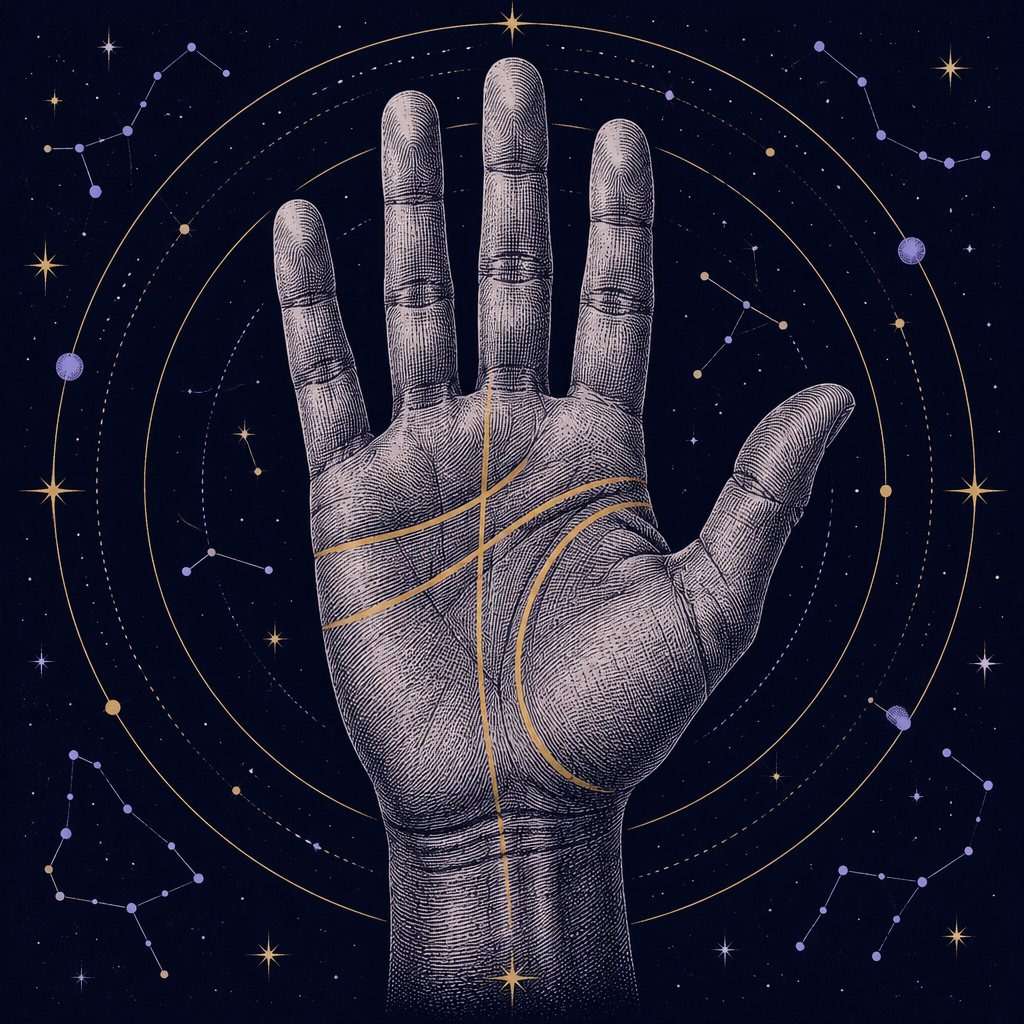
What are the four hand types in palmistry?
The four-element system is a 20th-century one, usually traced to Fred Gettings' The Book of the Hand (1965); Cheiro, writing in 1916, did not use it. Most guides teach it today, and they agree on the grid: the palm is square or long, the fingers short or long, and each of the four pairings gets an element.
Earth hand
Square palm, short fingers
Allure reads earth hands as “practical, logical, and grounded”; Cafe Astrology as practical, down-to-earth people with strong vitality.
Same name as the earth signs (Taurus, Virgo, Capricorn).
Air hand
Square palm, long fingers
Allure reads air hands as curious minds with “innate analytical abilities and communication skills”; the Old Farmer’s Almanac as intellectual, curious and talkative.
Same name as the air signs (Gemini, Libra, Aquarius).
Fire hand
Long palm, short fingers
Allure reads fire hands as “passionate, confident, and industrious”; Cafe Astrology as risk-takers and people of action.
Same name as the fire signs (Aries, Leo, Sagittarius).
Water hand
Long palm, long fingers
Allure reads water hands as “in tune with their emotions, intuition, and psychic ability”; the Almanac as sensitive, empathic and creative.
Same name as the water signs (Cancer, Scorpio, Pisces).
The guides disagree on one point: the Old Farmer's Almanac gives fire hands a square palm, where Allure, Cafe Astrology and most others give them a long one. The readings of each type are quoted from the guide named; Cheiro's book predates the system.
Find your hand type
You need a ruler or a tape measure and about two minutes; a photo of your palm next to a ruler works too. Measure the hand you write with. Enter the three numbers. The index and ring fingers, the shape of your fingertips and your Sun sign are optional.
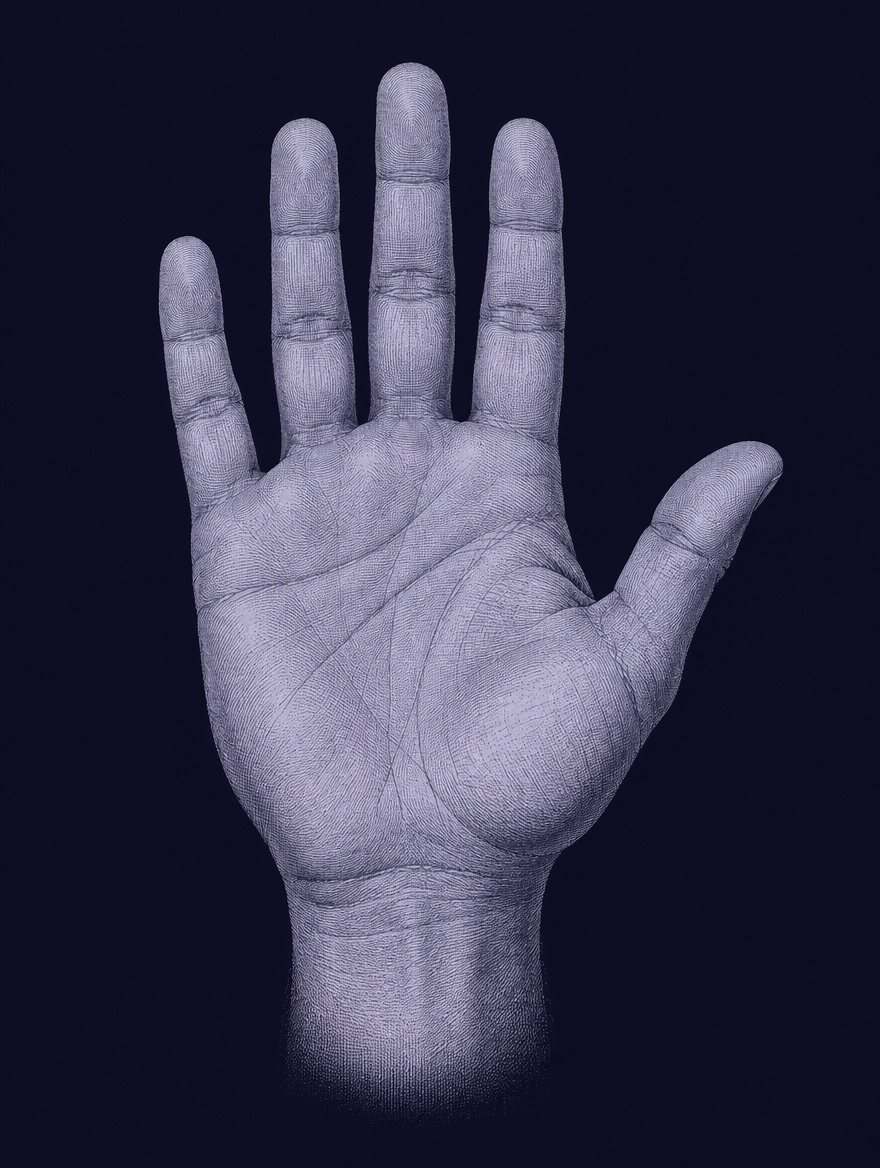
An engraved right palm, not your own hand. Arrows show where to measure; the index and ring fingers are optional.
Your hand, step by step
Your hand type, the arithmetic behind it and how your hand compares with 6,068 measured adults will appear here.
| Hand type | Palm width ÷ length | Middle finger ÷ palm length |
|---|---|---|
| Earth | 0.75 or more (square) | under 0.75 (short) |
| Air | 0.75 or more (square) | 0.75 or more (long) |
| Fire | under 0.75 (long) | under 0.75 (short) |
| Water | under 0.75 (long) | 0.75 or more (long) |
How to measure your hand for palm reading
Lay your hand flat, palm up, fingers together and straight. Measure in a straight line, not along the curve of the skin, and read to the nearest millimeter or sixteenth of an inch. The arrows on the drawing above show the same lines.
- Palm length. From the top crease of your wrist, the one closest to the palm, up to the crease where your middle finger joins the palm. This is the same line the ANSUR II survey measures, so our numbers can be compared with theirs.
- Palm width. Straight across the palm at the base of the fingers, from the edge under the index finger to the edge under the little finger. Leave the thumb out.
- Middle finger. From the same crease at its base to the tip of the finger, not the nail.
- Index and ring fingers (optional). Each from the crease at its base to its tip. These two give the 2D:4D ratio below.
What the measurements say about the four types
The guides draw the line between short and long fingers at three-quarters: Cafe Astrology counts fingers as long when the middle finger is at least three-quarters of the palm's length, and so do palmistry courses by G. E. Carlin and Anthony Writer. Carlin also gives the only number we found for the palm: a palm is long when its width is under three-quarters of its length. Other guides draw the finger line higher. Per Hogseth uses seven-eighths, and grahai and wikiHow compare the finger with the whole palm.
We checked those lines against the U.S. Army's ANSUR II survey, which measured the hands of 6,068 adults (4,082 men and 1,986 women) in 2010 to 2012 and released the data to the public. Its palm length runs from the wrist to the crease under the middle finger, the same line as in our tool.
| Hand type | By the three-quarters rule | Against the usual adult |
|---|---|---|
| Earth | 42% | 18.5% |
| Air | 4.8% | 31.7% |
| Fire | 52% | 31.5% |
| Water | 1.2% | 18.4% |
For the usual adult in that survey the middle finger is 0.66 of the palm's length and the width 0.75 of it. Only 6% have a middle finger of three-quarters or more, and nobody reaches seven-eighths. Run strictly on those soldiers, the guides' rule makes 52% of them fire hands and 42% earth hands, and leaves 4.8% for air and 1.2% for water.
The tool gives two answers. The first follows the guides' rule as written, because that is what a palm reader means by an earth or a water hand. The second compares your hand with the usual adult, so that "long fingers" means longer than most, which splits the survey into four groups of 18 to 32%. The survey covers only soldiers, and finger length is measured on the skin, so treat a result near either line as a coin toss.
Data: 2012 Anthropometric Survey of U.S. Army Personnel (ANSUR II), Gordon and colleagues, 2014, report NATICK/TR-15/007, released for public use; files at Penn State's OPEN Design Lab. Middle finger length is the survey's hand length minus its palm length.
Cheiro's seven types of hands
Cheiro, the society palmist of the 1890s, called the study of hand shape cheirognomy and gave seven types in Palmistry for All (1916). He described them by look and gave no measurements, so the tool picks his type from your answers about fingertips and joints. He also thought the type stays for life: work "may enlarge and broaden the hand, yet the type to which it belongs is never destroyed."
The square hand
A palm that "looks square", straight at the wrist, at the base of the fingers and at the sides, with square-cut fingers and a long, high-set thumb. Cheiro called it the practical or useful hand and read its owners as methodical and logical, people who "believe in things only by proof and by their reason". He found them doing well as business people, lawyers, doctors and scientists.
The spatulate hand
Fingertips that widen into pads "rather like the spatula chemists use", on a palm wider at one end than the other. Cheiro read it as "untiring energy" and originality: inventive, unconventional people. A palm wider at the base of the fingers was to him the more practical version, and one wider at the wrist the more impulsive one.
The philosophic hand
Long and bony, with knotty joints. To Cheiro these were the studious people, "great readers" drawn to books and quiet work. In his own day he more often saw a square palm with philosophic fingers, where "the practical nature is a basis or foundation on which the studious mind builds its theories."
The conic or artistic hand
Graceful, with fingers that taper, and often soft. Cheiro read it as the artistic temperament, "most sensitive to colour, music, and all the fine arts". The firmer the hand, he wrote, the more likely its owner turns that taste into work.
The psychic or idealistic hand
Long, slender fingers with pointed tips. Cheiro called it the highest development of the hand "on the purely mental plane", the hand of people who "live in a world of dreams and ideals".
The mixed hand
Fingers of several types on one hand, one pointed, one square, one spatulate. Cheiro summed it up as "versatility itself" and looked to a clear, straight head line to pick out the talent worth developing.
The elementary hand
Very short and thick-set, with a short, low thumb. Cheiro used this type to rank people from low to high, and modern guides have dropped it. We leave it out of the tool.
Several of Cheiro's readings are harsher than the ones above, especially for the psychic and mixed hands. We have left those out, as we do on every page of this section.
Long fingers, short fingers and knotty joints
Cheiro read finger length against the palm: "The fingers should be long in proportion to the palm; they then denote greater intellectuality and mental power." He named each finger for a planet, the index for Jupiter, the middle for Saturn, the ring for the Sun and the little finger for Mercury. To him a long index finger meant "love of power and command over others", and a long ring finger "love of the beautiful, desire for celebrity and fame".
The joints change the reading. "Smooth-jointed fingers are more impulsive than those with knotty joints," he wrote; knotty joints "arrest the impetuousness of the disposition and give reflection, love of detail". The same planets name the mounts under the fingers, which you can find on the palm map, and three of them have a page of their own here: Jupiter, Saturn and Mercury.
What science measures: the 2D:4D finger ratio
One finger measurement does have a research literature. The 2D:4D ratio is the length of the index finger divided by the length of the ring finger. In a 1998 study, John Manning and colleagues found an average of 0.98 in men and 1.00 in women, and saw the difference already in two-year-olds (Human Reproduction, doi:10.1093/humrep/13.11.3000). Researchers use it as a rough trace of the hormones a baby met before birth.
The difference holds up: a 2010 review of 116 samples, about 25,000 people, found it "moderate" and larger in the right hand (doi:10.1002/ajhb.21054). The links to personality are much weaker. A review of studies on aggression found "some evidence of a small, negative relationship" in men, a correlation of about 0.06, and none in women (doi:10.1016/j.paid.2010.05.003). Effects that looked bigger in early studies have shrunk: a 2020 review of one group of studies found the average effect almost halved in ten years (doi:10.1016/j.yhbeh.2020.104867).
2D:4D says something about groups of people and almost nothing about one person. Measuring it yourself adds error too: the same 2010 review rated self-measured ratios at about half the reliability of an expert's. If you enter both fingers, the tool shows your ratio next to the 1998 averages and gives no reading of it.
Does your hand type match your zodiac sign?
Not necessarily. A hand and a sign of the same element only share the name: one comes from the shape of your palm, the other from the date you were born. Allure's guide says your hand type "may not correspond with your astrological profile" and gives the example of an Aries, a fire sign, with water hands. Add your Sun sign in the tool to see whether yours agree.
In astrology a chart holds all four elements at once, spread over ten planets. The four elements page counts them for your birth date, and each element has its own page: fire signs, earth signs, air signs and water signs.
Questions about hand shapes
What are the 4 types of hands in palmistry?
Earth, air, fire and water. Earth hands have a square palm and short fingers, air hands a square palm and long fingers, fire hands a long palm and short fingers, and water hands a long palm and long fingers.
What is the rarest hand type?
By the guides' own rule, the water hand: in the 6,068 adults of the ANSUR II survey, 1.2% had a long palm and a middle finger of at least three-quarters of it. Air hands came next at 4.8%.
Is a fire hand a long or a square palm?
Most guides, Allure and Cafe Astrology among them, give fire hands a long palm with short fingers. The Old Farmer's Almanac gives them a square one. Our tool follows the majority.
Can your hand shape change?
Cheiro thought not: work may enlarge the hand, he wrote, but the type "is never destroyed". Lines and the fullness of the mounts are what palmists expect to change.
Which hand do you measure?
The one you write with. If you want to compare, measure the other hand too.
What does it mean if your ring finger is longer than your index finger?
It is the usual pattern in men, whose 1998 average ratio was 0.98. In women the average was 1.00, which means the two fingers are about equal. In Cheiro's palmistry a long ring finger, the finger of the Sun, is read as a love of beauty and a wish for recognition.
What is a psychic hand?
One of Cheiro's seven types: a long, slender hand with pointed fingertips. He read it as the most idealistic of the seven, the hand of people who "live in a world of dreams and ideals".
What is a spatulate hand?
A hand whose fingertips widen into pads like a spatula, on a palm wider at one end. Cheiro read it as energy and inventiveness.
Sources
- Cheiro, Palmistry for All (1916), Project Gutenberg: the line readings we quote and the right and left hand rule
- William G. Benham, The Laws of Scientific Hand Reading (1900), scan on archive.org: the age scale on our palm diagram and the mark readings
- ANSUR II, 2012 Anthropometric Survey of U.S. Army Personnel (Gordon et al. 2014, NATICK/TR-15/007): the hand proportions of 6,068 adults we compare your hand with
- Hönekopp and Watson, Meta-analysis of digit ratio 2D:4D, American Journal of Human Biology 2010: the sex difference in the 2D:4D finger ratio
- How we create our readings: how we write pages and check every quotation against the source
After the shape: the lines
Palmists read the lines against the type of hand they sit on. Two have full pages with an age diagram: the life line, read from the top down, and the fate line, read from the wrist up. All four main lines and the seven mounts are on the palm map.
Written by The Zodiac Atlas editorial team with the help of AI and edited by a person. Cheiro's types are quoted from Palmistry for All (1916, public domain), Part II; the four-element readings are credited to the guide they come from, and the proportions are our own count from the ANSUR II data. The palm in the diagram is an engraving, not a photo of a real hand. Palmistry is a symbolic tradition. It does not predict events, and hand shape says nothing about health.