
What does the life line mean in palm reading?
In palmistry the life line stands for the body's reserve of energy: how much drive you have, how fast you recover, how steady your health has been. The society palmist Cheiro read a long, clearly marked line as vitality and a strong constitution, and dated each mark on it by where it falls along the line.
The line also works as a timeline. Breaks, islands and small branches are read as events, and their position on the line gives the rough age. So palmists look at where a mark sits as well as what it is.
It wraps the Mount of Venus, the pad at the base of the thumb. Palmistry borrowed the planet names from astrology, and in both systems Venus stands for warmth and pleasure; see what Venus means in a birth chart. A wide arc gives that mount more room, and the old books read it as more physical warmth and energy.
Does a short life line mean a short life?
No. Many life lines fade or stop before the wrist, and a short line on one hand is common. Benham himself warned against reading a death date into it: "In no case, therefore, should absolute statements be made that death will come at a given time."
He also noticed the flaw in the idea from the other side. He found well-marked lines in the hands of people who had died, "which run past the age of their decease", and he wrote that short, deep lines often "cut their way through the hand, forming new channels". Palmists hold that lines change slowly over the years, which is one more reason to compare both hands and look again later.
Cheiro and Benham did tie the length of the line to the length of life, and Benham wrote that "the longer the line of Life, the longer will be the life", before adding that the rule "may lead to error". The idea came from the books, and the studies below did not support it.
Mark your own life line
Look at your palm in good daylight with the hand relaxed. Pick the hand, then set how your line starts, curves and ends. Add each break, island or branch you can see and slide it to the right spot; tap the diagram to drop a mark where you see it. Each mark gets its age on Benham's scale and its reading.
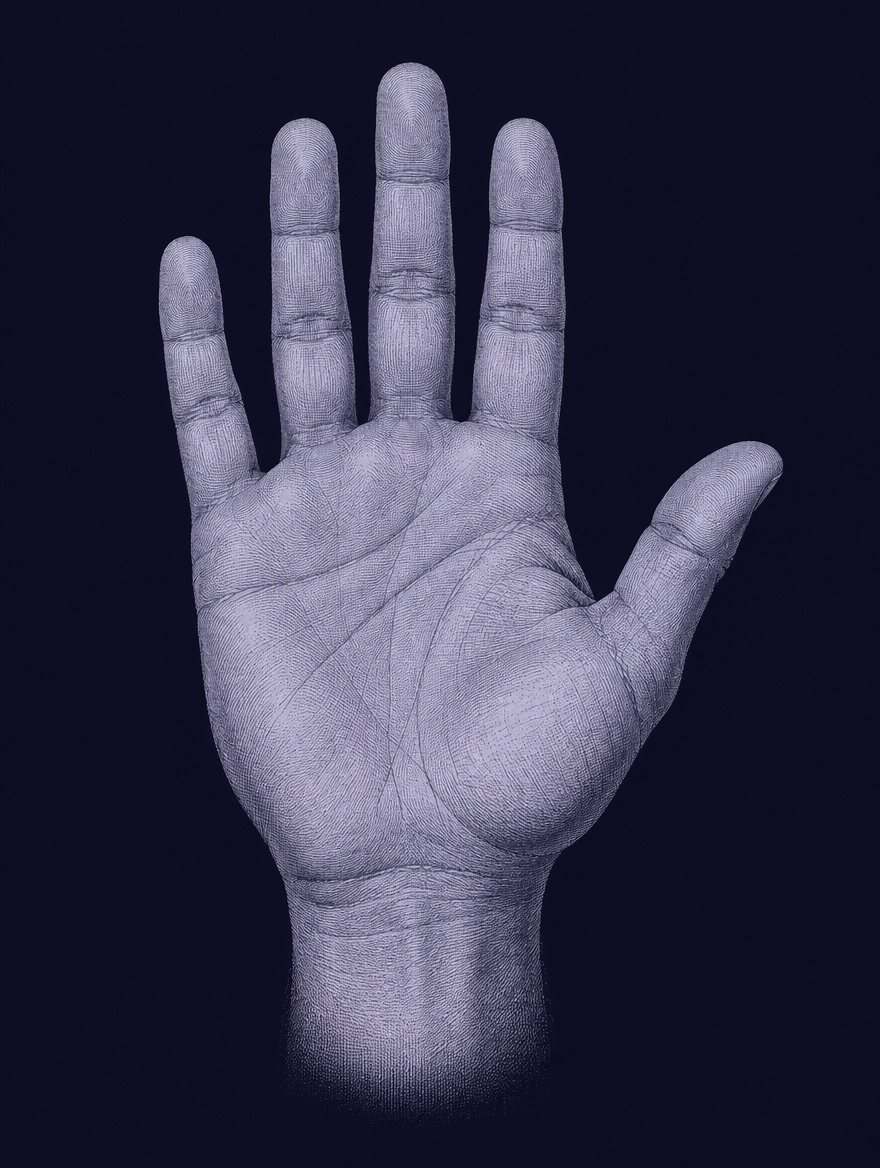
An engraved palm, not your own hand. Ages follow Benham's 1900 scale: 0 under the index finger, 36 at the middle of the line, 70 at the wrist.
It goes under the diagram so you can line the two up. The photo stays in this browser tab. It is not uploaded or saved anywhere, and it disappears when you close the page.
Your life line, mark by mark
No marks added yet. Below is the reading of the line itself; add a break, an island or a branch to see its age.
- Start: Starts between thumb and index
- This is the usual start. Benham called the edge of the palm under the index finger "the normal source" of the line, so on its own it adds no special reading.
- Curve: Medium arc
- Neither of the two classic readings applies, because the line neither hugs the thumb nor swings wide. The textbooks read it by its other features.
- Depth: Deep and clear
- Benham wrote that a deep, well-cut line shows someone "strong, vigorous, full of vitality". Cheiro preferred a clear, thin, deep line over a broad one: in his words, it is the finer line "that will hold out".
- Length: Runs all the way to the wrist
- A full-length line on Benham's scale. Both authors tied a long, clear line to vitality. In this tradition length speaks to energy and says nothing about years.
Right hand. Cheiro relied on the right hand for what has happened and read the left for inborn tendencies. Modern guides read the dominant hand as the active one, so if you are left-handed, swap the two.
Each mark here is read on its own, the way the old textbooks list them one by one. Weighing them against each other is the part this page cannot do: which mark matters most, whether the other hand agrees, and whether the head, heart and fate lines show something at the same age. Benham read those lines against the life line "to see whether events marked on them fit", which is a palm reader's work, done on the whole hand.
How to read age on the life line
Palmists read the life line from the top down: the start under the index finger is childhood, and the line ages as it curves toward the wrist. The scale on our diagram is William Benham's, from The Laws of Scientific Hand Reading (1900). He started the line at zero under the finger of Jupiter, ended it at 70 at the rascette (the wrist crease) and wrote: "I divide it in the centre, fixing that point as the age 36, which is approximately one half of 70."
| Age | Share of the line's length, from the top |
|---|---|
| 0 | 0% (start, at the edge of the palm under the index finger) |
| 6 | 8% |
| 12 | 17% |
| 18 | 25% |
| 24 | 33% |
| 30 | 42% |
| 36 | 50% (the midpoint of the line) |
| 43 | 60% |
| 51 | 72% |
| 60 | 85% |
| 70 | 100% (the end, at the wrist crease (rascette)) |
Benham's divisions, after "Age as Indicated on the Lines". Between the marks the years are spread evenly: six-year steps down to 36, then 43, 51, 60 and 70 over the lower half.
Benham set the end at 70 because insurance tables of his day put the average insurable life at sixty-five, and he wanted to allow a few extra years. It is a ruler for placing marks and says nothing about anyone's lifespan.
He also asked for some common sense. In a long hand the six-year steps spread wider, in a short hand they bunch up, and he thought a skilled reader could fix an event within two to five years at best: "To fix scientifically a month or specific day for any event is impossible."
Cheiro used another system, periods of seven years marked along the line on a printed plate. The two scales put the same mark a few years apart, which is one reason to read any age on the line as a stretch of years.
Breaks, islands, forks and other marks
The old textbooks list these marks one by one. Below are Cheiro's and Benham's readings of each, and how guides written today read the same marks.
Broken life line
A gap in the line. The modern guides we checked read it as a change of direction: a move, a new job, a fresh start, dated by where the gap falls. Benham, who read the whole line for health, called a break a "check" at that age and added that "small breaks which are at once repaired" are no more serious than islands or dots. If the break shows on one hand only, Cheiro gave the right hand more weight than the left.
Break with overlapping ends
The line stops and picks up again beside itself, so for a short stretch there are two lines. Benham listed overlapping ends, sister lines and squares as the ways a break is "repaired". It is read as the softest kind of change, where the new chapter starts before the old one is over.
Island on the life line
A small loop where the line splits and rejoins. Cheiro and Benham both read an island as a stretch of lower strength, from where the loop opens to where it closes, and Benham said that if the line is good after it, the stretch is over. Read the island's position on the scale to see which years it covers.
Lines crossing the life line
Short bars that cut across the line, often from the thumb side. Benham read fine ones as passing setbacks that are "annoying" more than serious, and gave more weight to deep bars that cut the line.
Branches rising from the line
Small lines that climb from the life line toward the fingers. Cheiro read each one as a point where you "made a particular effort", dated by where it leaves the line. A branch that heads for the index finger was ambition to rise in life.
Fork in the life line
The line splits into two prongs. Cheiro read a branch that leans across the palm toward the Mount of the Moon as a life full of change and travel.
Chained life line
A line made of small links, like a chain. Both authors read it as a weaker constitution, and Benham limited that reading to the years the chain covers. He found the first years chained on nearly every life line he studied.
Double life line (sister line)
A second, shorter line inside the life line, closer to the thumb. Cheiro called it the Line of Mars and wrote that it "appears to back up and reinforce the Line of Life", so that "all breaks or bad marks indicated on the Line of Life are minimized" where it runs. It is not found on every hand.
Square on the life line
Four small lines that box in a part of the line. Cheiro called the square "the Mark of Preservation", and on the life line he read it as protection at that age.
Where the life line starts, how it curves and how deep it is
Start. Benham called the edge of the palm under the index finger "the normal source" of the line. Cheiro read a line that rises higher, toward the Mount of Jupiter, as self-control and ambition, and one that rises lower, from the Mount of Mars, as a quicker temper. A life line that starts joined to the head line meant caution and a sensitive nature to him; a small gap between them was independence of thought.
Curve. A line that swings wide into the palm leaves a big Mount of Venus, and both authors read that as a strong constitution. A line that runs close to the thumb narrows the mount, which to Cheiro meant a more delicate build with less physical drive.
Depth. Cheiro preferred a clear, thin, deep line to a broad, shallow one: the broad line "seems to belong to people who have more robust animal strength", but under strain "it is the finer line that will hold out". Benham read a thin line as less robustness, and added in the same passage that it "does not mean that the subject is necessarily delicate or sickly".
Life line on the left or right hand: which do you read?
Read both, and give more weight to the hand you use most. Cheiro's rule was that the left hand shows inborn tendencies and the right shows what you made of them; a mark on the left alone "will never bear fruit or come to any result" unless the right hand has it too.
He wrote for right-handed readers. Modern guides, Allure's beginner's guide among them, read the dominant hand as the active one, so a left-handed person swaps the two. Cheiro's chapter on the two hands gives one rule for everyone; it says nothing about reading women on the left hand.
Has science tested the life line?
Three small studies have measured life lines against age at death, all of them on the bodies of people who had died.
In 1974 Wilson and Mather measured the lines of 51 cadavers of known age at death and found no significant correlation. In 1990 Newrick, Affie and Corrall (Journal of the Royal Society of Medicine) measured 100 consecutive autopsies and reported a "highly significant association" between line length and age at death. In 2019 Lucas, Dhugga and Henneberg repeated the 1990 method on 60 donated bodies at the University of Adelaide and found "no significant correlations", in either hand and for men and women alike.
So one positive result, not repeated, against two null results. The 1990 authors themselves noted that creases may lengthen as skin wrinkles with age, which would make older people's lines look longer without saying anything about lifespan. Read the life line as palmists do, for its shape and marks; it is no guide to health, and a health question belongs with a doctor.
| Study | Sample | Result |
|---|---|---|
| Wilson and Mather, 1974 | 51 cadavers | No significant correlation |
| Newrick, Affie and Corrall, 1990 | 100 autopsies | Association reported; not repeated since |
| Lucas, Dhugga and Henneberg, 2019 | 60 donated bodies | No significant correlation |
What Cheiro and Benham wrote about the life line
Both books are in the public domain and free to read online. Cheiro (William John Warner, 1866 to 1936) was a society palmist whom the 1990 study above calls the "undisputed doyen of palmistry"; we quote his Palmistry for All (1916). William G. Benham published The Laws of Scientific Hand Reading in 1900 and drew the age scale used on this page.
“Thus we start a line at zero and end it at 70. The intervening space we divide into sections mathematically exact, which point out the intervening years of the life.”
“In no case, therefore, should absolute statements be made that death will come at a given time, for, while you may see great danger, will power may be strong enough to wrest life from death.”
Benham quotes are from the transcription linked; the printed book is scanned at archive.org. Cheiro quotes are from the Project Gutenberg edition.
Questions about the life line
Does a short life line mean you will die young?
No. A short or faded line is common, and Benham, who drew the age scale on this page, warned against ever predicting a death date from the hand. Two of the three studies that measured lines against age at death found no link.
What does a broken life line mean?
In the tradition, a break marks a change at that age: a setback in the old books, a change of direction in modern readings. A break that closes again or overlaps is read as the mildest kind.
How do you read age on the life line?
From the top down. On Benham's scale the start under the index finger is 0, the midpoint of the line is 36 and the wrist crease is 70, with steps of six years up to 36. Read any age as give or take a few years.
Which hand should I read for the life line?
Both, with more weight on the hand you use most. Cheiro read the left hand as inborn tendencies and the right as what you made of them; left-handed people usually swap them.
What does a double life line mean?
A second line inside the life line, nearer the thumb, is the sister line or Line of Mars. Cheiro read it as extra vitality that softens any break or mark on the main line.
Can your life line change?
Palmists say so, and Benham wrote that deep short lines often extend over time. Look at your hands again in a few years and compare.
What does an island on the life line mean?
A small loop in the line. Cheiro and Benham read it as a stretch of lower strength during the years it covers, over once the line runs clean again.
Is there scientific evidence that the life line predicts lifespan?
A 1990 study of 100 autopsies reported a link; studies from 1974 (51 bodies) and 2019 (60 bodies) found none. The positive result has not been repeated.
Sources
- Cheiro, Palmistry for All (1916), Project Gutenberg: the line readings we quote and the right and left hand rule
- William G. Benham, The Laws of Scientific Hand Reading (1900), scan on archive.org: the age scale on our palm diagram and the mark readings
- Newrick, Affie and Corrall, J R Soc Med 1990;83:499-501 (PubMed Central): the one study that reported a link between life line length and age at death
- Lucas, Dhugga and Henneberg, Anthropological Review 2019: the repeat study that found no link
- How we create our readings: how we write pages and check every quotation against the source
Palm reading and astrology on this site
Benham dated the other lines against this one. The fate line runs up the middle of the palm and is read the other way, from the wrist up, for work and the outside turns of a life; all four main lines are on the palm map. Palmists read every line against the shape of the hand it sits on: earth, air, fire or water hand.
The heart line, across the top of the palm, is read for love and attachment and dated on the same 0 to 70 scale as this one, starting under the index finger.
The head line often starts from the life line above the thumb; Benham read the age where the two part as the age a person began to think for themselves.
The marriage lines are short creases on the edge of the hand under the little finger, dated by height above the heart line on their own scale.
The mounts of the palm carry planet names from astrology: the life line wraps the Mount of Venus, the index finger is Jupiter's, the middle finger Saturn's, the ring finger the Sun's, the little finger Mercury's, and the outer edge of the palm is the Mount of the Moon. Your own planets by sign, from your birth date: birth chart calculator · all planet signs.
Written by The Zodiac Atlas editorial team with the help of AI and edited by a person. Readings are quoted or summarized from Cheiro's Palmistry for All (1916) and Benham's The Laws of Scientific Hand Reading (1900), both in the public domain; the palm diagram is our own drawing. Palmistry is a symbolic tradition. It does not diagnose health or predict events, and nothing on this page is medical advice.