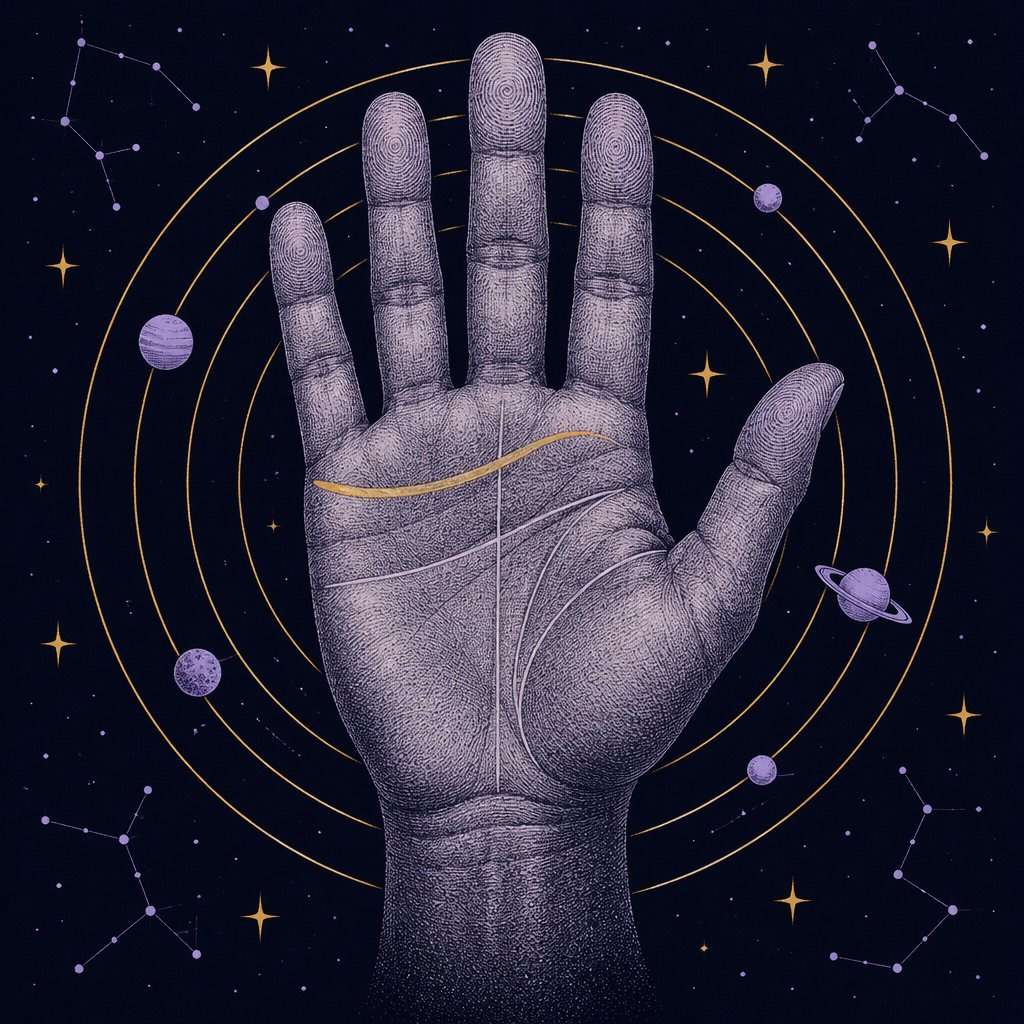
What does the heart line mean in palm reading?
Cheiro wrote that the line of heart "relates purely to the affectionate disposition, in fact, to the mental side of the love nature". In other words, it is read for feelings: how warmly you attach to people, how you show it and how steady those attachments are.
William Benham, whose Laws of Scientific Hand Reading (1900) is the other old textbook palmists still quote, read the line piece by piece. "The starting point of the heart line shows the source of its qualities. Where it ends shows their outcome," he wrote, and each stretch of the line was read for the years it covers. A line that changes from deep to thin was, to him, a person whose way of loving changed at that age.
Both men read it against the head line just below it. One line was feeling and the other reason, and where one leans toward the other they read which of the two usually wins.
Where does your heart line end?
Old textbooks describe the line from the index finger end and call that its start; modern guides start at the little finger and call the same place its end. Either way, this is the end near the fingers, and it carries most of the reading. Here is each ending in short; set yours on the diagram below for the full reading in both books' words.
Under the index finger
The line reaches the pad under the index finger, the Mount of Jupiter: an idealist in love who holds the person they choose to a high standard and, once they really love, loves for good.
Between the index and middle fingers
The line ends in the gap between the first and second fingers: the calm, deep nature of the lead above, someone who shows little but gives a great deal, and the common-sense middle ground of the affections for Benham.
Under the middle finger
The line stops under the middle finger, on the Mount of Saturn: reserved and undemonstrative in love, yet determined to win the person they want.
Straight across the whole palm
A line that runs from edge to edge, all the way to the thumb side. Benham read it as "too much heart", feeling deciding everything, and threw out the older reading of "failure in all enterprises".
Mark your own heart line
Look at your palm in daylight with the hand relaxed. Pick the hand, then set where yours ends near the fingers, how it curves and how it looks. Add a break, an island or a branch you can see and slide it to its place, or tap the line on the diagram. Each mark gets its age on Benham's scale and its reading.
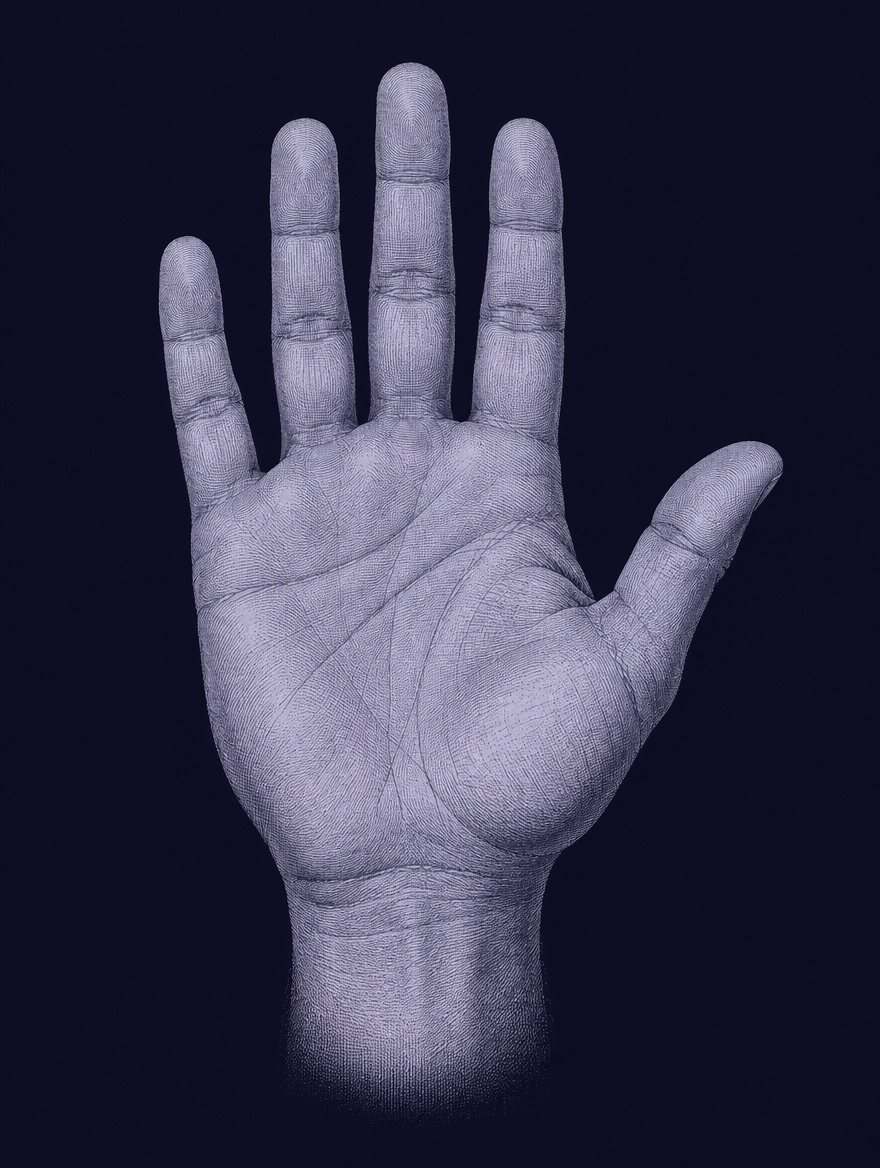
An engraved palm, not your own hand. Ages follow Benham's 1900 scale for the heart line: 0 under the middle of the index finger's mount, 36 halfway across, 70 at the outer edge of the palm. The dashed stretch is the scale where your line does not reach.
It goes under the diagram so you can line the two up. The photo stays in this browser tab. It is not uploaded or saved anywhere, and it disappears when you close the page.
Your heart line, mark by mark
No marks added yet. Below is the reading of the line itself; add a break, an island or a branch to see its age.
- End: Between the index and middle fingers
- The line ends in the space between the first and second fingers. Cheiro read this as "a calmer but a very deep nature in all matters of the affections": people who are not very demonstrative in love but are "capable of the very greatest sacrifices for those they care for". Benham called it the common-sense, "middle ground" of the affections, not "soft" or "spoony".
- Shape: Curves up toward the fingers
- Modern guides read a heart line that sweeps up toward the fingers as an open, expressive way of loving; Purple Garden calls it "a passionate and intense love life". The old textbooks did not grade the curve on its own; they read where the line ends.
- Depth: Deep and clear
- Benham called a deep, smooth heart line the perfect one: steady affection, "reliable in love matters", from people who love devotedly but "do not wear the heart on the sleeve". Cheiro wanted it "deep, clear, and well coloured".
- Fork: No fork
- A single line with no fork at the finger end is the usual form. The old textbooks give it no reading of its own: the line is read by where it ends.
Right hand. Cheiro read the right hand for what you have made of your life and the left for what you were born with. Modern guides read the dominant hand as the active one, so if you are left-handed, swap the two.
Each mark here is read on its own, the way the old textbooks list them one by one. Putting them together is the part this page cannot do: which mark matters most, whether the other hand agrees, and whether the life, head and fate lines show something at the same age. Benham dated the heart line for exactly that reason, "to see whether events marked on them fit into conditions seen on the Life line", which is a palm reader's work, done on the whole hand.
Can you read age on the heart line?
Benham did, and gave the scale. For the heart and head lines he measured along "an imaginary line beginning in the middle of the Mount of Jupiter and running across the hand to the percussion", the outer edge of the palm, and laid out on it "the periods of 6, 12, 18, 24, 30, 36, 43, 51, 60, and 70". So the line is dated from the index finger end: 0 under the middle of the index finger's mount, 36 halfway across, 70 at the edge of the palm.
| Age | Under which finger, on our diagram |
|---|---|
| 0 | the index finger (start: the middle of the mount under the index finger) |
| 6 | the index finger |
| 12 | the middle finger |
| 18 | the middle finger |
| 24 | the middle finger |
| 30 | the middle finger |
| 36 | the ring finger (halfway across the palm) |
| 43 | the ring finger |
| 51 | the ring finger |
| 60 | the little finger |
| 70 | the little finger (end: the outer edge of the palm) |
Benham's divisions, after "Age as Indicated on the Lines". The fingers are those of the engraved palm under our diagram; on your hand, look at which finger each part of your line sits under.
His own examples fix the fingers on that scale: under the middle finger is about 24, under the ring finger 43 and under the little finger 60. The table above is read off our diagram, which follows his scale on the engraved palm. There the fingers land at about 22, 44 and 64, so a division can sit a few years away from his own examples.
Benham dated this line to check it against the life line. He said no one can fix more than the year of an event from the hand, and most only within two, three or five years, so read every age here as a stretch of a few years.
Some modern guides read the line the other way round, from the little finger toward the index finger, with childhood at the edge of the palm. Numerologist.com is one of them. The same mark can read decades apart depending on the direction, so we keep to Benham, the only one of the sources we checked who printed a scale.
Curved or straight heart line
Modern guides read a line that sweeps up toward the fingers as an open, expressive way of loving, and a straight one as a quieter, more reasoned way. Purple Garden puts it as "a passionate and intense love life" for the long upward curve and "a more reserved and cautious approach to love" for the short straight line; mypalms.ai and grahai.com read the two the same way.
Cheiro and Benham did not grade the curve on its own. They read where the line ends and how it leans. Benham read a stretch that dips toward the head line as the head taking over from the heart for those years.
Broken heart line, forks and other marks
The old textbooks list these one by one and date each by its place on the line. Benham read most of them two ways, as health or as feeling; we give only the reading for feelings. Below is each mark in short. Add it on the diagram to get its age and the full reading.
Broken heart line
A gap in the line: a bond that stopped or changed at that age. A narrow break is one you get over, and ends that overlap, a sister line running past or a square around the gap were Benham's signs that it heals.
Forked heart line
A line that splits into two near the fingers. Cheiro called a fork with "one branch on Jupiter and the other between the first and second fingers" "an excellent sign of a well-balanced, happy, affectionate disposition". Benham read the deeper branch as the stronger side.
Branches rising
Small lines that climb toward the fingers, read as better signs than falling ones and by the finger they head for: the diagram gives the reading for each finger.
Branches falling
Small lines that drop from it toward the head line. Older palmists called them "love-sorrows and disappointments". Benham read them instead as the head stepping in: at the age where they fall, reason pulls harder than feeling.
An island
A small loop where the line splits and rejoins: a strained stretch in the affections for the years it covers.
Lines crossing it
Short bars cutting across it: quarrels or worries in a relationship at the age they cross.
Chained heart line
A line made of small links: an unsettled stretch in the affections for the years the chain covers.
One line instead of two: when the heart and head lines join
Some hands have a single deep crease right across the palm where the heart and head lines would be. Medicine calls it a single transverse palmar crease; it is found in about 1.5 to 3 percent of people, and on its own it says nothing about health. The older name, "simian line", has fallen out of use because it is seen as demeaning.
Cheiro read it as an intensely self-concentrated nature: "If such a subject loves, he unites with it all the forces of his mind, and if he put his mind on any subject, he throws his whole heart and soul into whatever it may be." He told readers to check where the single line sits: higher up, near the fingers, he read it as more feeling; lower down, as more thinking.
What if you can't find your heart line?
Almost every hand has one. Benham wrote that two of his warm-hearted hand types never have it "entirely absent", and he added that the one type he did find without it is rare. When people think theirs is missing, it is usually one of three things: a single crease across the palm where the heart and head lines have merged (see above), a faint line that shows better in side light with the fingers slightly bent, or a short line that stops under the middle finger.
The old readings of a truly absent line are harsh, and we leave them out. A faint or short line is read for its ending and its marks like any other.
Left or right hand
Read both. Cheiro's rule was that the left hand gives "the natural tendencies or inclinations" and the right what you have done with them, so a mark on the left that is missing on the right "will never bear fruit". Both wrote for right-handed readers; modern guides read the dominant hand as the active one, so if you are left-handed, swap them.
Grahai.com reads a line that is straighter on the dominant hand than on the other as someone who has learned to guard their feelings. A difference between the two hands is read as a change.
The mounts and the planets along the line
It runs under four mounts, each named for a planet: the little finger is Mercury's, the ring finger the Sun's, the middle finger Saturn's and the index finger Jupiter's. Palmistry took the names from astrology, and the line is read by the mount it ends under or bends toward. Cheiro's list for Jupiter was "ambition, power, domination", for Saturn "love of solitude, prudence, quiet determination".
The love planet of astrology, Venus, sits elsewhere on the hand, on the pad at the base of the thumb that the life line curves around. Cheiro read it for "a desire for love and companionship". In a birth chart, how you love is read from your Venus sign, and how two people fit from both charts: see zodiac compatibility.
What Cheiro and Benham wrote
Both books are in the public domain. Cheiro's Palmistry for All (1916) has a chapter on "The Line of Heart as Indicating the Affectionate and Emotional Nature", which gives the endings and the fork quoted here. Benham's The Laws of Scientific Hand Reading (1900) has the age scale and a long chapter on the heart line, where he reads each mark both as health and as feeling. We quote the feeling side and leave the medical readings out: palmistry is a tradition, not a way to check a heart.
Benham quotes are from the transcriptions linked ("Splits of the Heart Line", "Breaks in the Heart Line"); the printed book is scanned at archive.org. Cheiro quotes are from the Project Gutenberg edition. The figure for a single crease across the palm is from Wikipedia's article on the single transverse palmar crease.
Questions about the heart line
What does it mean if my heart line ends between my index and middle finger?
A calm but deep nature, in Cheiro's reading. See where it ends.
What does a heart line ending under the index finger mean?
An idealist in love, in Cheiro's reading. See where it ends.
What does a broken heart line mean?
In Benham's reading, an interruption in the affections at the age of the break. See breaks and other marks.
What does a fork at the end mean?
A well-balanced, affectionate nature, in Cheiro's reading. See breaks and other marks.
Is a straight heart line rare?
No. Straight and curved lines are both common; the rare one is a single crease right across the palm.
Which line is the love line on the palm?
The heart line: the top crease across the palm, under the fingers. The short lines on the edge of the hand under the little finger are a separate set, called marriage or relationship lines.
Which hand should I read?
Both. See left or right hand.
Can the heart line change?
Grahai.com says its depth and markings can change over the years, especially on the dominant hand. It is worth looking again in a few years.
Sources
- Cheiro, Palmistry for All (1916), Project Gutenberg: the line readings we quote and the right and left hand rule
- William G. Benham, The Laws of Scientific Hand Reading (1900), scan on archive.org: the age scale on our palm diagram and the mark readings
- How we create our readings: how we write pages and check every quotation against the source
Other lines and the planets behind them
This line is dated on the same scale as the life line, so Benham checked one against the other: see the life line, read from under the index finger toward the wrist, and the fate line, which crosses it at about 45 on its own scale. All four main lines and the seven mounts are on the palm map. The mounts under it carry planet names from astrology; your own planets by sign are in the birth chart calculator.
Just below it runs the head line, read for thinking rather than feeling and dated on the same scale; Benham read the two together to see which one leads.
The short creases on the edge of the hand just above the end of the heart line are the marriage lines, read for your deepest attachments and dated upward from the heart line.
Written by The Zodiac Atlas editorial team with the help of AI and edited by a person. Readings are quoted or summarized from Cheiro's Palmistry for All (1916) and Benham's The Laws of Scientific Hand Reading (1900), both in the public domain; modern readings are credited to the guide they come from. The palm under the diagram is an engraving, not a photo of a real hand. Palmistry is a symbolic tradition. It does not predict events or say anything about the health of your heart, and nothing on this page is medical or relationship advice.