Eight of Pentacles upright: learning a trade or just busy?
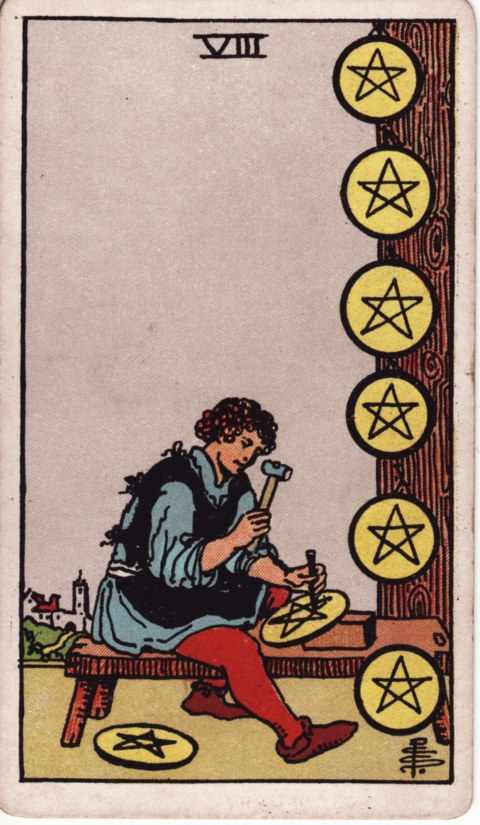
Upright, the card is a person at a bench. Waite describes the picture in a single line: "An artist in stone at his work, which he exhibits in the form of trophies." The finished pieces are hung on show, so the work is meant to be seen, and the card is as much about showing as about toiling. When you ask about work or money, finish one piece to the point where you would hang it up, and send it this week to the person who asked for it.
Waite's list is "Work, employment, commission, craftsmanship, skill in craft and business, perhaps in the preparatory stage." In its last clause he allows that the craftsman may still be learning, which fits the young face and the single bench. The Three of Pentacles shows the same trade a stage later, when the maker is trusted with a whole arch. Here the stage is repetition: carve, check, carve again.
The modern pages stress mastery. Biddy Tarot lists "Apprenticeship, repetitive tasks, mastery, skill development" for the upright card. Book T does not praise the worker so freely. It calls the card "Over-careful in small things at the expense of great," quotes the proverb "Penny wise and pound foolish," and ends with "hoarding, lacking in enterprise." Its description of the Golden Dawn card says the same thing in roses: four white roses touch the four lowest disks, and "only leaves" touch the four above. The upper half of that card has nothing in flower yet. So Smith's picture shows good work, and the old text asks whether it is pointed at the right target.
Eight of Pentacles reversed: burnout, perfectionism or a wrong aim?
Reversed, the Eight of Pentacles asks what the work is for. In a one-card pull, look at the aim first. Waite's list is "Voided ambition, vanity, cupidity, exaction, usury," and the modern pages read perfectionism or burnout. For work or money this week, stop polishing the thing nobody asked you to polish, and spend the saved time on the single task that decides your question.
Three readings sit inside one reversed card. The first is empty effort: a plan that has gone nowhere, or pride in the show of the work and not in what it does. That is Waite's "voided ambition" and "vanity." The second is in his next sentence: "It may also signify the possession of skill, in the sense of the ingenious mind turned to cunning and intrigue." So the craftsman is still good, and the question is who benefits from his cleverness. The third is a person who works from habit, and Tarot.com's question, "Are you learning, or are you just grinding because you think you're supposed to?", covers that case.
With only this card on the table, run the two-column week. Look back over the last seven days. In column A list every small job you checked, tidied, reformatted or redid, with the minutes beside each. In column B put the one job that would change the answer to your question, with its minutes. Add up each column. If B has less than a quarter of the time, you are on Book T's side of the card, careful about pennies, and the fix is to move one fixed hour a day to B. If B has most of the minutes and the matter still does not move, the trouble is skill or direction, Waite's "voided ambition," and the fix is to show one piece to someone who has done this work. If both columns are nearly empty, the card is about rest or a stalled start, and no amount of polish will help.
Getting the job, a course paying off or an ex returning all lie outside what the reversed card can answer. It shows how your effort and your aim stand today, with no view of another person's decision or a date. Waite's second list adds "The Querent will be compromised in a matter of money-lending," so if someone is offering you a loan or asking for one, go through the terms line by line before signing. A card cannot judge a lender's honesty, and a lawyer or an adviser can.
Is the Eight of Pentacles a yes or no card?
| Position | Answer |
|---|---|
| Upright | Yes, with steady work |
| Reversed | Not yet, check the aim |
Upright, the Eight of Pentacles says yes to anything you are prepared to practice: a course, a craft, a certification, a slow plan. Tarot.com gives yes as well. The yes carries a condition, because the picture shows hours at a bench and no shortcut.
Turned over, it says wait. Check what you are working toward before you add more effort. Neither old source gave verdicts, so both answers are modern convention.
Eight of Pentacles in love and friendship: effort for the bond, or for the job?
As a couple
For two people the card describes love as upkeep: the small, repeated jobs that keep a home or a bond in shape. Book T's caution applies too, since a partner can fuss over the details of a shared life and miss the big conversation. Choose one large thing you have both avoided saying and give it an evening, before another round of small repairs.
Single
With no partner, the card tends to point to a season of building yourself: a skill, a craft, a body of work. It says little about meeting anyone, but people often meet through the class or the workshop. A fair question is whether the busy schedule is a way of not going out. If it is, put one social evening in the calendar as firmly as a work shift.
As feelings
Read as a person's feelings, the Eight shows steady care expressed through effort: they fix things, help out and remember details. It is a practical affection and may not come with words. It can also show a person absorbed in their work who has little attention left. Judge it by whether they still make time on a busy week.
Rescheduled again: friends who wait while you work
You have moved the same coffee three times because the project needs one more evening. The craftsman at the bench is a fine reason to be busy, but Book T adds a catch: "Over-careful in small things at the expense of great." A friend can be the great thing.
Reversed, the skill turns to vanity or the work swallows every hour, and the friend, who may be patient, stops asking. Pick a night and put the friend in it first. Fit the work around it, and send them the date today, before the project grows again.
Reversed in love: work and effort out of balance
Reversed, the card points to lopsided effort. One of you works at the bond while the other coasts, or work takes the hours the relationship needed. Labyrinthos lists "not putting effort into love, neglecting relationship" for it. About an ex, the card describes how much effort went in then and how much is available now. A return cannot be read from it.
Eight of Pentacles at work and with money
At work the Eight is the trade card: apprenticeship, training, a craft, a technical role, any job where quality builds up slowly. It favors steady output, a portfolio, a certificate, a body of finished pieces you can show. Waite's "commission" is worth taking literally, since the card can mean paid work taken on for a client.
On money, Book T gives "gain of ready money in small sums," the pay that arrives in small amounts for work done. It suits a wage, freelance pieces or a savings habit that grows a little each month. The same text calls it "mean; avaricious," so check whether you are saving on the wrong things, such as a tool or a course that would let you earn more.
Reversed at work, look at the aim before the effort: a project nobody needs, polish with no buyer, or a colleague's clever shortcut you should not copy. Reversed on money, check small fees and subscriptions that add up, and be careful with anyone who charges interest or asks for yours. Waite's reversed list includes "usury."
Eight of Pentacles as advice and as a person
As advice, the Eight says to practice on purpose. Pick the one skill that would change your position, schedule a fixed block for it, and keep a simple record of the pieces you finish, so that you can show them.
Drawn as a figure, the Eight is the craftsperson who lets the work speak, careful and a little reserved. Take Marta, an invented bookbinder in her second year, who rebinds one volume a week and hangs the results in the shop window. Reversed, the question is whether the work leads anywhere, and the customers answer it by what they actually buy. For work, that means checking one number, such as orders, enquiries or hours billed, before putting in more.
How to read the Eight of Pentacles in a spread
As the only card, the Eight says your question is about effort and craft, so ask what you are making and who will see it. As the past card, it stands for the training or hard grind the situation rests on. In the middle position, steady work is under way and results come later. As an outcome, it suggests skill earned slowly and visible in the end.
Among neighbors, Book T says "Swords are inimical to Pentacles," so a blade nearby can be read as criticism of the work or a dispute over payment. Wands are friendly to Pentacles in the same table and give the maker drive. After the Seven of Pentacles the worker is back at the bench following the pause to count; before the Nine, the effort is still unrewarded.
The Eight of Pentacles among the Pentacles
Within the suit, the Eight is where the roses begin to divide the coins. In Book T's Seven, the buds fall short of the fruit. Here four roses touch the lowest four pentacles and leaves alone reach the others, a half-grown branch. The Nine of Pentacles, next in the suit, has "rosebuds on the branches as well as flowers" and a full branch of nine.
Book T's short gloss for the Eight is "Skill: prudence: cunning," and the word cunning is the one Waite's reversed line also reaches. The sephira is Hod, the eighth of the Tree. On Smith's card the product of the work is on show: finished coins hang on a post. That observation is ours.
- Ace of Pentacles
- Two of Pentacles · Harmonious Change
- Three of Pentacles · Material Works
- Four of Pentacles · Earthly Power
- Five of Pentacles · Material Trouble
- Six of Pentacles · Material Success
- Seven of Pentacles · Success Unfulfilled
- Eight of Pentacles · Prudence
- Nine of Pentacles · Material Gain
- Ten of Pentacles · Wealth
- Page of Pentacles
- Knight of Pentacles
- Queen of Pentacles
- King of Pentacles
Titles after the numbered cards are the Golden Dawn's names for them in Book T.
Symbolism of the Rider–Waite–Smith card
- The bench and the carving tools. A young man sits at a wooden bench with a hammer and chisel and cuts a pentacle into a coin. Waite calls him "An artist in stone at his work." The tools are small and the task is repetitive. Smith shows concentration without drama.
- Six pentacles on the post and one on the ground. Six finished coins are fixed down a post beside him and a seventh rests on the ground. The eighth is in his hands. Waite writes that he "exhibits" the work "in the form of trophies." Our reading of the coin on the ground is that the work piles up faster than it can be hung.
- The black apron. He wears a dark apron over a tunic. It marks a working craftsman, a person who gets dirty doing the job. Neither old source mentions it, so any further meaning is ours.
- The small town in the distance. A few buildings on the far hillside show the world he has stepped away from. Modern sites read this as isolation for the sake of focus. Waite does not mention the town. It is Smith's addition, and where the finished work goes next is left open.
- The rose branch in Book T. The old picture has a hand holding a rose branch with four white roses on the lower coins and only leaves above. Smith left the branch out. The old picture shows effort that has borne fruit in part and not in full.
What the oldest sources say
“Work, employment, commission, craftsmanship, skill in craft and business, perhaps in the preparatory stage. Reversed: Voided ambition, vanity, cupidity, exaction, usury. It may also signify the possession of skill, in the sense of the ingenious mind turned to cunning and intrigue.”
“A young man in business who has relations with the Querent; a dark girl. Reversed: The Querent will be compromised in a matter of money-lending.”
“Over-careful in small things at the expense of great: "Penny wise and pound foolish": gain of ready money in small sums; mean; avaricious; industrious; cultivation of land; hoarding, lacking in enterprise.”
Waite's main list is wholly about the trade: "Work, employment, commission, craftsmanship, skill in craft and business, perhaps in the preparatory stage." His reversed line begins as a judgment, "Voided ambition, vanity, cupidity, exaction, usury," and then adds a turn: skill "in the sense of the ingenious mind turned to cunning and intrigue." The second list is about people and money: "A young man in business who has relations with the Querent; a dark girl," and reversed, "The Querent will be compromised in a matter of money-lending." Those lines do not follow from the picture, and they are best read as period fortune-telling.
The old system titles it Lord of Prudence and gives the sephira Hod with the gloss "Skill: prudence: cunning." The text is critical: "Over-careful in small things at the expense of great." Book T names the arrangement of the coins after the geomantic figure Populus and says no more about it. The modern pages checked here praise dedication, and none mentions Book T's complaint. We think both are worth keeping, because attention to detail is good until it replaces the main job.
Eight of Pentacles and Sun in Virgo: the card's decan
| Suit and element | Pentacles, Earth (Major Arcana card of earth: The World) |
|---|---|
| Decan | 0° to 10° ♍︎ Virgo, the first ten degrees of the sign |
| Planet of the decan | Sun (Major Arcana: The Sun) |
| Major Arcana card of Virgo | The Hermit |
| Golden Dawn title | The Lord of Prudence |
| Place on the Tree of Life | Hod (Book T: “Skill: prudence: cunning”) |
Attributions from Book T (Golden Dawn, c. 1892; printed 1912).
In the Golden Dawn scheme the Eight of Pentacles falls in the first decan of Virgo, 0° to 10°, under the Sun, and is titled the Lord of Prudence. Virgo is an earth sign, which matches the suit. The Major Arcana match these with The Hermit for Virgo, The World for earth and The Sun for the Sun itself. The craftsman alone at his bench has something of the Hermit, though nothing in the old text says that.
The decan sits in the stretch of the Knight of Pentacles, which runs from 20° Leo to 20° Virgo, and is followed by the Nine of Pentacles. Saturn stood in these degrees from September 2007 to August 2008, by our ephemeris, and earlier in 1977 to 1979, with breaks. Uranus was here in 1961 to 1964 and Pluto between 1956 and 1963. Neptune stays out of this decan through the whole 1950 to 2060 range we computed.
When the Sun is in the Eight of Pentacles stretch
| Year | Sun enters 0° | Sun leaves (reaches 10° Virgo) |
|---|---|---|
| 2026 | Aug 22 | Sep 2 |
| 2027 | Aug 23 | Sep 2 |
| 2028 | Aug 22 | Sep 1 |
| 2029 | Aug 22 | Sep 2 |
This year the Sun crossed the Eight of Pentacles stretch of the zodiac (0° to 10° Virgo) from August 22 to September 2, 2026. Next time: August 23 to September 2, 2027 (US Eastern dates).
Dates are US Eastern, from the astronomy-engine ephemeris. Across 35,064 dates from 1930 to 2025, the Sun is in this stretch on 2.8% of them, and at least one of the ten planets is on 27.6%.
In 2026 the Sun passed through these degrees between August 22 and September 2, and in 2027 it does so between August 23 and September 2. Jupiter enters on July 28, 2027 and stays until September 12, 2027, by our ephemeris. It returns in late 2038 and in 2039. Saturn comes back in October 2036 and stays, with breaks, to June 2038. Those are positions on a chart, and nothing about them predicts an event.
Is the Eight of Pentacles in your birth chart?
Enter your birth date. We show which of the ten planets stood between 0° and 10° Virgo that day, the slice of sky Book T gives this card; add the time if a planet was near the edge.
Enter your birth date above to see your result.
Every planet, angle and house from your birth time: birth chart calculator.
Questions about the Eight of Pentacles
Is the Eight of Pentacles a lucky card to draw?
Usually yes. It describes steady skilled work. Book T adds a warning against fussing over small things at the expense of big ones, and Waite's reversed list is the less favorable half.
What is the Eight of Pentacles saying about someone's feelings?
Steady care that appears as effort and reliability. The person may say little and do a lot. Reversed, they may be distracted by work or unsure their effort counts.
Should I read the Eight of Pentacles as yes?
Upright it leans yes for anything you are ready to practice, and reversed it leans wait. The old books carry no verdict on this, so it is modern practice.
What sign does the Eight of Pentacles belong to?
Virgo, the first ten degrees, ruled here by the Sun. The Sun passes through around August 22 to September 2.
How long until the Eight of Pentacles pays off?
No card gives a date. August 22 to September 2 is the span of dates when the Sun sits in these degrees, as a calendar convention. Skill usually builds over months of regular practice, and a calendar block does more for you than waiting for a sign.
How should I read the Eight of Pentacles reversed?
Waite lists "Voided ambition, vanity, cupidity, exaction, usury," and adds skill turned to "cunning and intrigue." Modern pages read burnout, perfectionism or misdirected effort. Try the two-column week from the reversed section.
Is the Eight of Pentacles about a new job or an apprenticeship?
It fits an apprenticeship or training best, since Waite allows that the work may be "in the preparatory stage." A job offer is outside what it says.
Sources
- Astronomy Engine: the open-source ephemeris library behind our planet positions, dates and statistics
- A. E. Waite, The Pictorial Key to the Tarot (1911), Wikisource: the divinatory meanings we quote, upright and reversed
- Book T (Golden Dawn), as printed in The Equinox I:8, 1912: the zodiac sign, Hebrew letter, title and short meaning of each card
- Wikimedia Commons: Rider–Waite–Smith tarot deck: Pamela Colman Smith's 1910 card drawings, public domain
- How we create our readings: our own calculation of sign dates, positions and the 1930 to 2025 statistics
Next to the Eight of Pentacles
In the suit of Pentacles: Seven of Pentacles ← Eight of Pentacles → Nine of Pentacles.
Virgo on this site: Virgo zodiac sign · The Hermit, the card of Virgo · your full birth chart.
All 22 Major Arcana with their signs and planets, and the minor cards written so far: tarot card meanings.
Written by The Zodiac Atlas editorial team with the help of AI and edited by a person. Quotations are from Waite's Pictorial Key to the Tarot and the Golden Dawn's Book T, both in the public domain; the card picture is a 1910 printing of Pamela Colman Smith's drawing for the 1909 deck. Sun dates and planet positions come from the astronomy-engine ephemeris (tropical zodiac). Tarot and astrology are symbolic traditions; they do not predict events.