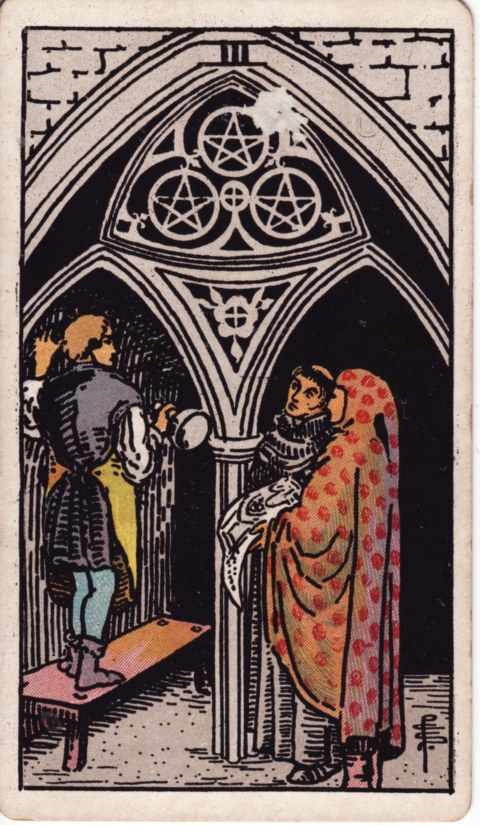
Three of Pentacles upright: whose work is on show?
Upright, the Three of Pentacles is about craft that someone else can see. Waite's picture text is a single scene: "A sculptor at his work in a monastery." He ties it to the Eight of Pentacles, whose apprentice "has received his reward and is now at work in earnest." So the card is the second stage of a trade: the learner has become the one trusted with the arch. To use it this week, pick the piece of work you are proudest of and put it in front of the person whose opinion decides what happens to it.
Waite's upright list is "Métier, trade, skilled labour," and then he swerves: the card is usually regarded as one of "nobility, aristocracy, renown, glory." The two halves fit the picture if you take renown to mean the reputation of a job well done in a public building. Book T speaks of "Working and constructive force, building up, creation, erection," and in the same list, "Commencement of matters to be established later." The card names a start that will last, with the finish still ahead.
Modern pages put the weight on the other two figures. Biddy Tarot gives the keywords "Teamwork, collaboration, learning, implementation," and Tarot.com says "no one builds an empire alone." Waite names none of the watchers and Book T draws no people at all, so the team reading comes from the image alone. It is a fair one: the monk holds plans, and the maker needs them. Book T also adds an edge, "Narrow and prejudiced," a worker who knows one trade well and trusts nothing else.
Three of Pentacles reversed: poor work, or a team out of step?
Reversed, Waite is blunt: "Mediocrity, in work and otherwise, puerility, pettiness, weakness." His second list only says it "depends on neighbouring cards," so he gives no fixed reading. Biddy Tarot gives the card a different turn and lists disharmony, misalignment and working alone. The reversed card can describe work that is merely adequate, or a group that cannot agree what the arch should look like. For work this week, ask the person whose approval you need one question: what would make this done, in their words.
The two readings share a root: nobody has agreed what good looks like. Waite's "pettiness" is what a group does when it argues about small things in place of the plan, and his "puerility" is work that shows no care. The social version is a project where everyone wants the credit and nobody wants the dull part. Book T's last line, "sometimes given to seeking after impossibilities," covers a third case, a team chasing a design nobody can build.
With one card, run the finish-sentence test. Ask each person on the project, or yourself on three different days, to finish the sentence 'It is done when...' on paper. Put the answers side by side. If they agree, the reversal is probably tiredness or a dull stretch, and the card is about stamina. If they differ, the card is Waite's "pettiness": the quarrels are standing in for a plan nobody wrote, and the first step is one agreed sentence.
Wondering about a job, a promotion or a contract? The reversed card shows how the work and the team stand now, with no date and no hiring decision in it. A rival or an ex at your workplace changes nothing: the card still covers your own side of the effort. For a dispute over pay or credit, an employment lawyer or a union rep can settle that.
Is the Three of Pentacles a yes or no card?
| Position | Answer |
|---|---|
| Upright | Yes, if you do the work |
| Reversed | Not yet, agree on the plan |
Upright, the card says yes to work you are willing to do properly and to show. That covers a joint project, training or a commission; a shortcut gets a weaker yes, because the picture is slow and careful.
Reversed, not yet. Settle what the job is and who does what, then return to the question. The old texts say nothing on yes or no, so both answers are current practice.
Three of Pentacles in love and friendship: building together, meeting at work
In a relationship
For a couple the card shows two people building something with their hands: a home, a business, a plan with a date, where love looks like joint tasks done well. Divide the jobs by what each of you is good at and say so aloud, because the picture has a maker, a planner and a watcher and none of them does the others' work. Book T's "selfishness" is the warning, one partner treating the shared project as theirs alone.
Single
When you are single, it often points to meeting someone through work, study or a shared project, a place where you see how a person actually behaves. It describes a courtship that starts with a task. If you are dating, notice who shows up for the dull part of a plan, such as the move, the paperwork or the repair.
As feelings
Seen as someone else's feelings, the Three shows respect for what you do and a liking that grows from working beside you. It is a practical regard, short of a vow and short of a denial. Judge it by whether they take your work seriously, which shows in small acts more than in declarations.
Painting a friend's apartment on weekends
A friend has bought a place that needs work, and three of you have promised Saturdays. The Three of Pentacles is skill meeting other people on one job. Waite's upright list is "Métier, trade, skilled labour", so let the one who can tile do the tiling, and let the one who cannot bring lunch and hold the ladder.
Reversed, the work turns petty: who came late, who left early, who got thanked. The card blames nobody. Ask the owner what finished looks like, and set the last Saturday now, before the helpers start counting.
Reversed in love: uneven effort
Reversed, the strain is about effort. One partner does the planning and the chores and the other coasts, or the two of you are building toward different homes. Waite's "pettiness" shows up as score-keeping over small tasks. About an ex, the card covers how the two of you worked together, and leaves a return unanswered.
Three of Pentacles at work and with money
On the job, the Three is the skilled hand: a trade, a craft, a technical role, an apprenticeship that has turned into a post of trust. The card favors anything where quality shows, and a review, a portfolio, a site visit or a demonstration is where it works best.
On money, Book T gives "gain in commercial transactions" and "increase of substance." That is earned money, pay for work done.
Reversed at work, the job is done badly or in a muddle. Check the brief, the owner and the date, then fix the one that is unclear. Reversed on money, look at work you are underpricing or paying for twice, and ask what the market rate for this kind of job is.
Three of Pentacles as advice and as a person
As advice, finish one piece of work to the standard you would sign. Put your name on it and let someone qualified look at it. Nothing here says rush: a monastery arch is cut stone by stone.
Pictured as someone you know, it is the capable maker, or the one who holds the plans and sees the whole job. Imagine Tomas, a joiner in his thirties, who builds the staircase for a client and an architect, and each of the three sees something different in it. Reversed as advice, stop doing the part that is not yours, and ask the person who is meant to hold the plan to say what they expect. For work, that means a written scope before you start.
How to read the Three of Pentacles in a spread
As the only card, the Three says the question is about the quality of the work and who sees it, so show it to someone who knows. Behind you, it is the training or first job the question rests on. In the middle, a project under way. At the end, a result earned by craft, with Book T's "to be established later" as the reminder that it is a beginning.
Among neighbors, "Swords are inimical to Pentacles," says Book T, so a blade beside it brings criticism or a dispute over the job. Wands are friendly with Pentacles by Book T's own count and give the maker energy. Beside the Eight of Pentacles, the same maker appears as apprentice.
The Three of Pentacles among the Pentacles
Threes in Book T all share one sephira, Binah. The Three of Swords is "Unhappiness, sorrow, and tears," the Three of Wands is "Pride, arrogance, self-assertion," the Three of Cups is "Plenty, hospitality, eating and drinking," and this card is "Business, paid employment, commercial transaction." Binah is the third sephira, and in each suit the number brings the same kind of stage: something first made now meets the world, in sorrow, pride, feasting or trade. The Three of Pentacles is the most down to earth of the four.
Inside the Pentacles the Three comes after the Two's juggling. Book T draws two white rosebuds that "touch and surmount the topmost Pentacle," after a Two that has no roses at all. The Four then holds still. It reads as motion, then work, then keeping; that sequence is ours, and Waite does not state it.
- Ace of Pentacles
- Two of Pentacles · Harmonious Change
- Three of Pentacles · Material Works
- Four of Pentacles · Earthly Power
- Five of Pentacles · Material Trouble
- Six of Pentacles · Material Success
- Seven of Pentacles · Success Unfulfilled
- Eight of Pentacles · Prudence
- Nine of Pentacles · Material Gain
- Ten of Pentacles · Wealth
- Page of Pentacles
- Knight of Pentacles
- Queen of Pentacles
- King of Pentacles
Titles after the numbered cards are the Golden Dawn's names for them in Book T.
Symbolism of the Rider–Waite–Smith card
- The three pentacles in the arch. Smith carves three coins into the stone in a triangle. Book T asks for the same shape: "The Pentacles are arranged in an equilateral triangle." On Smith's card the coins are part of the building, which makes the arch a sign of the craft itself.
- The craftsman on the bench. Waite writes "A sculptor at his work in a monastery." Smith shows a young man standing on a bench with a mallet in hand. The bench lifts him to the work, and the picture does not say he is the master. Waite's link to the Eight says he was an apprentice once.
- The plans. A monk holds a sheet of plans and looks up at the carving. The sheet is the design, and the picture has the maker and the planner in one frame. Waite does not mention it, so the team reading is ours.
- The hooded figure. A third figure in a spotted cloak stands close to the monk, face mostly hidden. Neither Waite nor Book T names him. Modern readers call him a patron or a nobleman, which fits Waite's "nobility, aristocracy," and it is a guess.
- The rosebuds. In Book T a hand holds a rose branch, and two white buds touch the top pentacle. Smith drops the roses, but the buds explain the card's title in the old system: growth has begun and is not finished.
What the oldest sources say
“Métier, trade, skilled labour; usually, however, regarded as a card of nobility, aristocracy, renown, glory. Reversed: Mediocrity, in work and otherwise, puerility, pettiness, weakness.”
“If for a man, celebrity for his eldest son. Reversed: Depends on neighbouring cards.”
“Working and constructive force, building up, creation, erection; realization and increase of material things; gain in commercial transactions, rank; increase of substance, influence, cleverness in business, selfishness. Commencement of matters to be established later. Narrow and prejudiced. Keen in matters of gain; sometimes given to seeking after impossibilities.”
Waite wrote two lists. The main one pairs "Métier, trade, skilled labour" with "nobility, aristocracy, renown, glory," and it says the second reading is the usual one. The second list is brief: "If for a man, celebrity for his eldest son," and, reversed, "Depends on neighbouring cards." The reversed main list, "Mediocrity, in work and otherwise, puerility, pettiness, weakness," is the darkest thing he says about the card. He pairs fame with weakness without saying how they connect.
In Book T this is the Lord of Material Works, and the text draws no craftsman, only a hand, a rose branch and three coins in a triangle. Its list mixes "Working and constructive force" with "selfishness," "Narrow and prejudiced" and "sometimes given to seeking after impossibilities." The old card is a strong worker with a narrow view. All three modern pages read teamwork.
Three of Pentacles and Mars in Capricorn: the card's decan
| Suit and element | Pentacles, Earth (Major Arcana card of earth: The World) |
|---|---|
| Decan | 10° to 20° ♑︎ Capricorn, the second ten degrees of the sign |
| Planet of the decan | Mars (Major Arcana: The Tower) |
| Major Arcana card of Capricorn | The Devil |
| Golden Dawn title | The Lord of Material Works |
| Place on the Tree of Life | Binah (Book T: “Business, paid employment, commercial transaction”) |
Attributions from Book T (Golden Dawn, c. 1892; printed 1912).
The middle ten degrees of Capricorn, 10° to 20°, belong to the Three of Pentacles in Book T. Mars is the ruler here, and in the Golden Dawn text this stretch is the Lord of Material Works. Capricorn is earth, the suit's own element. In the Major Arcana, Capricorn is The Devil, Mars is The Tower and earth is The World. By tradition Mars is exalted in Capricorn, where the planet of drive works under a sign that builds, and that matches a card of constructive force.
Book T's Queen of Pentacles zone, which starts in late Sagittarius, ends in this decan. The Two of Pentacles takes Capricorn's first ten degrees and the Four its last ten. The Sun passes this decan around the turn of the year, which gives the card a calendar of its own: the week when many people start a new plan, a new job or a resolution.
When the Sun is in the Three of Pentacles stretch
| Year | Sun enters 10° | Sun leaves (reaches 20° Capricorn) |
|---|---|---|
| 2026 | Dec 31 | Jan 10 |
| 2027 | Dec 31 | Jan 10 |
| 2028 | Dec 30 | Jan 9 |
| 2029 | Dec 31 | Jan 10 |
This year the Sun crosses the Three of Pentacles stretch of the zodiac (10° to 20° Capricorn) from December 31, 2026 to January 10, 2027 (US Eastern dates).
Dates are US Eastern, from the astronomy-engine ephemeris. Across 35,064 dates from 1930 to 2025, the Sun is in this stretch on 2.7% of them, and at least one of the ten planets is on 25.7%.
The next pass is December 31, 2026 to January 10, 2027, two months from this page, then December 31, 2027 to January 10, 2028. Pluto stood in this decan from January 2013 to December 2018, with breaks, and Saturn from December 2018 to December 2019, with a short break. Uranus was here in 1991 to 1993 and Neptune in 1988 to 1993. Jupiter passes from January 1, 2032 to mid-February 2032, and Saturn returns in 2048 to 2049, by our ephemeris. These are only positions in the sky, and they forecast nothing.
Is the Three of Pentacles in your birth chart?
Enter your birth date. We show which of the ten planets stood between 10° and 20° Capricorn that day, the slice of sky Book T gives this card; add the time if a planet was near the edge.
Enter your birth date above to see your result.
Every planet, angle and house from your birth time: birth chart calculator.
Questions about the Three of Pentacles
Is the Three of Pentacles a lucky draw?
Mostly, yes. In Waite's words it is a card of "renown, glory," and it describes work done well. Reversed, his list turns to "Mediocrity" and "pettiness," so the card is only as good as the effort behind it.
How does the Three of Pentacles read as someone's feelings?
Respect and liking that grows from working side by side. Reversed, the person may feel their effort goes unseen, or may be giving less than they say.
Is the answer to a question yes with the Three of Pentacles?
Upright, yes for work you will do properly; reversed, wait. This is a modern rule of thumb with no old text behind it.
Which sign does the Three of Pentacles belong to?
Capricorn, between 10° and 20°, with Mars in charge. The Sun passes through from about December 31 to January 10.
When will the job offer come?
The card cannot supply a date. Marking December 31 to January 10 is only a calendar convention. What you control is the work you show and the person you show it to.
Does the Three of Pentacles mean teamwork?
The modern pages say so, and the picture supports it with a maker, a planner and a watcher. Waite's text describes a lone sculptor and a card of renown, so teamwork is the later reading.
Is the Three of Pentacles a sign of a new job?
It can fit a start in paid work, since Book T's short title is "Business, paid employment, commercial transaction." It does not say a job is coming. It describes skilled work that is seen and paid for.
Sources
- Astronomy Engine: the open-source ephemeris library behind our planet positions, dates and statistics
- A. E. Waite, The Pictorial Key to the Tarot (1911), Wikisource: the divinatory meanings we quote, upright and reversed
- Book T (Golden Dawn), as printed in The Equinox I:8, 1912: the zodiac sign, Hebrew letter, title and short meaning of each card
- Wikimedia Commons: Rider–Waite–Smith tarot deck: Pamela Colman Smith's 1910 card drawings, public domain
- How we create our readings: our own calculation of sign dates, positions and the 1930 to 2025 statistics
Next to the Three of Pentacles
In the suit of Pentacles: Two of Pentacles ← Three of Pentacles → Four of Pentacles.
Capricorn on this site: Capricorn zodiac sign · The Devil, the card of Capricorn · your full birth chart.
All 22 Major Arcana with their signs and planets, and the minor cards written so far: tarot card meanings.
Written by The Zodiac Atlas editorial team with the help of AI and edited by a person. Quotations are from Waite's Pictorial Key to the Tarot and the Golden Dawn's Book T, both in the public domain; the card picture is a 1910 printing of Pamela Colman Smith's drawing for the 1909 deck. Sun dates and planet positions come from the astronomy-engine ephemeris (tropical zodiac). Tarot and astrology are symbolic traditions; they do not predict events.