Knight of Pentacles: a good card, or just slow?
Is the Knight of Pentacles a good card? Yes, with a speed warning. Waite's list is made of dependable virtues: "Utility, serviceableness, interest, responsibility, rectitude," and then the qualifier "all on the normal and external plane." None of it is glamorous. It describes the person who turns up, does the whole job and checks it twice.
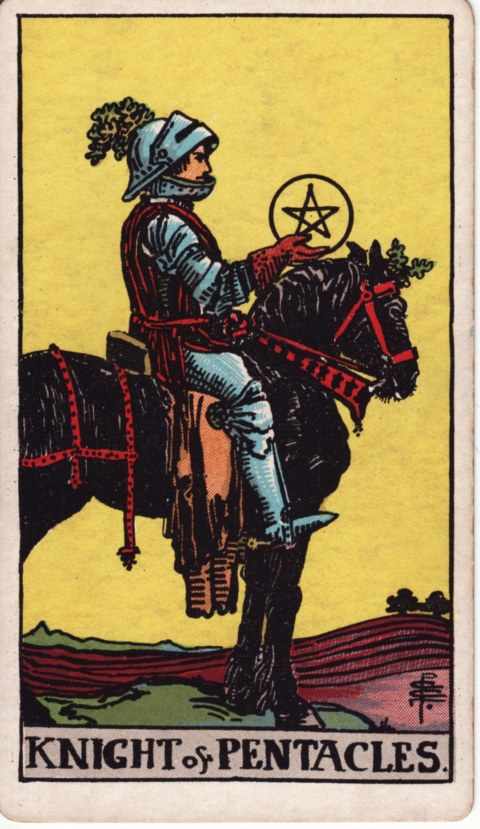
Of the four knights he is the one who does not gallop. Labyrinthos puts it this way: "Unlike the other knights, who are always off on one adventure or another, this knight decides to stay home, and instead, focus on tilling the fields." Biddy Tarot adds, "He is in no hurry, preferring to assess and plan his path ahead before taking action." The picture is a project in its middle, past the idea and short of any result, where the only thing that works is more of the same, done well.
What the card asks for is patience with a plan you already have. It praises the finish more than the start. Expect weeks of effort rather than a turn of luck, and expect the field behind him to stay bare for a while: it is plowed, and nothing is up yet. If the question is "when," the picture says later than you would like.
Knight of Pentacles reversed: stuck, or working too hard?
Reversed, the Knight of Pentacles splits into opposite problems, and the first job is to tell which one you have. Waite lists "inertia, idleness, repose of that kind, stagnation; also placidity, discouragement, carelessness." That is the stuck side, where the horse never starts. Labyrinthos runs its reversed keywords from "workaholic, laziness, dull, boring" to risky investments, so the same card can also mean too much of the same grind.
A third version is perfectionism. Biddy Tarot warns that the reversed knight may mean you are "becoming a perfectionist in how you approach your work": the plow turns the same furrow again because nothing is yet good enough to show. A further reversed line from Waite's second list, "A brave man out of employment," has a modern ring. Skill and willingness are there, and there is nowhere to use them.
A one-card test takes twenty minutes. Pick the single task you have been putting off longest and work on it today with a timer set for twenty minutes. If it starts easily and you are done before the timer, the card was about routine fatigue, and the fix is to change how you do the work. If you find three other jobs to do first, the card was about avoidance, and the fix is to shrink the task until it is embarrassingly small. If you can hardly stop at twenty minutes and feel guilty when you do, the card is pointing at the other pole, over-work.
Reversed, this card turns up a lot beside "Will I get the job?" and "Will the money arrive?" It cannot answer either. What it shows is the state of your own effort: stalled, stiff or overdone. An employer's decision or a payment date is outside the picture, so use the card to check your own application, invoice or follow-up, and leave the other side's answer to the other side.
Is the Knight of Pentacles a yes or no card?
| Position | Answer |
|---|---|
| Upright | Yes, slowly |
| Reversed | Not yet |
Yes and no are a habit of today's readers; the 1910 book and Book T have nothing of the kind. By that habit, the upright Knight of Pentacles says yes, slowly: yes if the thing can be earned by steady effort, no if you need it by Friday.
Reversed, read it as "not yet." Either the effort is missing or it is the wrong size. Correct the pace, then ask again.
Knight of Pentacles in love and friendship: loyal or boring?
In a relationship
In a settled relationship the card is the partner who shows love by fixing the tap and remembering the insurance renewal. Waite's word "rectitude" fits: promises are kept. The cost is little spontaneity. If you want a surprise, say so aloud, and expect it to arrive scheduled.
Single
For a single person the opening tends to be someone you see every week: a colleague, a neighbor, a person from the same course. Interest grows by repetition. This knight will not ride up to you, so give a month of ordinary contact before you decide what it is.
As feelings
Read as the other person's feeling, the card is serious, steady and slow to speak. They show it through acts: they turn up, they remember, they make plans with you in them. Words come late, so judge by the plans. Slow can still mean interested, though a person who never reaches a plan after months may be comfortable rather than committed. The card shows steadiness without saying what it is aimed at.
A dependable friend with a truck
Every group has the one who arrives on time with the truck, the toolbox or the casserole. Waite's list for the Knight includes "serviceableness," the right word: he is useful, and nobody thinks to ask what he needs back. He is slow to speak and quick to show up.
Reversed, Waite's list gives inertia and stagnation. The friendship runs on autopilot, and you meet only when something has to be moved. Invite him to something with no task in it, a meal or a game, and ask how he is before anything else comes up.
Reversed: stale or stalled?
Reversed in love, the card means one of two things. Either the relationship has settled into a rut, or one partner is buried in work and the other gets the leftovers. Labyrinthos reads the dull-and-neglected pair that way. A third case is the slow person who never moves toward commitment. For the first two, put one evening a week in the diary that is not a chore. For the third, ask a plain question about where this is going.
Knight of Pentacles at work and with money
This is one of the best work cards in the deck for jobs that reward care: bookkeeping, farming, building, maintenance, research, anything with a long list of small correct steps. Book T's line fits: "Laborious, clever, and patient in material matters." For money, it means slow accumulation and a budget that is kept, without windfalls. Waite's extra line, "An useful man; useful discoveries," says the same in fewer words.
Pulled reversed, the card asks you to look at the job from both ends and ask whether you are putting in too little or too much. One side is the stalled project, the missed deadline, the savings plan dropped after two weeks. The other is the ledger with no weekend in it. On money, Labyrinthos lists impulsive and risky spending for the reversed card, and a budget that is rewritten every month but never followed belongs on that list too.
Knight of Pentacles as advice and as a person
As advice, the card says finish what is open. Pick the commitment that is furthest along and give it the hours before you start anything else. Skip new tools and new systems, and be dull on purpose for a few weeks.
Imagine a bookkeeper, Marta, who has done one client's accounts on the fifth of every month for nine years, never late, never asked for a raise. That is the upright knight. When she is offered a second client and says "let me think about it" for six months, that is the reversed one.
Turned upside down, the advice is to change the pace and leave the plan alone. If you have been idle, start with twenty fixed minutes a day. If you have been grinding, put a stop time in the calendar and keep it.
How to read the Knight of Pentacles in a spread
Sitting in the past, the card marks a long stretch of dutiful work that built what you have now. Placed in the present, the knight says you are mid-task and the job is to continue. As an outcome it promises results through patience, and promises them late.
Neighbors change this knight in Book T, and one rule bears on him directly: "Swords are inimical to Pentacles." Swords nearby bring deadlines, quarrels or a sharper voice into slow work. Wands, listed in Book T as friends of Pentacles, add energy without breaking his pace. More Pentacles beside him deepen the grind, for better or worse.
Next to the Ace of Pentacles, a new opportunity meets someone willing to build it. Next to the Four of Pentacles, steadiness shades into holding on. Next to the Knight of Swords, a slow rider and a fast one disagree about pace, and the question becomes whose pace the project needs.
The Knight of Pentacles among the Pentacles
Inside Pentacles, the Knight sits where the suit turns from learning to labor. By our framing, the Page studies the coin, the Knight works with it and the Queen keeps it. His zone in Book T also holds the working and reaping stretch of the numbered cards: the Eight of Pentacles, "Prudence," and the Nine, "Material Gain." The Ten, where Book T says "nothing beyond," lies past his border.
Book T's elemental titles give the suit court a pattern: Fire of Earth for him, Water of Earth for the Queen, Air of Earth for the King, Earth of Earth for the Page. He is the spark inside the ground, an odd job for the slowest rider in the deck. Read that way, his slowness is a choice.
- Ace of Pentacles
- Two of Pentacles · Harmonious Change
- Three of Pentacles · Material Works
- Four of Pentacles · Earthly Power
- Five of Pentacles · Material Trouble
- Six of Pentacles · Material Success
- Seven of Pentacles · Success Unfulfilled
- Eight of Pentacles · Prudence
- Nine of Pentacles · Material Gain
- Ten of Pentacles · Wealth
- Page of Pentacles
- Knight of Pentacles
- Queen of Pentacles
- King of Pentacles
Titles after the numbered cards are the Golden Dawn's names for them in Book T.
Symbolism of the Rider–Waite–Smith card
- The pentacle he looks at. Waite says he "exhibits his symbol, but does not look therein." In Pamela Colman Smith's painting his head is turned to the pentacle and he plainly looks at it. We cannot tell whether Waite meant a different drawing or was writing loosely. What the printed card shows is a man examining his work.
- The horse that stands still. Waite calls it "a slow, enduring, heavy horse." The black horse is built like a farm animal and stands with its front hooves planted. Of the four knights, he is the only one at rest.
- Green leaves on helmet and horse's head. Leaves crown both knight and horse, so the rider and the animal wear the same crop. Our reading: the work and the worker are of one piece.
- The plowed field. Behind him lie furrowed fields under a yellow sky. Book T draws a different ground, "fertile land with ripened corn," so its crop is already standing. In the Smith picture the soil is turned and nothing is up yet, which is the stage of the job the card is about.
What the oldest sources say
“Utility, serviceableness, interest, responsibility, rectitude—all on the normal and external plane. Reversed: inertia, idleness, repose of that kind, stagnation; also placidity, discouragement, carelessness.”
“An useful man; useful discoveries. Reversed: A brave man out of employment.”
Waite gives the Knight of Pentacles one list of virtues and one of faults, and the faults are mostly about rest: "inertia, idleness" and "stagnation," plus "placidity." His picture text carries a quirk: "He exhibits his symbol, but does not look therein," while the Smith painting printed with the book shows the opposite. Modern pages such as Biddy Tarot describe him "carefully looking" at the coin, going by the picture rather than the book. The §4 lines are blunt: "An useful man; useful discoveries" and, reversed, "A brave man out of employment."
Book T's heading for him is "The Lord of the Wide and Fertile Land: the King of the Spirits of Earth," a dark winged warrior with a sceptre and a pentacle. Its praise comes with a condition: "Unless very well dignified he is heavy, dull, and material." Modern sites present the hard worker without that clause. Book T also calls him "not very courageous" when ill dignified, where Waite's §4 has "A brave man." The two sources disagree on his nerve, and the picture settles nothing.
Knight of Pentacles in the zodiac: Leo to Virgo
| Suit and element | Pentacles, Earth (Major Arcana card of earth: The World) |
|---|---|
| Part of the zodiac | 20° Leo to 20° Virgo |
| Book T | Fire of Earth |
Attributions from Book T (Golden Dawn, c. 1892; printed 1912).
A court card has no decan in Book T. It has a stretch of sky instead, and the Knight of Pentacles "Rules from above 20 Degree of Leo to 20 Degree of Virgo." The book labels him Fire of Earth and closes the entry with "King of Gnomes." The stretch starts in a fire sign and ends in an earth sign. Among the Major Arcana, Strength goes with Leo, The Hermit with Virgo, and The World with the element earth.
Counting by the decan list in Book T, three numbered cards fall inside the stretch (the tally is ours). The end of Leo holds the Seven of Wands, "Lord of Valour," under Mars. The start of Virgo holds the Eight of Pentacles, "Lord of Prudence," under the Sun, and the next ten degrees hold the Nine of Pentacles, "Lord of Material Gain," under Venus. Nerve, then care, then payoff is a tidy order for a knight called Fire of Earth. Book T draws no such line; the tidiness is our observation.
When the Sun is in the Knight of Pentacles stretch
| Year | Sun enters 20° Leo | Sun leaves (reaches 20° Virgo) |
|---|---|---|
| 2026 | Aug 12 | Sep 12 |
| 2027 | Aug 12 | Sep 12 |
| 2028 | Aug 12 | Sep 12 |
| 2029 | Aug 12 | Sep 12 |
This year the Sun crossed the Knight of Pentacles stretch of the zodiac (20° Leo to 20° Virgo) from August 12 to September 12, 2026. Next time: August 12 to September 12, 2027 (US Eastern dates).
Dates are US Eastern, from the astronomy-engine ephemeris. Across 35,064 dates from 1930 to 2025, the Sun is in this stretch on 8.5% of them, and at least one of the ten planets is on 56.7%.
Sun dates for the stretch run from about August 12 to September 12. A month-wide window is a weak link to any one birthday, so the card works better as a note on a chart than as a label for a person. By our calculation Jupiter moved in on October 5, 2026, stays to late February 2027 and comes back at points through 2028. Saturn was here between 2006 and 2009.
Is the Knight of Pentacles in your birth chart?
Enter your birth date. We show which of the ten planets stood between 20° Leo and 20° Virgo that day, the slice of sky Book T gives this card; add the time if a planet was near the edge.
Enter your birth date above to see your result.
Every planet, angle and house from your birth time: birth chart calculator.
Questions about the Knight of Pentacles
Is the Knight of Pentacles a good card?
For steady, patient effort, yes. Waite lists "responsibility, rectitude." The cost is speed: this knight does not gallop, and Book T says he is "heavy, dull" unless well dignified.
What does the Knight of Pentacles say about someone's feelings?
Steady, serious feeling that shows in actions more than words. They turn up, remember and plan with you in mind. Reversed, it can mean a person who is comfortable but not moving toward commitment.
Who is the Knight of Pentacles as a person?
A reliable, methodical, patient person who does the work properly and dislikes being rushed. At their worst, per Book T, they are avaricious, grasping and dull.
Is the Knight of Pentacles slow?
Yes, deliberately. The horse stands still in the picture, and Waite calls it "slow, enduring, heavy." Slow in this card means thorough, and work goes on all the while.
Is the Knight of Pentacles yes or no?
Yes, slowly, if the outcome depends on steady effort. Reversed, it means not yet. Yes-or-no readings are a modern layer that the old books lack.
Which sign does the Knight of Pentacles go with?
Late Leo into Virgo. Book T has him ruling the sky between those two points and names him Fire of Earth; mid-August to mid-September the Sun passes there.
How soon does the Knight of Pentacles pay off?
Slowly, and the card keeps no calendar. The picture shows a plowed field and a patient rider, with nothing up yet. Dates for the Sun in his stretch are only a convention.
Sources
- Astronomy Engine: the open-source ephemeris library behind our planet positions, dates and statistics
- A. E. Waite, The Pictorial Key to the Tarot (1911), Wikisource: the divinatory meanings we quote, upright and reversed
- Book T (Golden Dawn), as printed in The Equinox I:8, 1912: the zodiac sign, Hebrew letter, title and short meaning of each card
- Wikimedia Commons: Rider–Waite–Smith tarot deck: Pamela Colman Smith's 1910 card drawings, public domain
- How we create our readings: our own calculation of sign dates, positions and the 1930 to 2025 statistics
Next to the Knight of Pentacles
In the suit of Pentacles: Page of Pentacles ← Knight of Pentacles → Queen of Pentacles.
Leo on this site: Leo zodiac sign · Strength, the card of Leo · your full birth chart.
All 22 Major Arcana with their signs and planets, and the minor cards written so far: tarot card meanings.
Written by The Zodiac Atlas editorial team with the help of AI and edited by a person. Quotations are from Waite's Pictorial Key to the Tarot and the Golden Dawn's Book T, both in the public domain; the card picture is a 1910 printing of Pamela Colman Smith's drawing for the 1909 deck. Sun dates and planet positions come from the astronomy-engine ephemeris (tropical zodiac). Tarot and astrology are symbolic traditions; they do not predict events.