Seven of Pentacles: patience, or work with no harvest?
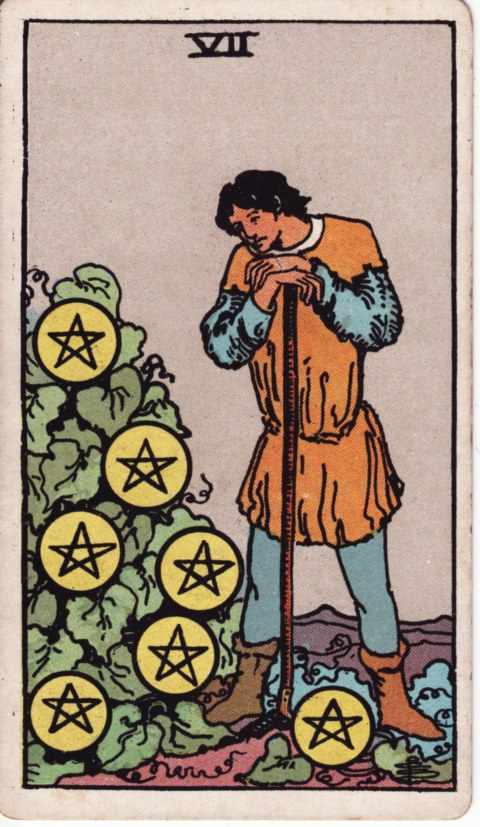
Waite's picture is quiet: "A young man, leaning on his staff, looks intently at seven pentacles attached to a clump of greenery on his right; one would say that these were his treasures and that his heart was there." Nothing is being picked, and the man is looking. Biddy Tarot reads that as "an invitation to step back from the day-to-day operations and look at the bigger picture." This week, put the project, the savings plan or the course on a single page, write what it has produced so far in numbers, and decide whether the next month gets the same effort.
Book T reads the card more darkly than the blogs. It calls the card "Promises of success unfulfilled," and explains in a bracket that this is "Shewn, as it were, by the fact that the rosebuds do not come to anything." The list goes on to "A cultivator of land, and yet a loser thereby." So the old text sees a farmer who worked and did not get what the promise suggested. The modern reading of patience is a softer version of the same scene.
Look at the picture the way a farmer would: the bush is full, and one coin has fallen already. The question is whether the crop is worth the field, and an honest answer may be yes, or it may be that you should sell now and plant something else.
Seven of Pentacles reversed: quit, or lend nothing?
Reversed, Waite gives two different things. In the main list, the reversed card is "Cause for anxiety regarding money which it may be proposed to lend." His additional meanings add "Impatience, apprehension, suspicion." The first is a precise warning that someone may ask you for money, and the second is a mood. Labyrinthos lists "unfinished work, procrastination, low effort, waste" among the keywords. This week, if anyone has asked you for a loan or an investment, put the request in writing before you answer, with the amount, the date and what happens if it is not repaid.
So the reversed card has a cautious side and an exhausted side. The cautious side is sensible: you spot a bad bet early and refuse it. The exhausted side is the one who has dug for months, sees no fruit, and starts suspecting everyone. Waite's "suspicion" belongs to that second case, and it can get in the way of a good plan as easily as a bad one.
A one-card test: finish the sentence "If I stopped today, I would lose ___." Fill it with an amount, a number of hours and a name. If the blank comes out small and the future payoff cannot be described in a sentence, the card leans toward cutting the loss. If the blank is large and you can state exactly what the next stage yields and by when, keep going and write a date to review it. If you cannot fill the blank at all, that is the sign you have not been counting.
If you asked whether the investment, the promotion, the book deal or the exam result will pay off is beyond the card. What it shows is how you hold the waiting, and nothing about a dated outcome. For a loan or investment of real size, take it to a licensed adviser.
Is the Seven of Pentacles a yes or no card?
| Position | Answer |
|---|---|
| Upright | Wait, count first |
| Reversed | Not on those terms |
Upright, the Seven of Pentacles answers wait. Asked whether to quit, sell or call it a success, the card says to look at the numbers first. Tarot.com is firmer still and answers no for the upright card.
Reversed, it reads as not on those terms, especially for a loan. No old source wrote a verdict; both answers are present-day practice.
Seven of Pentacles in love and friendship: is the effort growing anything?
In a relationship
The picture fits a long relationship that has taken years of work, in which one of you stops to ask what it has produced. Labyrinthos writes that the card is a reminder that love is also "partners putting in the work every day." A useful move is to name one thing the effort has grown and one thing it has not, and to say both aloud to each other.
Single
Single, you may find the card describes a slow friendship or a long search. The man does not chase; he looks. Ask whether the effort you put into dating has a shape, such as a weekly plan, or whether you are standing at the same bush waiting for it to change.
As feelings
As someone's feelings, it suggests they are weighing the connection. That is neither rejection nor commitment: the person is thinking, and nothing on it hints at the answer.
Years of effort, little back from an old friend
You have texted first, visited and sent the birthday gifts for years, and now you stand over the plant wondering what it grew. Book T's gloss for the Seven of Pentacles is "little gain for much labour," a fair summary of a friendship where only one person waters. Upright, the pause is honest accounting, not a verdict.
Reversed, Waite gives "Impatience, apprehension, suspicion," and every slow reply starts to look like proof. Take one month and stop being the one who starts. Notice what comes to you, then decide based on what actually happened.
Reversed in love: waiting that has gone sour
Turned upside down, it can show frustration after years of effort, or a sense that you have invested more than you got back. Waite's "Impatience, apprehension, suspicion" is a good description of that mood. On the question of an ex returning, it speaks only to how you feel about the waiting. Ask whether you are tending something real, or only guarding a field because you planted it.
Seven of Pentacles at work and with money
At work the Seven is the card of the long project, the slow promotion, the business whose first year has ended with little to show. Waite's §2 says that "in the main, it is a card of money, business, barter." The practical response is a review: list outputs, hours and income, and compare month to month. A hoe is for weeding, so cut the tasks that feed nothing.
On money, the card fits savings, a pension, a small investment or a side business that needs years. Book T's "slight and isolated gains with no fruits resulting therefrom" is the cautious reading, and the patient reading in the modern guides is the hopeful one. Compare what you put in against what has come out, and write down the date at which you will decide again.
Reversed at work, you may be pouring effort into the wrong task, or someone may propose a deal that asks for your money. Check the numbers before you say yes. Reversed on money, Waite's lending warning applies first: be slow to lend, be slow to co-sign, and never stake money whose loss would hurt you.
Seven of Pentacles as advice and as a person
As advice, stop and count. Put the tools down for an hour, look at the field, and write what has grown. Then decide whether to water, to move, or to harvest what is ready.
As a figure in a story, it is the patient worker who is tired and suspects the effort is not paying. Our invented example: Tomas has spent three years building a small online shop and made little, and one evening he adds up the sales and the hours. He finds that one product line brings in most of the income, and he drops the rest. Reversed as advice, do not let tiredness make the decision. Wait a night, and if someone is asking for a loan, say that you will answer in writing.
How to read the Seven of Pentacles in a spread
Alone, the Seven of Pentacles says you have work in the ground and a decision about it to make. Name the work, name what it has produced, and set a date to look again.
Behind you, it marks effort whose results you are still judging. In the present slot, you are mid-crop. As an outcome, it suggests a modest return that may need more time or may not justify the field. A Sword close by can bring a dispute over the money, since the dignity rules call Swords "inimical to Pentacles," a fit for a quarrel over money. A Wand next to it supplies the push to keep going. The Six in the suit is the exchange that began the matter; the Eight that follows has no page here yet.
The Seven of Pentacles among the Pentacles
Here is the one place where the Six and Seven of Pentacles can be set side by side in Book T. On the Six, the rose branch has buds "each of which touches a Pentacle." On the Seven, "There are only five buds, which overhang, but do not touch the five uppermost Pentacles." That small gap in the drawing is how the old text shows success turning into promise. Book T draws a hand and a branch and no people on either card, so the farmer with the hoe belongs to Smith's version.
In the suit, the Seven also moves from Material Success to a card Book T names for its disappointments, "Success Unfulfilled," and its short gloss is "Unprofitable speculations and employments; little gain for much labour." The Six is at Tiphareth and the Seven is at Netzach. The Six of Pentacles has its own page on this site.
- Ace of Pentacles
- Two of Pentacles · Harmonious Change
- Three of Pentacles · Material Works
- Four of Pentacles · Earthly Power
- Five of Pentacles · Material Trouble
- Six of Pentacles · Material Success
- Seven of Pentacles · Success Unfulfilled
- Eight of Pentacles · Prudence
- Nine of Pentacles · Material Gain
- Ten of Pentacles · Wealth
- Page of Pentacles
- Knight of Pentacles
- Queen of Pentacles
- King of Pentacles
Titles after the numbered cards are the Golden Dawn's names for them in Book T.
Symbolism of the Rider–Waite–Smith card
- The hoe. He rests his chin on his hands on a long hoe. Waite says "leaning on his staff." A hoe is a weeding tool, so the pose reads as a break in the middle of the work, with the end still ahead.
- The bush with six pentacles. Six gold coins sit among the leaves like fruit. Waite says seven pentacles "attached to a clump of greenery." The bush looks full, so the crop seems promising from where he stands.
- The seventh pentacle on the ground. One coin lies by his foot, outside the bush. Waite does not single it out. We read it as the part already fallen or already harvested, and it is the detail that makes the card about counting.
- His look. Waite says he "looks intently," and "one would say that these were his treasures and that his heart was there." His head rests on his hands, and the expression is tired and watchful.
- Rubeus, in Book T. Book T arranges the seven pentacles "like the geomantic figure Rubeus." Geomancy is an old method of divination with patterns of dots, and Rubeus is one of its figures. Book T does not explain it further.
What the oldest sources say
“These are exceedingly contradictory; in the main, it is a card of money, business, barter; but one reading gives altercation, quarrel—and another innocence, ingenuity, purgation. Reversed: Cause for anxiety regarding money which it may be proposed to lend.”
“Improved position for a lady's future husband. Reversed: Impatience, apprehension, suspicion.”
“Promises of success unfulfilled. (Shewn, as it were, by the fact that the rosebuds do not come to anything.) Loss of apparently promising fortune. Hopes deceived and crushed. Disappointment, misery, slavery, necessity and baseness. A cultivator of land, and yet a loser thereby. Sometimes it denotes slight and isolated gains with no fruits resulting therefrom, and of no further account, though seeming to promise well.”
Waite's §2 admits his own sources are confused: "These are exceedingly contradictory; in the main, it is a card of money, business, barter; but one reading gives altercation, quarrel" and another "innocence, ingenuity, purgation." His reversed meaning is the most specific line on the card, the warning about money "which it may be proposed to lend." His additional meanings give "Improved position for a lady's future husband," which has no obvious link to the picture, and "Impatience, apprehension, suspicion" reversed, which does.
Book T is the grimmest reading here. Its title is "Lord of Success Unfulfilled." It has "Hopes deceived and crushed" and "Disappointment, misery, slavery, necessity and baseness," and then, almost as a consolation, "Sometimes it denotes slight and isolated gains," with no fruits following. The modern pages checked here start from patience and long-term investment, and none of them mentions the unfulfilled buds. Smith's hoe and bush are friendlier than Book T's drawing, and the card sits between them.
Seven of Pentacles and Saturn in Taurus: the card's decan
| Suit and element | Pentacles, Earth (Major Arcana card of earth: The World) |
|---|---|
| Decan | 20° to 30° ♉︎ Taurus, the third ten degrees of the sign |
| Planet of the decan | Saturn (Major Arcana: The World) |
| Major Arcana card of Taurus | The Hierophant |
| Golden Dawn title | The Lord of Success Unfulfilled |
| Place on the Tree of Life | Netzach (Book T: “Unprofitable speculations and employments; little gain for much labour”) |
Attributions from Book T (Golden Dawn, c. 1892; printed 1912).
Book T assigns the Seven of Pentacles to the last decan of Taurus, 20° to 30°, ruled by Saturn: "Above and below are the Decan symbols, Saturn and Taurus respectively." Taurus shares the suit's element. By tradition Saturn rules Capricorn and Aquarius, and Taurus is not among its homes, so the card's title reads as a limit placed on a sign of ripening. We draw that link; Book T does not. The trump cards are The Hierophant for Taurus and The World for both Saturn and earth.
This decan lies within the Knight of Swords' zone in Book T. The Sun was here May 10 to 20 in 2026 and will be again May 10 to 21 in 2027. Uranus entered on May 30, 2023, took two breaks, and moved on April 28, 2026, which makes its exit a spring event of this year, by our ephemeris. Saturn is next here from June 2029 to June 2030, with a break, after 1970 to 1972 and 2000 to 2001, and Neptune arrives in 2047 and stays until 2052.
When the Sun is in the Seven of Pentacles stretch
| Year | Sun enters 20° | Sun leaves (reaches 30° Taurus) |
|---|---|---|
| 2026 | May 10 | May 20 |
| 2027 | May 10 | May 21 |
| 2028 | May 9 | May 20 |
| 2029 | May 10 | May 20 |
This year the Sun crossed the Seven of Pentacles stretch of the zodiac (20° to 30° Taurus) from May 10 to May 20, 2026. Next time: May 10 to May 21, 2027 (US Eastern dates).
Dates are US Eastern, from the astronomy-engine ephemeris. Across 35,064 dates from 1930 to 2025, the Sun is in this stretch on 2.8% of them, and at least one of the ten planets is on 19.3%.
The Sun sits in this slice on 2.8 percent of dates, while some planet of the ten is inside it on roughly a fifth. One Golden Dawn scheme ties that theme to this card. Nobody should be labeled by it.
Is the Seven of Pentacles in your birth chart?
Enter your birth date. We show which of the ten planets stood between 20° and 30° Taurus that day, the slice of sky Book T gives this card; add the time if a planet was near the edge.
Enter your birth date above to see your result.
Every planet, angle and house from your birth time: birth chart calculator.
Questions about the Seven of Pentacles
Is the Seven of Pentacles lucky or unlucky?
It depends on the source. Modern guides treat it as patience. Book T calls it "Promises of success unfulfilled." Neutral is the fairest word: a pause to judge a crop.
Seven of Pentacles: what is the other person feeling?
Someone weighing the connection. It shows thought, and no verdict. Reversed, it points to impatience.
Is the Seven of Pentacles a yes?
Upright, wait and count first. Reversed, not on those terms. The old books give no verdict.
Does the Seven of Pentacles mean my investment will pay off?
No payoff is promised. It asks you to check what the effort has grown and set a date to decide again.
Where does the Seven of Pentacles sit in the zodiac?
Taurus, 20° to 30°, ruled by Saturn in Book T. Look for the Sun here around May 10 to 20.
When will the results come?
May 10 to 20 is the Sun's passage, a convention only.
What does the reversed Seven of Pentacles mean for lending money?
Waite writes "Cause for anxiety regarding money which it may be proposed to lend." Put terms in writing and lend only what you could lose.
Sources
- Astronomy Engine: the open-source ephemeris library behind our planet positions, dates and statistics
- A. E. Waite, The Pictorial Key to the Tarot (1911), Wikisource: the divinatory meanings we quote, upright and reversed
- Book T (Golden Dawn), as printed in The Equinox I:8, 1912: the zodiac sign, Hebrew letter, title and short meaning of each card
- Wikimedia Commons: Rider–Waite–Smith tarot deck: Pamela Colman Smith's 1910 card drawings, public domain
- How we create our readings: our own calculation of sign dates, positions and the 1930 to 2025 statistics
Next to the Seven of Pentacles
In the suit of Pentacles: Six of Pentacles ← Seven of Pentacles → Eight of Pentacles.
Taurus on this site: Taurus zodiac sign · The Hierophant, the card of Taurus · your full birth chart.
All 22 Major Arcana with their signs and planets, and the minor cards written so far: tarot card meanings.
Written by The Zodiac Atlas editorial team with the help of AI and edited by a person. Quotations are from Waite's Pictorial Key to the Tarot and the Golden Dawn's Book T, both in the public domain; the card picture is a 1910 printing of Pamela Colman Smith's drawing for the 1909 deck. Sun dates and planet positions come from the astronomy-engine ephemeris (tropical zodiac). Tarot and astrology are symbolic traditions; they do not predict events.