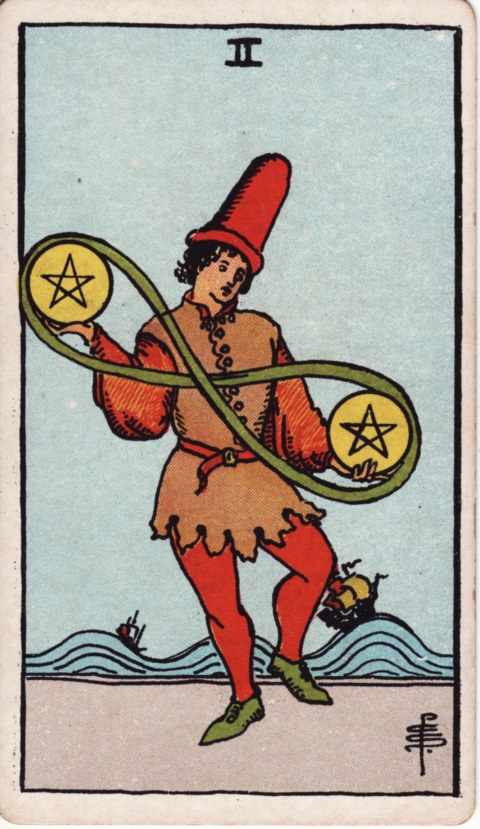
What does the Two of Pentacles mean when you are juggling it all?
Upright, the Two of Pentacles meaning is about motion. The man is dancing, and the coins stay up because he keeps moving with them. Waite puts the design first, "a card of gaiety, recreation and its connexions, which is the subject of the design," and only then adds "news and messages in writing, as obstacles, agitation, trouble, embroilment." So one card holds a light step and a pile of paperwork, and the dancer manages both.
Biddy Tarot gives the practical version: you are doing a good job of balancing roles, and "the line between coping with these demands and losing control is thin." Labyrinthos is blunter, warning that "multi-tasking may just worsen the situation" and advising you to drop to the two matters that trouble you most. That fits the picture, which has two coins and no third. A third would force the figure eight to change shape.
Book T agrees about the rhythm and is less flattering about the person. Its list runs "now elated, then melancholy; industrious, yet unreliable," and ends "Fortunate in journeying. Argumentative." The old card describes a changeable season, steady only in that it keeps turning. Use the good half: keep both coins in sight, move early, and plan for the swing in mood or money before it arrives.
Two of Pentacles reversed: overloaded, or just acting fine?
Reversed, the dance goes stiff. Waite's list opens with "Enforced gaiety, simulated enjoyment," which is the dancer putting on a show while a coin slips. The rest is paper: "handwriting, composition, letters of exchange," an old term for bills moving between hands. The card can mean cheer worn as a costume, or correspondence and debts piling up behind a good mood.
Tarot.com adds a layer the other two pages lack, saying the reversal "can also hint at avoidance, trying to do everything so you don't have to face that one thing that's haunting you." Busyness as a hiding place is a different problem from too much work, and the fix differs too: a calendar will not help someone who is dodging one phone call.
Try the drop test with one card in hand. Write the two things you are keeping in the air, one per line. Picture each hitting the floor for a full week and mark what it would cost. If one costs almost nothing, that is the coin to set down, and the card is pointing at effort spent in the wrong place. If both would cost a lot, you are holding two real jobs, and the move is to ask for help or move a deadline. If you cannot stop at two, count again; the card is a sign that the list got longer than you admitted.
If you asked about choosing between two people, two jobs or two offers, the reversed card describes the strain of keeping both options open. It does not rank them, and if one of the two is an ex, it says nothing about what they intend. What it asks is what you gain by keeping that second coin in the air.
Is the Two of Pentacles a yes or no card?
| Position | Answer |
|---|---|
| Upright | Yes, if flexible |
| Reversed | Not yet, lighten the load |
Upright, the answer is yes with a condition. Yes to adjusting, adding a second task, or trying a new arrangement while the first still runs. It does not back an all-in bet, since both coins are still airborne and nothing has landed.
Reversed, not yet. Lighten the load first, then ask again. No old text hands this card a verdict, so both answers are modern habit, to be held loosely.
Two of Pentacles in love and friendship: split time, two people, their feelings
In a relationship
The usual scene is two pulls on your time: work and family, two homes, a partner and a crowded week. The card puts the relationship in the air as one of the two coins, so give it a fixed slot instead of whatever is left over. Ask for one standing evening and protect it. A partner who hears "I'll see when I can" every week starts making plans without you. Book T's "Argumentative" is the warning: a stretched person picks fights over small things.
Single
Single, the card often shows dating squeezed in among everything else, or attention split between two people. It describes the load before it describes the match. With two options, pick one criterion in advance, such as who makes a plan with a date, and let it sort them. The picture has no third coin, so a long list of maybes is a separate problem.
As feelings
As someone's feelings, the Two of Pentacles shows real interest and a crowded week. Book T's "wavering and inconsistent" and "now elated, then melancholy" describe the pattern: close on Monday, out of reach by Wednesday. That is schedule and mood, and it says little about depth. Judge them by what they arrange, such as a plan with a date, over how they sound in the moment.
Two parties, one Saturday: friends and the Two of Pentacles
Two friends invite you out on the same night, and you want to please both. The Two of Pentacles is the dancer who keeps two coins up by moving, which here means telling each friend early and plainly. Pick one for the night and offer the other a specific different day.
Reversed, Waite's "Enforced gaiety, simulated enjoyment" fits the night you attend both, check your phone at each and are present at neither. Friends feel that. Text the friend you will miss this morning, not at six p.m., and offer a different Thursday.
Reversed in love: faking fine, or dropping the partner
Reversed in love, the dance is forced. "Simulated enjoyment" can be a date night attended on autopilot, or acting fine when the relationship is the coin that slipped. Neglect is the common form: one partner feels they come last. If an ex is the question, the card covers your own balancing act and leaves their plans out. Ask whether one of your two coins is a bond you keep half alive.
Two of Pentacles at work and with money
At work this is the card of two jobs, two bosses, or one job with a project on the side. Book T grants "everchanging occupation," which fits a role that changes shape every week. It favors people who switch tasks well. The risk is the one in Book T's own list, "industrious, yet unreliable": busy, and still missing a deadline. Put both deadlines on one list in one place.
On money, the coins are two accounts or two bills in motion, a good week followed by a lean one. Book T calls it "alternation of gain and loss." A small buffer keeps a swing from becoming a crisis. Waite's "letters of exchange" is old banking paper, so the modern habit it suggests is checking what you owe and when it is due.
Reversed at work, you are over-committed or covering with a cheerful face. Say no to the third task, or ask which of two tasks comes first. Reversed on money, line up the dates money comes in against the dates it goes out; juggling fails first at the gap between them.
Two of Pentacles as advice and as a person
As advice, keep two things in the air and keep moving. Choose the two that matter this month and write them on one card. Everything else waits or goes to someone else.
Read as a person, the card is the capable, cheerful one who is a missed alarm away from dropping a coin. Our invented example: Dana keeps the books for a firm on weekdays and runs a bread stall on Saturdays, good at both and tired by Thursday. Reversed as advice, stop performing fine. Tell one person which coin is slipping, and ask for help with that one. On a work or money question, that means asking for an extension or a second pair of eyes on the numbers.
How to read the Two of Pentacles in a spread
With one card, the Two of Pentacles says you are holding two demands and the answer lives in the rhythm, so name the two and decide which gets the next free hour. Behind you, it marks a stretch of juggling that the whole matter grew out of. In the middle of a spread it is the juggle in progress. At the end it suggests a balance held by effort, which can last or tip.
Among neighbors, a Sword is the hard one: a blade near the coins tends to cut into the balance or start a quarrel, and Book T's line for it is "Swords are inimical to Pentacles." Wands are friendly with Pentacles in the same rules and keep both coins moving. Cups put feeling between the two coins. Beside the Wheel of Fortune, the card of Jupiter, the swings get larger. With the Ace of Pentacles close by, the juggling begins from one solid start.
The Two of Pentacles among the Pentacles
In Book T the Pentacles open in Capricorn with the Two, so this card begins the suit's run of numbered cards. It is also the only numbered Pentacles card in Book T without a rose. The Ace holds a rose-tree branch, the Three has two white rosebuds, the Four has one blown rose in the center, and the Two has "No roses enter into this card."
After it, the coins settle. The Three builds, with the pentacles in a triangle, and the Four sits still on what it owns. Seen from the Two, the suit shows money in the order it usually behaves: first in motion, then worked into something, then held.
- Ace of Pentacles
- Two of Pentacles · Harmonious Change
- Three of Pentacles · Material Works
- Four of Pentacles · Earthly Power
- Five of Pentacles · Material Trouble
- Six of Pentacles · Material Success
- Seven of Pentacles · Success Unfulfilled
- Eight of Pentacles · Prudence
- Nine of Pentacles · Material Gain
- Ten of Pentacles · Wealth
- Page of Pentacles
- Knight of Pentacles
- Queen of Pentacles
- King of Pentacles
Titles after the numbered cards are the Golden Dawn's names for them in Book T.
Symbolism of the Rider–Waite–Smith card
- The tall red hat. The dancer wears a very tall red hat. Neither Waite's picture sentence nor Book T mentions it. It works as a costume piece that makes the act look slightly comic and unsteady, which suits a balancing trick.
- The figure-eight band. Waite calls it "that endless cord which is like the number 8 reversed." On Smith's card it is a green band with no head or tail. Book T draws a green-and-gold serpent that "holds its tail in its mouth," an old sign of a cycle that feeds itself.
- The two ships. Two ships ride tall waves behind him. They are not in Waite's picture sentence or in Book T, and Biddy Tarot reads them as life's ups and downs. The dancer works on level ground while the sea behind him heaves, so the unsteadiness stays outside the task.
- One foot down, one knee up. He balances on a single foot with the other knee lifted. Waite says he is "in the act of dancing." Nothing in the pose is braced, so the balance comes from moving.
- The two pentacles. Each coin carries a five-pointed star. Book T calls them "wheels, disks or pentacles" and says "It is a revolving symbol," which makes the coins turning parts of one mechanism.
What the oldest sources say
“On the one hand it is represented as a card of gaiety, recreation and its connexions, which is the subject of the design; but it is read also as news and messages in writing, as obstacles, agitation, trouble, embroilment. Reversed: Enforced gaiety, simulated enjoyment, literal sense, handwriting, composition, letters of exchange.”
“Troubles are more imaginary than real. Reversed: Bad omen, ignorance, injustice.”
“It is a revolving symbol. The harmony of change, alternation of gain and loss; weakness and strength; everchanging occupation; wandering, discontented with any fixed condition of things; now elated, then melancholy; industrious, yet unreliable; fortunate through prudence of management, yet sometimes unaccountably foolish; alternatively talkative and suspicious. Kind, yet wavering and inconsistent. Fortunate in journeying. Argumentative.”
Waite's upright list pulls two ways: gaiety on one side, "obstacles, agitation, trouble, embroilment" on the other. The short list agrees, "Troubles are more imaginary than real," which suits a dancer who treats a heavy act as play. The reversed lines are stranger. "Enforced gaiety, simulated enjoyment" follows from the picture, while "Bad omen, ignorance, injustice" in the short list has no hook in it at all. We leave that line unused and say so.
Book T draws no dancer. It describes "TWO wheels, disks or pentacles" bound by a serpent "like a figure of 8," a hand holding "the centre of the whole," and the symbols of Jupiter and Capricorn above and below. The meaning is the list quoted above, closing with Chokmah and the short phrase "Pleasant change, visit to friends." Of the three modern pages, none mentions the serpent, and only Labyrinthos touches the gaiety that Waite puts first, calling the man carefree.
Two of Pentacles and Jupiter in Capricorn: the card's decan
| Suit and element | Pentacles, Earth (Major Arcana card of earth: The World) |
|---|---|
| Decan | 0° to 10° ♑︎ Capricorn, the first ten degrees of the sign |
| Planet of the decan | Jupiter (Major Arcana: Wheel of Fortune) |
| Major Arcana card of Capricorn | The Devil |
| Golden Dawn title | The Lord of Harmonious Change |
| Place on the Tree of Life | Chokmah (Book T: “Pleasant change, visit to friends”) |
Attributions from Book T (Golden Dawn, c. 1892; printed 1912).
Book T gives the Two of Pentacles the first decan of Capricorn, 0° to 10°, ruled by Jupiter, and names it the Lord of Harmonious Change. Capricorn is an earth sign, like the suit. In traditional astrology Jupiter is in its fall in Capricorn, the sign of Saturn, where the planet of expansion sits under a cautious ruler. Book T still gives the card its pleasant title. A card of "alternation of gain and loss" suits a planet that grows things inside a sign that counts them.
The decan lies inside the zone of the Queen of Pentacles, who rules from 20° Sagittarius to 20° Capricorn. Book T's table gives all of Capricorn's Pentacles to the sign in order: change first, then works, then power. The Sun crosses this decan in the last ten days of the year, the holiday stretch, when hosting, travel and year-end bills all want attention at once. That link is our own observation about the calendar.
When the Sun is in the Two of Pentacles stretch
| Year | Sun enters 0° | Sun leaves (reaches 10° Capricorn) |
|---|---|---|
| 2026 | Dec 21 | Dec 31 |
| 2027 | Dec 21 | Dec 31 |
| 2028 | Dec 21 | Dec 30 |
| 2029 | Dec 21 | Dec 31 |
This year the Sun crosses the Two of Pentacles stretch of the zodiac (0° to 10° Capricorn) from December 21 to December 31, 2026 (US Eastern dates).
Dates are US Eastern, from the astronomy-engine ephemeris. Across 35,064 dates from 1930 to 2025, the Sun is in this stretch on 2.7% of them, and at least one of the ten planets is on 26.8%.
Jupiter itself comes back to the decan about every twelve years. The last two passes and the next fall at the turn of the year: late 2007 into early 2008, December 2019 into mid-January 2020, and mid-November 2031 to the start of 2032 by our ephemeris. Saturn was here in 1959, 1988 to 1989 and 2017 to 2018. Pluto stood here from 2008 to 2013, Uranus in 1988 to 1991 and Neptune in 1984 to 1989. Those years only record where each planet stood, and they predict nothing for the card.
Is the Two of Pentacles in your birth chart?
Enter your birth date. We show which of the ten planets stood between 0° and 10° Capricorn that day, the slice of sky Book T gives this card; add the time if a planet was near the edge.
Enter your birth date above to see your result.
Every planet, angle and house from your birth time: birth chart calculator.
Questions about the Two of Pentacles
Is the Two of Pentacles lucky or unlucky?
Neither. It is a busy card. Waite gives it gaiety and trouble in the same line, and the dancer is doing well at a hard task. It turns bad when the cheer is forced or the load grows past two.
What does the Two of Pentacles mean as feelings?
Interest on a crowded schedule. Book T's "wavering and inconsistent" fits a person whose attention comes and goes with the week. Reversed, they may be putting on a cheerful face over strain.
Is the Two of Pentacles a yes or no?
Upright, yes if you stay flexible; reversed, not yet. That pairing is a modern convention with no old source.
What zodiac sign is the Two of Pentacles?
Capricorn, the first decan (0° to 10°), with Jupiter as its planet. The Sun is in that decan from about December 21 to December 31.
When will things settle down?
A card cannot give a date. December 21 to 31 is when the Sun passes through, used here as a convention only. The drop test, putting down the coin that costs least, is the part you control.
Does the Two of Pentacles mean balancing two jobs?
It fits, and it is the common modern reading. The picture holds exactly two coins, so the card is most useful when the list really is two. A third job needs a different answer.
Does the Two of Pentacles mean choosing between two people?
It can describe the strain of keeping both options open. It does not pick one. The reversed card asks what you gain by delaying the choice.
Sources
- Astronomy Engine: the open-source ephemeris library behind our planet positions, dates and statistics
- A. E. Waite, The Pictorial Key to the Tarot (1911), Wikisource: the divinatory meanings we quote, upright and reversed
- Book T (Golden Dawn), as printed in The Equinox I:8, 1912: the zodiac sign, Hebrew letter, title and short meaning of each card
- Wikimedia Commons: Rider–Waite–Smith tarot deck: Pamela Colman Smith's 1910 card drawings, public domain
- How we create our readings: our own calculation of sign dates, positions and the 1930 to 2025 statistics
Next to the Two of Pentacles
In the suit of Pentacles: Ace of Pentacles ← Two of Pentacles → Three of Pentacles.
Capricorn on this site: Capricorn zodiac sign · The Devil, the card of Capricorn · your full birth chart.
All 22 Major Arcana with their signs and planets, and the minor cards written so far: tarot card meanings.
Written by The Zodiac Atlas editorial team with the help of AI and edited by a person. Quotations are from Waite's Pictorial Key to the Tarot and the Golden Dawn's Book T, both in the public domain; the card picture is a 1910 printing of Pamela Colman Smith's drawing for the 1909 deck. Sun dates and planet positions come from the astronomy-engine ephemeris (tropical zodiac). Tarot and astrology are symbolic traditions; they do not predict events.