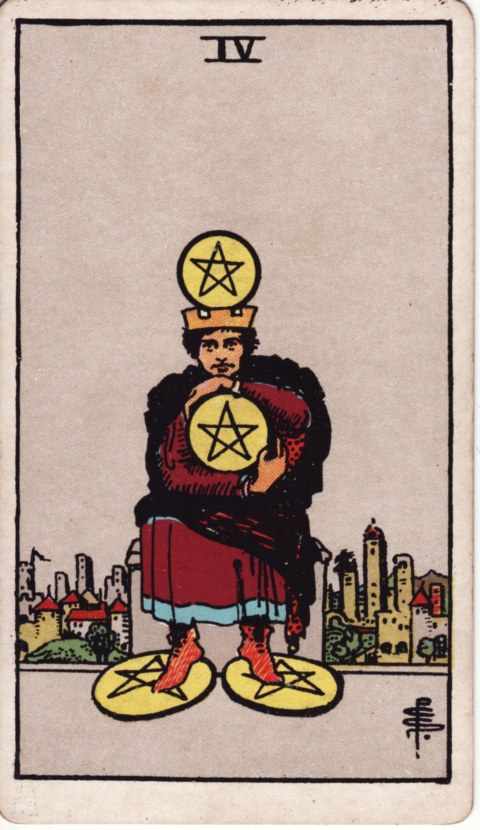
Four of Pentacles upright: saving or hoarding?
The man on this card has built something and is sitting on it. Every coin is accounted for, and none can move without him noticing. Waite compresses it into one line, "He holds to that which he has." Labyrinthos adds the cost: "To some, money does not always bring freedom," and notes that he "is restrained from acting because he is holding too tight to his possessions."
The same picture gives two readings, and they depend on why he holds. Biddy Tarot lists "Saving money, security, conservatism, scarcity, control." as the upright keywords, so a savings plan and a clenched fist both fit. The useful question is whether the holding serves a goal, such as a down payment or a cushion for a slow year, or has become the goal. Waite's own list is neutral and about property: possessions, gift, legacy, inheritance. A question about an estate, an apartment you own or a present on its way fits the card well.
Outside money the grip shows up as control. Biddy Tarot says the card appears when you want more command over your life, and at work that can look like "micromanaging or not letting others mess around with your area." A closed door is sometimes sensible, and it becomes a problem only when nothing new can get in.
Four of Pentacles reversed: letting go, or leaking?
Reversed, the Waite list is short and about time: "Suspense, delay, opposition." Modern guides shift the focus to what the hands do with money. Labyrinthos gives the reversed keywords as "generosity, giving, spending, openness, financial insecurity, reckless spending," which covers both directions at once. The grip can loosen because you finally trust that there is enough, or because control over spending has slipped.
Biddy Tarot describes the second case as "money is slipping through your fingers," with spending that brings stress instead of comfort. The first case it describes as a clear-out: "declutter your home or opt for a minimalist lifestyle." Some readers add a third, quieter one, which matches Waite: a payment, an answer or an inheritance is held up, and the card describes waiting.
To tell them apart with one card, open last month's bank statement and mark each line as kept, spent or given. If the "given" column is empty and you feel tense about it, you are still in the old grip. If the "kept" column is empty and the month ended with a surprise, read the leak. If both have entries and you can say why, the card is describing a loosening you chose.
Asking whether the money, the refund or the job offer will arrive? The reversed card gives no date or verdict. It shows how you hold your resources and what stands in the way, which tells you about your own position and nothing about anyone's decision. An ex works the same way, since the card describes your own grip.
Is the Four of Pentacles a yes or no card?
| Position | Answer |
|---|---|
| Upright | Yes to keeping, no to a leap |
| Reversed | Wait, check the numbers first |
Upright, this is a yes to keeping, saving and staying put, and a no to the leap. If you asked whether to put money in a deposit, keep the stable job or hold off on a big purchase, it leans toward holding. If you asked whether to quit and try something new, it leans against.
Reversed, the answer is wait. Something is held up or loosening too fast, so check the numbers before deciding. The yes and the no come from modern practice; the old books say nothing of either.
Is the Four of Pentacles clingy in love and friendship?
In a relationship
Between two people, the card describes something built and guarded: a shared home, routines, a family. At its best it is loyalty. At its worst it is the pattern Labyrinthos lists in its love column: "clingy lover, jealousy, feeling insecure, holding onto past." The question for a pair is whether protecting what you have has left room for either of you to breathe.
Single
Without a partner, this is usually a heart kept closed on purpose, or a past relationship still held in place. Labyrinthos names it exactly: "the dream of an ex returning to your life." Before you make room for a new person, the card asks you to notice what you are still carrying.
As feelings
Read as another person's feelings, it is attachment with a lock on it. Labyrinthos reads "a need for stability that often masks their fear of loss or vulnerability." Such a person may value you highly and still say little, or may be possessive. The card shows a state of guarding and gives no hint of what they will do with it.
When an old friend resents your new friends
You make plans with someone new and an old friend goes stiff: fine, have fun. The Four of Pentacles holds on to what it has. Upright, that is loyalty. The friend may value you more than they can say. Labyrinthos reads "a need for stability that often masks their fear of loss or vulnerability", which is a fair guess at the stiffness, and only a guess.
Reversed, the grip loosens, or tightens into sulking and tallying. You may be the one who grips, and then the card is about you. Invite the friend along once to something with the others. Fix one evening a month that is only theirs.
Reversed in love
Reversed in a love question, the card can mean a person starting to relax their guard. Labyrinthos describes someone "beginning to let go of their fears around vulnerability and possessiveness." The opposite is also possible: giving so much that nothing is left for yourself. Check which one is true before you read it as good news.
Four of Pentacles at work and with money
At work the card is a stable position and the wish to keep it. It fits a person who has a steady salary, a pension plan or a corner of the office that is theirs. It warns against guarding it too closely: sharing credit, knowledge and tasks is how a position grows. Labyrinthos notes that in a work spread it can mean staying in a stable but unfulfilling job just for the pay.
With money the card is simply savings. Biddy Tarot suggests "a savings plan, family budget, a retirement plan, and safe investments." That is ordinary prudence, and a professional can check the numbers. If it came up reversed in a work or money question, look for delay first (a payment held up, a raise postponed, in Waite's words "Suspense, delay, opposition") and then for spending that has stopped being deliberate.
Four of Pentacles as advice and as a person
For advice, protect what is truly needed and stop guarding the rest. List what you would defend in a crisis and what you only keep out of habit. Then spend a small, deliberate sum on something from the second list, and see what happens to the fear.
As a person, think of an imaginary shopkeeper named Ivan who has run the same stationery shop for thirty years. He pays his suppliers early, keeps a reserve for two bad winters, and has never once let anyone borrow a till key. People call him tight. He calls it keeping the lights on. Reversed, the advice is to find out whether a delay is yours or the other side's, and to look at your spending before you blame the delay.
How to read the Four of Pentacles in a spread
Placed in the past, it marks a security you built, or an old habit of holding on. Placed in the present, it names something you are guarding now. In an outcome position it gives stability, and with it a ceiling. Book T's own phrase for the card is "completed but leading to nothing beyond," so read it as a warning against stopping at the first safe place.
Neighbors change the tone. In the dignity rules a Sword beside it is the enemy ("Swords are inimical to Pentacles"), which reads as a sharp challenge to the hoard: a dispute over money, a loss, a sudden bill. A Wands card is an ally under the same rules and reads as energy that gets the money moving. Another Pentacles card beside it strengthens the matter and keeps it practical.
Next to the Three of Pentacles, which Book T calls the Lord of Material Works, the Four is the result of work done. Next to the Five of Pentacles, called the Lord of Material Trouble, it is the fear that the security can go. Beside The Devil, the trump Book T pairs with Capricorn, the hold becomes a bond.
The Four of Pentacles among the Pentacles
Book T puts the Four of Pentacles between Material Works and Material Trouble. The Three is the work, the Four is what the work has secured, and the Five is the trouble that follows. Read in order, the three cards trace building, holding and losing, a story Book T does not spell out.
The Four also sits at Chesed in Book T's Tree of Life scheme, with the short gloss "Gain of money or influence: a present." That echoes Waite's "gift, legacy, inheritance." It is a mild card in its own suit: the other Pentacles go on to work, loss and mastery, and this one only settles.
- Ace of Pentacles
- Two of Pentacles · Harmonious Change
- Three of Pentacles · Material Works
- Four of Pentacles · Earthly Power
- Five of Pentacles · Material Trouble
- Six of Pentacles · Material Success
- Seven of Pentacles · Success Unfulfilled
- Eight of Pentacles · Prudence
- Nine of Pentacles · Material Gain
- Ten of Pentacles · Wealth
- Page of Pentacles
- Knight of Pentacles
- Queen of Pentacles
- King of Pentacles
Titles after the numbered cards are the Golden Dawn's names for them in Book T.
Symbolism of the Rider–Waite–Smith card
- The pentacle on the crown. Waite writes of "a pentacle over his crown." Balanced on the head, it shows the coin as his sense of self. A coin that must be balanced is also a coin that cannot be dropped, and we read that as the nervousness at the card's center.
- The pentacle at the chest. He "clasps another with hands and arms," as Waite puts it. It sits over the heart, so the picture links possession to feeling. Labyrinthos reads the posture as "very defensive and tight."
- Two pentacles under the feet. One coin is under each foot. He cannot stand up without moving them, which is the point of the picture: security that keeps him on his seat.
- The town behind him. A town stands in the background and he sits with his back to it, so the community is in plain sight and ignored.
- The rose in Book T. Book T shows no seated man, only a hand holding "a branch of a rose tree, but without flowers or buds, save that in the centre is one fully blown white rose," with four pentacles placed like the corners of a square. The bare branch and one finished flower fit its phrase "completed but leading to nothing beyond."
What the oldest sources say
“The surety of possessions, cleaving to that which one has, gift, legacy, inheritance. Reversed: Suspense, delay, opposition.”
“For a bachelor, pleasant news from a lady. Reversed: Observation, hindrances.”
“Assured material gain: success, rank, dominion, earthy power, completed but leading to nothing beyond. Prejudicial, covetous, suspicious, careful and orderly, but discontented. Little enterprise or originality. According to dignity as usual.”
Waite wrote two lists for the card. The main one, about "the surety of possessions," is clear and fits the picture. The later one in the additional meanings gives "For a bachelor, pleasant news from a lady," which is hard to find in the image: a lone man holding coins has no visible news and no lady. The likeliest link is the word "gift," a present from a woman to a man, and Book T's Chesed line "a present" supports that. Waite's reversed list there says "Observation, hindrances," which agrees with "Suspense, delay, opposition."
Book T titles it the Lord of Earthly Power, and its list is less friendly than the picture: "Assured material gain: success, rank, dominion, earthy power," followed by "Prejudicial, covetous, suspicious, careful and orderly, but discontented." The second half is close to the modern label of greed, but Book T is describing a person who has won and is not happy about it. That is a more precise reading than "miser."
Four of Pentacles and Sun in Capricorn: the card's decan
| Suit and element | Pentacles, Earth (Major Arcana card of earth: The World) |
|---|---|
| Decan | 20° to 30° ♑︎ Capricorn, the third ten degrees of the sign |
| Planet of the decan | Sun (Major Arcana: The Sun) |
| Major Arcana card of Capricorn | The Devil |
| Golden Dawn title | The Lord of Earthly Power |
| Place on the Tree of Life | Chesed (Book T: “Gain of money or influence: a present”) |
Attributions from Book T (Golden Dawn, c. 1892; printed 1912).
Book T assigns the Four of Pentacles the third decan of Capricorn, ruled by the Sun: "Symbols Sun and Capricorn above and below to represent the Decan." Capricorn is an earth sign, which fits the suit. Book T pairs the sign with The Devil, the Sun with The Sun and earth with The World.
The Sun is a planet of rank and visibility, and Capricorn is the sign of Saturn, of structure and limits. Our reading is that "Lord of Earthly Power" means power held inside a fence: real, but enclosed. Saturn itself stood in this decan in 2019 and 2020 and returns from January 2049 to January 2050, by our calculation. The Sun spends about January 10 to January 19 there.
When the Sun is in the Four of Pentacles stretch
| Year | Sun enters 20° | Sun leaves (reaches 30° Capricorn) |
|---|---|---|
| 2026 | Jan 10 | Jan 19 |
| 2027 | Jan 10 | Jan 20 |
| 2028 | Jan 10 | Jan 20 |
| 2029 | Jan 9 | Jan 19 |
This year the Sun crossed the Four of Pentacles stretch of the zodiac (20° to 30° Capricorn) from January 10 to January 19, 2026. Next time: January 10 to January 20, 2027 (US Eastern dates).
Dates are US Eastern, from the astronomy-engine ephemeris. Across 35,064 dates from 1930 to 2025, the Sun is in this stretch on 2.7% of them, and at least one of the ten planets is on 25.9%.
The decan is only ten degrees wide, so few birthdays fall inside it; the chart tool below also checks the other nine bodies. Having a planet here does not make anyone a hoarder. In the Golden Dawn system the decan carries one theme, and the Four of Pentacles stands for it.
Is the Four of Pentacles in your birth chart?
Enter your birth date. We show which of the ten planets stood between 20° and 30° Capricorn that day, the slice of sky Book T gives this card; add the time if a planet was near the edge.
Enter your birth date above to see your result.
Every planet, angle and house from your birth time: birth chart calculator.
Questions about the Four of Pentacles
Is the Four of Pentacles a good or bad card?
Neither alone. It is a good card for security and a poor one for risk. Book T pairs "assured material gain" with "discontented," so it is stability that does not yet feel like enough.
Is the Four of Pentacles greedy?
It can be. Labyrinthos names possessiveness, hoarding and stinginess among its upright keywords. It can also be plain prudence: savings, a budget, a reserve. Look at what the holding is for.
What does the Four of Pentacles mean as feelings?
Attachment with a guard on it. The person values you and may hold on tightly, partly from fear of loss. Reversed, they begin to relax.
What does it mean when the Four of Pentacles is about holding on?
It points to something you will not release: money, a person, a past version of yourself. The card asks if it is still worth the effort of guarding.
Does the Four of Pentacles answer yes or no?
Upright, it favors keeping and discourages a risky leap; reversed, it says wait. Both answers are modern practice.
Which zodiac sign does the Four of Pentacles belong to?
Capricorn. Book T assigns it the final stretch, degrees 20 to 30, ruled by the Sun, which passes through from about January 10 to January 19.
Can the Four of Pentacles say when something happens?
No card carries a date. January 10 to 19 marks the Sun passing through the decan, a calendar hook of ours.
Sources
- Astronomy Engine: the open-source ephemeris library behind our planet positions, dates and statistics
- A. E. Waite, The Pictorial Key to the Tarot (1911), Wikisource: the divinatory meanings we quote, upright and reversed
- Book T (Golden Dawn), as printed in The Equinox I:8, 1912: the zodiac sign, Hebrew letter, title and short meaning of each card
- Wikimedia Commons: Rider–Waite–Smith tarot deck: Pamela Colman Smith's 1910 card drawings, public domain
- How we create our readings: our own calculation of sign dates, positions and the 1930 to 2025 statistics
Next to the Four of Pentacles
In the suit of Pentacles: Three of Pentacles ← Four of Pentacles → Five of Pentacles.
Capricorn on this site: Capricorn zodiac sign · The Devil, the card of Capricorn · your full birth chart.
All 22 Major Arcana with their signs and planets, and the minor cards written so far: tarot card meanings.
Written by The Zodiac Atlas editorial team with the help of AI and edited by a person. Quotations are from Waite's Pictorial Key to the Tarot and the Golden Dawn's Book T, both in the public domain; the card picture is a 1910 printing of Pamela Colman Smith's drawing for the 1909 deck. Sun dates and planet positions come from the astronomy-engine ephemeris (tropical zodiac). Tarot and astrology are symbolic traditions; they do not predict events.