What does the Ten of Pentacles mean when the money is settled?
Upright, the Ten of Pentacles is the top of the suit: money in hand and a household around it. Book T states it with a limit, "Completion of material gain and fortune; but nothing beyond: as it were, at the very pinnacle of success." Nothing grows past ten, so the card describes a result already reached and now to be kept up. For work this week, take the one thing that already pays you, a contract, a salary account or a steady client, and get its terms into one tidy folder.
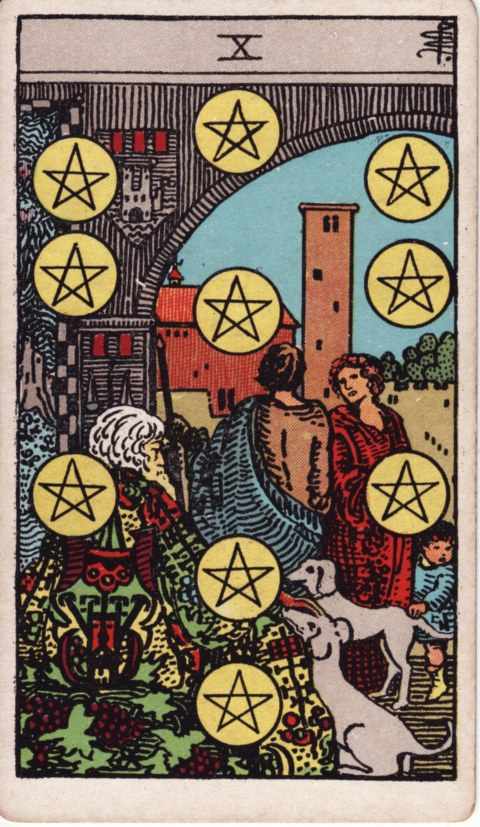
Waite's list is short and domestic: "Gain, riches; family matters, archives, extraction, the abode of a family." Archives are papers kept for later. "Extraction" is an old word for descent or lineage. The picture agrees: three generations stand under one arch.
Modern writers put the weight on legacy, and Tarot.com calls this "the Tarot's legacy card." Waite never mentions wills or heirs; the idea comes from a family living on what someone made before them. Book T adds a shadow to the comfort: "Old age, slothfulness," and later "heaviness." A full house makes people slow. Use the security to start something small, so the fortune does not turn into furniture.
Ten of Pentacles reversed: is the family fortune at risk?
Reversed, Waite's list turns to luck and loss: "Chance, fatality, loss, robbery, games of hazard; sometimes gift, dowry, pension." Most of it describes exposure, money that rides on a throw of the dice or on someone else's hands. Biddy Tarot takes the reversed card inward and says "sometimes, wealth can be a trap," a life built so tightly around keeping a standard that you cannot step down. For work this week, find the one source of money your plans all lean on and ask what happens if it stops for two months.
The end of that list turns: gift, dowry and pension are sums that arrive by arrangement, and they sit oddly beside "robbery." His second list shrugs in the same way, "An occasion which may be fortunate or otherwise." So the reversed card marks money and family matters that are not yet secured, where the outcome can go either way.
With a single card in hand, try the folder test. Pick the one thing that matters most to your household: the lease, the loan, the insurance, the will, the main account. Give yourself five minutes to put a hand on the papers and the login, and check that the names on them are right. If you can do it, the reversal is probably friction or tiredness, and the card is about people. If you cannot, you are in Waite's "chance, fatality," a gap that costs money the day something happens, and closing it comes first.
If you asked whether an inheritance will arrive, a family will make peace, or someone you lost will come back, the card describes how secure the ground feels now. No date and no one's intentions are on it. Labyrinthos reads the reversed card as a warning that "you are placing too many bets on your short-term success, while harming your long-term potential," which is worth holding against any plan that depends on a windfall. If debts have run away from you, talk to a nonprofit credit counselor; for an estate, a lawyer; they are who to ask about that.
Is the Ten of Pentacles a yes or no card?
| Position | Answer |
|---|---|
| Upright | Yes, if you will keep it |
| Reversed | Not yet, secure it first |
Upright, this is a yes for whatever you mean to keep and maintain: a house, a long contract, a family plan. It is a weak yes for a quick flip or a risk you hope to outrun, because the card shows something completed and not something starting.
Reversed, not yet. Secure the papers and the base first, then ask again. Neither old source attaches a yes or no to this card, so read both answers as a convention.
Ten of Pentacles in love and friendship: marriage, home, relatives, feelings
In a relationship
Between two partners it shows a shared home, shared money and relatives who are part of the arrangement. The picture has a pair standing together, a child close by and an elder in the foreground, so the question is usually the long view: a mortgage, a move, whose parents host the holidays. The card fits a bond with a household around it, ring or no ring. Book T's "heaviness" is the cost, because a settled couple can stop trying. Plan one new thing a year.
Single
Single, the card often shows a pull toward someone who fits a life already built: a person who gets along with your family, wants a home and thinks in decades. That can be a useful filter, and it can also be a script. If you notice you are choosing for the family's approval, ask whether you would pick the same person with nobody watching.
As feelings
When the question is another person's heart, the Ten points to a steady attachment and a wish to build with you, with the practical side included. They may see you as part of a household or a plan. It does not promise that they will say so aloud, so judge by what they arrange: a key, a shared bill, an introduction to relatives.
Spare key, godparent, emergency contact: the Ten of Pentacles
Some friends end up in the paperwork of your life. One has your spare key, another is named godparent, a third is who the hospital would call. Waite's upright list includes "family matters," and the card does not name friends, but a household of chosen people fits it. Upright, the arrangement has been built over years.
Reversed, Waite lists chance and loss, so a setup nobody ever wrote down can fail the first time it is tested. A card cannot show who would actually come. Ask one close friend whether they are willing to be your emergency contact, and tell them plainly that they can say no.
Reversed in love: family friction, money between you
Reversed, the strain usually sits around the couple: relatives who disapprove, an unequal income, a shared debt, a quarrel over an estate. Waite's "games of hazard" can be literal, a partner gambling away shared money, or loose, a relationship run on chance. Where an ex is concerned, the card covers the home, money and family knots left over from the time together, and leaves their return unanswered.
Ten of Pentacles at work and with money
In a job, the Ten stands for the secure position: a long-held job, a family firm, a pension, a business that now runs without daily pushing. Book T gives both sides, "clever and prosperous in money transactions" and "great wealth, yet sometimes loss in part." A good result still has leaks.
On money, the card points to assets more than income: property, savings kept for years, an estate. Waite's "archives" suggests the habit that goes with it, which is keeping records. The practical step is to update beneficiaries, insurance and account access while things are calm. A money question also needs its neighbors, since the card takes its value from them.
Reversed at work, a position that looked permanent shows a crack: a family business with unclear ownership, a pension or inheritance in dispute, or a plan that depended on luck. Put the agreement in writing and ask who gets what. Reversed on money, look for the single point of failure, one client, one loan or one relative's promise.
Ten of Pentacles as advice and as a person
As advice, think in decades about one decision. Choose the matter that will still be yours in ten years and treat it like something to hand on: write it down, insure it, and tell the person who would need it where the papers are.
In person form, it is the established elder or the provider, often the one who holds the family's papers. Imagine Marta, sixty, who runs the hardware store her father opened and has never written down who owns what, so her children assume. Reversed as advice, say the unwritten thing aloud to those it concerns, and bring a lawyer if the sums are large. For work, that means a signed agreement before the next big purchase.
How to read the Ten of Pentacles in a spread
As the only card, the Ten says the matter has a household and a history around it, and the question is what to keep. Behind you, it is the family or money base the question stands on. In the middle, a settled situation that needs upkeep. At the end, security reached, with Book T's "nothing beyond" as the caution that the card stops there.
Among neighbors, Book T's table, "Swords are inimical to Pentacles," puts a blade next to this card as a cut into the money or the house: a dispute over the estate, a hard letter. By the same table Wands are friendly with Pentacles, and they lend the settled base some drive. Beside the Four of Pentacles, keeping tips toward clinging. Beside the Five of Pentacles, you see the same wealth from the street.
The Ten of Pentacles among the Pentacles
The Ten closes the numbered Pentacles in Book T. Its sephira is Malkuth, the tenth, with the short title "Riches and wealth." The roses of the run change as they go: the Three has two buds touching the top coin, and in the Ten the roses reach every coin and no buds are left to flower.
The suit then starts again with the Page, a student looking at one coin. Seen that way, the Ten ends the story of earth by handing it back to a beginner, and in the picture the child by the dogs stands where the Page begins. That reading is ours.
- Ace of Pentacles
- Two of Pentacles · Harmonious Change
- Three of Pentacles · Material Works
- Four of Pentacles · Earthly Power
- Five of Pentacles · Material Trouble
- Six of Pentacles · Material Success
- Seven of Pentacles · Success Unfulfilled
- Eight of Pentacles · Prudence
- Nine of Pentacles · Material Gain
- Ten of Pentacles · Wealth
- Page of Pentacles
- Knight of Pentacles
- Queen of Pentacles
- King of Pentacles
Titles after the numbered cards are the Golden Dawn's names for them in Book T.
Symbolism of the Rider–Waite–Smith card
- The ten pentacles. Smith lays the coins over the scene in a layout many readers compare to the Kabbalistic Tree of Life, which is a reading and not Waite's statement. Book T names the matching sephira: Malkuth, the tenth. The pattern ends at the lowest coin, the one for the material world.
- The old man in the patterned robe. Waite calls him "an ancient personage seated in the foreground." On Smith's card his robe is the richest thing in the picture, covered in dots and squares, and he sits nearer the viewer than the couple. Waite does not say whether he owns the house. Calling him the one who made the fortune is our guess.
- The two dogs and the child. Waite writes that the child "looks curiously at two dogs accosting an ancient personage" and that "The child's hand is on one of them." The child is the only figure touching an animal. Dogs usually stand for loyalty, an association the picture does not state, and here they greet the oldest person first.
- The arch and the town. The arch "gives entrance to a house and domain." Through it you see a town with a tower and a red roof. The arch is the threshold between what the family holds and the street.
- Roses on every coin. Book T draws a hand holding a branch "whose roses touch all the Pentacles." The last sentence of its picture text is "No buds, however, are shewn." In Book T's design that means the fullest bloom of the suit and no new growth beside it.
What the oldest sources say
“Gain, riches; family matters, archives, extraction, the abode of a family. Reversed: Chance, fatality, loss, robbery, games of hazard; sometimes gift, dowry, pension.”
“Represents house or dwelling, and derives its value from other cards. Reversed: An occasion which may be fortunate or otherwise.”
“Completion of material gain and fortune; but nothing beyond: as it were, at the very pinnacle of success. Old age, slothfulness; great wealth, yet sometimes loss in part; heaviness; dullness of mind, yet clever and prosperous in money transactions.”
Waite's upright list is about the house and the family line. His second list calls the card a "house or dwelling" that "derives its value from other cards," which makes it a container whose worth the neighbors set. That is an odd claim for the richest card.
Book T's title for it is the Lord of Wealth. Its meaning list mixes "great wealth" with "slothfulness" and "dullness of mind," then reverses again with "clever and prosperous in money transactions." The result is a rich person who is also a little dull. The three modern pages checked all stress legacy and sharing, and none quotes the "nothing beyond" limit or the dullness.
Ten of Pentacles and Mercury in Virgo: the card's decan
| Suit and element | Pentacles, Earth (Major Arcana card of earth: The World) |
|---|---|
| Decan | 20° to 30° ♍︎ Virgo, the third ten degrees of the sign |
| Planet of the decan | Mercury (Major Arcana: The Magician) |
| Major Arcana card of Virgo | The Hermit |
| Golden Dawn title | The Lord of Wealth |
| Place on the Tree of Life | Malkuth (Book T: “Riches and wealth”) |
Attributions from Book T (Golden Dawn, c. 1892; printed 1912).
The last ten degrees of Virgo, 20° to 30°, belong to the Ten of Pentacles in Book T. Mercury is the planet of the decan, and the Golden Dawn text calls it the Lord of Wealth. Virgo is an earth sign, so sign and suit agree. In the Major Arcana, Virgo is The Hermit, Mercury is The Magician and earth is The World. Mercury rules Virgo and, by tradition, is exalted there as well.
This decan is part of the Queen of Swords' zone, which begins at 20° Virgo and ends at 20° Libra; this is its first decan. In Book T the next decan after it is the first of Libra, the Two of Swords, so the zodiac moves from this fortune straight into a truce. The Sun crosses the decan in the last days of summer and leaves Virgo at the September equinox.
When the Sun is in the Ten of Pentacles stretch
| Year | Sun enters 20° | Sun leaves (reaches 30° Virgo) |
|---|---|---|
| 2026 | Sep 12 | Sep 22 |
| 2027 | Sep 12 | Sep 23 |
| 2028 | Sep 12 | Sep 22 |
| 2029 | Sep 12 | Sep 22 |
This year the Sun crossed the Ten of Pentacles stretch of the zodiac (20° to 30° Virgo) from September 12 to September 22, 2026. Next time: September 12 to September 23, 2027 (US Eastern dates).
Dates are US Eastern, from the astronomy-engine ephemeris. Across 35,064 dates from 1930 to 2025, the Sun is in this stretch on 2.8% of them, and at least one of the ten planets is on 26.2%.
This year's Sun pass ended on September 22, and the next runs September 12 to 23, 2027. Saturn stood in this decan from October 1979 to September 1980 and in several stretches between late 2008 and mid-2010, and it returns from September 2038 to September 2039, by our ephemeris. Jupiter enters it on November 1, 2027, a year from this page, and stays into April 2028, with a second stay from late June to late August 2028. Pluto was here from 1966 to 1972 with breaks, and Uranus from 1966 to 1969. That is a list of where planets stood, and it forecasts nothing.
Is the Ten of Pentacles in your birth chart?
Enter your birth date. We show which of the ten planets stood between 20° and 30° Virgo that day, the slice of sky Book T gives this card; add the time if a planet was near the edge.
Enter your birth date above to see your result.
Every planet, angle and house from your birth time: birth chart calculator.
Questions about the Ten of Pentacles
Is the Ten of Pentacles a good card?
Mostly. It is the fullest card of its suit, and Waite gives it "gain, riches." Book T adds "nothing beyond," so it is good as a result and quiet as a promise. Reversed, it points to exposure, and the picture does not fix an outcome.
What does the Ten of Pentacles mean as feelings?
A steady, practical attachment, with a wish to build a household. Reversed, the person may be tied up in family pressure or money worries, so the feeling is there and the room for it is small.
Will the Ten of Pentacles answer yes?
Upright, yes when you mean to keep what you are asking about; reversed, not yet. Neither old text says this; it is a working habit.
Which sign does the Ten of Pentacles belong to?
Virgo, in the final ten degrees (20° to 30°), ruled here by Mercury. Expect the Sun in that stretch around September 12 to 22.
When will the money come?
No date is on offer here. Using September 12 to 22 as a marker is a calendar convention only, and the next pass is in 2027. What you control is the folder test: get the papers in order.
Does the Ten of Pentacles mean marriage?
The old lists never use the word. Waite gives "family matters" and "the abode of a family." Modern readers often hear a wedding or a move-in, which fits a lasting household and says nothing about a proposal or a date.
Does the Ten of Pentacles mean an inheritance is coming?
Labyrinthos lists inheritance among its keywords, and Waite's reversed list ends with "gift, dowry, pension," which is closer to the old reading. Neither gives an amount or a time. For a real estate question, ask a lawyer.
Sources
- Astronomy Engine: the open-source ephemeris library behind our planet positions, dates and statistics
- A. E. Waite, The Pictorial Key to the Tarot (1911), Wikisource: the divinatory meanings we quote, upright and reversed
- Book T (Golden Dawn), as printed in The Equinox I:8, 1912: the zodiac sign, Hebrew letter, title and short meaning of each card
- Wikimedia Commons: Rider–Waite–Smith tarot deck: Pamela Colman Smith's 1910 card drawings, public domain
- How we create our readings: our own calculation of sign dates, positions and the 1930 to 2025 statistics
Next to the Ten of Pentacles
In the suit of Pentacles: Nine of Pentacles ← Ten of Pentacles → Page of Pentacles.
Virgo on this site: Virgo zodiac sign · The Hermit, the card of Virgo · your full birth chart.
All 22 Major Arcana with their signs and planets, and the minor cards written so far: tarot card meanings.
Written by The Zodiac Atlas editorial team with the help of AI and edited by a person. Quotations are from Waite's Pictorial Key to the Tarot and the Golden Dawn's Book T, both in the public domain; the card picture is a 1910 printing of Pamela Colman Smith's drawing for the 1909 deck. Sun dates and planet positions come from the astronomy-engine ephemeris (tropical zodiac). Tarot and astrology are symbolic traditions; they do not predict events.