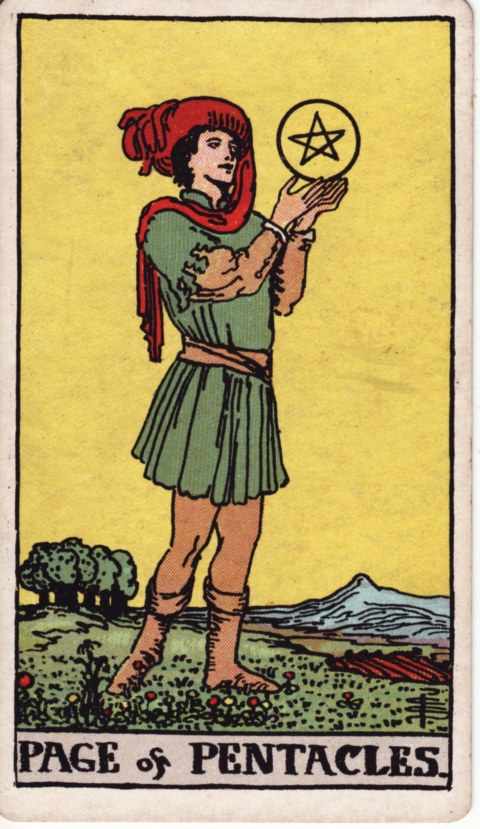
What does the Page of Pentacles mean when you draw it?
Is it a good card? For a beginning that needs patience, yes. Waite's list is short and bookish: "Application, study, scholarship, reflection." Nothing in it is a windfall. The page is somebody who has decided to learn a trade, a language, a craft or a budget, and who accepts that the first year looks unimpressive.
The picture agrees. Waite writes that "He moves slowly, insensible of that which is about him," and the figure looks only at the coin. Labyrinthos reads the same walk and says the young man "appears unaware of his surroundings." That is concentration, and it is also a small warning: a person this absorbed can miss what happens at the edge of the field.
Tarot.com puts the mood in one line: "Big things start small." Biddy Tarot adds a caution: the Page gives "the initial motivation and energy to begin the process," and the result comes later. So the useful reading is a course enrolled in, a certificate begun, an apprenticeship accepted, an account opened with a first small deposit. The card says nothing about the size of the payoff.
Page of Pentacles reversed: wasting time or money?
Modern guides read the reversed Page as procrastination or poor follow-through, and Tarot.com says the potential "is real, but you have to put in some effort." Waite points somewhere less familiar: "Prodigality, dissipation, liberality," then "luxury; unfavourable news." Those are words about spending. One way to read the old reversed Page is as the student who buys the equipment before learning the craft.
Book T agrees from a different direction. The Princess is "generous, kind, diligent, benevolent, careful," and if ill dignified she is "wasteful and prodigal." Generosity and waste are the same trait in two conditions, so the reversed card can describe a good heart that leaks money, time or attention.
The shelf test needs only this card. Write down everything you bought, joined or signed up for in the last three months for the sake of one goal: courses, books, tools, memberships. Next to each item put the date you last used it. If most dates are weeks old, the plan has turned into shopping, and the card says to stop buying and use one item for a full week. If the dates are recent and the list is short, the reversal is only fatigue, and rest is the remedy.
If you asked whether you will pass the exam, win the place or get the offer, the reversed Page does not know. It shows how you are handling the preparation. Another person's decision and the date of any result sit outside the picture.
Is the Page of Pentacles a yes or no card?
| Position | Answer |
|---|---|
| Upright | Yes, as a first step |
| Reversed | Not yet, check the spending |
Upright, yes, for a first step that costs little and teaches something: enroll, apply, start saving, ask for the training. Tarot.com answers the card with "the answer is YES." For a large bet that has to pay off quickly, make the yes a "slowly."
Upside down, the answer is not yet. Look at where the money or time is going first. No old source gives a verdict of this kind; the answers in this section are modern practice.
Page of Pentacles in love and friendship: slow interest, real feelings
In a relationship
Between two partners, the Page is the quiet project: saving for a deposit, learning each other's routines, planning a year ahead on paper. Tarot.com sees "growth through shared goals and practical steps." Warmth may be low-key here. If it feels flat, a shared task with a finish line, such as a trip budget or a renovation, gives the card something to work on.
If you are single
Without a partner, the card suggests interest that grows by repetition: a classmate, a coworker, a person from the same workshop. Labyrinthos describes this type of lover as "quiet" in its love column, and that kind is easy to overlook. Give a few weeks of ordinary contact before judging. Nothing on the card promises that such a person is about to arrive.
As their feelings
Read as another person's feelings, the Page means sincere, careful and in no hurry. They are learning how you work, and they show interest by turning up and asking practical questions. Because the card is slow, a person reading it as "not interested" may be wrong, and a person reading it as "committed" may be early. Watch for plans that include you.
New friends from a night class: the Page of Pentacles
You joined a pottery class or a study group and know four first names. Waite's Page is "Application, study, scholarship, reflection," and he moves slowly. Friendships made over a shared task usually grow the same way, by turning up and not by one big evening. Upright, give it a full term before you judge.
Reversed, Waite lists dissipation: money and energy go on drinks and plans that never repeat, and the group stays thin. Stay after the next session and ask someone about their piece, then suggest coffee while the first names are still fresh.
Reversed in love
In a reversed love draw, the card can be affection spent on gifts and nights out while nothing is built, or a person who starts things with enthusiasm and drops them. Waite's word is "dissipation." It can also be you, putting a dream of the relationship ahead of the actual weeks. With an ex, the Page describes how you are handling your own time and money after the split. It does not describe what that person plans.
Page of Pentacles at work and with money
At work the Page is the trainee, intern, new hire or student: someone building skills in a field where results come later. Biddy Tarot recommends seeing the card as "an invitation to take a class, continue your education or start an apprenticeship." If you are already established, it suggests learning one adjacent skill on purpose. Money follows effort slowly here. Labyrinthos advises saving and investing "in a safe and traditional way," and the card matches that tone.
Reversed on a job question, expect training that is not being finished, or a side project funded faster than it earns. Put a cap on what the plan may cost this quarter. Ask what one thing, finished, would show a future employer that you can do the job.
Page of Pentacles as advice and as a person
As advice the Page says pick one skill and give it a fixed hour on fixed days. Keep a record of what you did, because a student who can see the pages turning stays at it. Turned over, the advice is to cut what the plan costs to the minimum and spend hours instead.
As a person, imagine a nineteen-year-old named Tomas who started as a warehouse assistant, takes a forklift certificate on Saturdays and asks the electrician questions at lunch. He says little, is rarely late, and in two years he is the one the team asks. That is the upright Page. Waite's second list also says "a dark youth; a young officer or soldier; a child," so the card can also describe a young person in your life.
How to read the Page of Pentacles in a spread
With only this card, treat it as a question: what am I learning, and what is it costing? Then use the positions. In the past it marks an apprenticeship that still shapes you. In the present spot, it says the work is young and should stay simple. As an outcome it shows a patient start with no finish in sight.
Neighbors matter. One Book T rule reads "Swords are inimical to Pentacles," and a Sword beside the Page can bring criticism, an exam or a cold look at the budget. A Wand, which Book T counts as a friend to Pentacles, adds drive to the study. Beside the Ace of Pentacles, her own Ace, you get the chance and the person who can use it. Beside the Eight of Pentacles, Book T's Prudence, the training turns into a trade.
The Page of Pentacles among the Pentacles
In the suit, the Page sits after the Ten of Pentacles, named Wealth by Book T, and before the Knight. If the Ten is the full harvest, the Page is the first furrow of the next field: a young person or a new venture starting again from the soil. The suit's numbered run ends in wealth and its court begins with someone learning to earn it.
Book T lays the other three Pentacles courts along the zodiac, with the Knight in Leo and Virgo, the Queen in Sagittarius and Capricorn and the King in Aries and Taurus. The Page has no stretch. She stands under the pole, on the ground the other three move across.
- Ace of Pentacles
- Two of Pentacles · Harmonious Change
- Three of Pentacles · Material Works
- Four of Pentacles · Earthly Power
- Five of Pentacles · Material Trouble
- Six of Pentacles · Material Success
- Seven of Pentacles · Success Unfulfilled
- Eight of Pentacles · Prudence
- Nine of Pentacles · Material Gain
- Ten of Pentacles · Wealth
- Page of Pentacles
- Knight of Pentacles
- Queen of Pentacles
- King of Pentacles
Titles after the numbered cards are the Golden Dawn's names for them in Book T.
Symbolism of the Rider–Waite–Smith card
- The raised pentacle. The coin hovers above his open hands, and Waite says he looks "intently" at it. The coin is held up like something to examine before it is used. Attention comes first, spending later.
- The meadow of flowers. He stands in grass dotted with red and yellow blossoms. Book T has "grass or flowers" under its Princess too. Flowers on ground that is also a field suggest growth that has not yet been put to use.
- The plowed field. On the right, a plowed field shows brown furrows. Biddy Tarot reads it as a promise of "an abundant harvest." The seed has not come up, and the card keeps that stage.
- The grove and the mountain. A compact grove stands on the left and a pale blue mountain far off on the right. Biddy Tarot takes the mountain for "upcoming challenges and obstacles." The old books skip it, which makes it a later reading. It shows that the distance to the goal is large and that the Page has not noticed.
- The red cap and green tunic. Red cap, green tunic, brown boots: the figure is dressed for work outdoors, with nothing for show. Book T gives its Princess a mantle of sheepskin and a winged ram's head as a crest.
What the oldest sources say
“Application, study, scholarship, reflection; another reading says news, messages and the bringer thereof; also rule, management. Reversed: Prodigality, dissipation, liberality. luxury; unfavourable news.”
“A dark youth; a young officer or soldier; a child. Reversed: Sometimes degradation and sometimes pillage.”
Waite gives the Page a quiet list: "Application, study, scholarship, reflection," then "another reading says news, messages and the bringer thereof; also rule, management." The reversed list turns to money: "Prodigality, dissipation, liberality." His second list is short and odd: "A dark youth; a young officer or soldier; a child," and for reversed, "Sometimes degradation and sometimes pillage." The second list reads like a stranger in uniform, and Labyrinthos, Biddy Tarot and Tarot.com all leave it out. It works only as a hint that the card can stand for a young person, with no soldier required.
Book T paints a very different figure. Its Princess is a "STRONG and beautiful Amazon," and the general text calls her "a Queen of Queens --- an Empress," standing firmly "of themselves," with no horse, throne or chariot under her. The passage closes on a warning: "Woe unto whomsoever shall make war upon her, when thus established!" Her form "suggests Hebe, Ceres, and Proserpine," goddesses of youth, grain and the underworld. The modern shy student and the old Empress describe the same card from opposite ends: a beginner who stands on her own ground.
Page of Pentacles and Earth
| Suit and element | Pentacles, Earth (Major Arcana card of earth: The World) |
|---|
Attributions from Book T (Golden Dawn, c. 1892; printed 1912).
Book T puts all four Princesses around the north pole instead of in a sign. This one "rules over one quadrant of the heavens around the North Pole of the Ecliptic," and her elemental label is "Earth of Earth," the only court card in the deck that is earth twice over. The full title reads "The Princess of the Echoing Hills: the Rose of the Palace of Earth." The Major Arcana card for earth is The World.
She is also "Throne of the Ace of Pentacles," the seat on which that Ace's force rests. Book T hangs the Princesses over the "respective Cherubic Signs of the Zodiac." Should that mean the fixed signs, Taurus is the one above the Pentacles Princess. Book T never names Taurus here; the equation is an assumption that suits a Taurus-like patience.
The numbered Pentacles are shared among the three earth signs: Capricorn, then Taurus, then Virgo, three cards each. The Page is the soil under them all.
Questions about the Page of Pentacles
Is the Page of Pentacles a good card?
Favorable for study and slow beginnings. Waite lists "Application, study, scholarship, reflection." Reversed it warns of waste: his word is "Prodigality."
What does the Page of Pentacles say about their feelings?
Careful, sincere, unhurried interest that shows in practical acts. Reversed, the feelings are scattered or spent on gestures with no plan behind them.
Who is the Page of Pentacles when he is a person?
A student, trainee or young worker who is diligent and quiet. Waite adds "a dark youth; a young officer or soldier; a child." Book T's Princess is "generous, kind, diligent, benevolent, careful."
Does the Page of Pentacles point to a new job or an exam?
It points to training, study and an early stage of work. Whether you pass or are hired is outside the card. Prepare the way the Page does, slowly and on schedule.
Is money what the Page is about?
Often in modern readings, as learning to earn and save. Waite's reversed list is about spending, though. The upright card is about skill first and money later.
Does the Page say yes or no?
Upright, yes as a first step; reversed, not yet. Tarot.com answers yes. Waite and Book T do not pair cards with answers, so this is modern practice.
Does the Page have a zodiac sign?
None. Book T seats the Pentacles Princess near the pole as "Earth of Earth." If its Cherubic Signs are the fixed ones, Taurus is nearest. With no stretch of the zodiac of her own, she has no Sun dates and a timing question has no calendar answer.
Sources
- Astronomy Engine: the open-source ephemeris library behind our planet positions, dates and statistics
- A. E. Waite, The Pictorial Key to the Tarot (1911), Wikisource: the divinatory meanings we quote, upright and reversed
- Book T (Golden Dawn), as printed in The Equinox I:8, 1912: the zodiac sign, Hebrew letter, title and short meaning of each card
- Wikimedia Commons: Rider–Waite–Smith tarot deck: Pamela Colman Smith's 1910 card drawings, public domain
- How we create our readings: our own calculation of sign dates, positions and the 1930 to 2025 statistics
Next to the Page of Pentacles
In the suit of Pentacles: Ten of Pentacles ← Page of Pentacles → Knight of Pentacles.
All 22 Major Arcana with their signs and planets, and the minor cards written so far: tarot card meanings.
Written by The Zodiac Atlas editorial team with the help of AI and edited by a person. Quotations are from Waite's Pictorial Key to the Tarot and the Golden Dawn's Book T, both in the public domain; the card picture is a 1910 printing of Pamela Colman Smith's drawing for the 1909 deck. Sun dates and planet positions come from the astronomy-engine ephemeris (tropical zodiac). Tarot and astrology are symbolic traditions; they do not predict events.