Six of Pentacles: giver, receiver, or both?
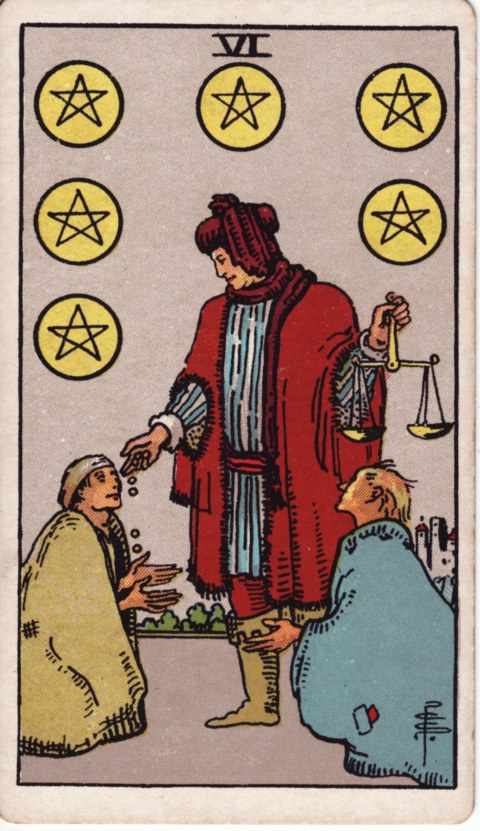
Waite describes a person "in the guise of a merchant" who weighs money in scales and gives it "to the needy and distressed," and he adds that the scene is "a testimony to his own success in life, as well as to his goodness of heart." Note the word guise: Waite does not say the figure is a merchant, only that the figure looks like one. The weighing matters as much as the giving, because the scales say that the amount was measured. Labyrinthos gives the modern version: you can be either "the man giving away money to the needy, or a beggar gratefully receiving what you need." This week, pick one open item, such as a small debt you owe, a loan you made, or a favor you never returned, and close it with a message or a payment.
Waite's list for the card is "Presents, gifts, gratification," then, from "another account," "attention, vigilance," then "now is the accepted time, present prosperity." So he reads the figure as a giver, and also as someone who keeps watch over what he has. The scales are held up in the open, where anyone can check them, and the coins are counted out one by one into the hands below.
Both roles are valid readings of the card. If you are short, the picture says that taking help is part of how money moves. If you are comfortable, it asks you to give by measure and to know why. The card describes a flow that works while both sides know the terms.
Six of Pentacles reversed: strings attached or just envy?
Reversed, Waite's list is short and sharp: "Desire, cupidity, envy, jealousy, illusion." Nothing there is about charity. It is about wanting what someone else holds, and he adds the word illusion, which suggests that the wanting distorts the view. Tarot.com reads the same card as a check on whether help is honest, saying that "Generosity isn't generosity if it's transactional or exploitative." The old and new readings meet at one point: somebody is looking at a gift and seeing a price. This week, write down any money you have lent or been lent, and next to each line the date it was agreed to be repaid.
Two situations fit. In the first, you are the giver and the help has become a lever: you expect gratitude, obedience or a say in how the money is used. In the second, you are the receiver and you envy the giver, or resent the terms, or suspect the gift will be called in later. One reading puts envy and jealousy on the receiving side and cupidity on the giving side; Waite does not assign them. Both can be true in a single household or a single workplace.
To tell which side you are on with one card, try the out-loud test. Say to yourself, in one sentence, exactly what the money or favor was for and what, if anything, you expect back. If the sentence comes easily, the exchange is clean and the card is a reminder to keep it that way. If you find yourself softening the sentence, leaving out a condition, or hoping the other person will not ask, that is the string. Fix it by stating the term to the other person before anything else moves.
Perhaps the real question is whether one named person will repay you or return. No answer appears there. The card shows how the exchange feels from your side. For a loan that has gone wrong, write down the terms, and if the sum is large, ask a lawyer or a nonprofit credit counselor, because no card can do that part.
Is the Six of Pentacles a yes or no card?
| Position | Answer |
|---|---|
| Upright | Yes, on fair terms |
| Reversed | Not like this |
Upright, the Six of Pentacles leans toward yes, on fair terms. If you asked whether to lend, to accept help, to pay someone fairly or to ask for a raise, the card supports an exchange that both sides can describe plainly.
Reversed, it reads as not like this. Change the terms, or wait until the motive is clear. Tarot.com puts it bluntly: "the answer is YES" for its upright card. Neither old author wrote a verdict; any answer here is a later habit.
Six of Pentacles in love and friendship: who carries what?
In a relationship
Here the card asks who carries what: the money, the housework, the phone calls to relatives, the effort of making up after a fight. A couple does not need an even split every week, but it helps when each person can say what the other gives. Treat the scales in the picture as a question to put on the table, such as "Does this feel fair to you?", asked on a calm evening.
Single
Single readers may find help arriving through other people: a friend who introduces you, a neighbor who invites you to something. It also asks whether you are giving as much as you take in your friendships, since a thin social life often starts there. It does not announce a partner.
As feelings
Read as another person's heart, the Six of Pentacles points to care shown by what they do: lending a hand, bringing food, covering a cost. That is warmth, though not necessarily romance. The card names no love, and a generous person can be generous to everyone.
Splitting the check: friends and the Six of Pentacles
Five friends, one bill, and incomes that are nowhere near equal. The scales in the Six of Pentacles weigh giving and receiving. Waite's upright list opens with "Presents, gifts, gratification," so treating a friend to dinner is the card at its easiest, provided the one treated can accept it without shrinking.
Reversed, Waite's list turns to envy and jealousy: the one who always pays feels used, or the one who is paid for feels watched. The picture says nothing about what anyone thinks of the bill. Before the next dinner, suggest a rule that fits everyone, such as ordering to a budget or taking turns to treat.
Reversed in love: strings, envy and score-keeping
Reversed, the card tends to show a relationship in which giving has become a ledger. One person pays and expects control, or one person takes and keeps score of what the other has. Waite's "jealousy" and "envy" can also be literal: a partner's success may sting. When you ask about an ex coming back, the card is silent on what they plan, and only shows how you currently feel about giving and being owed.
Six of Pentacles at work and with money
At work the Six is the card of mentoring, bonuses, grants, references and fair pay. The picture invites you to ask the person who has more experience for help, and to pass help on when you have it. When weighing two offers, compare how clearly each side states its terms.
On money, it favors a plan you can explain: a loan with a written schedule, a donation you decided on in advance, a shared bill split by a rule. Waite's §4 adds a counterweight, "The present must not be relied on." Keep a reserve in case today's comfort changes.
Reversed at work, check for favors with an unstated price, a boss who gives perks and expects loyalty in return, or a colleague you envy. Reversed on money, avoid lending any sum whose loss would hurt, and avoid borrowing from a person who will use it later. The quick audit is to write each obligation with its date and its terms.
Six of Pentacles as advice and as a person
As advice, give by measure and receive without apology. Work out in advance what you are willing to give, then give it fully, and when help is offered to you, take it and say thank you in plain words.
In person form, the card is the generous friend who keeps good accounts. Our invented example: Priya runs a small bakery, pays her two part-timers on the day she promised, and lends her old oven to a neighbor who is starting out, writing down the week it comes back. Reversed as advice, ask what each gift is really for. If one of them is meant to buy a favor, name that to yourself first, and on a money question, put any loan in writing before it leaves your hands.
How to read the Six of Pentacles in a spread
By itself, the Six of Pentacles says that an exchange is on the table and its terms are what matter. Look at who is giving, who is receiving and whether the scales are level.
Behind you, it marks help given or received that still shapes the situation. In the present slot, the exchange is current. As an outcome, it suggests support arriving, with the condition that you accept its terms. Book T's dignity rules say "Wands are friendly with Swords and Pentacles." That makes a neighboring Wand a lively sign. A Sword close by sharpens the question of who owes whom. Just ahead of it in the suit is the Five's hardship, and just behind it the Seven's long wait; both have pages here.
The Six of Pentacles among the Pentacles
Book T places the Six of Pentacles after Material Trouble and before Success Unfulfilled, under the title "Lord of Material Success." Seen in sequence, the suit goes from the lean Five straight into the best stretch of the numbered run, and then into the Seven, where the picture goes quiet. The Five and the Seven of Pentacles have their own pages, linked in the suit row below.
The numbered Pentacles start from a hard time and pass through a good one. The Six sits at Tiphareth in Book T's scheme, the middle of the tree, which is the place of balance, with the short gloss "Success in material things, prosperity in business."
- Ace of Pentacles
- Two of Pentacles · Harmonious Change
- Three of Pentacles · Material Works
- Four of Pentacles · Earthly Power
- Five of Pentacles · Material Trouble
- Six of Pentacles · Material Success
- Seven of Pentacles · Success Unfulfilled
- Eight of Pentacles · Prudence
- Nine of Pentacles · Material Gain
- Ten of Pentacles · Wealth
- Page of Pentacles
- Knight of Pentacles
- Queen of Pentacles
- King of Pentacles
Titles after the numbered cards are the Golden Dawn's names for them in Book T.
Symbolism of the Rider–Waite–Smith card
- The scales. The merchant holds a golden pair of scales at shoulder height. Waite mentions them only as the 'pair of scales' in which money is weighed. On this card the pans hang slightly uneven. We read them as a sign that fairness has to be checked.
- Two kneeling figures. They wear patched cloaks, one tan and one blue-gray, and one holds out cupped hands for the coins. Waite names them only as "the needy and distressed."
- The merchant's red cloak and striped tunic. He wears a red hat and cloak over a blue and white striped tunic. Waite says only "in the guise of a merchant." The rich color sets him apart from the kneeling pair, and the stripes make a busy contrast with their plain cloth.
- Six pentacles above. Six gold coins hang over the scene. Book T draws the same number in "two columns of three each," and the coins are tied to the title "Material Success." On Smith's card they stay in the sky while a few small ones fall into the open hands.
- The coins in the air. A few coins are caught mid-fall between his hand and the kneeling man. They show the exchange as a moment in motion, with the transfer still unfinished.
What the oldest sources say
“Presents, gifts, gratification; another account says attention, vigilance; now is the accepted time, present prosperity, etc. Reversed: Desire, cupidity, envy, jealousy, illusion.”
“The present must not be relied on. Reversed: A check on the Querent's ambition.”
“Success and gain in material undertakings. Power, influence, rank, nobility, rule over the people. Fortunate, successful, liberal and just. If ill dignified, may be purse-proud, insolent from excess, or prodigal.”
Waite's two lists do not agree. His §2 meaning includes "now is the accepted time, present prosperity," which reads as go ahead. His additional meanings say the opposite, "The present must not be relied on," and for the reversed card "A check on the Querent's ambition." He may be giving two uses of the same picture, a good moment and a warning that moments pass. Modern pages usually keep only the first half. His reversed list, "Desire, cupidity, envy, jealousy, illusion," has almost nothing in common with the charity story.
Book T tells a different story. Its drawing is a hand, a white rose branch with buds, and six pentacles in two columns of three. Nobody is giving to anybody, and the title is "Lord of Material Success," about the success itself and what it does to the person who has it. Its meaning list runs from "Fortunate, successful, liberal and just" to the warning "If ill dignified, may be purse-proud, insolent from excess, or prodigal." The giving scene comes from Smith's picture and Waite's text, not from Book T.
Six of Pentacles and Moon in Taurus: the card's decan
| Suit and element | Pentacles, Earth (Major Arcana card of earth: The World) |
|---|---|
| Decan | 10° to 20° ♉︎ Taurus, the second ten degrees of the sign |
| Planet of the decan | Moon (Major Arcana: The High Priestess) |
| Major Arcana card of Taurus | The Hierophant |
| Golden Dawn title | The Lord of Material Success |
| Place on the Tree of Life | Tiphareth (Book T: “Success in material things, prosperity in business”) |
Attributions from Book T (Golden Dawn, c. 1892; printed 1912).
The middle decan of Taurus, 10° to 20°, belongs to the Six of Pentacles, per Book T, with the Moon as ruler: "Above and below are the symbols Taurus and Moon of the Decan." Taurus shares its element with the suit. By tradition the Moon is exalted in Taurus, so this is the Moon at its strongest position. Among the Major Arcana, Taurus is The Hierophant, the Moon is The High Priestess and earth is The World.
This decan lies inside the King of Pentacles zone. In 2026 the Sun was here April 30 to May 10, and in 2027 it returns on the same dates. Our ephemeris puts Uranus in the slice from July 2020 to March 2024, with breaks, and Jupiter in 2023 and early 2024. Saturn comes back from July 16, 2028, in three stages ending in March 2030, and Neptune arrives in July 2042 and stays, with breaks, until April 2048.
When the Sun is in the Six of Pentacles stretch
| Year | Sun enters 10° | Sun leaves (reaches 20° Taurus) |
|---|---|---|
| 2026 | Apr 30 | May 10 |
| 2027 | Apr 30 | May 10 |
| 2028 | Apr 29 | May 9 |
| 2029 | Apr 29 | May 10 |
This year the Sun crossed the Six of Pentacles stretch of the zodiac (10° to 20° Taurus) from April 30 to May 10, 2026. Next time: April 30 to May 10, 2027 (US Eastern dates).
Dates are US Eastern, from the astronomy-engine ephemeris. Across 35,064 dates from 1930 to 2025, the Sun is in this stretch on 2.8% of them, and at least one of the ten planets is on 20.1%.
Few dates, about 2.8 percent, put the Sun in this slice, yet roughly one date in five finds some planet of the ten inside it. Such a planet touches a Golden Dawn theme that this card names. That says nothing about the character of anyone born then.
Is the Six of Pentacles in your birth chart?
Enter your birth date. We show which of the ten planets stood between 10° and 20° Taurus that day, the slice of sky Book T gives this card; add the time if a planet was near the edge.
Enter your birth date above to see your result.
Every planet, angle and house from your birth time: birth chart calculator.
Questions about the Six of Pentacles
Is the Six of Pentacles lucky?
Mostly. Book T calls it "Fortunate, successful, liberal and just." Waite adds a caution in §4: "The present must not be relied on." It is good when the terms are clear.
Six of Pentacles as someone's feelings?
Care shown through acts, such as help, gifts or a shared cost. It does not say whether the person is in love, and it can describe plain generosity.
Does the Six of Pentacles mean go ahead?
Yes on fair terms upright, and not like this reversed. Tarot.com gives yes for the upright card. Waite and Book T give neither, so treat it as habit.
Does the Six of Pentacles mean I will get the money?
No payment is promised by a card. It shows an exchange in which someone gives and someone receives, and asks you to check the terms.
Which sign holds the Six of Pentacles?
Taurus, 10° to 20°, ruled by the Moon in Book T. Expect the Sun in this decan around April 30 to May 10.
When will the help come?
The card carries no date. April 30 to May 10 is the Sun's passage, a calendar habit that predicts nothing.
Is the Six of Pentacles about charity?
On Smith's picture, yes: a merchant and two kneeling figures. In Book T, no. It draws only a hand, roses and six pentacles, and names the card "Lord of Material Success."
Sources
- Astronomy Engine: the open-source ephemeris library behind our planet positions, dates and statistics
- A. E. Waite, The Pictorial Key to the Tarot (1911), Wikisource: the divinatory meanings we quote, upright and reversed
- Book T (Golden Dawn), as printed in The Equinox I:8, 1912: the zodiac sign, Hebrew letter, title and short meaning of each card
- Wikimedia Commons: Rider–Waite–Smith tarot deck: Pamela Colman Smith's 1910 card drawings, public domain
- How we create our readings: our own calculation of sign dates, positions and the 1930 to 2025 statistics
Next to the Six of Pentacles
In the suit of Pentacles: Five of Pentacles ← Six of Pentacles → Seven of Pentacles.
Taurus on this site: Taurus zodiac sign · The Hierophant, the card of Taurus · your full birth chart.
All 22 Major Arcana with their signs and planets, and the minor cards written so far: tarot card meanings.
Written by The Zodiac Atlas editorial team with the help of AI and edited by a person. Quotations are from Waite's Pictorial Key to the Tarot and the Golden Dawn's Book T, both in the public domain; the card picture is a 1910 printing of Pamela Colman Smith's drawing for the 1909 deck. Sun dates and planet positions come from the astronomy-engine ephemeris (tropical zodiac). Tarot and astrology are symbolic traditions; they do not predict events.