Ace of Wands upright: what is the spark asking for?
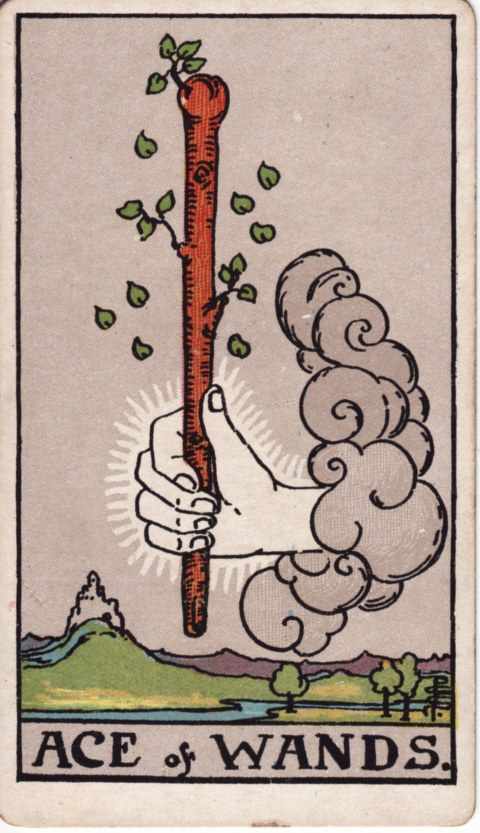
Of the four Aces this is the one that arrives without a plan, and the Ace of Wands meaning starts there. A hand reaches out of the cloud and the wand is already alive, leaves breaking from the wood. Tarot.com sums it up as "Think of it as the match, not the bonfire." What you get is the push to start, and the rest, the fuel and the fire-break, you supply yourself.
Most modern guides turn that into a green light for projects: a business, a book, a move, a new craft. Labyrinthos calls the card the boldest of the suit and says "It is bravely finding your own voice." That fits the picture, since a living wand in a bare hand does not look like a thing that waits for permission. Waite's own list is broader: "Creation, invention, enterprise," then "birth, family, origin."
The practical reading is to start before you feel ready, with something small enough to finish this week. The Ace has no thought of what comes second. Pick the draft, the call, or the first rehearsal and do it while the energy is there, because fire cools quickly and a spark kept in a drawer goes out.
Ace of Wands reversed: stalled idea or wrong timing?
Reversed, the usual readings fall into three. The first is an idea you cannot yet shape. Biddy Tarot describes this as a time when "you can sense an idea emerging from within but are uncertain what form it will take." The second is delay. The same page gives the message as "Not now, but maybe later." The third is a flame that never catches, which Tarot.com puts as fear blocking the leap.
Waite's reversed list reads "Fall, decadence, ruin, perdition, to perish; also a certain clouded joy." The first part is severe and reads like the end of a thing. The last phrase is the useful one. "A clouded joy" suggests you do want it and something is in the way, which fits a person who is excited and afraid in equal measure.
With one card to go on, sort it by what happens to the energy. Write down the idea you keep returning to, then ask what you would do on it tomorrow in the first ten minutes. If you can name a first ten minutes and keep not doing it, the block is fear or habit. If you cannot name one, the idea is not shaped yet and the card says to spend a day shaping it before you push.
If you asked about a person and a call or a return, the reversed Ace is silent on what they decide. It shows your own drive, and the fire in the picture sits in the hand. For a question about a pregnancy, see the questions below.
Is the Ace of Wands a yes or no card?
| Position | Answer |
|---|---|
| Upright | Yes |
| Reversed | Not yet |
Upright, yes. This is the clearest yes of the Wands: Tarot.com answers "YES" outright and Biddy Tarot calls it "a clear YES!" It suits questions about starting, asking, applying, trying. Whether the project will last is outside the card; the push is real.
Reversed, the card says not yet. The question may be sound while the timing or your readiness is off. The old books pair no card with an answer of this kind, so the verdict here is modern practice.
Ace of Wands in love and friendship: attraction, restarts, what they feel
With a partner
Between two people, the Ace of Wands brings back heat after a flat stretch: a trip you did not plan, an old argument that turns into laughing, a sudden interest in each other's plans. It is about momentum more than stability, and the card appears when someone is ready to try something new together. Fire wants fuel. A spark left alone will not hold a season.
If you are single
Single, the card describes your own energy more than any particular stranger. You may want to go out, flirt, say yes to the invitation you would have refused last year. Someone arriving is not in the picture. The willingness to start something is, and that is the part you control.
As their feelings
As feelings, the Ace is attraction and eagerness: interest that is fresh, energetic and a little impulsive. The person wants to act on it. This kind of feeling moves fast and can fade fast. What counts is whether they follow it with steady behavior over the coming weeks.
A friend wants to start something with you
A friend says they want to start a podcast, a side business or a weekly run, and you feel the old spark. Waite's Ace of Wands words include "the starting point of enterprises", and that is what you get here: a start, with no promise about the finish. Say yes to the first small step and keep it cheap.
Reversed, the idea stalls, or one of you carries it alone and begins to resent it. Book one hour-long session within two weeks, and agree out loud who does what.
Reversed in love
Reversed, attraction exists but is blocked or mistimed: one person is keen and the other is not, or both are keen and the circumstances are wrong. Within a couple it can mean a flat patch where nobody starts anything. With an ex, the flame in the picture is your own, so the question to ask is whether you want to start something new or only to relight the old.
Ace of Wands at work and with money
At work the Ace of Wands is the new idea, the pitch, the side project, the first day of a business. It favors anyone who can start without being told and moves quickest where there is room to try. Do the first piece of the job in the first week, because a project begun with energy gets over the hump of inertia.
Money is a side topic for this Ace. Waite's main list does mention "money, fortune, inheritance" as "another account," and the same list opens with "Creation, invention, enterprise." Read that way, money comes from making something: income from a new venture.
If you drew it reversed on a work question, the project is stalling at the start. The plan may be thin, or the timing off. Sometimes you are the only one pushing. Cut the project to its smallest working version, or wait for the date that suits it.
Ace of Wands as advice and as a person
Begin, and let the first version be rough. Pick the project you have rehearsed in your head and do the opening step today. Do not wait for the full plan.
Read as a person, this is the one who starts things. Picture a colleague who spots a gap in the schedule on a Monday and has a prototype by Friday, or a friend who decides in March to run a half marathon and signs up that evening. They are good company at the start and less reliable at the middle.
Reversed as advice: stop pushing the wrong door. Rest the idea for a few days, find out what is actually in the way, and begin again from a smaller step.
How to read the Ace of Wands in a spread
Placed among the cards behind you, the Ace marks the day the matter began: the idea, the first meeting, the decision to try. Placed in the middle, it says the spark is lit now and the choice is whether to feed it. Placed last, it shows a start only, so the neighbors say whether it carries.
A Cups card beside the Ace tends to damp it or confuse the feeling with the plan, which matches the Book T rule "Wands are inimical to Cups." The same rule list makes Wands allies of Swords and Pentacles, so Swords give the idea a shape and Pentacles give it resources. The Ace of Swords beside it is a pair Book T draws sharply: one is natural force and the other is invoked.
The Two of Wands, which Book T titles Dominion, is the natural next step: the spark gets a place to rule. Beside the Ten of Wands, Oppression, it shows an idea that began lightly and has grown into a burden. With the Five, Strife, the start meets competition at once.
The Ace of Wands among the Wands
In the suit, the Ace is where the fire begins and every other card shows what happens when it has to live. Book T gives the three Wands of Aries as Dominion, Established Strength and Perfected Work, which is the spark turned into a working thing. Then the Leo cards turn to Strife, Victory and Valour, which is the same fire put to a test.
The last three, in Sagittarius, run Swiftness, Great Strength and Oppression. The suit ends with the fire carrying more than it can bear. Seen from the Ace, it is one story told in ten steps: a flame that starts as a gift, wins a few fights and then gets heavy.
- Ace of Wands
- Two of Wands · Dominion
- Three of Wands · Established Strength
- Four of Wands · Perfected Work
- Five of Wands · Strife
- Six of Wands · Victory
- Seven of Wands · Valour
- Eight of Wands · Swiftness
- Nine of Wands · Great Strength
- Ten of Wands · Oppression
- Page of Wands
- Knight of Wands
- Queen of Wands
- King of Wands
Titles after the numbered cards are the Golden Dawn's names for them in Book T.
Symbolism of the Rider–Waite–Smith card
- The living wand. Waite's picture text says the hand "grasps a stout wand or club." On Smith's card the wood sprouts green leaves, and some drift loose in the air. A cut stick that is still growing is our reading of what makes this Ace different from a weapon: the force is alive.
- The hand from the cloud. Like the other three Aces, this one shows a bodiless hand reaching from the cloud bank. Book T calls its hand "Angelic" and "Radiating." The gift comes from outside the usual run of events.
- The castle. A castle stands on a green hill on the left. Biddy Tarot reads it as "the promise of opportunities to come," and Labyrinthos as opportunities in the future. Neither Waite nor Book T mentions it, so it is a later interpretation.
- The river and the low mountains. A river runs through the valley below the castle, with small trees and low mountains behind. Biddy Tarot reads the peaks as challenges that can be overcome with effort. The land in the picture is open and has no fence.
- The falling leaves. Loose leaves hang in the air beside the wand. They are the picture's most plain sign of growth in progress, and they stand where Book T has its flames. Leaves and flames show the same idea in different ways: energy that spills over the edges of the thing.
What the oldest sources say
“Creation, invention, enterprise, the powers which result in these; principle, beginning, source; birth, family, origin, and in a sense the virility which is behind them; the starting point of enterprises; according to another account, money, fortune, inheritance. Reversed: Fall, decadence, ruin, perdition, to perish; also a certain clouded joy.”
“Calamities of all kinds. Reversed: A sign of birth.”
Waite splits this card across two lists that pull apart. The first entry is about making: "Creation, invention, enterprise," "birth, family, origin," with an aside on virility and a late "another account" of "money, fortune, inheritance." The short list gives "Calamities of all kinds" upright and "A sign of birth" reversed. That is close to the opposite of what today's guides say, and Waite leaves it unexplained. One guess is that it comes from a different fortune-telling tradition than his own description of the picture. This page does not lean on it. The text here is built from the first list, and a reader who finds the second elsewhere should know it is there.
Book T is more helpful. It describes a heavy club with three branches that end in flames, ten in total for the Sephiroth, and 22 leaping flames around it for the paths. Then it says the card stands for "Force --- strength, rush, vigour, energy," and adds "It implies Natural, as opposed to Invoked, Force." The Ace of Swords is the invoked one. That distinction is a good key to the whole card: this fire arrives without a ritual or a decision to call it, and what you do with it is a separate matter.
Ace of Wands and Fire
| Suit and element | Wands, Fire (Major Arcana card of fire: Judgement) |
|---|
Attributions from Book T (Golden Dawn, c. 1892; printed 1912).
The numbered Wands get a slice of the zodiac from Book T, and this card gets a place instead. "The Ace of Wands is called the Root of the Powers of Fire," it says, and the four Aces are "placed on the North Pole of the Universe" to revolve and rule its revolution. The element is fire, matched in the Major Arcana by Judgement.
Book T's drawing is a flaming torch. The club has three branches, and 22 flames, called Yodh, surround it in numbers that answer to the 22 paths of the Tree of Life. A card with no sign is given the whole alphabet of the paths instead. The Princess of Wands is its "Throne of the Ace of Wands," and Book T places the Princesses above the "Cherubic Signs." If "Cherubic" means the fixed signs, which is our own guess, then Leo is the sign overhead.
This page has no Sun table or birth-date tool, since a pole has no birthdays. Among the numbered Wands, Aries holds the Two, Three and Four, Leo the Five, Six and Seven, and Sagittarius the Eight, Nine and Ten. The Ace is the root under all nine, and "natural force" suits a card that has no sign to channel it.
Questions about the Ace of Wands
Is the Ace of Wands good or bad?
Good in most readings. It is the card of a start, with plenty of energy. Waite's short list is odd: it gives "Calamities of all kinds" upright, which none of the three modern pages checked repeats.
Does the Ace of Wands mean pregnancy?
Waite's list has "birth, family, origin" and the short list gives "A sign of birth" for the reversed card. Only a pregnancy test or a physician can settle it.
Does the Ace of Wands mean a new start?
Yes, that is the heart of it: a project, a move, a relationship or a creative push begins. The card gives the energy to start and no promise about how the thing ends.
What does the Ace of Wands mean as feelings?
The other person is fresh, eager and a bit impulsive about you. They want to act on the attraction. Reversed, the interest is real but stuck or badly timed.
Does the Ace of Wands say yes or no?
For beginning something, upright, the answer is yes; reversed, wait. Neither Waite nor Book T pairs cards with answers, so that rule is modern.
Does the Ace of Wands have a zodiac sign?
Book T leaves the Ace without a sign and seats it at the pole. Fire is its element, so Aries, Leo and Sagittarius are the nearest fit.
When will the Ace of Wands happen?
Tarot offers no calendar for it, and the Ace has no sign whose Sun dates could substitute. If the urge is here, the time to start is also here.
Sources
- Astronomy Engine: the open-source ephemeris library behind our planet positions, dates and statistics
- A. E. Waite, The Pictorial Key to the Tarot (1911), Wikisource: the divinatory meanings we quote, upright and reversed
- Book T (Golden Dawn), as printed in The Equinox I:8, 1912: the zodiac sign, Hebrew letter, title and short meaning of each card
- Wikimedia Commons: Rider–Waite–Smith tarot deck: Pamela Colman Smith's 1910 card drawings, public domain
- How we create our readings: our own calculation of sign dates, positions and the 1930 to 2025 statistics
Next to the Ace of Wands
In the suit of Wands: Ace of Wands → Two of Wands.
All 22 Major Arcana with their signs and planets, and the minor cards written so far: tarot card meanings.
Written by The Zodiac Atlas editorial team with the help of AI and edited by a person. Quotations are from Waite's Pictorial Key to the Tarot and the Golden Dawn's Book T, both in the public domain; the card picture is a 1910 printing of Pamela Colman Smith's drawing for the 1909 deck. Sun dates and planet positions come from the astronomy-engine ephemeris (tropical zodiac). Tarot and astrology are symbolic traditions; they do not predict events.