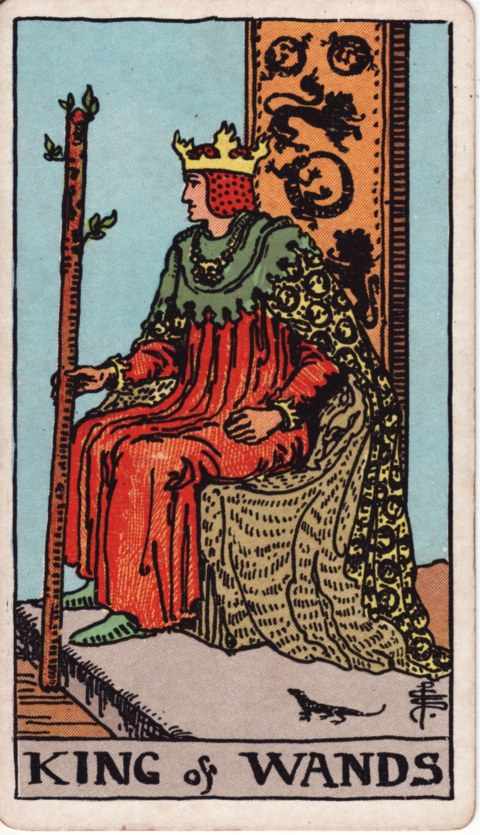
King of Wands meaning: who is this leader?
The King of Wands works outdoors. Waite's list for him is plain and almost rural: "Dark man, friendly, countryman, generally married, honest and conscientious." He then adds the line that carries the card: "The card always signifies honesty." Tarot.com sums up the same figure as someone who "doesn't wait for permission," and the picture agrees, since his wand is leafing out in his hand and no one is carrying it for him.
Think of a farm-co-op chairman, a head coach or a restaurant owner who works the line on a busy Friday. People follow because he has done the job and tells them straight what comes next. Labyrinthos calls him "a natural born leader of people," while Biddy Tarot adds that he is more inclined "to take an idea and then enlist others to help him actualise it."
Waite also mentions that the card "may mean news concerning an unexpected heritage to fall in before very long." That is a faint thread of luck running through the card, and the §4 line "Generally favourable; may signify a good marriage" pulls the same way. Take these as old fortune-teller flourishes.
King of Wands reversed: severe, hasty or just ignored?
Most modern pages turn this king over into a tyrant or a burnout. Tarot.com calls it "burnout masked as bravado." Waite does not. His reversed list reads: "Good, but severe; austere, yet tolerant." That is the same honest man, with his warmth switched down. The §4 list is odder still: for the reversed card it says only "Advice that should be followed."
Reading the two together gives a useful picture. The reversed king is a leader whose standards have hardened, who is stricter than the moment needs, or who gives orders faster than he explains them. Book T's ill-dignified portrait goes further, "cruel, intolerant, prejudiced and ill natured," and that is the version to watch for if the reversal is paired with other hard cards. On its own, Waite's version is a severe friend.
A check for a single-card draw: think of the last instruction you gave, or received, that began "just do it." Then ask whether the person could have repeated the reason back. If yes, the severity is earned and the advice in Waite's §4 line is worth following. If no, the reversal is a shortage of explanation, and the repair costs one extra sentence per order.
Wondering if the promotion, the loan or an ex will come through? The card shows how authority is behaving around the question and carries no dated result. If it stands for someone else, the fair question is whether that person listens when told something unwelcome; if it stands for you, the question is whether you would listen to yourself.
Is the King of Wands a yes or no card?
| Position | Answer |
|---|---|
| Upright | Yes, go ahead |
| Reversed | Yes, after you listen |
Upright, the King of Wands is a yes to starting, leading or asking for what you earned. Tarot.com says it outright, "the answer is YES," and the card's wand is already in leaf. Pair the yes with one honest check, whether you have told the people involved what you intend.
Reversed, it is a yes that carries a listening requirement: go ahead, but listen first. Waite's own reversed line is "Advice that should be followed," so take the advice before the action. Yes and no values are modern practice; neither old source states them.
King of Wands in love and friendship: how does he show what he feels?
In a relationship: loyal, loud and fast to forgive
In a couple the king is the partner who plans the trip and remembers the anniversary, and says so across a crowded room. Waite's "generally married" is a quirk of its era, but it points at something real, a person who treats commitment as a given. Labyrinthos adds a fair warning: "he is as quick to forget his anger as he is to incite it." So the argument can be big and the make-up quick, and the card checks whether both of you can live with that rhythm.
Single: someone who makes the first move
For someone single the card points to a person who asks you out plainly, or to your own readiness to do it. It suits a bold, open person in their middle years who already has a life worth joining. Expect warmth and a direct question, with little game-playing in between.
As feelings: attention, not hints
As feelings, this king gives open, steady interest that shows in time and effort. Tarot.com sees "magnetic, driven, and emotionally self-assured." The drawback is the style: a king used to leading can mistake a plan for a conversation, and a partner may feel managed when they meant to be asked.
Blunt friend, hard truth: the King of Wands
A friend tells you flatly that the person you are dating treats you badly, or that your business plan has a hole. Waite writes that the King "always signifies honesty". Among friends he says it to your face, not behind your back. He can still be wrong.
Reversed, he stays well meant but turns severe, and the truth arrives as a verdict. Either way the card describes his manner, not whether he is right. Ask one question before you answer: what made you say that? Then take a day. If you are the King here, ask first whether your friend wants your honest view.
Reversed in love: the fire gone strict
Reversed in love, Waite's wording suits the card well: "Good, but severe." It can describe a partner who has stopped asking and begun instructing, or a stretch in which you hold yourself to a strict standard and are hard to reach. The remedy is the same for both: say what you want as a request, then wait for an answer.
King of Wands at work and with money
At work he is the founder, the shop-floor manager, the department head and the freelancer who is also their own boss. Biddy Tarot's keyword list includes "entrepreneur" and "honour," and Waite's "honest and conscientious" supports the second one. The card advises setting the direction in one sentence and then letting the specialists do their part.
With money it favors straightforward dealing: a clear price, a written agreement and a plan for the next quarter. Waite's "unexpected heritage" is a curiosity that no budget should count on. This is not financial advice.
Upside down at work, the likely trouble is a leader whose standards leave no room for questions, which wastes talent and invites quiet resentment. Waite's phrase "Advice that should be followed" is a good test: has someone recently told you something useful that you waved off? With money, the reversed king can show a hasty commitment, so read the terms twice before signing.
King of Wands as advice and as a person
As advice the king says: announce it. Whatever you have been weighing in private, state it to the people it affects, with a date and a first step. A plan said aloud to the right three people is half done.
As a person, imagine a woman named Ilse who runs a bakery cooperative. A new member makes a mistake that costs a day's batch. Ilse says what went wrong in two sentences, asks what the member needs to avoid it, and is back at the ovens by noon. That is the upright king: no grudge held overnight.
Reversed, the advice is to slow down enough to be corrected. Ask one person you trust what they would change about how you lead, and write down the answer before replying.
How to read the King of Wands in a spread
In a spread, the king as the past stands for a leader or a burst of energy that set the question going. In the present he asks you to act with open intent. As an outcome he promises respect and a result you can be proud to own, and as advice he says to lead from the front. In the obstacle position he can be your own impatience.
Neighbors shift him a lot. By the dignity rules, "Wands are inimical to Cups." Put a Cups card next to him and either feeling cools the fire or the fire floods the feeling. The following line has it that "Wands are friendly with Swords and Pentacles," which suggests a Swords card gives his drive a clear aim and a Pentacles card gives it something to build on. More Wands cards flanking him raise his volume, for better or worse.
Beside the Five of Wands he is the one who settles the argument. Beside the Six of Wands he is the victory itself, with the crowd. Beside The Chariot, Book T's card for Cancer, where his zone begins, he is a ruler already in motion.
The King of Wands among the Wands
The Wands court closes with the King, whom Book T alone labels "Air of Fire," air feeding flame. The Knight is "Fire of Fire," pure and sudden, the Queen is "Water of Fire," steady and attractive, and the King is fire guided by thought. That explains the ease with which this king plans: he is the part of the suit that has learned to aim.
Book T lays the suit's courts around the sky in turn: the Knight from 20° Scorpio to the first two decans of Sagittarius, the Queen from the last decan of Pisces to 20° Aries, the King from the last decan of Cancer to the second decan of Leo. His span reaches into the height of summer, between about July 12 and August 12, so the leader of the fire suit is placed where the days are still long and the harvest is still ahead.
- Ace of Wands
- Two of Wands · Dominion
- Three of Wands · Established Strength
- Four of Wands · Perfected Work
- Five of Wands · Strife
- Six of Wands · Victory
- Seven of Wands · Valour
- Eight of Wands · Swiftness
- Nine of Wands · Great Strength
- Ten of Wands · Oppression
- Page of Wands
- Knight of Wands
- Queen of Wands
- King of Wands
Titles after the numbered cards are the Golden Dawn's names for them in Book T.
Symbolism of the Rider–Waite–Smith card
- The flowering wand. Waite says the king "uplifts a flowering wand." In the picture the staff is still sprouting leaves. We read it as authority that is still growing.
- Lions on the throne. Waite notes that "he connects with the symbol of the lion, which is emblazoned on the back of his throne." Book T goes one better and hitches a lion to the chariot: "His chariot is drawn by a lion."
- Salamanders. Salamanders bite their tails on his cloak, and a small one sits on the step beside him. Labyrinthos reads the tail-biting salamander as infinity, and the salamander is also the fire spirit of the suit: Book T calls the king "Prince and Emperor of Salamanders."
- Flame-shaped crown and cap of maintenance. Under the crown he wears what Waite calls "a cap of maintenance," like the other three kings. Our reading: the cap is the old mark of a ruler who holds office by right, which fits a card about honest authority.
- Book T's picture of him. Book T gives him large white wings and a winged crown, scale armor with a winged lion's head, a fire-wand and flames beneath his chariot. Where the modern card shows a man at rest on a throne, Book T shows one already moving.
What the oldest sources say
“Dark man, friendly, countryman, generally married, honest and conscientious. The card always signifies honesty, and may mean news concerning an unexpected heritage to fall in before very long. Reversed: Good, but severe; austere, yet tolerant.”
“Generally favourable; may signify a good marriage. Reversed: Advice that should be followed.”
Waite's main list reads like a character reference: friendly, married, honest, conscientious. The reversed list keeps the same man and turns the dial: "Good, but severe; austere, yet tolerant." Then §4 adds two odd lines. Upright, "Generally favourable; may signify a good marriage" sounds like a matchmaker's note. Reversed, "Advice that should be followed" is a direct address to the reader. Together they put the card on the side of its user, which is a long way from the arrogant tyrant of many modern pages.
Book T is harder on him. Its portrait begins "Swift, strong, hasty; rather violent, yet just and generous; noble and scorning meanness," and the ill-dignified clause turns that into "cruel, intolerant, prejudiced and ill natured." Haste is Book T's name for his fault, and it explains why a modern reader finds him reversed so often as impulsive. It also lets us place the card: Waite wrote the kind man and Book T the dangerous one.
King of Wands in the zodiac: Cancer to Leo
| Suit and element | Wands, Fire (Major Arcana card of fire: Judgement) |
|---|---|
| Part of the zodiac | 20° Cancer to 20° Leo |
| Book T | Air of Fire |
Attributions from Book T (Golden Dawn, c. 1892; printed 1912).
For the King of Wands Book T names a stretch of sky, not one decan: "He rules the heavens from above the last Decan of Cancer to the second Decan of Leo; hence he includes most of Leo Minor." In Book T the entry opens "The Prince of the Chariot of Fire" and closes on "Air of Fire." Leo Minor is the small constellation above Leo. The zone starts in Cancer, a water sign, and runs through Leo, a fire sign, and the major card for Cancer is The Chariot, a fitting match for a Prince in a chariot.
Walking Book T's decans in order, we find three numbered cards inside it: the Four of Cups (Lord of Blended Pleasure), the Five of Wands (Lord of Strife) and the Six of Wands (Lord of Victory). The order runs from mixed comfort through a quarrel to a win, which suits a leader who is known for settling matters. The Sun is in it from roughly July 12 to August 12.
When the Sun is in the King of Wands stretch
| Year | Sun enters 20° Cancer | Sun leaves (reaches 20° Leo) |
|---|---|---|
| 2026 | Jul 12 | Aug 12 |
| 2027 | Jul 12 | Aug 12 |
| 2028 | Jul 11 | Aug 12 |
| 2029 | Jul 11 | Aug 12 |
This year the Sun crossed the King of Wands stretch of the zodiac (20° Cancer to 20° Leo) from July 12 to August 12, 2026. Next time: July 12 to August 12, 2027 (US Eastern dates).
Dates are US Eastern, from the astronomy-engine ephemeris. Across 35,064 dates from 1930 to 2025, the Sun is in this stretch on 8.6% of them, and at least one of the ten planets is on 58.3%.
By our calculation the slow planets leave a short list. Saturn stood in the zone from 1975 to 1977 and again from 2004 to 2007, and it returns from late 2033 to mid-2036. Uranus arrives in July 2037 and stays, with a short break, until mid-2044. Jupiter was in the zone from May to October 2026 and comes back from late February to late May 2027. These are calendar facts about the sky, and nothing in them forecasts a result for the card.
Is the King of Wands in your birth chart?
Enter your birth date. We show which of the ten planets stood between 20° Cancer and 20° Leo that day, the slice of sky Book T gives this card; add the time if a planet was near the edge.
Enter your birth date above to see your result.
Every planet, angle and house from your birth time: birth chart calculator.
Questions about the King of Wands
Is the King of Wands a good card?
Yes. Waite writes "The card always signifies honesty," and his §4 list calls it "Generally favourable." Reversed, Waite gives "Good, but severe," so even then it is a stricter version of the same man.
What does the King of Wands mean as a person?
A warm, direct, experienced leader, honest and generous. Waite describes him as "Dark man, friendly, countryman, generally married." In a reading the card can also be you, or a part of you ready to lead.
What feelings does the King of Wands show?
Open, loyal interest that shows in time and effort, with plain speech. Reversed, the feelings stay but turn strict or impatient.
Is a King of Wands draw a yes?
Upright he is a yes, and Tarot.com agrees. Reversed he is a yes after listening to someone first. Both are modern readings; the old sources state neither.
What does the King of Wands reversed mean?
Many modern pages say arrogance or burnout. Waite is milder: "Good, but severe; austere, yet tolerant," with the §4 note "Advice that should be followed."
What sign does the King of Wands sit in?
His zone begins in Cancer and ends in Leo, per Book T, which labels him "Air of Fire." Sun dates: July 12 to August 12.
Is there a time attached to the King of Wands?
The card carries no date. As a convention only, the Sun is in his zone July 12 to August 12; that predicts nothing.
Sources
- Astronomy Engine: the open-source ephemeris library behind our planet positions, dates and statistics
- A. E. Waite, The Pictorial Key to the Tarot (1911), Wikisource: the divinatory meanings we quote, upright and reversed
- Book T (Golden Dawn), as printed in The Equinox I:8, 1912: the zodiac sign, Hebrew letter, title and short meaning of each card
- Wikimedia Commons: Rider–Waite–Smith tarot deck: Pamela Colman Smith's 1910 card drawings, public domain
- How we create our readings: our own calculation of sign dates, positions and the 1930 to 2025 statistics
Next to the King of Wands
In the suit of Wands: Queen of Wands ← King of Wands.
Cancer on this site: Cancer zodiac sign · The Chariot, the card of Cancer · your full birth chart.
All 22 Major Arcana with their signs and planets, and the minor cards written so far: tarot card meanings.
Written by The Zodiac Atlas editorial team with the help of AI and edited by a person. Quotations are from Waite's Pictorial Key to the Tarot and the Golden Dawn's Book T, both in the public domain; the card picture is a 1910 printing of Pamela Colman Smith's drawing for the 1909 deck. Sun dates and planet positions come from the astronomy-engine ephemeris (tropical zodiac). Tarot and astrology are symbolic traditions; they do not predict events.