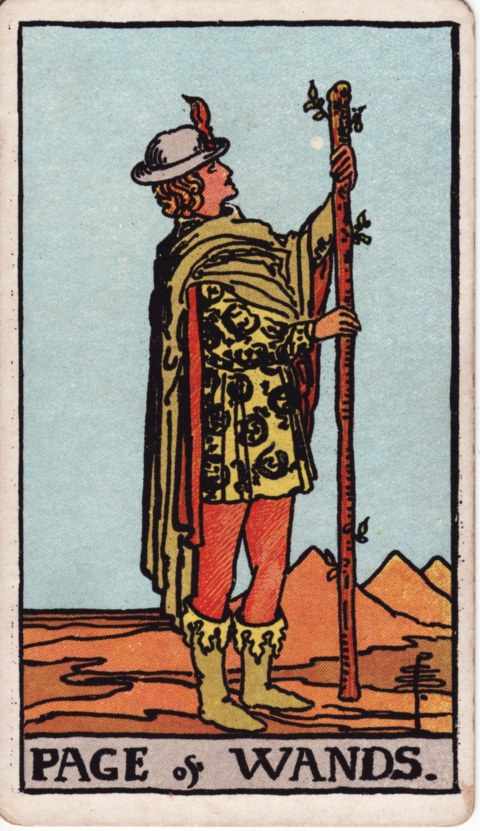
Page of Wands meaning: what is the spark asking?
Waite pictures the Page "in the act of proclamation," a young man who is "unknown but faithful" and whose "tidings are strange." Then his list becomes a job description: "Dark young man, faithful, a lover, an envoy, a postman." The card is partly a person and partly an errand. Either someone like this enters the picture, or something arrives that wants to be said aloud.
Modern readers keep the energy and drop the postman. Tarot.com calls it "that electric moment when an idea strikes and your whole body says yes." Biddy Tarot adds a point from the picture that is easy to miss: the Page "stands still, with his staff firmly planted on the ground," so the inspiration has not been acted on yet.
In a reading, that means a new interest that has hold of you, a course you want to take, a project you keep looking at, or a message with some enthusiasm in it. Waite also writes that "He may signify family intelligence," meaning news from relatives, and that "Beside a man, he will bear favourable testimony concerning him." Take the card as a good sign for curiosity and a small, useful errand.
Page of Wands reversed: bad news, doubt or too many starts?
Waite's reversed list is a bundle of words about speech: "Anecdotes, announcements, evil news. Also indecision and the instability which accompanies it." In §4 it shortens to "Bad news." Compare the modern pages, which hardly mention news and describe a temperament. Tarot.com has "shiny-object syndrome," and Biddy Tarot has ideas not yet formed, fear of starting and limiting beliefs.
That gives you four readings to sort. News you would rather not have is the old one. Indecision, also Waite's, is the second. The third is the pile of starts that never get followed up: Tarot.com's "lots of starts, no follow-through." The fourth is an idea that is not ready, which Biddy Tarot says needs room, since it is "very much in the early stages of formation." Only the first is something that happens to you. The other three describe how you are handling the spark.
A test for a single card: list the last three things you were keen about and write one word beside each, either "done," "waiting" or "dropped." Mostly "dropped" means the scattered start, and the fix is to choose one and finish a small piece of it this week. Mostly "waiting" means the idea is still forming and the card asks for patience. If nothing on the list stirs you at all, the card may be about the news: write down what you are bracing for and check whether it has arrived.
Asked about an ex, a reply or a decision somebody else has to make, the reversed Page shows your own indecision and has nothing to say about another person's answer. On pregnancy the card is silent: a test or a physician settles it, and the questions below say more.
Is the Page of Wands a yes or no card?
| Position | Answer |
|---|---|
| Upright | Yes, try it |
| Reversed | Hold off |
Yes and no belong to later practice; the old books never use them. Upright, the Page of Wands leans yes for trying, asking, learning and starting small, and Tarot.com adds a plain "YES." If the matter is large and permanent, take that as a yes to a first step only.
Reversed, hold off. Either the idea needs more shape or you are waiting for conditions that never arrive. Choose one small piece, do it, then ask again.
Page of Wands in love and friendship: a crush, a text or a rival?
In a relationship: playful, curious and a little cheeky
In a couple, the Page is the wish to try something new together and the surprise that comes with it: a message in the middle of the day, a plan made on impulse, a joke that restarts a flat week. Tarot.com mentions "passionate texts, or a revived spark." It suits a partnership that has gone quiet better than one that is already steady and settled.
Single: a crush or a first message
Alone, you may see this card as a new interest, a message with some enthusiasm in it, or your own readiness to write first. Labyrinthos lists "fleeting romance" for upright love, so enjoy it and give it a few weeks before you give it a name. Waite's §4 line, "Young man of family in search of young lady," is the old picture of the same thing: a keen beginner coming forward.
As feelings: eager, curious, not yet committed
As someone's feelings, the Page means fresh, eager, slightly shy interest. They are curious about you and want to find out more. This is a first-stage feeling, so it has not yet become a plan. Book T lists "enthusiasm" and "sudden in anger or love," which tells you that both warmth and temper arrive fast with this suit.
Flaky friends and the Page of Wands
A friend says yes to the hike, the birthday dinner and the apartment move, then cancels the day before with a cheerful apology. The Page of Wands is the messenger, full of news and keen on every new plan. Waite calls him "unknown but faithful", so upright he is a friend who means it each time and does turn up when it counts.
Reversed, Waite adds indecision, and the enthusiasm outruns the follow-through. The card gives no sign that they stopped caring. Propose one plan with a fixed time and place, and tell them you will go ahead without them if they are not there.
Reversed in love: mixed signals and a rival
Reversed, the card shows interest that starts and stalls: messages that come in bursts, plans that are not followed up, or hesitation on your own side. Waite's upright list has a line that fits a love triangle: "A dangerous rival, if followed by the Page of Cups." Reversed, his "indecision and the instability which accompanies it" is the plainer reading. If you ask whether someone will contact you, the card gives no answer; it describes the indecision and the stop-start rhythm around the question.
Page of Wands at work and with money
The Page at work is the new idea, the course, the internship, the first pitch, the person who is happy to learn on the job. Tarot.com says the card favors "boldness without attachment to outcomes." Waite's "envoy" and "postman" also suggest messages, deliveries, introductions and errands. For money, the card points at small beginnings at most: a first client, a side project, a modest fee. It promises no sum.
Drawn reversed, look at the pile of half-started projects, the application not sent, or news from a client or an employer that you have been putting off opening. Reversed on money, a keen start can turn into spending on gear and courses before any income arrives. Buy the cheapest version first.
Page of Wands as advice and as a person
Advice from the card: try the small version. Take the idea you keep thinking about and give it one hour this week. Tarot.com puts it as "Follow the spark," and adds that it "doesn't have to make sense yet."
In human form the Page is the keen beginner. Picture Lena, who has never run a race and signs up for a 5K on a whim after a friend's post. She buys shoes the same afternoon and tells everyone. If she is out on the road three weeks later, that is the upright Page. If the shoes are by the door and she has signed up for a pottery class instead, that is the reversed Page.
Reversed as advice: pick one thing and give it a month. Drop the rest for now and tell nobody else about it until you have something to show. If a message is what you are waiting for, remember it settles nothing you cannot settle yourself.
How to read the Page of Wands in a spread
Alone on the table, the Page says there is a new spark or a message in your life, and your move is to look at it and take one small step.
Early in a spread she marks the spark that began the matter, or a message that set it going. In the present she names a keen beginner or an errand now in progress. In the outcome position she points to a beginning more than an ending. Book T's table reads "Wands are friendly with Swords and Pentacles." A Swords card beside her shapes the idea into a plan, and Pentacles give it ground. The same table says "Wands are inimical to Cups." A Cups card can damp the fire or turn it into mood. Waite's own pair is the Page of Cups after her, which he reads as "A dangerous rival." The Knight of Wands after her is the same fire moving.
The Page of Wands among the Wands
In the suit the Page is the entry point. Book T seats the force of the Ace in her and calls her "Throne of the Ace of Wands." She is the first form the spark takes on earth. After her come the Knight who leaves, the Queen who holds and the King who rules.
Book T gives her the name "Earth of Fire," the ground in which the flame can burn. This is why the card reads as potential. She has the heat of the suit and none of its history yet.
- Ace of Wands
- Two of Wands · Dominion
- Three of Wands · Established Strength
- Four of Wands · Perfected Work
- Five of Wands · Strife
- Six of Wands · Victory
- Seven of Wands · Valour
- Eight of Wands · Swiftness
- Nine of Wands · Great Strength
- Ten of Wands · Oppression
- Page of Wands
- Knight of Wands
- Queen of Wands
- King of Wands
Titles after the numbered cards are the Golden Dawn's names for them in Book T.
Symbolism of the Rider–Waite–Smith card
- The tall leafing wand. Both his hands are on the wand and looks up at the green shoots near the top. Biddy Tarot says he is "inspired by the potential growth." Our reading is that he looks at it before he does anything with it, which is why the card is about the start of curiosity.
- The salamander tunic. Salamanders cover his yellow tunic, which are the fire animals of old lore. Labyrinthos reads them as "a symbol of transformation from bad to good." Book T calls the whole order of fire the "Salamanders," and its Page "Princess and Empress of the Salamanders."
- The feathered hat. The hat carries a single red feather. Waite's text does not mention it. Our reading is a messenger or a young traveler, which fits the "envoy" and "postman" of his list.
- The desert and the three pyramids. The ground is dry sand, and three pyramids sit far behind him, the same landscape as on the Knight of Wands card. Labyrinthos reads the desert as a world "that has not bared fruit yet." The empty ground can be read as a sign that nothing has been built, so everything is still possible.
- The Amazon in Book T. Book T does not draw a boy at all. Its Page is "A VERY strong and beautiful woman with flowing red-gold hair, attired like an Amazon," in a short kilt and scale-mail belt with a winged tiger's head, with her hand on an altar "ornamented with ram's heads." The Smith card draws a young man instead, in a tunic of salamanders.
What the oldest sources say
“Dark young man, faithful, a lover, an envoy, a postman. Beside a man, he will bear favourable testimony concerning him. A dangerous rival, if followed by the Page of Cups. Has the chief qualities of his suit. He may signify family intelligence. Reversed: Anecdotes, announcements, evil news. Also indecision and the instability which accompanies it.”
“Young man of family in search of young lady. Reversed: Bad news.”
Waite gives the Page two jobs. In the picture text he is "unknown but faithful," a proclaimer whose "tidings are strange." In the first list he is a lover, an envoy or a postman who "has the chief qualities of his suit," and the reversed list moves to "evil news" and "indecision." The §4 line, "Young man of family in search of young lady," is a matchmaker's sentence that treats the card as a suitor. The reversed "Bad news" is blunt. Neither is how the card is usually read now; modern pages go to the creative spark.
Book T is stranger and more forceful. Book T heads her entry "The Princess of the Shining Flame: the Rose of the Palace of Fire," and the temperament line reads "Brilliance, courage, beauty, force, sudden in anger or love, desire of power, enthusiasm, revenge." Ill dignified, she is "superficial, theatrical, cruel, unstable, domineering." In the general section the Princesses are "a Queen of Queens --- an Empress" who are "standing firmly of themselves." The word "Page" in modern use makes a beginner of her, yet Book T makes her a Queen of Queens, while adding that her power "existeth not, save by reason of the others."
Page of Wands and Fire
| Suit and element | Wands, Fire (Major Arcana card of fire: Judgement) |
|---|
Attributions from Book T (Golden Dawn, c. 1892; printed 1912).
Book T gives the Princess no decan and no sign. She "rules the heavens over one quadrant of the portion around the North Pole." Her elemental title is "Earth of Fire." The Princesses are said to rule the four parts of heaven that lie "above the respective Cherubic Signs of the Zodiac." They also form "the Thrones of the Powers of the Four Aces." The Major Arcana card for the element of fire is Judgement.
Which sign sits under her is a question of reading "Cherubic Signs." Read "Cherubic" as the fixed signs (that step is ours; Book T never spells it out) and the fire sign under her is Leo, the lion of the fixed cross. Book T's own picture shows a big cat, though a tiger and not a lion: a tiger on her crown, a tiger's head on her belt, and a tiger's skin on her mantle.
The nine numbered Wands, the Two to the Ten, are spread over Aries, Leo and Sagittarius in Book T, and the Page is not one of them. She stands outside that wheel beside the Ace, and her element is the fire of the Salamanders. Her club, Book T says, is "much longer than that carried by the King or Queen," a longer torch than theirs.
Questions about the Page of Wands
Is the Page of Wands lucky?
In most readings, yes. It is curiosity, a spark and a small beginning. Waite adds that the news may be "strange," and his reversed list includes "evil news."
What does the Page of Wands mean as feelings?
Fresh, eager, curious interest. They want to learn more about you and may act on impulse. Book T adds "sudden in anger or love." Reversed, the interest starts and stalls, or the person is unsure.
Does the Page of Wands mean pregnancy?
No standard source ties it to pregnancy. Waite's list has "family intelligence," meaning news from family. That question is for a pregnancy test or a doctor.
Who does the Page of Wands stand for?
A young, eager, curious person, or anyone new to something. Waite writes "Dark young man, faithful, a lover, an envoy, a postman." Book T draws a woman, "attired like an Amazon." Reversed, someone indecisive or easily distracted.
Is the Page of Wands a yes?
Yes for starting small and trying. Reversed, hold off. Tarot.com gives it YES; Waite and Book T are silent on it, so that rule is modern.
Is the Page of Wands a message or news?
It can be. Waite calls the figure an envoy and a postman, and his picture shows a proclamation. Upright, news is lively or curious. Reversed, it is "evil news" or an announcement that disappoints.
When will the Page of Wands happen?
The card gives no date, and Book T assigns the Page no stretch of the zodiac, so there are no Sun dates to borrow. The spark in the picture is a present-tense thing: the time to try is when you notice it.
Sources
- Astronomy Engine: the open-source ephemeris library behind our planet positions, dates and statistics
- A. E. Waite, The Pictorial Key to the Tarot (1911), Wikisource: the divinatory meanings we quote, upright and reversed
- Book T (Golden Dawn), as printed in The Equinox I:8, 1912: the zodiac sign, Hebrew letter, title and short meaning of each card
- Wikimedia Commons: Rider–Waite–Smith tarot deck: Pamela Colman Smith's 1910 card drawings, public domain
- How we create our readings: our own calculation of sign dates, positions and the 1930 to 2025 statistics
Next to the Page of Wands
In the suit of Wands: Ten of Wands ← Page of Wands → Knight of Wands.
All 22 Major Arcana with their signs and planets, and the minor cards written so far: tarot card meanings.
Written by The Zodiac Atlas editorial team with the help of AI and edited by a person. Quotations are from Waite's Pictorial Key to the Tarot and the Golden Dawn's Book T, both in the public domain; the card picture is a 1910 printing of Pamela Colman Smith's drawing for the 1909 deck. Sun dates and planet positions come from the astronomy-engine ephemeris (tropical zodiac). Tarot and astrology are symbolic traditions; they do not predict events.