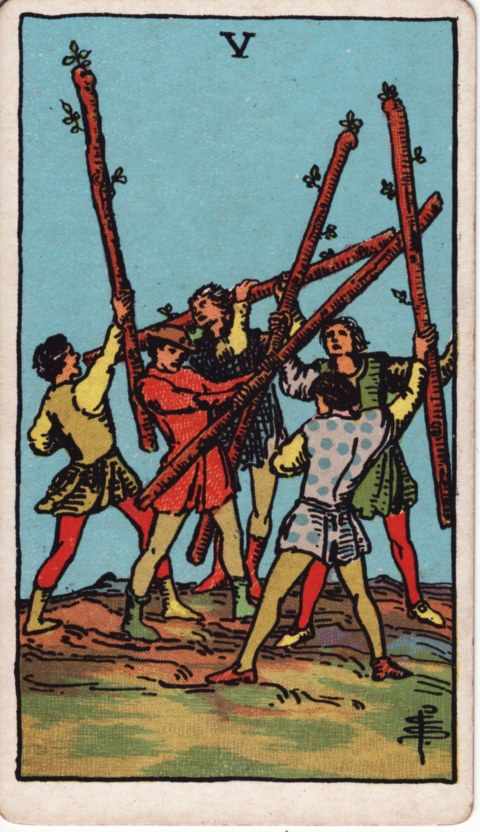
Five of Wands upright: a game, a fight or a race for gold?
Waite's picture line is short: "A posse of youths, who are brandishing staves, as if in sport or strife. It is mimic warfare." Mimic means imitation, and the meaning list opens with the same idea, "sham fight." Look at the card with that in mind. Nobody is on the ground or bleeding, and no one has pulled ahead. Biddy Tarot makes the same observation: "their wands are raised but not striking or injuring anyone." At work this week, find the rival offer or competing proposal in your way and set yours beside it on one written measure, such as cost, deadline or result.
Waite then turns to money. The imitation, he says, is joined by "the strenuous competition and struggle of the search after riches and fortune," and some attributions call it "a card of gold, gain, opulence." His short list adds "Success in financial speculation." That is an odd verdict for a card of quarrels, and it is no tip about markets. It does show that the old reading of this card was about getting ahead, with the noise as a side effect.
Labyrinthos allows that the men may be enjoying "a good natured rivalry, not anger." Book T is rougher. Its list runs from "Violent strife and boldness" to "cruelty," and then on to "prodigality and generosity," with the whole thing "depending on whether the card is well or ill dignified." So the same five staves can mean a sparring match or a brawl, and the surrounding cards decide which.
Five of Wands reversed: has the quarrel turned real?
Reversed, Waite gives "Litigation, disputes, trickery, contradiction." The play goes out of the fight. Staves become letters, claims and counter-claims. His short list softens that with "Quarrels may be turned to advantage," so even the bad side keeps a use. Newer pages often read the reversal the other way, as a truce or as a habit of dodging every argument. This week, put the disputed terms into one written message with a date for the reply, so the quarrel has a record.
That gives two roads from the same reversed card: a contest that has become real, and one that has stopped. They feel alike from inside, because in both you are tired of the noise. The difference is whether anything has been lost.
Working from this card alone, try the loss ledger. Take a sheet, write each person in the dispute as a column (yours too), and under every name list what that person has actually lost so far, with a sum or a date beside it. If every column is empty, you are still in the sham fight: ego, volume and position, and your choice is whether to keep playing. If a column holds a number or a date, the dispute is real and Waite's "litigation" side applies, so keep records and consider a mediator or a lawyer. If only your own column has entries, you are the one paying for this, and the next move is to stop paying.
If you asked whether a rival will back down, an ex will return or the case will end in your favor, the card cannot give a verdict. It describes the state of the contest as you stand in it, and it names no winner. For a real legal matter, a lawyer is the right reader.
Is the Five of Wands a yes or no card?
| Position | Answer |
|---|---|
| Upright | Not yet, a contest first |
| Reversed | Wait, settle it first |
Upright, the answer leans to not yet. Tarot.com says flatly "the answer is NO," and the picture agrees that a contest comes before any clean result. Yes fits a question like "should I enter the competition?" Old sources give no verdicts like this one; it is how readers use the card now.
Reversed, wait. If the dispute is still open, ask again once it has settled; if it has already ended, the question has probably changed.
Five of Wands in love and friendship: sparring, rivals, feelings
Together
For a couple, the card fits loud, quick arguments between two people who both like to win. Waite's "as if in sport or strife" is the useful phrase, because the picture leaves it open which one it is. A fair check is the day after a row: can both of you laugh about it, or is someone still keeping score? Laughter makes it a sham fight. Score-keeping is the sign to talk about the real subject.
Single
Single, the card shows competition for someone's attention, such as a rival, a crowded friend group or a person who enjoys being pursued. A wand does not win a person, so the picture is a warning against turning courtship into a match. Be one of the five who stands out by listening.
As feelings
If the card stands for how someone feels, it shows attraction with friction in it. They are engaged, perhaps excited, and they may tease or push. The card shows the heat and says nothing about the intention behind it. Play and hostility look the same until you watch how they act when you push back.
Banter or a jab? The Five of Wands in a friend group
One friend in your group has a joke about you that comes out at every dinner, and everyone laughs. Waite calls this card "mimic warfare," play that looks like a fight. Upright, check whether you are laughing too. Real sparring goes both ways and leaves nobody quiet in the car. Reversed, the play can go out of it: the jabs turn serious, or the sparring stops and a chill takes its place. If you flinch each time, tell that friend privately which joke it is and ask them to drop it.
Reversed: a truce or a silence?
Turned over in a love reading, arguments may stop because they are settled, or because someone has stopped speaking up. The second only looks calm. Ask which one applies. If one of you has given up bringing things up, that is the quarrel in its quiet form.
Five of Wands at work and with money
The card is a competition at work: colleagues going for one promotion, a pitch against two other firms, a team where every person has a different plan. Book T's "boldness" and "rashness" sit in the same list, so the warning is to compete on facts and pass on the first fight offered. Waite connects the card to "the battle of life," which here means the daily pressure of keeping up.
With money, Waite's second pass says "Success in financial speculation." Treat it as a record of what the card was thought to mean; it is no licence to gamble. If the question is about a sum at risk, an adviser knows more than any card. Reversed, a workplace quarrel may move to a formal channel such as HR or a written complaint, which fits Waite's "litigation." On money, a disputed invoice or shared bill should be settled in writing.
Five of Wands as advice and as a person
As advice, pick the arena you want to win in and leave the others alone. Compete where there is a measure, say what yours is, and let the noise outside it go past. Choose one small contest to enter this week and one to skip.
Taken as a person, this is a lively rival who likes the contest more than the prize. Picture a sales rep we will call Dana, an invented case, who is one of five on the same account. She does well when the team races and badly when it argues about who owns the lead. She needs a scoreboard everyone has agreed to. Book T's list supplies her fault, "rashness." For the reversed card the advice is this: a quarrel has stopped being play, so write down what it has cost and decide what you will still spend.
How to read the Five of Wands in a spread
Alone, the Five of Wands says there is a contest around your question. First find out whether it is a game or a fight, then ask who the other four are and what the prize is.
With three cards in a row, the first is a rivalry that shaped the matter, the middle one is a fight still running, and the last is friction that no card has resolved. Book T puts it as "Wands are inimical to Cups," which makes a Cup beside this card a bruise: feelings get hurt in the scuffle. Beside the Four of Wands, a settled matter is stirred up again; beside the Six of Wands, the contest ends in a win. Next to Strength, the trump of Leo, the temper is held by courage.
The Five of Wands among the Wands
The Five opens the Leo run in the suit. In Book T the three decans of Leo go to the Five (Strife), the Six (Victory) and the Seven (Valour), so the fight comes first, the win second and valour third. The card just before it, the Four of Wands, sits in the last decan of Aries and is titled Perfected Work. The fire passes from a finished job to a quarrel in one step.
The fifth sphere in Book T's general list carries the line "Opposition, strife and struggle: war; obstacle to the thing in hand." It adds that "Ultimate success or failure is otherwise shewn." The Five of Wands sets the question and leaves the result to other cards.
- Ace of Wands
- Two of Wands · Dominion
- Three of Wands · Established Strength
- Four of Wands · Perfected Work
- Five of Wands · Strife
- Six of Wands · Victory
- Seven of Wands · Valour
- Eight of Wands · Swiftness
- Nine of Wands · Great Strength
- Ten of Wands · Oppression
- Page of Wands
- Knight of Wands
- Queen of Wands
- King of Wands
Titles after the numbered cards are the Golden Dawn's names for them in Book T.
Symbolism of the Rider–Waite–Smith card
- Five leafy staves in a tangle. The staves cross in the middle and put out small green leaves near the tips. Waite says only "brandishing staves." Book T draws a different picture, with one upright wand in the middle and flames at the point of junction. As we see it, living wood makes a bad weapon, which supports the sham-fight reading.
- Five different tunics. Each young man wears his own colors, and no two match. There are no uniforms and no sides. Waite calls them "a posse of youths," and the picture shows each man for himself. Biddy Tarot reads the clothes as diverse backgrounds.
- Nobody hurt. No one has fallen, bled or dropped a staff. The absence is the strongest symbol on the card, since it is what Waite means by "mimic."
- Open rough ground. The ground is brown earth with patches of grass, under a plain blue sky. Nothing marks a boundary: no wall, referee or crowd. With nobody watching or judging, only the players can end the contest.
- A figure seen from behind. One youth is drawn from the back, legs wide apart, both arms up in the tangle. As we read it, he is the player you cannot read, the rival whose motive you are guessing.
What the oldest sources say
“Imitation, as, for example, sham fight, but also the strenuous competition and struggle of the search after riches and fortune. In this sense it connects with the battle of life. Hence some attributions say that it is a card of gold, gain, opulence. Reversed: Litigation, disputes, trickery, contradiction.”
“Success in financial speculation. Reversed: Quarrels may be turned to advantage.”
“Violent strife and boldness, rashness, cruelty, violence, lust, desire, prodigality and generosity; depending on whether the card is well or ill dignified.”
Waite's text puts the play first. His meaning list begins "Imitation, as, for example, sham fight," and only then turns to "the strenuous competition and struggle of the search after riches and fortune." The reversed line is the legal side, "Litigation, disputes, trickery, contradiction." The later digest adds one hopeful line for each direction, "Success in financial speculation" and "Quarrels may be turned to advantage." Together they make a card of competition that pays off when handled well.
Book T has no youths. Two "White Radiant Angelic Hands" hold five wands "or torches," one upright in the middle and the others crossing. The card is called the Lord of Strife, and its short label is "Quarrelling and fighting." Its meaning list is openly contradictory, with "cruelty" and "generosity" side by side. Book T leaves the choice to the dignity, so the card stays open until the cards around it settle it.
Five of Wands and Saturn in Leo: the card's decan
| Suit and element | Wands, Fire (Major Arcana card of fire: Judgement) |
|---|---|
| Decan | 0° to 10° ♌︎ Leo, the first ten degrees of the sign |
| Planet of the decan | Saturn (Major Arcana: The World) |
| Major Arcana card of Leo | Strength |
| Golden Dawn title | The Lord of Strife |
| Place on the Tree of Life | Geburah (Book T: “Quarrelling and fighting”) |
Attributions from Book T (Golden Dawn, c. 1892; printed 1912).
In Book T, the first ten degrees of Leo belong to the Five of Wands, and the planet is Saturn: "Above the middle wand is the sign Saturn, and below is that of Leo." So the sign and the suit share one element. The trumps that answer to this decan: Strength for Leo, The World for Saturn, Judgement for fire.
Tradition counts Saturn in Leo as a planet in its detriment, since Saturn rules Aquarius, the sign opposite. That is the old way of saying the planet works against the grain here, which suits a card of friction. The decan also "hath its beginning from the Royal Star of Leo," usually identified as Regulus (that identification is ours). The whole decan sits within the sky that Book T assigns to the King of Wands.
When the Sun is in the Five of Wands stretch
| Year | Sun enters 0° | Sun leaves (reaches 10° Leo) |
|---|---|---|
| 2026 | Jul 22 | Aug 2 |
| 2027 | Jul 22 | Aug 2 |
| 2028 | Jul 22 | Aug 1 |
| 2029 | Jul 22 | Aug 1 |
This year the Sun crossed the Five of Wands stretch of the zodiac (0° to 10° Leo) from July 22 to August 2, 2026. Next time: July 22 to August 2, 2027 (US Eastern dates).
Dates are US Eastern, from the astronomy-engine ephemeris. Across 35,064 dates from 1930 to 2025, the Sun is in this stretch on 2.9% of them, and at least one of the ten planets is on 25.4%.
This is Saturn's own decan, and by our ephemeris it stood here from 1975 to 1977 with breaks, again in 2005 and 2006, and returns from 2034 to 2035. Jupiter crossed it this summer, from July 1 to August 16, 2026, and was here before in 2014. Uranus passed through from 1955 to 1958 and returns from 2039 to 2042. Neptune and Pluto stay out of it for the whole span from 1950 to 2060. None of this forecasts an event.
Is the Five of Wands in your birth chart?
Enter your birth date. We show which of the ten planets stood between 0° and 10° Leo that day, the slice of sky Book T gives this card; add the time if a planet was near the edge.
Enter your birth date above to see your result.
Every planet, angle and house from your birth time: birth chart calculator.
Questions about the Five of Wands
Is the Five of Wands a bad card?
It is uncomfortable more than bad. Waite calls it "mimic warfare," and his short list adds "Success in financial speculation." Book T is harsher and lets the dignity of the card decide.
What does the Five of Wands mean as feelings?
Attraction with friction: interest, teasing, pushing. The card shows the heat and leaves the intent open.
Is the Five of Wands yes or no?
Upright, mostly no for now, because the contest comes first; reversed, wait. The old sources stay out of yes and no; the rule is modern.
What does the Five of Wands reversed mean?
Waite gives "Litigation, disputes, trickery, contradiction." Modern pages also read a truce or avoidance. A written list of what each side has actually lost shows which one fits.
What is the Five of Wands meaning in love?
Rows between two people who both like to win, or rivals for one person. Check whether the arguments end in laughter or in score-keeping.
What does the Five of Wands mean at work?
Competition among colleagues or firms. Compete on a measure you can show, and settle any real dispute in writing.
Five of Wands: which sign, and which dates?
Leo, the first ten degrees, held by Saturn in Book T. The card names no date. By convention some readers use the Sun's pass through this decan, about July 22 to August 2, and that is only a calendar habit.
Sources
- Astronomy Engine: the open-source ephemeris library behind our planet positions, dates and statistics
- A. E. Waite, The Pictorial Key to the Tarot (1911), Wikisource: the divinatory meanings we quote, upright and reversed
- Book T (Golden Dawn), as printed in The Equinox I:8, 1912: the zodiac sign, Hebrew letter, title and short meaning of each card
- Wikimedia Commons: Rider–Waite–Smith tarot deck: Pamela Colman Smith's 1910 card drawings, public domain
- How we create our readings: our own calculation of sign dates, positions and the 1930 to 2025 statistics
Next to the Five of Wands
In the suit of Wands: Four of Wands ← Five of Wands → Six of Wands.
Leo on this site: Leo zodiac sign · Strength, the card of Leo · your full birth chart.
All 22 Major Arcana with their signs and planets, and the minor cards written so far: tarot card meanings.
Written by The Zodiac Atlas editorial team with the help of AI and edited by a person. Quotations are from Waite's Pictorial Key to the Tarot and the Golden Dawn's Book T, both in the public domain; the card picture is a 1910 printing of Pamela Colman Smith's drawing for the 1909 deck. Sun dates and planet positions come from the astronomy-engine ephemeris (tropical zodiac). Tarot and astrology are symbolic traditions; they do not predict events.