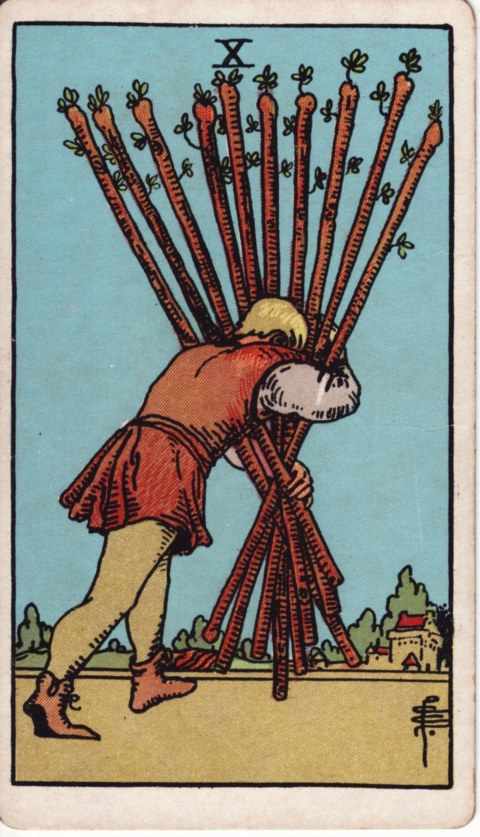
Ten of Wands upright: who is this load really for?
Waite draws the scene in a single line: "A man oppressed by the weight of the ten staves which he is carrying." Count what he has: ten staves, no free hand, no view of the road. The bundle rises above his head, and it hides his face. Tarot.com puts the modern verdict well: "Success isn't about carrying it all." At work this week, list everything you are carrying and pick the one item that another named person could do at 80 percent of your standard, then give it away.
Waite's long entry is odd, and he says so himself: "A card of many significances, and some of the readings cannot be harmonized. I set aside that which connects it with honour and good faith." Then comes the line that carries the weight: "it is also fortune, gain, any kind of success, and then it is the oppression of these things." The load, on this account, is what the good fortune turned into. People who have just won something, such as a promotion, a business or a family, know the shape of it.
Waite adds a warning most readers pass over: "The place which the figure is approaching may suffer from the rods that he carries." The house in the picture is where he is going, and the lower ends of the staves point toward it. A burden you bring home to the people you live with becomes their burden. Labyrinthos reads a happier ending, that the man "has finished the hardest part" and needs only a place to rest. The picture can support either. Look at how close the house is, and how much of the load will still be on your back when you reach the door.
Ten of Wands reversed: put it down, or tangled up?
Waite's reversed line is "Contrarieties, difficulties, intrigues, and their analogies." In his book the turned card is no lighter. It adds friction, with people working against each other, and that differs from the modern reading of a load being set down. Biddy Tarot's keywords for the reversed card include "delegation, release." This week, if your task is tied up in a dispute, write the three facts both sides agree on and send them to the people involved before anything else.
The two meanings can sit in one situation. A person who is carrying too much alone often has a quarrel with someone over who should have helped. The load and the intrigue grow from the same place: nobody agreed who owns what. The first aim is to see which stave belongs to whom.
With one card, try the one-stave test. Pick a single task from your load. Write a person's name and the exact sentence you would use to hand it over, in one line, beginning "Could you take." If the line writes itself, the load was never the problem, and you can simply say it to that person. If you cannot write it, because you do not trust anyone with it or you doubt anyone would say yes, the problem is the asking, and the useful work is to find who could be asked. If you can name no one at all, the load is bigger than a favor, and the question for a manager or a family meeting is who is missing.
A lawsuit to be won, a rival to fail or a person to return: the card does not say. Waite himself adds that in a lawsuit the card means "certain loss," which is a period remark. It describes your own load, and it names no date or ruling. A legal matter needs a lawyer, not a card.
Is the Ten of Wands a yes or no card?
| Position | Answer |
|---|---|
| Upright | Yes, at a cost |
| Reversed | Not alone |
Upright, the answer is a qualified yes, and effort is the cost. The picture supports a hedge: you can get there, and you will carry more than you planned. It fits a question like "can I finish this?" and fits worse a question like "will this be easy?"
On a reversed draw the answer depends on company. If someone else shares the load it improves; if no one does, ask again after you have handed one task over. Neither old book rates this card, so these two answers are ours.
Ten of Wands in love and friendship: who carries the house?
In a relationship
For a couple, the card describes one person who carries the house: the bills, the calendar, the feelings, the family. Labyrinthos reads the card as responsibility that follows success. Ask each other what the other thinks you carry, and compare the lists. Waite's warning about the house the man approaches fits a partner who comes home from work with the load still on.
Single
Single, the card shows someone whose life is so full that dating has no room in it. A new person would be one more stave. One modest move fits the picture: decide on one evening a month that carries no tasks, and keep it free for whatever, or whoever, arrives.
As feelings
Read as feelings, the card shows an overloaded person who still cares. They may be short with you because they have nothing to spare, and the feeling may be intact; the card cannot say which. Book T's list of "Ill-will, levity, lying" is the ill-dignified side, a different case, and the picture shows neither.
Carrying a friend's whole wedding: the Ten of Wands
You said yes to helping a friend with her wedding, and now the venue calls, the gift list and the bridesmaids' group chat all land on you. That bundle is the Ten of Wands. Waite's chief meaning is "oppression simply", and he admits it can arrive with success: the happy event itself becomes the weight.
Reversed, he adds intrigues, which in a wedding party looks like side chats about who is slacking. None of it means you love her less. Write down three tasks, put a name beside each, and send the list to the group. Keep one for yourself and let the rest go.
Reversed in love: dropped, shared or tangled?
Turned the other way up, the card may show a couple finally splitting the weight, a partner who put everything down and walked away, or, in Waite's wording, tangled "intrigues," such as a third person or a family quarrel. Check which one fits before you assume the best or the worst.
Ten of Wands at work and with money
In a workplace, the card is the overloaded high performer: the person who said yes to the promotion, the product and the team. Book T traces failure to "the person's too great selfishness at the beginning," and we read that as a warning about the first yes. Whoever takes everything at the start meets an opposition "too strong to be controlled" at the end. The practical move is to write down who owns each task, and what you will drop.
With money, the load is debts, dependents or a business that has grown past one pair of hands. Waite's "fortune, gain, any kind of success, and then it is the oppression of these things" suits a windfall that brings tax, a raise that brings a bigger rent, or a firm that outgrows its owner. Reversed, the same sums may be shared out or paid down, or an intrigue may surface in the accounts, so keep records.
Ten of Wands as advice and as a person
Stop admiring the load and measure it. Count the staves, mark which ones are yours by choice and which by habit, and put the habit ones down first. The house is close. Setting down three before you arrive costs less than collapsing at the door.
Seen in human form, the card is the one everyone leans on. Ines is an invented example: a head nurse who covers every shift gap, trains the new hires and fills the family's calendar too, and calls it nothing. Book T supplies her good side, "generosity, disinterestedness and self-sacrifice, when well dignified." On a reversed draw, say to one person what you can no longer carry, and name the date you will stop.
How to read the Ten of Wands in a spread
Alone in a spread, the Ten of Wands says the matter is heavy because too much of it sits with you. Ask what you are carrying that belongs to someone else, and who could take it.
In a row, an early Ten is a load behind the question, a middle one is today's weight, and a last one is a success that will cost effort to keep. Among the dignities, "Wands are inimical to Cups" makes a Cup beside it the feeling that suffers under the load. Waite writes that success is stultified if the Nine of Swords follows, which is a worry spreading into the night. After the Nine of Wands, the stand has turned into a haul. Beside Temperance, the trump of Sagittarius, pace yourself before you speed up.
The Ten of Wands among the Wands
The Ten closes the numbered Wands, and Book T gives it the last ten degrees of Sagittarius. The suit's fire has crossed three signs: Aries starts it, Leo fights it, and Sagittarius carries it. Of the three cards of Sagittarius, the Eight is Swiftness, the Nine Great Strength and the Ten Oppression, as the Nine of Wands page sets out.
Waite's Ten is also the one Wands card where the staves are not planted, wielded or thrown. They are gathered into one armful. The suit that begins with a single branch in a hand ends with a man who cannot put it down. The next card in the suit is the Page, who holds a single staff, so the suit starts again with the load reduced to one. That sequence is our reading.
- Ace of Wands
- Two of Wands · Dominion
- Three of Wands · Established Strength
- Four of Wands · Perfected Work
- Five of Wands · Strife
- Six of Wands · Victory
- Seven of Wands · Valour
- Eight of Wands · Swiftness
- Nine of Wands · Great Strength
- Ten of Wands · Oppression
- Page of Wands
- Knight of Wands
- Queen of Wands
- King of Wands
Titles after the numbered cards are the Golden Dawn's names for them in Book T.
Symbolism of the Rider–Waite–Smith card
- Ten staves in one bundle. The staves are brown-orange with green sprouts and leaf tufts, so the wood is alive. Waite does not describe the leaves. As we read it, a load of living things is a load of obligations that keep growing.
- The hidden face. The staves cover the man's head, and the viewer sees only his back and hair. Waite names no expression. The hidden face suggests he cannot see where he is going.
- The bent walk. He leans forward and walks to the right, hugging the bundle to his chest with his arms around the lower half. The lower ends of several staves reach the ground. Nothing is held by the end, as the other Wands figures hold theirs; the whole bundle is simply embraced.
- The house with red roofs. A small village with red roofs and trees stands on the horizon ahead. It is the place Waite says may suffer from the rods. The picture also allows a rest there, and its distance is the useful part.
What the oldest sources say
“A card of many significances, and some of the readings cannot be harmonized. I set aside that which connects it with honour and good faith. The chief meaning is oppression simply, but it is also fortune, gain, any kind of success, and then it is the oppression of these things. It is also a card of false-seeming, disguise, perfidy. The place which the figure is approaching may suffer from the rods that he carries. Success is stultified if the Nine of Swords follows, and if it is a question of a lawsuit, there will be certain loss. Reversed: Contrarieties, difficulties, intrigues, and their analogies.”
“Difficulties and contradictions, if near a good card.”
“Cruel and overbearing force and energy, but applied only to material and selfish ends. Sometimes shows failure in a matter, and the opposition too strong to be controlled; arising from the person's too great selfishness at the beginning. Ill-will, levity, lying, malice, slander, envy, obstinacy; swiftness in evil and deceit, if ill dignified. Also generosity, disinterestedness and self-sacrifice, when well dignified.”
Waite gives a plain verdict after admitting his list is uneven: "The chief meaning is oppression simply." The rest of the entry is a list of what oppression can wear: fortune, gain, success, and also "false-seeming, disguise, perfidy." The last clause, "if it is a question of a lawsuit, there will be certain loss," is the period note. His short list is milder: "Difficulties and contradictions, if near a good card." His reversed entry, "Contrarieties, difficulties, intrigues," echoes it.
Its Book T title is Lord of Oppression, with Malkuth as the sphere with the label "Cruelty, malice, revenge, injustice." That label is harsher than anything in the picture. The meaning list starts with "Cruel and overbearing force and energy," and then does something odd for a card of cruelty: it ends with "generosity, disinterestedness and self-sacrifice, when well dignified." The same force is the villain or the hero by the cards around it. One way to read the pair: the oppressor is a person who takes everything, and the Waite man is the oppressed version of the same energy.
Ten of Wands and Saturn in Sagittarius: the card's decan
| Suit and element | Wands, Fire (Major Arcana card of fire: Judgement) |
|---|---|
| Decan | 20° to 30° ♐︎ Sagittarius, the third ten degrees of the sign |
| Planet of the decan | Saturn (Major Arcana: The World) |
| Major Arcana card of Sagittarius | Temperance |
| Golden Dawn title | The Lord of Oppression |
| Place on the Tree of Life | Malkuth (Book T: “Cruelty, malice, revenge, injustice”) |
Attributions from Book T (Golden Dawn, c. 1892; printed 1912).
In Book T the Ten of Wands rules the last ten degrees of Sagittarius, 20° to 30°, under Saturn: "Saturn and Sagittarius." Sagittarius is fire too, like the suit. Linked Major Arcana cards: Temperance for Sagittarius, The World for Saturn and Judgement for fire.
Saturn is the planet of weight and limit, and a card of weight with Saturn on it fits without much argument. The link between the planet and the heavy bundle is our reading; Book T stops at naming the planet and the sign. The decan ends at the December solstice. The Queen of Pentacles page covers the wider zone that holds it.
When the Sun is in the Ten of Wands stretch
| Year | Sun enters 20° | Sun leaves (reaches 30° Sagittarius) |
|---|---|---|
| 2026 | Dec 11 | Dec 21 |
| 2027 | Dec 12 | Dec 21 |
| 2028 | Dec 11 | Dec 21 |
| 2029 | Dec 11 | Dec 21 |
This year the Sun crosses the Ten of Wands stretch of the zodiac (20° to 30° Sagittarius) from December 11 to December 21, 2026 (US Eastern dates).
Dates are US Eastern, from the astronomy-engine ephemeris. Across 35,064 dates from 1930 to 2025, the Sun is in this stretch on 2.7% of them, and at least one of the ten planets is on 26.3%.
The Sun passes through the decan from December 11 to December 21, 2026, so the next pass is soon, and again from December 12 to 21, 2027. Our ephemeris puts Saturn in the decan from December 22, 2016 to December 21, 2017, with a return in 2046 and 2047. Jupiter stood here from February to June and October to December 2019, and returns in 2031. Pluto was in the decan from 2003 to 2008, Uranus from 1986 to 1988 and Neptune from 1979 to 1984. No event is foretold by these ranges.
Is the Ten of Wands in your birth chart?
Enter your birth date. We show which of the ten planets stood between 20° and 30° Sagittarius that day, the slice of sky Book T gives this card; add the time if a planet was near the edge.
Enter your birth date above to see your result.
Every planet, angle and house from your birth time: birth chart calculator.
Questions about the Ten of Wands
Is the Ten of Wands a bad card?
It is a heavy card more than a bad one. Waite calls the chief meaning "oppression simply," yet includes fortune and success among its forms. Book T balances cruelty with generosity.
What does the Ten of Wands mean as feelings?
Care that is buried under duties. The person may have little left to give, which is not the same as having no feeling.
Can I read the Ten of Wands as a yes?
Upright, yes at a cost; reversed, not alone. No verdict of this kind appears in the old books, so the rule is convention.
Ten of Wands reversed: setting it down or intrigue?
In Waite: "Contrarieties, difficulties, intrigues." Modern pages read setting the load down. Writing one name and one sentence of request shows if the problem is the load or the asking.
What does the Ten of Wands mean in love?
One partner carrying most of the household or the emotional work. Compare lists before blaming anyone.
What does the Ten of Wands mean at work?
Overload after success. Name an owner for each task and hand one away this week.
Ten of Wands astrology: which sign, and when?
Sagittarius, the last ten degrees, Saturn's in Book T. The card gives no day. Some readers borrow the Sun's pass, December 11 to 21, as a calendar habit.
Sources
- Astronomy Engine: the open-source ephemeris library behind our planet positions, dates and statistics
- A. E. Waite, The Pictorial Key to the Tarot (1911), Wikisource: the divinatory meanings we quote, upright and reversed
- Book T (Golden Dawn), as printed in The Equinox I:8, 1912: the zodiac sign, Hebrew letter, title and short meaning of each card
- Wikimedia Commons: Rider–Waite–Smith tarot deck: Pamela Colman Smith's 1910 card drawings, public domain
- How we create our readings: our own calculation of sign dates, positions and the 1930 to 2025 statistics
Next to the Ten of Wands
In the suit of Wands: Nine of Wands ← Ten of Wands → Page of Wands.
Sagittarius on this site: Sagittarius zodiac sign · Temperance, the card of Sagittarius · your full birth chart.
All 22 Major Arcana with their signs and planets, and the minor cards written so far: tarot card meanings.
Written by The Zodiac Atlas editorial team with the help of AI and edited by a person. Quotations are from Waite's Pictorial Key to the Tarot and the Golden Dawn's Book T, both in the public domain; the card picture is a 1910 printing of Pamela Colman Smith's drawing for the 1909 deck. Sun dates and planet positions come from the astronomy-engine ephemeris (tropical zodiac). Tarot and astrology are symbolic traditions; they do not predict events.