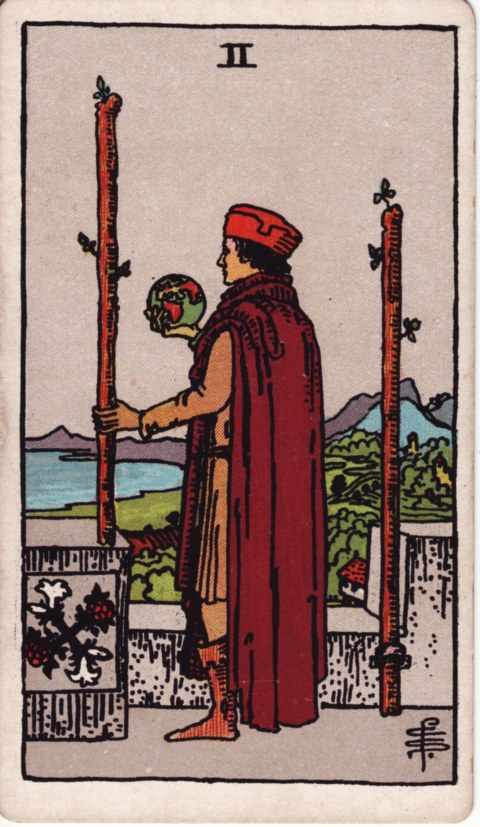
Two of Wands upright: a plan, or a sad lord on a wall?
Waite's picture line is plain: "A tall man looks from a battlemented roof over sea and shore; he holds a globe in his right hand, while a staff in his left rests on the battlement; another is fixed in a ring." Nobody is in a hurry. He has a wall under his feet, a view in front of him and two staffs, one held and one bolted down. Biddy Tarot sees planning in it: the man "is still very much in the planning phase." For work or money, pick the one project you keep describing in the future tense and spend this week on its first small, dated step, such as a call, a quote or a draft.
The card gets odd when you read Waite's own text, because his upright entry never mentions a plan. It says "Between the alternative readings there is no marriage possible," and it sets "riches, fortune, magnificence" against "physical suffering, disease, chagrin, sadness, mortification." Then comes the line that explains the face: "here is a lord overlooking his dominion and alternately contemplating a globe." The man has everything in view and is not obviously glad. Waite compares him to "the sadness of Alexander amidst the grandeur of this world's wealth." The old story of Alexander is the conqueror who wept because no worlds were left to win, but Waite does not retell it, so that link is ours.
So there are two Twos on offer. The modern one is a person with options, ready to choose how far to go. Waite's is a person who already holds a lot and feels that it is not enough, or not what he wanted. Both fit the picture, and they ask different questions. Do you need a bigger plan, or do you need to find out what the plan is for? If your answer to the second is vague, make that your first step, before a map or a budget.
Two of Wands reversed: fear, surprise or a plan on hold
Reversed, Waite's short list is "Surprise, wonder, enchantment, emotion, trouble, fear." It is the odd one out among the lists on this card: it has no planning in it. It reads like something arriving from outside and shaking the lord out of his thoughts. Newer pages lean elsewhere. Biddy Tarot gives the reversed card "fear of unknown, lack of planning," which is closer to a plan stalled on the wall. So the same upside-down card can be an interruption or a standstill. For work and money, hold any big signature or order for now. First note what you fear, then check one fact about it (a price, a date, a rule).
The two readings feel alike from the inside, so run a one-sentence test. Say the plan aloud as a sentence with a verb, a place and a month: "I will apply to the Lisbon office by March." If the sentence will not form, you are in planning fog and the next job is to choose, which a reread of the card will not do. If it forms and your stomach drops, that drop is the "fear" in Waite's list, and it is information about the size of the step. If it forms and you feel flat, the plan may be somebody else's.
The surprise side is worth a look too. When something unexpected has just shifted your picture, such as an offer, a message or a bill, the reversed card says take a day before you commit your answer. Waite lists "wonder" beside "trouble" and does not say which one is coming.
Questions about a partner's commitment or an ex's return get no answer here. The picture holds a lord on a wall, and nobody else. It describes where you are standing and how far you can see. Their plans are theirs to state.
Is the Two of Wands a yes or no card?
| Position | Answer |
|---|---|
| Upright | Yes, with a first step |
| Reversed | Hold off |
Upright, the usual modern answer is yes. Tarot.com is direct: "the answer is YES." We agree with a condition: yes to planning, researching and making a first move, while the old ground stays unburned. The staff bolted to the wall is still there.
Reversed, hold off. Waite's "trouble, fear" argues for delay, and a surprise argues for a pause. Neither old text rules on it, which leaves both answers to later practice.
Two of Wands in love and friendship: your future, theirs or a shared one?
In a relationship
For a pair, the card looks ahead: where you want this to go, and whether both of you can see the same horizon. Talking about a move, a shared trip or a long-term plan fits it. Waite's sad lord adds a second reading, a partner who has plenty and still looks past it. If one of you keeps looking out over the wall, ask what they are looking for.
Single
Single, the card describes a person thinking about the shape of a future life, such as where to live or what kind of bond to want, more than one person in particular. It can mean widening where you look, like a new city, a class or a trip. Waite's "alternately contemplating a globe" also covers the mood of having much on offer and wanting none of it for now. Both are fine to say out loud.
As feelings
As a reading of someone's feelings, the Two of Wands is interest held in check by thought, with ambition in it. They may be considering you alongside other plans, a job, a move. The picture shows a man alone with his thoughts, so the feeling may be about their own future more than about you. Ask what they are planning. A card cannot read it.
Does it mean commitment is coming?
Reversed in love, the card shows a plan that stalled or a fear of the next step, and Waite's "surprise" can mean a turn nobody expected. It does not tell you what another person will decide, and it gives no dates. Use it to look at your own side: what you want next, and whether you have said it.
Asked to share a flat with a friend? The Two of Wands
A close friend asks if you would take an apartment together next year, and you say you will think about it. The Two of Wands is Waite's "a lord overlooking his dominion": a man with a globe in one hand who has not yet chosen. Upright, the offer is real and you may look at it from the wall for a while. Reversed, the card leans to doubt or a surprise, and the doubt usually hides one specific worry, such as rent or dishes. Write down two things you would need from a shared home and ask the friend for theirs.
Two of Wands at work and with money
Where a job is the question, the card fits someone standing between a stable job and a larger step: a second office, a business of their own, a role abroad. The picture backs a slow start, since both staffs are close and nothing is in motion yet. Book T's title, Dominion, adds a note of authority: the lord wants influence over others, which suits a manager, an owner or someone about to run a project. Money-wise, it points to planning and holding what you have while you look, with no promise of income.
Reversed, work and money read as a plan on pause or a decision under fear. Do not quit, buy or invest in the same week the card shakes you. Instead, write the worst realistic result of the plan in one line and the cheapest way to test it in another. Waite's "surprise" can also mean news from outside, such as a reorganization or an offer, so wait for the details before answering.
Two of Wands as advice and as a person
Taken as a tip, look at the whole map before choosing a road. Spend one evening listing assets, wishes and trade-offs, then pick one small action that starts it. Waite's sad lord is a warning that a lot of resources do not settle the question of what you want them for.
In human form, the Two of Wands is someone planning far ahead who may be restless in a good position. Here is an invented case: Marta runs a bakery that does well and keeps pricing a second shop in another town. She has the means and the view, and what she lacks is a reason for the second shop that she could say in one sentence. Reversed as advice: stop collecting options, say the plan in one sentence, and give it a month. If it will not form, let it go for now.
How to read the Two of Wands in a spread
Pulled alone, the Two of Wands says you are standing on a wall with a view, and the question is how far to go. Use it to write down the plan and its first step. If the card seems unrelated to your question, treat it as a nudge to list what you hold and what you want.
In a past position, it shows a plan or an ambition that shaped the matter. In the present, you are weighing options. In the future spot, it points to a choice coming, a decision about how far to expand. A Sword nearby gives the plan words; a Pentacle gives it money or ground. After the Ace of Wands, the spark has been given a place; before the Three of Wands, the plan is on its way to something steady. Beside The Emperor, the trump of Aries, the lord is in his own country. Book T backs the Sword and Pentacle pairing with its rule "Wands are friendly with Swords and Pentacles."
The Two of Wands among the Wands
The Two sits where the Wands stop being a spark and start being a decision. In Book T the Ace is the root of fire, one hand and one force. The Two is the first card to give the fire a place to rule, titled Lord of Dominion, with Mars in the first ten degrees of Aries. The next card, the Three, is Established Strength under the Sun, also Aries, and the Four is Perfected Work under Venus. The Two, Three and Four of Wands all sit in Aries.
That makes the Two a beginning that already has authority in it. The same hand grasps two crossed wands and "Flames issue from the point of junction." Smith's picture is quieter than Book T's: one staff held, one fixed. The difference suits a card Waite reads with sadness. Where the Golden Dawn drew fire meeting fire, Smith drew a man alone with it.
- Ace of Wands
- Two of Wands · Dominion
- Three of Wands · Established Strength
- Four of Wands · Perfected Work
- Five of Wands · Strife
- Six of Wands · Victory
- Seven of Wands · Valour
- Eight of Wands · Swiftness
- Nine of Wands · Great Strength
- Ten of Wands · Oppression
- Page of Wands
- Knight of Wands
- Queen of Wands
- King of Wands
Titles after the numbered cards are the Golden Dawn's names for them in Book T.
Symbolism of the Rider–Waite–Smith card
- The globe. The man holds a small globe in one hand. Waite names it in the picture line and again in the meaning, "alternately contemplating a globe." As we read it, the globe is the whole world held at arm's length: it is in his hand, and it is small.
- Two staffs. One staff is held and the other is fixed in a ring on the wall. Waite says "another is fixed in a ring." A reading that fits both Waite and Book T: one wand in use, one kept in reserve. Book T's two wands cross instead, with flames at the junction.
- Rose and cross and lilies. On the parapet at the left sits a design of red roses and white lilies. Waite says only "The Rose and Cross and Lily should be noticed on the left side" and does not explain it, so any reading is a guess. Book T draws no flowers on this card.
- Sea and shore. The water is at the left, the fields and hills at the right, and mountains behind. Waite's phrase is "over sea and shore." The picture shows no ships and no road, so the way out is not drawn.
- The red cap and long cloak. He wears a red cap and a long red cloak over an ochre tunic. Waite gives no clothing. Red is also the color people tie to Mars, the decan's planet, but that link is ours; the old sources do not draw it.
What the oldest sources say
“Between the alternative readings there is no marriage possible; on the one hand, riches, fortune, magnificence; on the other, physical suffering, disease, chagrin, sadness, mortification. The design gives one suggestion; here is a lord overlooking his dominion and alternately contemplating a globe; it looks like the malady, the mortification, the sadness of Alexander amidst the grandeur of this world's wealth. Reversed: Surprise, wonder, enchantment, emotion, trouble, fear.”
“A young lady may expect trivial disappointments.”
“Strength, domination, harmony of rule and of justice. Boldness, courage, fierceness, shamelessness, revenge, resolution, generous, proud, sensitive, ambitious, refined, restless, turbulent, sagacious withal, yet unforgiving and obstinate.”
Waite's two lists for this card pull apart. The main entry has "riches, fortune, magnificence" on one side and "physical suffering, disease, chagrin, sadness, mortification" on the other, and he adds that there is "no marriage possible" between them. The reversed line is "Surprise, wonder, enchantment, emotion, trouble, fear." The second pass is a single line: "A young lady may expect trivial disappointments." It has no reversed line. That leaves a card Waite himself could not settle, with a mood of grandeur and a sting in it.
Book T is a different card. It draws no man, only an angelic hand "grasping two crossed wands" with flames at the junction. The meaning list opens on "Strength, domination, harmony of rule and of justice" and then spends most of its words on character, from "generous, proud" to "restless, turbulent," ending on "unforgiving and obstinate." Under Chokmah it says "Influence over others, authority, power, dominion." Nothing in it speaks of plans, comfort zones or travel. Those belong to the modern card.
Two of Wands and Mars in Aries: the card's decan
| Suit and element | Wands, Fire (Major Arcana card of fire: Judgement) |
|---|---|
| Decan | 0° to 10° ♈︎ Aries, the first ten degrees of the sign |
| Planet of the decan | Mars (Major Arcana: The Tower) |
| Major Arcana card of Aries | The Emperor |
| Golden Dawn title | The Lord of Dominion |
| Place on the Tree of Life | Chokmah (Book T: “Influence over others, authority, power, dominion”) |
Attributions from Book T (Golden Dawn, c. 1892; printed 1912).
Book T puts the Two of Wands in the first ten degrees of Aries and gives it to Mars: "the symbols of Mars and Aries for the Decan." Aries belongs to fire, as the Wands do. Tradition makes Mars the ruler of Aries, so Mars sits in a sign it rules; Book T leaves that unsaid. On the Major Arcana side the sign has The Emperor, Mars has The Tower and fire has Judgement.
The sphere Chokmah carries the gloss "Influence over others, authority, power, dominion." The Emperor, who stands for Aries, is a ruler too, so sign and sphere agree on rule. This decan starts at the March equinox, the point where the zodiac begins. The Sun enters it each year around March 20 and leaves around March 30, which is the table above.
When the Sun is in the Two of Wands stretch
| Year | Sun enters 0° | Sun leaves (reaches 10° Aries) |
|---|---|---|
| 2026 | Mar 20 | Mar 30 |
| 2027 | Mar 20 | Mar 30 |
| 2028 | Mar 19 | Mar 30 |
| 2029 | Mar 20 | Mar 30 |
This year the Sun crossed the Two of Wands stretch of the zodiac (0° to 10° Aries) from March 20 to March 30, 2026. Next time: March 20 to March 30, 2027 (US Eastern dates).
Dates are US Eastern, from the astronomy-engine ephemeris. Across 35,064 dates from 1930 to 2025, the Sun is in this stretch on 2.8% of them, and at least one of the ten planets is on 19.6%.
By our ephemeris Saturn is in this decan now: from October 23, 2026 to January 29, 2027, after earlier stays from May 27 to September 2, 2025 and from February 15 to May 10, 2026. Its earlier passes were 1967 to 1968 and 1996 to 1997, and the next comes in 2055 and 2056. Neptune stayed from April 1 to October 24, 2025, re-entered on January 28, 2026 and stays, with a break, until March 2030. Uranus crossed it from 2010 to 2014. These are positions in the sky and carry no forecast for anyone.
Is the Two of Wands in your birth chart?
Enter your birth date. We show which of the ten planets stood between 0° and 10° Aries that day, the slice of sky Book T gives this card; add the time if a planet was near the edge.
Enter your birth date above to see your result.
Every planet, angle and house from your birth time: birth chart calculator.
Questions about the Two of Wands
Is the Two of Wands a good card?
Mostly, in modern use: it shows a person with options and a view. Waite is less sure. His main entry sets "riches, fortune, magnificence" against "sadness, mortification," and his second list gives "trivial disappointments." The Two of Wands meaning is potential with a question attached.
What does the Two of Wands mean as feelings?
Interest and ambition, held while the person thinks. They may be weighing you with other plans. The picture shows one man alone, so the feeling can be about their own future.
Does the Two of Wands answer yes or no?
Yes to planning and a first step when upright; hold off when reversed. The Golden Dawn text and Waite alike name no verdict; the yes and no here are modern convention.
What does the Two of Wands reversed mean?
Waite lists "Surprise, wonder, enchantment, emotion, trouble, fear." Modern pages read fear of the unknown or a stalled plan. Try saying the plan in one sentence with a verb, a place and a month, and see what happens.
What does the Two of Wands mean for a career?
A step toward authority or a larger scope, such as a new role, a second site or a business of your own. Book T titles it Dominion. It does not promise the job.
Which zodiac sign does the Two of Wands belong to?
Aries, the first ten degrees, with Mars as ruler according to Book T. The Sun stays in that span from about March 20 to March 30.
When will the plan work out?
No date comes with this card. If you want a calendar anyway, the Sun crosses this decan around March 20 to 30 each year; that is a convention and tells you little about your own timing. Saturn is in the decan until January 29, 2027, by our ephemeris, which is a sky fact and promises nothing.
Sources
- Astronomy Engine: the open-source ephemeris library behind our planet positions, dates and statistics
- A. E. Waite, The Pictorial Key to the Tarot (1911), Wikisource: the divinatory meanings we quote, upright and reversed
- Book T (Golden Dawn), as printed in The Equinox I:8, 1912: the zodiac sign, Hebrew letter, title and short meaning of each card
- Wikimedia Commons: Rider–Waite–Smith tarot deck: Pamela Colman Smith's 1910 card drawings, public domain
- How we create our readings: our own calculation of sign dates, positions and the 1930 to 2025 statistics
Next to the Two of Wands
In the suit of Wands: Ace of Wands ← Two of Wands → Three of Wands.
Aries on this site: Aries zodiac sign · The Emperor, the card of Aries · your full birth chart.
All 22 Major Arcana with their signs and planets, and the minor cards written so far: tarot card meanings.
Written by The Zodiac Atlas editorial team with the help of AI and edited by a person. Quotations are from Waite's Pictorial Key to the Tarot and the Golden Dawn's Book T, both in the public domain; the card picture is a 1910 printing of Pamela Colman Smith's drawing for the 1909 deck. Sun dates and planet positions come from the astronomy-engine ephemeris (tropical zodiac). Tarot and astrology are symbolic traditions; they do not predict events.