Three of Wands upright: whose ships are those?
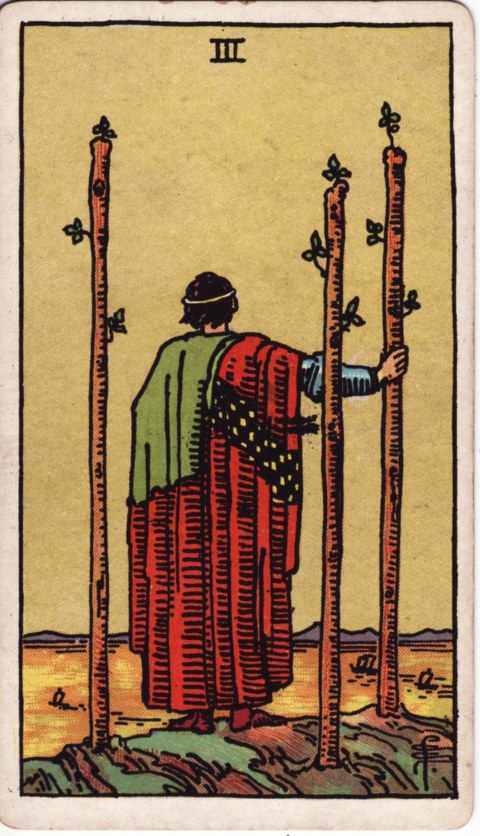
Waite pictures him in one calm sentence: "A calm, stately personage, with his back turned, looking from a cliff's edge at ships passing over the sea." The work of launching is finished, and what is left is watching. Labyrinthos calls the card "one of the main cards of foresight and vision," which fits a man who has stopped carrying things and started looking. At work this week, pick one proposal, order or application you have already sent out and ask the other side for a decision date.
The last line of Waite's meaning list is the one readers skip. The merchant prince looks "from his side towards yours with a view to help you." So the card can be more than your own plan at sea: a senior person, a partner or a supplier may be willing to back you. If the question is who will support this, look for the one who already has ships out, and say plainly what you need. His short list agrees: "A very good card; collaboration will favour enterprise."
Book T is less easy. It opens with "Established force, strength, realization of hope" to "Pride, nobility, wealth, power, conceit," before closing on "Rude self-assumption and insolence." The card carries the flaw of anyone who has done well, which is believing the sea belongs to him. The Equinox text closes the entry with a remark in square brackets, "[This card is much better than as described.]" The text does not say who wrote it, but it reads as a correction made by someone who knew the list was harsh.
Three of Wands reversed: troubles over, or plan stalled?
Waite turns the card over to good news: "The end of troubles, suspension or cessation of adversity, toil and disappointment." Modern pages tend to say the opposite. Biddy Tarot's keywords for the turned card are "Playing small, lack of foresight, unexpected delays." Both are in use, and the first step is to find out which one is yours. This week, send one message about the item in question: a thank-you and handover if the trouble is over, a dated question if the ships are late.
Here is how the two differ from inside. When Waite's reading fits, you are tired but the news is better: a dispute closes, a bill is paid, a long job ends. When the modern reading fits, you are waiting and nothing arrives, and the quiet is the problem. Waite's "suspension" sits between the two, because a pause can be a rest or a stall.
With a single card, keep a ship log. Write each venture you have launched as one line (a pitch, a loan, a friendship you tried to repair, a trip you planned). Beside each, write the date you last had word, and one of three marks: arrived, at sea, or no word. Arrived items are Waite's ended troubles, so close them. At-sea items need nothing but patience. Every no-word item with no message sent from you is the stalled plan, and the next step is a message, since another month of looking at the water will change nothing.
Questions such as whether a job offer will come, an ex will write or a result will arrive by a date get no verdict here. The card shows how your ventures stand and names no outcome or day. Pregnancy and health are for a pharmacy test or a doctor; a card cannot settle them.
Is the Three of Wands a yes or no card?
| Position | Answer |
|---|---|
| Upright | Yes, if you act |
| Reversed | Check the ships first |
For an upright draw the answer is yes, provided you act on it. Tarot.com gives the card a plain "YES" in its yes-or-no section, and the picture agrees for a plan that is already moving. It fits less well for a question about starting from nothing, because the card shows the stage after the start.
On a reversed draw, count the ships before you answer. If the trouble is over, yes; if nothing has come back, send a message and ask again. The old books never use yes or no, so both lines are convention.
Three of Wands in love and friendship: a shared horizon, feelings
In a relationship
Inside a relationship, it suits two people who have built something and can now look at where it goes: a shared lease, a move, a trip, a child. The figure stands alone in the picture, so the useful question is whether you are both looking at the same sea. Say your picture of the next three years out loud and ask for theirs.
Single
Single, the card shows someone who has put effort into their life and is open to what arrives. Waite's merchant looks toward you with a view to help, so a friend or colleague may be the one who introduces you. A distant person, a pen friend or a match in another city also fits the sea in the picture. The card leaves the person unnamed.
As feelings
If it stands for someone else's feelings, the card gives hope and a look ahead: who sees room to grow with you. They may be watching to see whether you come toward them. Whether they will say it first, and how deep it goes, the card leaves open.
Envy, then an offer: a friend who got ahead
A friend who landed a good job says they can introduce you to their boss, and your first feeling is a small sting. In Waite's picture, the merchant prince has ships out and a "view to help you." Upright, that is a friend willing to lend a hand, and you can accept without a speech. Reversed, Waite reads troubles ending, while modern pages read delay. Here it may mean the envy is passing, or that your answer is overdue. Reply to the offer with a clear yes or a kind no.
Reversed: a trouble ended or a plan stuck?
Turned over in love, Waite's "end of troubles" suits a hard stretch finally closing. The modern reading, a plan for the future that has stopped moving, suits a couple who talk about the future and never set a date. The two cases are easy to tell apart: ask whether there is anything left to argue about, or only something left to schedule.
Three of Wands at work and with money
On the job, the card is a venture in motion: a product shipped, an export order, a new office, a client abroad. Waite lists "enterprise, effort, trade, commerce, discovery," which is a word list for a merchant. The practical point is that you are no longer planning. Follow up, track what is out, and make an offer of help to the people whose ships overlap with yours.
With money, the card suits income that is on its way and not yet in hand: invoices sent, goods shipped, a deal pending. Count only what has arrived. Reversed, Waite's "end of troubles" can mean a debt cleared or a hard season over, while the modern reading is a delay in payment. On a reversed card, add a week's buffer to any date you rely on.
Three of Wands as advice and as a person
Stop adding to the plan and look at what is already out. Make a list of what you have launched, and for each item write the next person you will speak to. Go to the cliff edge on purpose, once a week, and then step back to the work.
Think of a generous backer who has been at it a long time. Rafi is an invented example: an importer twenty years in business who still asks young traders what they plan to ship. He is worth knowing and sometimes proud, which is Book T's "Pride" in a mild form. Reversed, the advice runs like this: if your trouble is over, say so and thank whoever helped; if it is stuck, tell him exactly what is missing.
How to read the Three of Wands in a spread
Drawn on its own, the Three of Wands says something is already under way around your question; the task is to follow it up. Ask which of your ventures is at sea, and who could help it land.
In a row, the card marks the project that has left the dock, as a past card, or the one now being watched, as a present one. At the end of a row it points to a plan that grows and finds partners. Among the dignities, "Wands are friendly with Swords and Pentacles" fits here. A Pentacle beside it is the cargo, a Sword is the contract or the plan on paper. The Two of Wands before it is the decision to go, and the Four of Wands after it is the plan reaching a finished state. With The Emperor, who answers to Aries, the venture has a firm hand behind it.
The Three of Wands among the Wands
The Three is the middle card of the Aries run in the suit. Book T gives the Two to Mars and Dominion, the Three to the Sun and Established Strength, and the Four to Venus and Perfected Work. The Sun puts the middle card under the sky's brightest body, which suits a figure standing in open light on a ridge. Read in order, the Two decides, the Three launches and the Four finishes.
Book T's list has "wealth" and "insolence" side by side. Waite's version keeps the successful merchant and drops the rudeness, so a mixed list becomes a kind picture. That is the gap the bracketed remark in the Equinox text seems to answer.
- Ace of Wands
- Two of Wands · Dominion
- Three of Wands · Established Strength
- Four of Wands · Perfected Work
- Five of Wands · Strife
- Six of Wands · Victory
- Seven of Wands · Valour
- Eight of Wands · Swiftness
- Nine of Wands · Great Strength
- Ten of Wands · Oppression
- Page of Wands
- Knight of Wands
- Queen of Wands
- King of Wands
Titles after the numbered cards are the Golden Dawn's names for them in Book T.
Symbolism of the Rider–Waite–Smith card
- The figure seen from behind. He wears a red robe with a green cloak and a plain headband, and the viewer stands behind him. Waite calls him calm and stately. With his back turned, he puts the viewer on his side of the view, looking at the same ships.
- Three staffs in the ground. The staves are planted, and a few green sprigs show on them. Waite says only "Three staves are planted in the ground, and he leans slightly on one of them." As we read it, a leaning staff means the figure is resting.
- The ships on the golden sea. Small ships cross a sea of gold-orange light under a flat yellow sky. Waite says "those are his ships, bearing his merchandise." Waite does not say which way they sail; Tarot.com wonders whether they sail toward the horizon or away from it. Either way, the goods are out of his hands.
- The ledge and the far hills. He stands on rock with distant hills on the other side of the water. The ledge makes the overview possible, and the hills mark the far market. The height can be taken as seniority; that is our reading, and Waite says nothing of it.
What the oldest sources say
“He symbolizes established strength, enterprise, effort, trade, commerce, discovery; those are his ships, bearing his merchandise, which are sailing over the sea. The card also signifies able co-operation in business, as if the successful merchant prince were looking from his side towards yours with a view to help you. Reversed: The end of troubles, suspension or cessation of adversity, toil and disappointment.”
“A very good card; collaboration will favour enterprise.”
“Established force, strength, realization of hope. Completion of labour. Success after struggle. Pride, nobility, wealth, power, conceit. Rude self-assumption and insolence. Generosity, obstinacy, etc.”
Waite builds the card out of trade: "established strength, enterprise, effort, trade, commerce, discovery." Only the last word looks like exploring; the others are business. The sentence about the merchant prince making a gesture of help is the most original line in the entry, since it turns the figure into a helper for the Querent. His short list keeps it simple, "A very good card; collaboration will favour enterprise." The reversed meaning, "The end of troubles," is a plain good report, and nothing in it suggests a delay.
Book T entitles it Lord of Established Strength and places it in Binah, with the gloss "Pride, arrogance, self-assertion." The long list mixes the good ("Completion of labour. Success after struggle") with the bad ("conceit," "Rude self-assumption and insolence"), and ends on "Generosity, obstinacy, etc." The picture is a hand holding three wands, two crossed and one upright, with flames where they meet; the cliff, the ships and the man are Smith and Waite additions. The two old sources are almost two cards: a fire diagram with a proud temper, and a merchant above the sea.
Three of Wands and Sun in Aries: the card's decan
| Suit and element | Wands, Fire (Major Arcana card of fire: Judgement) |
|---|---|
| Decan | 10° to 20° ♈︎ Aries, the second ten degrees of the sign |
| Planet of the decan | Sun (Major Arcana: The Sun) |
| Major Arcana card of Aries | The Emperor |
| Golden Dawn title | The Lord of Established Strength |
| Place on the Tree of Life | Binah (Book T: “Pride, arrogance, self-assertion”) |
Attributions from Book T (Golden Dawn, c. 1892; printed 1912).
In Book T the Three of Wands rules the second ten degrees of Aries (10° to 20°), under the Sun, and the diagram text reads "Above and below are the symbols Sun and Aries." Aries is fire, which matches the Wands. Its Major Arcana links are The Emperor for Aries, The Sun for the Sun and Judgement for fire.
Tradition places the Sun's exaltation at 19° Aries, and that degree falls inside this decan. By that tradition, this stretch is the one where the Sun is at its strongest in the sky, which suits "Established Strength." Book T does not mention the degree, and the link is ours. The Queen of Wands page covers the wider zone around it.
When the Sun is in the Three of Wands stretch
| Year | Sun enters 10° | Sun leaves (reaches 20° Aries) |
|---|---|---|
| 2026 | Mar 30 | Apr 9 |
| 2027 | Mar 30 | Apr 9 |
| 2028 | Mar 30 | Apr 9 |
| 2029 | Mar 30 | Apr 9 |
This year the Sun crossed the Three of Wands stretch of the zodiac (10° to 20° Aries) from March 30 to April 9, 2026. Next time: March 30 to April 9, 2027 (US Eastern dates).
Dates are US Eastern, from the astronomy-engine ephemeris. Across 35,064 dates from 1930 to 2025, the Sun is in this stretch on 2.8% of them, and at least one of the ten planets is on 21.4%.
The Sun crosses the decan around March 30 to April 9. By our ephemeris, Saturn left the decan on October 23, 2026, after a stay that began May 10, and returns from January 29 to April 27, 2027. Before that Saturn was here in 1997 and 1998. Jupiter was in it from February 21 to April 6, 2023, and comes back in 2034 and 2035. Uranus was here in 2013 to 2016, Neptune enters on May 10, 2029, and Pluto has no stay in this decan in the years our tables cover. Nothing here predicts an event.
Is the Three of Wands in your birth chart?
Enter your birth date. We show which of the ten planets stood between 10° and 20° Aries that day, the slice of sky Book T gives this card; add the time if a planet was near the edge.
Enter your birth date above to see your result.
Every planet, angle and house from your birth time: birth chart calculator.
Questions about the Three of Wands
Is the Three of Wands a good sign?
Yes, and Waite agrees: "A very good card; collaboration will favour enterprise." Book T lists pride and conceit beside the strength, then adds that the card is better than described.
Does the Three of Wands show how someone feels?
Hope and a wish to build ahead with you. The person sees room to grow. The card does not say if they will speak first.
Is the Three of Wands a sign to go ahead?
Upright, go ahead if you act on it; reversed, check the ships first. The old sources say nothing on this, so it is convention.
Three of Wands reversed: good news or a stall?
In Waite it is "The end of troubles." Modern pages read delays and a plan that stopped. A ship log of what you launched and when you last had word shows which one is yours.
What does the Three of Wands say about a relationship?
A couple looking to a shared future, or a single person open to what comes, perhaps through a friend's introduction. It names no one and gives no day.
What does the Three of Wands mean for a job?
A venture already launched, and a helper who may back it. Follow up on what you have sent out and ask for a decision date.
Three of Wands and astrology: which sign?
Aries, the second ten degrees, under the Sun for Book T. No day is attached to it. A reader who wants a calendar can use the Sun's pass, about March 30 to April 9.
Sources
- Astronomy Engine: the open-source ephemeris library behind our planet positions, dates and statistics
- A. E. Waite, The Pictorial Key to the Tarot (1911), Wikisource: the divinatory meanings we quote, upright and reversed
- Book T (Golden Dawn), as printed in The Equinox I:8, 1912: the zodiac sign, Hebrew letter, title and short meaning of each card
- Wikimedia Commons: Rider–Waite–Smith tarot deck: Pamela Colman Smith's 1910 card drawings, public domain
- How we create our readings: our own calculation of sign dates, positions and the 1930 to 2025 statistics
Next to the Three of Wands
In the suit of Wands: Two of Wands ← Three of Wands → Four of Wands.
Aries on this site: Aries zodiac sign · The Emperor, the card of Aries · your full birth chart.
All 22 Major Arcana with their signs and planets, and the minor cards written so far: tarot card meanings.
Written by The Zodiac Atlas editorial team with the help of AI and edited by a person. Quotations are from Waite's Pictorial Key to the Tarot and the Golden Dawn's Book T, both in the public domain; the card picture is a 1910 printing of Pamela Colman Smith's drawing for the 1909 deck. Sun dates and planet positions come from the astronomy-engine ephemeris (tropical zodiac). Tarot and astrology are symbolic traditions; they do not predict events.