Seven of Wands: are you under attack or on high ground?
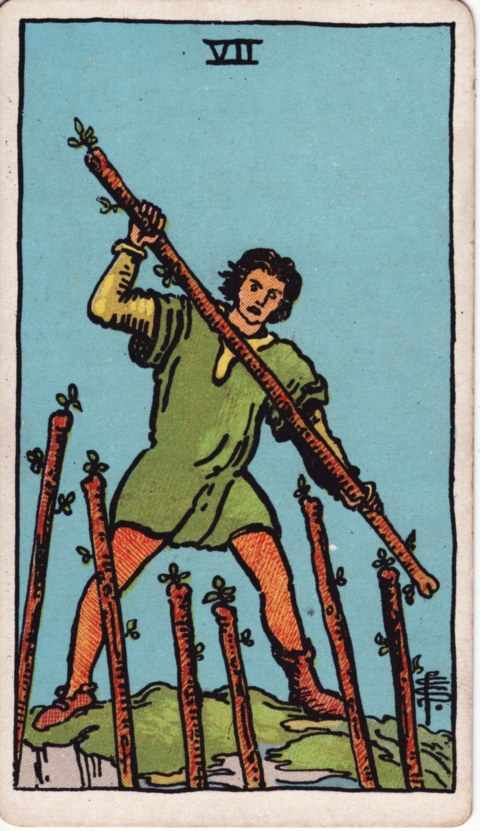
Waite begins with a warning against the obvious reading. Six staves are raised against one, "on the surface," and he adds that the one "has, however, the vantage position." The man stands on a crag, the attackers are below, and Waite concludes: "It is further a card of success, for the combatant is on the top and his enemies may be unable to reach him." So the card shows an advantage under pressure, and the pressure is what makes it visible. At work this week, name the one thing you hold that others want (a role or a budget line) and send the update that makes your claim to it plain.
Modern sites keep the pressure and often drop the advantage. Labyrinthos says the card is about the struggle "to maintain your position, rather than to attain it." Waite adds two fields of battle. One is the mind: "discussion, wordy strife." The other is trade: "negotiations, war of trade, barter, competition." The staves here are arguments and offers more often than blows.
Book T has a gentler note that most pages skip. Its list ends with "also victory in small and unimportant things: and influence upon subordinates." It hints that some of these battles are minor ones, without saying which. That gives the upright card a second question: is what you are guarding as big as it feels? Ask it before you spend a month on it.
Seven of Wands reversed: giving up or imagining the fight?
Reversed, Waite writes "Perplexity, embarrassments, anxiety. It is also a caution against indecision." The man on the hill does not fall in this list. He stops being sure that it is his hill. Tarot.com reads the reversal as burnout, avoidance or "second-guessing your right to take up space." This week, make the smallest decision you have been circling, such as answering the message or naming the price, and make it before Friday.
Because Waite says "on the surface," the upside-down card can also mean the attack is thinner than it looks. Book T's "victory in small and unimportant things" lends support. A reader who feels surrounded may be facing one or two voices, plus a lot of anticipation.
With a single card, try counting the six. Write down the six staves as six names or tasks: who or what is actually pressing on you. Next to each, write the last time it did something you could point to. Staves with no name or no recent date are worry. If three or more are blank, the fight is mostly inside, and the step is to drop those blanks and deal with the rest. If all six are real and recent, the reading is overload, and the step is to ask for help on the two you can least afford to lose.
If you are asking whether an ex will return, whether a boss will back down or whether a dispute ends in your favor, the card stays silent on that. It shows how you stand and how crowded the ground feels. What other people do next is outside it.
Is the Seven of Wands a yes or no card?
| Position | Answer |
|---|---|
| Upright | Yes, if you hold your ground |
| Reversed | Not yet, doubt first |
Upright, we take the Seven of Wands as a yes for anything you are defending: keeping the job or holding the price. It is a no for questions that need you to give up the high ground. That answer is a modern habit, since the old books attach a verdict to no card.
Reversed, it is not yet. The doubt in Waite's "perplexity" and "indecision" suggests you cannot answer cleanly while unsure what you are protecting. Settle that first, then put the question again.
Seven of Wands in love and friendship: defending a bond, feelings
In a partnership
Within a couple, the card shows a bond being defended against outside pressure, such as family opinion, a rival or distance, or one of you holding a limit. Labyrinthos reads it as a reason to fight for the relationship against family, rivals or friends who object. The picture gives a gentler rule: stand where you can see the whole slope. Decide what you will defend and say it once, calmly, before the arguments start.
Single
On your own, the card describes standards. You know what you will not accept and you keep to it even when a date or a friend leans on it. The danger is that every question starts to feel like an attack. Test one new person against two or three real limits, and leave the others open.
As feelings
Read as someone's feelings, the Seven of Wands describes a committed but defensive person. They have something they are protecting, and they may bristle at questions. Labyrinthos reads the card as the other person seeing you as worth fighting for. That is one reading; the picture is equally of a person on guard. The card shows their stance; whether they act on it stays open.
Defending a choice to your friends: the Seven of Wands
You told your friends you are quitting your job, or dating someone they dislike, and now several opinions arrive at once. In Waite's picture, six staves rise against one man who "has, however, the vantage position." Upright, you stand on higher ground: you know your reasons, and you can listen without handing over the decision. Reversed, the card gives perplexity and indecision, so the pressure may be getting in. Count how many friends actually said something against it. Thank the one who was kind, and tell the rest once, calmly, that the decision is made.
Reversed in love
Upside down in love, the card can show someone who has stopped defending the relationship, or who defends it so hard that nobody can get close. Waite's "anxiety" fits both. Ask whether the fight is with the other person or with an outside pressure you have both been feeling.
Seven of Wands at work and with money
The card is a good fit for a promotion held against competition, a client you are being asked to defend, or an opinion given in a meeting that others dislike. Waite's "negotiations, war of trade, barter, competition" is a list of working situations. The vantage position is your preparation: figures, dates and your own paper trail.
With money, think of defending a budget or keeping an asset others want a share of. Book T's "influence upon subordinates" fits managing people or money under your authority. If the claim on your money is unwelcome, such as a contested bill or a dispute with a lender, a lawyer or adviser can hold the line better than a card.
Reversed, the fight is wearing you down at work, or the doubt about the role has become the main problem. List what you would need to hear to feel secure, and ask for it in plain words this week.
Seven of Wands as advice and as a person
The advice is to take the higher ground and stay on it. Stand where your facts are strongest, answer the challenges that reach you, and let the rest go past. Choose one boundary to hold this week and tell the person it concerns.
In human form, the Seven of Wands is someone who defends their own territory. Imagine a shop owner named Marta, a made-up case, whose landlord has proposed a big rent rise, while two competitors open on the same street. She has a lease, a customer list and good reviews. She does not need to answer every rumor. Book T supplies her fault: "quarrelling, ignorance, pretence, and wrangling." Reversed as advice: stop and ask what you are guarding before you add another front.
How to read the Seven of Wands in a spread
Alone, the Seven of Wands says you hold something worth defending and a challenge has arrived. Ask what the high ground is in your situation, and who is below. Laid out in sequence, the past slot is a position you won and now must keep, the present slot is a live contest, and the outcome slot is holding firm.
From the Book T dignity rules: "Wands are friendly with Swords and Pentacles." A Sword next to the card brings the debate or the strategy, and a Pentacle the practical stakes. A Cup is the awkward neighbor in Book T's rules, and it may bring feelings that disrupt the stand. Next to the Six of Wands, the win comes first and the challenge follows it. Next to Strength, the Major Arcana card of Leo, the stand is steady courage.
The Seven of Wands among the Wands
The Seven takes the last ten degrees of Leo in Book T, after the Five (Strife) and the Six (Victory), and here the lord is Mars, "Valour." The Six reads "Victory after strife." The Seven opens differently: "Possible victory, depending on the energy and courage exercised." The word "possible" says the win of the Six is not yet secure, and the Seven is the work that makes it so.
That gives the Seven a place in the suit that the Eight cannot take. After the Seven's hold comes the Eight's rush, but the Seven is the card where a gain is tested and kept. Waite's picture makes the same point with one man who cannot be reached.
- Ace of Wands
- Two of Wands · Dominion
- Three of Wands · Established Strength
- Four of Wands · Perfected Work
- Five of Wands · Strife
- Six of Wands · Victory
- Seven of Wands · Valour
- Eight of Wands · Swiftness
- Nine of Wands · Great Strength
- Ten of Wands · Oppression
- Page of Wands
- Knight of Wands
- Queen of Wands
- King of Wands
Titles after the numbered cards are the Golden Dawn's names for them in Book T.
Symbolism of the Rider–Waite–Smith card
- The staff held across his body. Both his hands close on a single staff held crosswise, and Waite says he is "brandishing a staff." It is raised as a guard more than swung, and it reads as readiness.
- Six staves from below. Six wands, uneven in height and angle, rise from the lower edge. Waite says "six other staves are raised towards him from below." No hands or faces are visible, so the opposition has no name. Tarot.com makes the same point: "we never see who's holding them."
- The high green crag. He stands on the rounded top of a hill with a pale rocky edge at lower left. Waite writes "a craggy eminence" and later, "the vantage position." The slope under him is the advantage.
- One shoe, one boot. On Smith's card one foot wears a low shoe and the other a heavier boot. Waite does not mention it. As we read it, he has been called out in a hurry and stood up anyway.
- Budding wands. Green shoots break from the staves. They are living wood, which can be read as growth, so the quarrel may be about something that is still growing.
What the oldest sources say
“It is a card of valour, for, on the surface, six are attacking one, who has, however, the vantage position. On the intellectual plane, it signifies discussion, wordy strife; in business—negotiations, war of trade, barter, competition. It is further a card of success, for the combatant is on the top and his enemies may be unable to reach him. Reversed: Perplexity, embarrassments, anxiety. It is also a caution against indecision.”
“A dark child.”
“Possible victory, depending on the energy and courage exercised; valour; opposition, obstacles and difficulties, yet courage to meet them; quarrelling, ignorance, pretence, and wrangling, and threatening; also victory in small and unimportant things: and influence upon subordinates.”
Waite's list for this card is short and mixed. The main entry gives valour, wordy strife, trade war, and success for the man on top. Reversed is "Perplexity, embarrassments, anxiety." In the later digest of additional meanings it shrinks to "A dark child," a cartomancer's way of labeling a child, which we leave aside. He gives no reversed line there. The odd result is that the long reading is the only one that tells you much.
Its Book T title is "Lord of Valour" and puts it on Netzach with the short label "Opposition, yet courage." Its list opens on "Possible victory, depending on the energy and courage exercised" and goes on to "quarrelling, ignorance, pretence, and wrangling, and threatening." It does not draw a man at all, only two hands holding six wands, three crossed, with a third hand holding an upright wand that "passes between the others." Smith's young man is her own addition.
Seven of Wands and Mars in Leo: the card's decan
| Suit and element | Wands, Fire (Major Arcana card of fire: Judgement) |
|---|---|
| Decan | 20° to 30° ♌︎ Leo, the third ten degrees of the sign |
| Planet of the decan | Mars (Major Arcana: The Tower) |
| Major Arcana card of Leo | Strength |
| Golden Dawn title | The Lord of Valour |
| Place on the Tree of Life | Netzach (Book T: “Opposition, yet courage”) |
Attributions from Book T (Golden Dawn, c. 1892; printed 1912).
The third decan of Leo, 20° to 30°, belongs to the Seven of Wands in Book T, and its planet is Mars: "Above and below the central wand are the symbols of Mars and Leo, representing the Decan." Leo belongs to fire, the element of Wands. The trumps linked to it are Strength for Leo, The Tower for Mars and Judgement for the element of fire.
The Knight of Pentacles has this decan within his zone, set by Book T at 20° of Leo through 20° of Virgo, so the two pages share sky. As a reading of ours, Mars and the Lion make a combative pairing, while the Sun-ruled sign adds pride in holding the position.
When the Sun is in the Seven of Wands stretch
| Year | Sun enters 20° | Sun leaves (reaches 30° Leo) |
|---|---|---|
| 2026 | Aug 12 | Aug 22 |
| 2027 | Aug 12 | Aug 23 |
| 2028 | Aug 12 | Aug 22 |
| 2029 | Aug 12 | Aug 22 |
This year the Sun crossed the Seven of Wands stretch of the zodiac (20° to 30° Leo) from August 12 to August 22, 2026. Next time: August 12 to August 23, 2027 (US Eastern dates).
Dates are US Eastern, from the astronomy-engine ephemeris. Across 35,064 dates from 1930 to 2025, the Sun is in this stretch on 2.8% of them, and at least one of the ten planets is on 23.8%.
By our ephemeris, Jupiter is in this decan right now. It entered on October 5, 2026, stays until February 28, 2027, and returns from May 29 to July 28, 2027. Saturn was here in 2006 and 2007 and returns in 2036 and 2037. Pluto stood in the decan from 1951 to 1958, Uranus from 1959 to 1962 and again in 2043 to 2046, and Neptune does not reach it between 1950 and 2060. These dates say where the planets stand and forecast no event.
Is the Seven of Wands in your birth chart?
Enter your birth date. We show which of the ten planets stood between 20° and 30° Leo that day, the slice of sky Book T gives this card; add the time if a planet was near the edge.
Enter your birth date above to see your result.
Every planet, angle and house from your birth time: birth chart calculator.
Questions about the Seven of Wands
Is the Seven of Wands a good card?
Hard, with an advantage built in. Waite names it "a card of success" because the man is on top, and Book T gives "victory in small and unimportant things" beside its list of obstacles.
What does the Seven of Wands mean as feelings?
Commitment with a guard up. The person has something to protect and may bristle at questions. Reversed, they doubt or have stopped defending it.
Is the Seven of Wands yes or no?
Yes when you hold your ground; reversed, not yet. No old text rules on it; the answer is modern practice.
What does the Seven of Wands reversed mean?
Waite lists "Perplexity, embarrassments, anxiety" and a caution against indecision. Modern sites add burnout and giving up.
What does the Seven of Wands mean for work and career?
Holding a position under competition. Prepare figures and dates, answer the challenges that reach you, and ask for help when the fight is bigger than one person.
Which sign holds the Seven of Wands?
Leo, its closing third, where Book T puts Mars as ruler. The Sun is in that slice from about August 12 to 22.
When does the pressure end?
A card sets no dates. For anyone who needs dates, the Sun covers these ten degrees from August 12 to 22, and that is only a convention.
Sources
- Astronomy Engine: the open-source ephemeris library behind our planet positions, dates and statistics
- A. E. Waite, The Pictorial Key to the Tarot (1911), Wikisource: the divinatory meanings we quote, upright and reversed
- Book T (Golden Dawn), as printed in The Equinox I:8, 1912: the zodiac sign, Hebrew letter, title and short meaning of each card
- Wikimedia Commons: Rider–Waite–Smith tarot deck: Pamela Colman Smith's 1910 card drawings, public domain
- How we create our readings: our own calculation of sign dates, positions and the 1930 to 2025 statistics
Next to the Seven of Wands
In the suit of Wands: Six of Wands ← Seven of Wands → Eight of Wands.
Leo on this site: Leo zodiac sign · Strength, the card of Leo · your full birth chart.
All 22 Major Arcana with their signs and planets, and the minor cards written so far: tarot card meanings.
Written by The Zodiac Atlas editorial team with the help of AI and edited by a person. Quotations are from Waite's Pictorial Key to the Tarot and the Golden Dawn's Book T, both in the public domain; the card picture is a 1910 printing of Pamela Colman Smith's drawing for the 1909 deck. Sun dates and planet positions come from the astronomy-engine ephemeris (tropical zodiac). Tarot and astrology are symbolic traditions; they do not predict events.