Knight of Wands meaning: a blessing or a warning?
Waite is gloomy about this card. His second list says flatly, "A bad card; according to some readings, alienation," and the first list reads "Departure, absence, flight, emigration" with "Change of residence" after it. Modern pages go the other way. Tarot.com opens with "The Knight of Wands doesn't wait for signs -- they are the sign," and Biddy Tarot closes its opening paragraph with "This card is your sign to go for it!" Both are partly right, because the picture shows a rider who is leaving something as much as he is heading for something.
Waite's picture text backs the long list. The knight is "not on a warlike errand," and "The motion of the horse is a key to the character of its rider, and suggests the precipitate mood." So the card is about movement itself: a trip, a relocation, a new job taken on a week's notice, a day when sitting still is impossible. Labyrinthos is practical about it: "More often than not, the Knight of Wands indicates a hasty change of job, residence, or anything in your life."
At its best the upright knight has fuel and a destination and sets off before the doubts are finished. Biddy Tarot names the cost of the type: "act first, think later." Drawn for a decision, the card comes down to two questions. What am I leaving, and what is the first stretch of road? A knight who can answer both is the good version. One who can answer neither is Waite's "precipitate mood."
Reversed Knight of Wands: are you blocked, rushing or running?
Waite's reversed list is about a break: "Rupture, division, interruption, discord." Modern pages describe a temperament instead. Labyrinthos writes of "frustrations and delays" and anger at not getting anywhere, and Tarot.com lists impulsiveness, false starts and bravado. In the old picture something cuts across the ride from outside; in the new one the rider cuts across it himself.
The first modern reading is the closed road: you have the energy and the plan, and a person, a rule or a delay stands in the way. The second is the false start, a run of beginnings that never reach the second week. The third is the short fuse, where the speed is spent on arguments. One card cannot tell you which of these applies, so check yourself against each.
A test that needs only a pen: finish the sentence "I am going toward ..." without using the word "away." If the sentence comes quickly and something outside is blocking you, the card is the interrupted ride, and the job is to find the interruption and name it. If the sentence only comes out as "away from," the card is flight, and the thing to work out is what you would want if nothing were chasing you. If you can finish it but cannot say when you will leave, the card is plain haste with no date on it. Pick a date or drop the plan.
The card shows up often on questions about an ex, a partner who left, or a move that did not happen. It cannot say whether anyone will return, stay or write back. Waite's second-list entry for the reversed card, "For a woman, marriage, but probably frustrated," reads as a period remark and makes no forecast. What the card describes is your own speed and your own breaks. If you are packing, quitting or sending messages at the top of your anger, that is where the reversed knight sits.
Is the Knight of Wands a yes or no card?
| Position | Answer |
|---|---|
| Upright | Yes, with a map |
| Reversed | Not yet |
Old sources rule on neither yes nor no, so this one is modern practice. Upright, the Knight of Wands leans yes when the matter is starting, going, traveling or asking, and Tarot.com gives the upright card a flat "YES." The picture adds a condition: know the road. For a lease, a loan or a resignation letter, make it a "yes, after a night's sleep."
Turned over, it says wait. The plan can be fine while the timing, the temper or the interruption is the trouble. Ask again after you have a destination you can say in one sentence.
Knight of Wands in love and friendship: heat that stays, or heat that goes?
In a relationship: the trip, the spark, the restless week
In a couple, the knight brings movement. A trip, a move in together, a sudden wish to do something unusual on a Tuesday. Tarot.com says that with this card "things can escalate quickly." The same page adds that it "sometimes disappears just as quickly," and Waite's "absence" fits that. Heat is available here; steadiness is a separate thing to plan for.
Single: who is riding toward you?
Single people get a quick start from this card: a person who texts first, a plan made within the hour, a few weeks that move faster than you expected. Labyrinthos files "difficult to commit" under upright love, so enjoy the pace and watch what the second month looks like. A person who is exciting at full speed may still be good company at walking pace; you only find out later.
As feelings: how hot does the fire run?
As someone's feelings, the knight means attraction that is strong, direct and active. They want to do something about it, soon. Book T lists him as "generous" and "impetuous" in the same line, so expect big gestures and quick changes of mind. The warmth is genuine, and how long it lasts is not on the card.
Last-minute invitations from a restless friend
Your friend texts at nine at night: the road trip leaves tomorrow, come along. Waite says the horse's motion suggests "the precipitate mood", and among friends that is the one who lives on a whim. Fun, generous, and gone for weeks without a word. Upright, say yes when you can and enjoy the heat.
Reversed, Waite lists rupture and interruption: plans collapse, or the friend vanishes mid-conversation and you feel like a stop on the route. Decide how much notice you need and say it plainly: I would love to, but I need three days. How they answer tells you which pace the friendship can keep.
Reversed in love: running, quarreling or standing still?
Turned over in love, the card fits a relationship where one person keeps a foot out of the door, a quarrel begun on impulse, or a stretch when neither of you starts anything. Labyrinthos names "running from commitment" and adds that arguments are "easy to spark." Waite's "Rupture, division, interruption, discord" reads the same way in older language. On the question of someone coming back, the card has no answer; it describes the rhythm you are both stuck in.
Knight of Wands at work and with money
At work the knight backs a bold step you have already half-planned: the pitch, the transfer, the new city, the business that has sat in a notebook. He suits fieldwork, sales, sport, travel and any role in which being first counts. Labyrinthos links the card to "passion and energy for work" and "brave decisions." On money, Labyrinthos calls travel a sound way to spend. A trip, a course or a relocation can be money well used, while a rushed purchase made for the thrill is the other side of the card.
Drawn reversed, look first for job-hopping without a destination, a project started on Monday and dropped by Friday, or a resignation sent in anger. On money, reversed warns about the large purchase or investment that feels urgent today; wait a night before paying.
Knight of Wands as advice and as a person
As advice, the card says go, and carry a map. Choose the move you have been circling, whether a trip, an application or a conversation, and set a date within two weeks. Tarot.com puts the balance in four words, "Leap, but look first."
As a person, the knight is the friend or colleague who says yes to the last-minute trip. Picture Rafael, who hears about an opening in another city on Thursday and has an interview booked by Friday. When he has thought about what he wants there, that is the upright knight, and everyone is glad he went. When he has quit three jobs in two years and leaves each time before the first review, he is the reversed knight.
Reversed as advice: stop and find the interruption before you ride again. If the road is shut, work out who can open it. If you keep cutting the ride short yourself, finish one thing to the end before you start the next. Tarot.com's line fits here too: "Burn bright, not out."
How to read the Knight of Wands in a spread
With this as your single card, the message is a moving phase: something wants to go, change place or begin, and the choice is how fast. Ask the two questions from the upright section and you have the reading.
Back in the past position he marks a departure or a move that set the matter going. In the present he names a restless stretch or a person who keeps pushing the pace. In the outcome position he points to a change of place or situation, which could be a fine result or merely a fast one. Book T's table has "Wands are friendly with Swords and Pentacles." Nearby Swords supply a route, and nearby Pentacles supply solid footing. With the Eight of Wands, titled "Swiftness" in Book T, the pace doubles. Beside the Four of Pentacles, the rider meets someone clutching what they have, and the tug between leaving and keeping becomes the subject.
The Knight of Wands among the Wands
Of the four Wands courts, the Knight is the one who really goes. The Page stands in place and looks at his sprouting wand. The Queen, after him, sits with a sunflower and a cat. The King rules from a throne. The Knight is the only figure in the suit whose picture is built around leaving, with the horse up on its hind legs and the wand carried like a torch.
In Book T he is "Fire of Fire," the most concentrated fire in the deck, and his zone runs through three numbered cards whose titles move from "Illusionary Success" through "Swiftness" to "Great Strength."
- Ace of Wands
- Two of Wands · Dominion
- Three of Wands · Established Strength
- Four of Wands · Perfected Work
- Five of Wands · Strife
- Six of Wands · Victory
- Seven of Wands · Valour
- Eight of Wands · Swiftness
- Nine of Wands · Great Strength
- Ten of Wands · Oppression
- Page of Wands
- Knight of Wands
- Queen of Wands
- King of Wands
Titles after the numbered cards are the Golden Dawn's names for them in Book T.
Symbolism of the Rider–Waite–Smith card
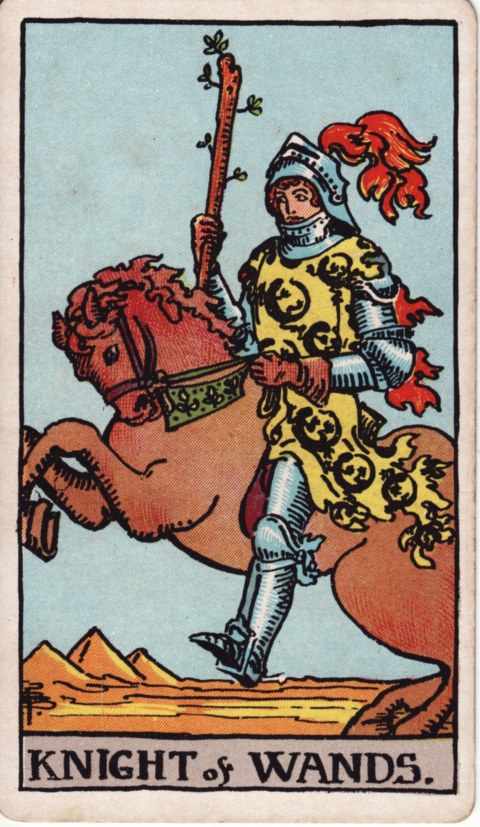
- The rearing chestnut horse. The horse is up on its hind legs and turned to the left, ready to bolt. Waite says the motion of the horse is "a key to the character of its rider." Book T draws a different animal: a black horse with a flaming mane and tail, which "is not winged," although the rider's crest is a winged black horse's head. The Smith horse is chestnut.
- The leafing wand. He holds the wand upright, and a few leaves are growing from it. It is shorter than the King's, in line with Waite's "short wand." Book T says his club has flaming ends, is "somewhat similar" to the Ace of Wands' club "but not so heavy." Our reading of the leaves is that the force he carries is still alive and growing, and he has not turned it into a weapon.
- The salamander tunic. The yellow tunic is patterned with small black salamanders, the animal of fire in old lore, and Book T names the whole fire order "the Salamanders." Tarot.com reads them as fire and transformation. They mark this rider as made of the element.
- The red plume and the armor. He wears silver armor with a red plume streaming back, which gives the picture a flame at the head. Waite says that although he is "mailed" he is "not on a warlike errand," so the armor is gear for the road. Book T's knight wears a "corslet of scale-mail" and a winged helmet with a rayed crown; the Smith helmet is plainer.
- The pyramids and the desert. Three orange pyramids stand far off in dry sand, and Waite writes "He is passing mounds or pyramids." The ground is barren, so he is crossing a long stretch of nothing. Our reading is that the destination is not in sight, which is why the card suits departures better than arrivals.
What the oldest sources say
“Departure, absence, flight, emigration. A dark young man, friendly. Change of residence. Reversed: Rupture, division, interruption, discord.”
“A bad card; according to some readings, alienation. Reversed: For a woman, marriage, but probably frustrated.”
Waite's two lists split on the question of whether this is good news. The first is mobile and mostly neutral: "Departure, absence, flight, emigration," a "dark young man, friendly," a change of residence. The second says "A bad card; according to some readings, alienation." The words "according to some readings" hedge it, so even Waite sounds unsure. The reversed lines are "Rupture, division, interruption, discord" and, from §4, "For a woman, marriage, but probably frustrated." That last one is dated language, and the useful part is the pairing of marriage with frustration, our way of reading a rider who leaves before the knot is tied.
Book T is warmer and fiercer. The heading calls him "The Lord of the Flame and Lightning: the King of the Spirits of Fire," and his temperament line is "active," "generous," "fierce," "sudden," "impetuous." Ill dignified he is "evil-minded," "cruel," "bigoted" and "brutal." Set beside Waite, the old authors agree on the speed and differ on the mood. Waite warns about what the speed costs, and Book T gives him generosity and then lets the fire turn cruel when the cards around him are hard.
Knight of Wands in the zodiac: Scorpio to Sagittarius
| Suit and element | Wands, Fire (Major Arcana card of fire: Judgement) |
|---|---|
| Part of the zodiac | 20° Scorpio to 20° Sagittarius |
| Book T | Fire of Fire |
Attributions from Book T (Golden Dawn, c. 1892; printed 1912).
Book T gives the Knight a span of sky instead of a decan. He "rules the celestial heavens from above the Twentieth Degree of Scorpio to the First Two Decans of Sagittarius," which is 20° Scorpio to 20° Sagittarius. His elemental title is "Fire of Fire." Among the Major Arcana, Death belongs to Scorpio and Judgement to the element of fire.
Book T adds a detail that none of the modern pages has: the span "includes a part of the Constellation Hercules. (Hercules is always represented with a Club.)" So the sky behind this knight holds a hero with a club, and the knight carries a lighter club of his own. Book T's decan list puts three numbered cards inside the span: the Seven of Cups, "Illusionary Success," with Venus; the Eight of Wands, "Swiftness," with Mercury; and the Nine of Wands, "Great Strength," with the Moon. The order runs from a dream to speed to a hard stand. Book T never sets that outline out; it is how the three titles read to us in a row.
When the Sun is in the Knight of Wands stretch
| Year | Sun enters 20° Scorpio | Sun leaves (reaches 20° Sagittarius) |
|---|---|---|
| 2026 | Nov 12 | Dec 11 |
| 2027 | Nov 12 | Dec 12 |
| 2028 | Nov 11 | Dec 11 |
| 2029 | Nov 11 | Dec 11 |
This year the Sun crosses the Knight of Wands stretch of the zodiac (20° Scorpio to 20° Sagittarius) from November 12 to December 11, 2026 (US Eastern dates).
Dates are US Eastern, from the astronomy-engine ephemeris. Across 35,064 dates from 1930 to 2025, the Sun is in this stretch on 8.1% of them, and at least one of the ten planets is on 61.4%.
The Sun is in the span for about a month in mid-November to mid-December, in the table above. The slow planets move through it over years. By our ephemeris Uranus stood in the span from 1979 to 1986, Pluto from 1991 to 2003, and Saturn from December 2013 to December 2016, with a break in mid-2014. Jupiter returns for part of 2029 to 2031. These are sky facts that suit a chart reading; the card itself sets no date for anything.
Is the Knight of Wands in your birth chart?
Enter your birth date. We show which of the ten planets stood between 20° Scorpio and 20° Sagittarius that day, the slice of sky Book T gives this card; add the time if a planet was near the edge.
Enter your birth date above to see your result.
Every planet, angle and house from your birth time: birth chart calculator.
Questions about the Knight of Wands
Is the Knight of Wands lucky or unlucky?
Modern pages treat it as a good, energetic card. Waite is less sure: his second list calls it "A bad card; according to some readings, alienation." It is good when you know where you are going and bad when speed replaces a destination.
What does the Knight of Wands mean as feelings?
Strong, direct, fast attraction and a wish to act on it. Book T calls him "generous" and "impetuous," so expect big gestures. How long it lasts is not on the card. Reversed, the feeling is erratic or the person is running from commitment.
Does the Knight of Wands mean moving house or traveling?
Often, yes. Waite lists "Departure, absence, flight, emigration" and "Change of residence," and Labyrinthos reads it as a good time to get away. The card marks the urge and the movement, and no calendar comes with it.
What kind of person is the Knight of Wands?
A bold, charming, restless one who starts fast and likes freedom. Waite says "A dark young man, friendly." Reversed, the person is impatient, hot-tempered or unreliable about finishing.
Does the Knight of Wands mean yes or no?
Yes for starting, going or asking, as long as you know the road. Reversed, not yet. Tarot.com gives the upright card YES; the old texts are silent here, so the rule is modern.
How does someone see me if I draw the Knight of Wands?
As bold, magnetic and hard to pin down. Biddy Tarot says others see this rider as "highly charismatic." The unknown is whether they think you can be counted on to stay.
Which sign belongs to the Knight of Wands?
Scorpio and Sagittarius. Book T gives the Knight the sky between 20° Scorpio and 20° Sagittarius and calls him Fire of Fire. The Sun is in that span from about November 12 to December 11, which is a date convention and carries no timing for events.
Sources
- Astronomy Engine: the open-source ephemeris library behind our planet positions, dates and statistics
- A. E. Waite, The Pictorial Key to the Tarot (1911), Wikisource: the divinatory meanings we quote, upright and reversed
- Book T (Golden Dawn), as printed in The Equinox I:8, 1912: the zodiac sign, Hebrew letter, title and short meaning of each card
- Wikimedia Commons: Rider–Waite–Smith tarot deck: Pamela Colman Smith's 1910 card drawings, public domain
- How we create our readings: our own calculation of sign dates, positions and the 1930 to 2025 statistics
Next to the Knight of Wands
In the suit of Wands: Page of Wands ← Knight of Wands → Queen of Wands.
Scorpio on this site: Scorpio zodiac sign · Death, the card of Scorpio · your full birth chart.
All 22 Major Arcana with their signs and planets, and the minor cards written so far: tarot card meanings.
Written by The Zodiac Atlas editorial team with the help of AI and edited by a person. Quotations are from Waite's Pictorial Key to the Tarot and the Golden Dawn's Book T, both in the public domain; the card picture is a 1910 printing of Pamela Colman Smith's drawing for the 1909 deck. Sun dates and planet positions come from the astronomy-engine ephemeris (tropical zodiac). Tarot and astrology are symbolic traditions; they do not predict events.