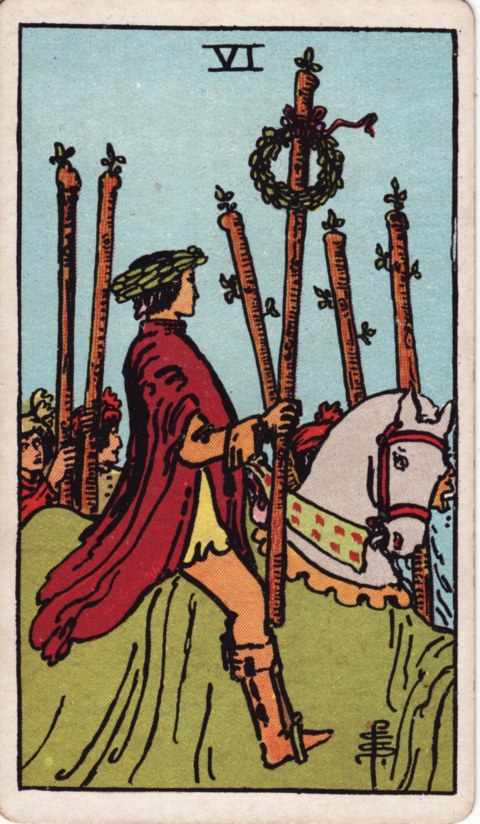
Six of Wands upright: a winner, a courier, or hope fulfilled?
Waite does not stop at the winner. His entry says the card "can cover several significations": "on the surface, it is a victor triumphing, but it is also great news, such as might be carried in state by the King's courier." So the rider may be bringing a result as well as wearing one. Tarot.com stresses the public side: "it's about being seen as victorious." Both fit the picture, a person on horseback while others walk. In the office this week, put the result in two lines with a number in it, such as sales closed, a deadline met or a project shipped, and send it to the person who decides your next role or budget.
Waite's next phrase is "expectation crowned with its own desire, the crown of hope." That is quieter than a parade. It describes the moment when something you were waiting for turns up. The wreath is on the wand as much as on the head, so the honor belongs to the work as well as to the man.
Book T adds a condition that is easy to skip. Its list opens with "Victory after strife" and later says "avoiding of strife, yet victory therein." The win can come by way of calm as well as by way of a fight.
Six of Wands reversed: fear at the gate or a late reply?
Reversed, Waite's list is dark: "Apprehension, fear, as of a victorious enemy at the gate; treachery, disloyalty, as of gates being opened to the enemy; also indefinite delay." The parade has turned into a siege. Newer pages read it as loss of recognition or private doubt. This week, ask for the one thing that has been left hanging, the decision or the payment, and ask when it will come.
The three parts of Waite's list differ in what they need. Apprehension is a feeling, disloyalty is a fact about someone, and indefinite delay is a fact about time. They are easy to mix up, so try the gate check with a single card. Finish this sentence: "What I fear is at the gate is ___." Then ask whether the answer has a name and a date. If it has both, it is a real thing and you can prepare for it. If it has a name and no date, it is the delay in Waite's list, and the move is to request one day from whoever holds it. If it has neither, it is apprehension, and a smaller check, such as looking at one account or reading one message, usually shrinks it.
Waite's second list turns the card around. It gives the upright card "Servants may lose the confidence of their masters; a young lady may be betrayed by a friend," and the reversed card "Fulfilment of deferred hope." On that reading, an upside-down Six is hope arriving late. The sources disagree, and there is no ruling between them except the question you asked.
On an ex, a boss's notice or a job offer, the card holds no answer. It shows how you stand toward a win, whether you fear losing it or are waiting for it. Whatever other people decide lies outside the picture.
Is the Six of Wands a yes or no card?
| Position | Answer |
|---|---|
| Upright | Yes, for a win |
| Reversed | Not yet, a delay |
Upright, the answer is yes to any question about a win, a result or good news. Old sources never say yes or no for this card, so that part is modern habit. The yes weakens when the question is whether the victory will last, since Book T makes everything "dependent on the dignity."
Turned over, it reads as not yet. Waite's "indefinite delay" and his second list's "deferred hope" both point to a result that is late, so hold off and ask again when there is a date.
Six of Wands in love and friendship: pride, praise and feelings
Together
In a couple, the card fits something you got through together: a move, a hard year, a long-distance stretch. Book T puts love in the list itself, "Love: pleasure gained by labour." The pleasure is earned. Say out loud what the two of you managed, and let the credit go both ways, since the picture has a crowd walking beside the rider.
Single
If you are single, the card says you may be seen. It can mark a stretch of confidence after a hard period, with more attention at gatherings. Book T's "sociability" is a good word for it. Show up in company, and let one friendly introduction happen without turning it into a test.
As feelings
Seen as feelings, the Six of Wands is pride and admiration. They are pleased to be seen with you, or pleased by how you did something. The same card has a shadow in Book T, "insolence, and pride of riches and success," so a proud person may also be showing off. The card gives the mood; the plan is up to them.
Who gets the applause? The Six of Wands among friends
At a party, a friend tells the room about the project you built together and says I all the way through. That is the Six of Wands: public credit. Upright, look at who is on the horse and who is walking beside it, and ask which of you the crowd can see. Reversed, Waite gives "Apprehension, fear" and "indefinite delay": you swallowed it, and it is still sitting there. The card gives your side and is silent on whether the friend meant it. Tell the friend privately what you heard, then ask them to name your part next time.
When it is reversed
Reversed, the card can show fear that a bond is about to be undone from inside, which is Waite's "gates being opened to the enemy." It can also show a long wait with no answer. If you feel taken for granted, say which of the two you mean before you talk, since one needs reassurance and the other needs a deadline.
Six of Wands at work and with money
At work, the card suits a promotion, a launch, a finished project or credit from the people you answer to. Biddy Tarot's note that you are "not quite at the finish line just yet" is useful here, because the next review starts the day after the praise. Keep a short file of results with figures and dates, so the win can be shown later to people who were not there.
For money, read it as a gain that has been earned and can be counted. Book T's short label for the card is "Gain." The warning half of its list, "insolence, and pride of riches and success," argues against spending the win in advance. Reversed, the work is late, or someone else gets the credit. Document your part in writing this week, and ask in plain words when you can expect an answer.
Six of Wands as advice and as a person
As advice, let the win be seen. Tell the people who helped, put the result where it can be found and take the congratulations without arguing them down. Then pick the next small target before the glow fades.
As a human type, this is someone who has just been proved right and knows it. Imagine a nurse we will call Ines, a made-up case, who ran a new ward routine that cut missed medication. Her manager praised it in a meeting. She does well to thank her team by name, and she does badly if she answers every later criticism with the same story. Book T gives her fault, "pride of riches and success." Reversed as advice: if you are waiting for credit, write down what you did and send it before you complain that nobody noticed.
How to read the Six of Wands in a spread
Alone, the Six of Wands says a win or a piece of news is the topic, and the question is who knows about it. Ask what the result is and who should be told.
In a three-card line, the first position is a hard stretch that ended in your favor, the second is being seen, and the last is a recognized result that still has to be kept. Book T says "Wands are friendly with Swords and Pentacles," which puts a Sword beside it as the argument that backs the claim and a Pentacle as the payment. After the Five of Wands, the contest has an end; before the Seven, the win is about to be tested. With Strength, the Leo trump, beside it, the victory is held with grace.
The Six of Wands among the Wands
Sixes in tarot tend to be a point of balance after the strain of the Five, and in Book T all four share the sixth sphere, Tiphareth, whose line in the general list reads "Definite accomplishment. Thing carried out." The Cups Six is Pleasure, the Swords Six is Earned Success and the Pentacles Six is Material Success. The Wands Six is Victory, the one that happens in public.
In the suit, the Six is the middle of the Leo run. The Five is the fight, the Seven is Valour, and the Six is the moment between them, when the result is announced. The Seven's opening, "Possible victory," reads as if the Six has not quite settled anything.
- Ace of Wands
- Two of Wands · Dominion
- Three of Wands · Established Strength
- Four of Wands · Perfected Work
- Five of Wands · Strife
- Six of Wands · Victory
- Seven of Wands · Valour
- Eight of Wands · Swiftness
- Nine of Wands · Great Strength
- Ten of Wands · Oppression
- Page of Wands
- Knight of Wands
- Queen of Wands
- King of Wands
Titles after the numbered cards are the Golden Dawn's names for them in Book T.
Symbolism of the Rider–Waite–Smith card
- The laurel wreath on the rider. The rider wears a green wreath on his head. Waite calls him "a laurelled horseman." The wreath is the sign of the win itself.
- The wand with its own wreath. One staff stands upright in his hand with a laurel wreath tied on by a red ribbon. Waite says it is "adorned with a laurel crown." Two crowns on one picture is a doubling, as if the work and the man had both been honored.
- The white horse. The horse is white, with a red bridle and a patterned cloth, and it is cropped by the card's edge. Waite names no color. White horses are a common sign of honor, but that reading is ours.
- Footmen with staves. Waite writes "footmen with staves are at his side." On the card the walkers are small, partly hidden by the hill, and they look toward the rider. They carry their own wands, which is how the picture reaches six.
- No walls, only a green hill. There is no town, gate or crowd of buildings behind them, only a rolling hill under a pale sky. As we see it, the procession has not arrived anywhere yet, which fits the idea that the result is not final.
What the oldest sources say
“The card has been so designed that it can cover several significations; on the surface, it is a victor triumphing, but it is also great news, such as might be carried in state by the King's courier; it is expectation crowned with its own desire, the crown of hope, and so forth. Reversed: Apprehension, fear, as of a victorious enemy at the gate; treachery, disloyalty, as of gates being opened to the enemy; also indefinite delay.”
“Servants may lose the confidence of their masters; a young lady may be betrayed by a friend. Reversed: Fulfilment of deferred hope.”
“Victory after strife: Love: pleasure gained by labour: carefulness, sociability and avoiding of strife, yet victory therein: also insolence, and pride of riches and success, etc. The whole dependent on the dignity.”
Waite gives the card three meanings in one breath: a victor, a courier with "great news," and "expectation crowned with its own desire." That is already richer than the usual page. The reversed list is a siege, "a victorious enemy at the gate." In the later digest the signs swap in a way that does not match: the upright line is about betrayal and the reversed line is "Fulfilment of deferred hope." We leave the clash unresolved on purpose. Treat the digest as a list of old fortune-telling habits, and use the longer entry as the main text.
Book T has no horse and no crowd. It shows two hands "holding six wands crossed three and three" with "short wands with flames issuing," topped by the signs of Jupiter and Leo. Its title is Lord of Victory, and the short label is "Gain." The meaning list is broader than triumph. It includes "Love," "sociability," "avoiding of strife, yet victory therein," and then turns to "insolence, and pride of riches and success." It ends: "The whole dependent on the dignity." The victory is real, and what comes with it depends on the cards around it.
Six of Wands and Jupiter in Leo: the card's decan
| Suit and element | Wands, Fire (Major Arcana card of fire: Judgement) |
|---|---|
| Decan | 10° to 20° ♌︎ Leo, the second ten degrees of the sign |
| Planet of the decan | Jupiter (Major Arcana: Wheel of Fortune) |
| Major Arcana card of Leo | Strength |
| Golden Dawn title | The Lord of Victory |
| Place on the Tree of Life | Tiphareth (Book T: “Gain”) |
Attributions from Book T (Golden Dawn, c. 1892; printed 1912).
Book T gives the middle ten degrees of Leo to the Six of Wands and the rule to Jupiter: the short wands are "surmounted respectively by the symbols of Jupiter and Leo, representing the Decan." Leo belongs to the same element as the wands, fire. Three trumps link to this card: Strength (Leo), the Wheel of Fortune (Jupiter) and Judgement (fire).
Older astrology counts Jupiter as a benefic planet, and the sign is ruled by the Sun, which suits a card about being seen. Putting Jupiter and Leo together is our note. This decan also lies inside the King of Wands' zone.
When the Sun is in the Six of Wands stretch
| Year | Sun enters 10° | Sun leaves (reaches 20° Leo) |
|---|---|---|
| 2026 | Aug 2 | Aug 12 |
| 2027 | Aug 2 | Aug 12 |
| 2028 | Aug 1 | Aug 12 |
| 2029 | Aug 1 | Aug 12 |
This year the Sun crossed the Six of Wands stretch of the zodiac (10° to 20° Leo) from August 2 to August 12, 2026. Next time: August 2 to August 12, 2027 (US Eastern dates).
Dates are US Eastern, from the astronomy-engine ephemeris. Across 35,064 dates from 1930 to 2025, the Sun is in this stretch on 2.9% of them, and at least one of the ten planets is on 24.9%.
Jupiter left this decan on October 5, 2026, less than a month ago, by our ephemeris. It had entered on August 16 and returns from February 28 to May 29, 2027, on its retrograde loop. Saturn stood here in 1976 to 1977 and in 2005 to 2007, and returns in 2035 to 2036. Pluto was here in 1950 to 1952, and Uranus passes through from 1957 to 1960 and again from 2041 to 2044. Neptune never enters it between 1950 and 2060 in our tables. All of this is position, with no forecast attached.
Is the Six of Wands in your birth chart?
Enter your birth date. We show which of the ten planets stood between 10° and 20° Leo that day, the slice of sky Book T gives this card; add the time if a planet was near the edge.
Enter your birth date above to see your result.
Every planet, angle and house from your birth time: birth chart calculator.
Questions about the Six of Wands
Good news or bad, is the Six of Wands lucky?
Mostly, yes. Waite reads a victor and also "great news," and Book T adds a caution about pride, with the whole thing "dependent on the dignity."
If someone shows the Six of Wands, how do they feel?
Pride and admiration. They are pleased to be seen with you or by something you did. A proud person may also be showing off, so the card gives the mood and leaves the plan open.
Can I read the Six of Wands as a yes?
For a win or good news, yes; reversed, not yet. That verdict is modern practice; the old texts never assign one.
Reversed Six of Wands: what does it say?
Waite lists "Apprehension, fear" and "indefinite delay," and his later digest gives "Fulfilment of deferred hope." A named fear with a date is real; one with neither is mostly worry.
Does a promotion fit the Six of Wands?
It fits recognition for finished work. Record the result in figures and send it to the person who decides.
Will my ex come back with the Six of Wands?
No answer here. It describes your relation to a win or a wait; another person's choice is outside it.
Six of Wands: which zodiac sign, and what dates?
The middle ten degrees of Leo, under Jupiter in Book T. No date is attached to the card itself; the Sun crosses the slice from about August 2 to 12, which is only a calendar habit.
Sources
- Astronomy Engine: the open-source ephemeris library behind our planet positions, dates and statistics
- A. E. Waite, The Pictorial Key to the Tarot (1911), Wikisource: the divinatory meanings we quote, upright and reversed
- Book T (Golden Dawn), as printed in The Equinox I:8, 1912: the zodiac sign, Hebrew letter, title and short meaning of each card
- Wikimedia Commons: Rider–Waite–Smith tarot deck: Pamela Colman Smith's 1910 card drawings, public domain
- How we create our readings: our own calculation of sign dates, positions and the 1930 to 2025 statistics
Next to the Six of Wands
In the suit of Wands: Five of Wands ← Six of Wands → Seven of Wands.
Leo on this site: Leo zodiac sign · Strength, the card of Leo · your full birth chart.
All 22 Major Arcana with their signs and planets, and the minor cards written so far: tarot card meanings.
Written by The Zodiac Atlas editorial team with the help of AI and edited by a person. Quotations are from Waite's Pictorial Key to the Tarot and the Golden Dawn's Book T, both in the public domain; the card picture is a 1910 printing of Pamela Colman Smith's drawing for the 1909 deck. Sun dates and planet positions come from the astronomy-engine ephemeris (tropical zodiac). Tarot and astrology are symbolic traditions; they do not predict events.