Nine of Wands upright: what are you still defending?
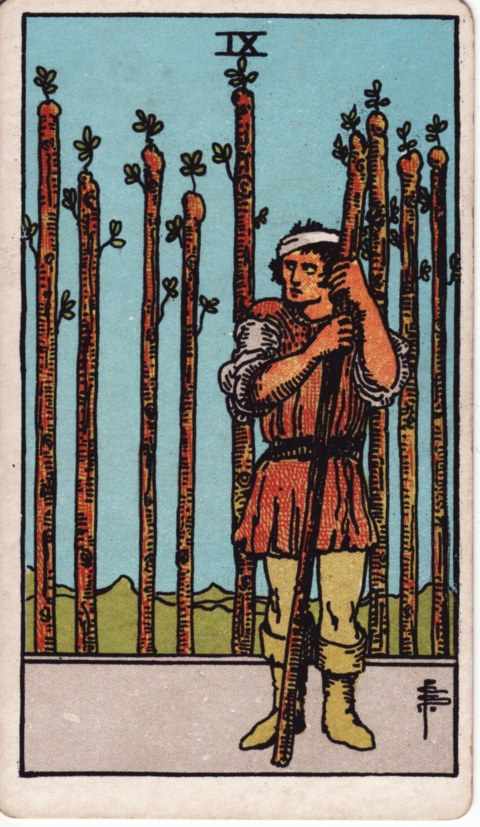
The picture shows a man who has already been hit and has not left. Waite describes him leaning on his staff with "an expectant look, as if awaiting an enemy," and the other eight staves stand behind him "like a palisade." The scene is a pause before the next blow. He means to be standing when it lands. Tarot.com calls it "a card of exhaustion," and the bandage agrees.
The reading that follows is endurance with a limit. Waite's main line is "strength in opposition," and he adds "delay, suspension, adjournment," which is a different thing from victory. The fight is paused or still going. Nobody has won it. Ask what you are protecting, how long you have been at it, and what a finish would look like. Someone who can answer all three is in the upright Nine. Someone who cannot may be sliding toward the reversed one.
Book T, the Golden Dawn text, sounds more confident. It calls the card "Lord of Great Strength" and lists "Tremendous and steady force that cannot be shaken" right beside "Victory, preceded by apprehension and fear." Fear before the win fits the man's face. In practice the upright card asks you to keep the position you have and stop opening new fronts, and to let someone help with the fence you already built.
Reversed Nine of Wands: when the fence outlasts the attack
Reversed, the Nine of Wands splits into collapse and a fence that outlived the attack. Collapse is the plain reading. The strength has run out, and the card says you cannot keep this up. Waite's reversed line is short and bleak, "Obstacles, adversity, calamity," and it fits that side best. The other side is quieter. Tarot.com asks, "Are you holding on to a battle that's long over?" and Biddy Tarot says the defensiveness is often "a sign of fear from within you rather than an actual external threat."
A single card can still be tested. Try the dated-threat test. Write down the name of whoever or whatever you are bracing against, then the last date it actually hurt you. If both come easily and the date is recent, the attack is real, so read the reversed card as exhaustion and cut the load. If you cannot name the threat, or the last date is months back, the staves are guarding a memory. Labyrinthos describes that state as a boundary that turns into "their own personal prison."
Each answer has a small next step. Real exhaustion needs one wand set down: a deadline moved, a task handed over, a night of sleep taken without apology. A stale guard needs one gate opened. Tell a trusted person what you have been bracing for. Neither step is a verdict on whether you are strong. The man stands in both versions.
Asking whether a former partner will come back? A fenced-in figure is not waiting by the gate for anyone. The reversed card reports how closed you are, and a closed gate says nothing about who stands outside it.
Is the Nine of Wands a yes or no card?
| Position | Answer |
|---|---|
| Upright | Yes, if you can keep holding |
| Reversed | No, not at this cost |
Upright, we read the Nine of Wands as a yes with a price, and the price is effort. Tarot.com gives it a flat answer, "the answer is YES," even though its own text calls the card exhaustion. Ask whether you can finish the thing and the card says you can, if you hold. Ask whether it will be over soon and Waite's "delay, suspension, adjournment" points to not yet.
Reversed, the answer is no to the plan as it stands. It is wearing you down. The fear behind it may be bigger than the threat. The old sources never rated a card yes or no, so these two verdicts are ours.
Nine of Wands in love, friendship and feelings: the guarded heart
In a relationship
With a partner, the card often shows two people who have been through something and are still standing, or one partner defending a position in a long argument. Or you may be the partner who stays braced, ready for the next hurt before it arrives. The question to ask is who the fence is for, and whether the other person knows it is there.
Single
Single, the Nine describes the gap between wanting someone and letting anyone close. One ordinary question from a date can set off the whole palisade. A small step suits the picture: let one person inside the fence for one evening and see what happens to your shoulders.
As feelings
As someone's feelings, the Nine of Wands shows a person who is wary. They have been hurt, they are tired, and they are watching to see whether you are another attack. That comes from the picture, where the man glances to the side and not at the viewer. Whether the guard comes down depends on what they are shown over time, and a card cannot say that.
Once burned by a friend, still guarding the gate?
A friend once repeated what you told her in confidence. Now a coworker keeps asking you to lunch, and you keep finding reasons to decline. This card is the guard who stays up after the fight is over. Waite reads the upright card as "strength in opposition", and between friends that means you can hold a boundary without being cruel.
Reversed, the fence outlasts the attack. You treat a kind person as a threat and call it self-respect. The coworker may or may not be safe; the card only says you are braced. Try one lunch. Share something small and true, and watch whether it is handled with care.
Reversed in love
Upside down in a love spread, the Nine names someone who has built the fence so well that no one gets in, or a couple where one partner treats every disagreement as an assault. It can also mean the war is over and the staves are finally coming down. Check the cards beside it. Questions about an ex are taken up in the reversed reading above.
Nine of Wands at work and with money
At work the card fits the last stretch of a long project, a year of layoffs survived, or a dispute that is not settled. Labyrinthos says it "marks the halfway mark in a battle," a useful correction to the usual "almost there" reading. The picture shows eight staves behind the man and gives no count of how many are ahead, so count your own remaining tasks before trusting either mood.
With money, the card suits a tight stretch where you are holding a line: a savings cushion kept intact, a payment plan being kept, a small business getting through a slow year. Book T lists "Herculean strength, yet sometimes scientifically applied," which we read as effort that works best with a plan. Spending driven by fear of the next hit is the reversed trap.
Nine of Wands as advice and as a person
As advice, the card says stay, but change how you stay. Keep the position you have won, stop recruiting new fights, and put one reliable person on the fence with you. A workable first step is to list everything you are defending right now and mark the one item that matters least.
As a person, the Nine of Wands is someone who has been hit and kept going. Picture a contractor three weeks from finishing a house while the client disputes the bill: tired, polite, careful with every email, carrying the paperwork in a folder. Book T gives this person a hard side, "intractable, obstinate," and a curious one, "Generous, questioning and curious." Loyal, and slow to ask for help.
How to read the Nine of Wands in a spread
Drawn in the past slot, the card shows a hard stretch you came through and still carry in how you stand. In the present slot it says you are mid-defense and tired. As the outcome, take it as a sign that the matter will not close quickly, Waite's "delay, suspension, adjournment." As advice it says hold, and ask for help.
Book T makes a card stronger or weaker by its neighbors, and a same-suit neighbor will "strengthen it greatly." More Wands beside the Nine add force and fight. Book T also says "Wands are friendly with Swords and Pentacles," so a Sword beside the Nine often brings the argument or the plan, and a Pentacle brings practical stakes. Cups are the awkward neighbor in that list, and a Cup here suggests feeling pulling against the stand you are making.
Next to the Eight of Wands, which Book T calls Swiftness, the fight has just sped up and you are catching your breath. Next to the Ten of Wands, Oppression, the stand is turning into a load too heavy to carry. Next to Temperance, the Major Arcana card of Sagittarius, pacing matters more than push.
The Nine of Wands among the Wands
The last three Wands share one sign. In Book T the Eight of Wands goes to Mercury in Sagittarius, the Nine to the Moon in Sagittarius, and the Ten to Saturn in Sagittarius, so the end of the suit sits inside a single stretch of sky. The Eight, Lord of Swiftness, is "Too much force applied too suddenly. Very rapid rush, but quickly passed and expended." The Nine is the opposite, "Tremendous and steady force that cannot be shaken." The Ten, Lord of Oppression, is "Cruel and overbearing force and energy."
So the Nine is the middle step between a sprint and a crush: burst, hold, burden. Read in order, the suit's fire goes from speed to endurance to weight. That ordering is ours. Book T does not tell it as a story. It does show why the Nine looks like an ending to a tired reader and a halfway point to a calm one.
- Ace of Wands
- Two of Wands · Dominion
- Three of Wands · Established Strength
- Four of Wands · Perfected Work
- Five of Wands · Strife
- Six of Wands · Victory
- Seven of Wands · Valour
- Eight of Wands · Swiftness
- Nine of Wands · Great Strength
- Ten of Wands · Oppression
- Page of Wands
- Knight of Wands
- Queen of Wands
- King of Wands
Titles after the numbered cards are the Golden Dawn's names for them in Book T.
Symbolism of the Rider–Waite–Smith card
- The bandaged head. The man in the picture wears a bandage on his head. As we read it, the wound is the picture's way of saying the stand has already cost something.
- Eight upright staves. Waite says they are "erect, in orderly disposition, like a palisade." The count is eight, one for each Wand card from the Ace through the Eight if you like, though that match is our reading and not Waite's.
- The ninth staff. He grips one staff in both hands, and in Waite's words he "leans upon his staff." It works as a prop and a weapon at once, which suits a figure who is defending and resting in the same moment.
- The sideways glance. The man looks to the side. Waite's phrase for the look is "an expectant look, as if awaiting an enemy." He is watching, not yet fighting.
- Book T's fire diagram. In Book T there is no man at all. Four hands hold eight wands crossed four and four, and "a fifth hand at the foot of the card holds another wand upright," with flames leaping from the junction. The Golden Dawn card is a fire diagram. As we read it, the Rider-Waite card swaps the hands for a person.
What the oldest sources say
“The card signifies strength in opposition. If attacked, the person will meet an onslaught boldly; and his build shews that he may prove a formidable antagonist. With this main significance there are all its possible adjuncts—delay, suspension, adjournment. Reversed: Obstacles, adversity, calamity.”
“Generally speaking, a bad card.”
“Tremendous and steady force that cannot be shaken. Herculean strength, yet sometimes scientifically applied. Great success, but with strife and energy. Victory, preceded by apprehension and fear. Health good, and recovery not in doubt. Generous, questioning and curious; fond of external appearances: intractable, obstinate.”
Waite gives this card two verdicts that do not agree. The main entry reads "strength in opposition" with "delay, suspension, adjournment," and the reversed line is "Obstacles, adversity, calamity." Near the end of the book Waite narrows the verdict. In a separate digest of meanings the upright entry shrinks to five words: "Generally speaking, a bad card." Strength that meets an attack boldly is hard to file under bad. Waite does not explain the gap. We suspect the short line records a fortune-telling habit of treating any opposition as bad news, and this page goes with the longer list.
Book T pulls the other way. It lists "Health good, and recovery not in doubt" among the card's meanings. Under the sphere Yesod it gives "Strength, power, health, recovery from sickness." Next to those sit "apprehension and fear" and "intractable, obstinate." The Golden Dawn put strength, fear and stubbornness in one run with no sorting, so the apprehension reads as part of the strength. These are the lists of an old card system and carry no medical weight; a doctor is the person to ask about health.
Nine of Wands and Moon in Sagittarius: the card's decan
| Suit and element | Wands, Fire (Major Arcana card of fire: Judgement) |
|---|---|
| Decan | 10° to 20° ♐︎ Sagittarius, the second ten degrees of the sign |
| Planet of the decan | Moon (Major Arcana: The High Priestess) |
| Major Arcana card of Sagittarius | Temperance |
| Golden Dawn title | The Lord of Great Strength |
| Place on the Tree of Life | Yesod (Book T: “Strength, power, health, recovery from sickness”) |
Attributions from Book T (Golden Dawn, c. 1892; printed 1912).
The Nine of Wands takes the middle ten degrees of Sagittarius (10° to 20°) in Book T, and the Moon rules it: "Above and below are the symbols Moon and Sagittarius." Sagittarius is a fire sign, and Wands are the fire suit. Temperance is the Major Arcana card of Sagittarius, and The High Priestess belongs to the Moon.
On paper the pairing is odd. The Moon is the fastest-changing body in the sky. The card is named for strength that "cannot be shaken." As we read it, the Moon here points to cycles and recovery: it wanes and returns, and the man is hurt and stays on his feet. Book T also files the card under Yesod, with recovery from sickness in the label. That link is ours; Book T names the planet and sign and stops there.
When the Sun is in the Nine of Wands stretch
| Year | Sun enters 10° | Sun leaves (reaches 20° Sagittarius) |
|---|---|---|
| 2026 | Dec 1 | Dec 11 |
| 2027 | Dec 2 | Dec 12 |
| 2028 | Dec 1 | Dec 11 |
| 2029 | Dec 1 | Dec 11 |
This year the Sun crosses the Nine of Wands stretch of the zodiac (10° to 20° Sagittarius) from December 1 to December 11, 2026 (US Eastern dates).
Dates are US Eastern, from the astronomy-engine ephemeris. Across 35,064 dates from 1930 to 2025, the Sun is in this stretch on 2.7% of them, and at least one of the ten planets is on 27.2%.
The Sun sits in that stretch of Sagittarius from about December 1 to December 11. People born then get the Nine of Wands as their decan card on this site, a label from the Golden Dawn scheme that predicts nothing. Saturn was last in this part of Sagittarius in 2015 and 2016 and returns in 2045 and 2046, by our calculation, and Pluto spent most of 1999 to 2003 here.
Is the Nine of Wands in your birth chart?
Enter your birth date. We show which of the ten planets stood between 10° and 20° Sagittarius that day, the slice of sky Book T gives this card; add the time if a planet was near the edge.
Enter your birth date above to see your result.
Every planet, angle and house from your birth time: birth chart calculator.
Questions about the Nine of Wands
Is the Nine of Wands a bad card?
Most modern guides read it as strength under pressure, and Book T lists "Health good, and recovery not in doubt." Waite is the exception: his additional-meanings list says "Generally speaking, a bad card," while his main entry says "strength in opposition." We read it as a hard card.
Does the Nine of Wands mean resilience?
Yes, resilience is the standard modern keyword, and the picture supports it: a hurt man still upright. The card describes endurance in progress. It does not say how the fight ends.
What does the Nine of Wands mean for health?
Tarot is no substitute for a doctor, and a card says nothing about your body. Book T lists good health and recovery among its meanings, but that is the Golden Dawn's card language. If worry about your health brought you here, ask a doctor.
What does the Nine of Wands mean as feelings?
Wariness. The person has been hurt, is tired, and is guarding what they have left. Reversed, the guard has become habit and may be keeping out people who mean no harm.
Is the Nine of Wands yes or no?
Upright, it leans yes provided you can hold out; Tarot.com agrees. Reversed, it leans no, because the cost is too high.
What zodiac sign is the Nine of Wands?
Sagittarius. Book T puts it in the middle of the sign and gives it to the Moon. The Sun spends about December 1 to December 11 in that span.
How long will the hard stretch last?
There is no date in the card. Waite's "delay, suspension, adjournment" suggests the matter drags before it ends. If you want a calendar, one option is the Sun's December 1 to 11 pass through the card's decan, a choice of ours and not a rule from the sources.
Sources
- Astronomy Engine: the open-source ephemeris library behind our planet positions, dates and statistics
- A. E. Waite, The Pictorial Key to the Tarot (1911), Wikisource: the divinatory meanings we quote, upright and reversed
- Book T (Golden Dawn), as printed in The Equinox I:8, 1912: the zodiac sign, Hebrew letter, title and short meaning of each card
- Wikimedia Commons: Rider–Waite–Smith tarot deck: Pamela Colman Smith's 1910 card drawings, public domain
- How we create our readings: our own calculation of sign dates, positions and the 1930 to 2025 statistics
Next to the Nine of Wands
In the suit of Wands: Eight of Wands ← Nine of Wands → Ten of Wands.
Sagittarius on this site: Sagittarius zodiac sign · Temperance, the card of Sagittarius · your full birth chart.
All 22 Major Arcana with their signs and planets, and the minor cards written so far: tarot card meanings.
Written by The Zodiac Atlas editorial team with the help of AI and edited by a person. Quotations are from Waite's Pictorial Key to the Tarot and the Golden Dawn's Book T, both in the public domain; the card picture is a 1910 printing of Pamela Colman Smith's drawing for the 1909 deck. Sun dates and planet positions come from the astronomy-engine ephemeris (tropical zodiac). Tarot and astrology are symbolic traditions; they do not predict events.