Four of Wands upright: a wedding, or a harvest supper?
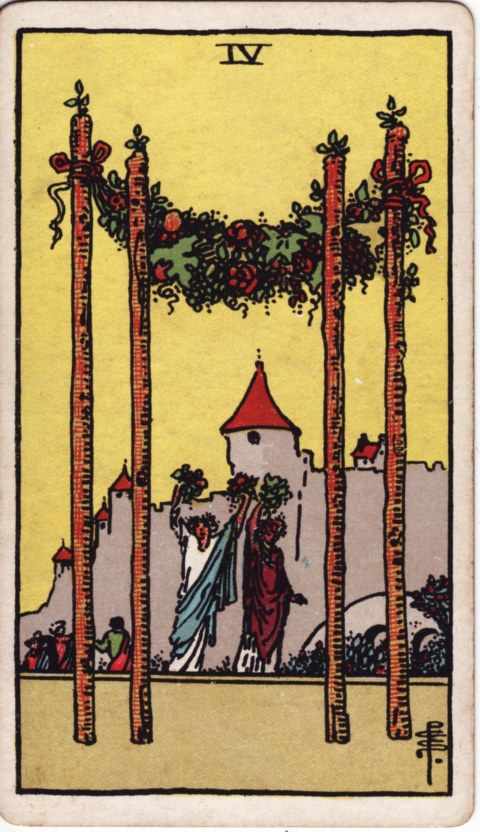
Waite's picture line reads like an inventory of a settled place: "From the four great staves planted in the foreground there is a great garland suspended; two female figures uplift nose-gays; at their side is a bridge over a moat, leading to an old manorial house." Nobody is fighting for anything here. The staves are planted like posts in ground that already belongs to the people standing on it. If a piece of work is finished in everything but name, send it, invoice it or hand it over by Friday, and stop adjusting it.
His meaning list is rural and quiet: "country life, haven of refuge, a species of domestic harvest-home, repose, concord, harmony, prosperity, peace." The phrase to stop on is "harvest-home," the feast held when the crop is in. It is a party for work that is over, shared with the people who did it. A wedding, which many modern pages hang on this card, is a later reading. Labyrinthos sees a flower canopy in the picture that resembles the canopy of "the traditional Jewish ceremony," a fair observation about the garland, though Waite never mentions it.
Book T opens on the same note, "Perfection or completion of a thing built up with trouble and labour. Rest after labour," and then turns: "Unreadiness, unreliable and unsteady through over-anxiety and hurriedness of action." Read together, the thing is finished and the person who built it may be too anxious to rest. If you cannot enjoy the finish, that clause is the likely reason.
Four of Wands reversed: a late party, or no change at all?
Waite does something rare here: "The meaning remains unaltered; it is prosperity, increase, felicity, beauty, embellishment." Most cards flip when turned over, and this one stays good. Tarot.com goes the other way and reads the reversed card as "instability where there should be celebration," which is a modern layer. For work and money, finish the one item that blocks the invoice or the sign-off, and ask for the sign-off in writing this week.
To tell a late party from a finish you will not allow, run the "done when" test. Take five minutes and complete this sentence about the thing you are waiting to celebrate: "This is finished when ...". If it ends in a fact somebody else could check, such as a signature, a payment or a key handed over, the work is nearly done and the party is only waiting for that fact. If it ends in three more tasks, or you catch yourself moving the line, that is Book T's "over-anxiety and hurriedness of action," and the reversed card is describing someone who has not let the work count as done.
No old text turns the Four dark upside down. The shaky-party reading has a source only if you borrow Book T's anxious clause, and that clause is already in the upright card. A reversed Four is the same house with the gate not yet open.
Wondering if a wedding is coming, or if someone will cross the bridge back to you? The picture fixes no couple and no date. It shows a settled mood; a particular person's return is that person's decision.
Is the Four of Wands a yes or no card?
| Position | Answer |
|---|---|
| Upright | Yes, once it's done |
| Reversed | Yes, later |
Upright, the Four of Wands is a yes for finishing, settling and marking something. Tarot.com gives a plain "the answer is YES." That verdict is a later habit, and the old texts leave the card without one. Expect the yes to hold best when the work behind the question is truly done.
Turned over, the answer is still yes, just later. Waite says the meaning is unchanged, and modern readers add delay, so ask what is unfinished and deal with it first.
Four of Wands in love and friendship: engaged, settled or just at home?
In a relationship
Between partners the card is a stretch of settled peace after a hard job: a move, a difficult year, a decision finally made. Waite's "repose, concord, harmony, prosperity, peace" is the list. Use it to hold the dinner, invite the family or mark the anniversary. The step that comes next might be a ring, or just as well a shared lease, because Waite's word is a harvest feast and says nothing of vows.
Single
Single, the card describes someone whose own ground is in order: home, friends, work. It favors meeting people at a table, a family gathering or a neighbor's house over a hunt. Book T's "Graceful in manner, at times insincere" is worth keeping in mind: enjoy the good manners at a first meeting and watch the second.
As feelings
Taken as what a partner feels, the Four of Wands is contentment: warm, at ease with you and happy to have you in their circle. Book T's "at times insincere" and "unsteady" are the shadow side, since warmth in company is not a promise in private. Watch what they do when the room is empty.
Seating two friends who stopped speaking
You are hosting a housewarming, and two friends who fell out in the spring are both on your list. The Four of Wands is Waite's "a species of domestic harvest-home," a feast held once the work is done, and it favors a table where people can sit down without a verdict. Upright, invite both and tell each who else is coming. Waite leaves the reversed card unchanged, so a stiff evening is a modern reading. Still, plan for some awkwardness and skip the peace speech. Text each of them one line saying you would like them there.
Reversed in love: wedding off, or just late?
Waite keeps the reversed card good, so no breakup is written into it. Modern readers see strain at home, a celebration that fizzles or a relative's tension at the table. If you asked about an engagement, a wedding date or a former partner, the card offers neither a date nor a name. It shows the mood of your own household.
Four of Wands at work and with money
At work the Four of Wands is the delivery. Book T's "Perfection or completion of a thing built up with trouble and labour" and "success in completion" fit a launch, a final exam, a signed contract or a handed-over project. Waite's "prosperity" points at steady household money: rent paid, a mortgage settled, savings that finally cover the year. It makes no promise about an amount.
Reversed, the sign-off is late or the last step keeps slipping. Waite does not read losses into it, so look for the practical reason: a missing signature, a client who has not replied, or your own habit of polishing past the deadline. Money-wise, delay a large purchase for a week and see whether the number still looks right.
Four of Wands as advice and as a person
As advice, stop at the gate and look before you start the next thing. Mark the finish within a week, with the people who did the work, and keep it small enough that you will really do it. Reversed, set the date of the celebration first and let it pull the last tasks into shape.
Personified, the Four of Wands is the one who hosts after the work is done. Here is an invented case: Ines spent two years renovating her late aunt's house and still keeps a list of walls she has not painted. The card in her hand says to invite the street over for a harvest-home, paint list and all, and see who comes.
How to read the Four of Wands in a spread
Drawn alone, the Four of Wands says something is finished enough to be marked. Ask what it is, and who should be at the table.
Placed in the past, it is a settled stretch behind the question; placed now, it permits rest; placed ahead, it promises a settlement only if the work gets completed. A Sword beside it brings terms and paperwork to the finish, and a Pentacle brings the money. Cups add feeling to the table. Next to the Five of Wands the quiet ends and the staves are waved about again. With The Emperor, the Aries trump, close by, the house gets a head.
The Four of Wands among the Wands
In Book T the Wands cross Aries in three steps, Dominion, then Established Strength, then Perfected Work, which is this card. By this card the fire is building something. The Four closes the first fire sign, and the card after it opens in Leo under the title Strife.
The pictures show the same step. In the Four the staves are planted; in Waite's Five a crowd of youths waves them about. Book T draws two clasped hands holding four wands or torches crossed, with flames at their meeting. The garland, the women and the moat all come from Smith and Waite, so the suit's rest stop is the artist's addition.
- Ace of Wands
- Two of Wands · Dominion
- Three of Wands · Established Strength
- Four of Wands · Perfected Work
- Five of Wands · Strife
- Six of Wands · Victory
- Seven of Wands · Valour
- Eight of Wands · Swiftness
- Nine of Wands · Great Strength
- Ten of Wands · Oppression
- Page of Wands
- Knight of Wands
- Queen of Wands
- King of Wands
Titles after the numbered cards are the Golden Dawn's names for them in Book T.
Symbolism of the Rider–Waite–Smith card
- The four planted wands. Four tall wands, already in leaf, stand upright across the foreground. Waite calls them "four great staves planted in the foreground." Book T's wands are held crossed in clasped hands, so planting is Smith's change. As we read it, wands that have taken root mean the building phase is over.
- The garland. A swag of flowers and fruit hangs across the tops of the wands. Waite says only "a great garland suspended." Flowers and fruit together make it a harvest, which suits his "harvest-home".
- Two women with bouquets. Two women in long gowns lift bouquets over their heads. Waite's word for the bunches is "nose-gays," an old term for small posies. Only a few tiny figures dance far behind them, so the card is a welcome, and the bouquets are the greeting.
- The bridge and the moat. At the right a small bridge crosses the moat to the wall. Waite writes "a bridge over a moat, leading to an old manorial house." A moat is a defense, and the bridge shows it is down. The reading is ours: you are let in.
- The castle wall and tower. Behind the women a stone wall with a round red-roofed tower stands under a yellow sky. Waite calls the building an "old manorial house," which is homelier than a castle. It carries the sense of rest and belonging in his list.
What the oldest sources say
“They are for once almost on the surface—country life, haven of refuge, a species of domestic harvest-home, repose, concord, harmony, prosperity, peace, and the perfected work of these. Reversed: The meaning remains unaltered; it is prosperity, increase, felicity, beauty, embellishment.”
“Unexpected good fortune. Reversed: A married woman will have beautiful children.”
“Perfection or completion of a thing built up with trouble and labour. Rest after labour, subtlety, cleverness, beauty, mirth, success in completion. Reasoning faculty, conclusions drawn from previous knowledge. Unreadiness, unreliable and unsteady through over-anxiety and hurriedness of action. Graceful in manner, at times insincere, etc.”
Waite's lists here are mild. The main entry is a country picture, "haven of refuge" and "harvest-home," and the line for the turned card leaves it alone. His second pass reads "Unexpected good fortune" one way up and "A married woman will have beautiful children" the other. The second line is a promise of its period about a married woman, and as a rule it gives you nothing to test, so treat it as an old way of calling the household blessed.
In Book T nobody stands in the scene: two hands clasped in the centre hold the wands, and the figures, garland and house belong to the Waite-Smith card. Its list is odder than the picture: after "Rest after labour, subtlety, cleverness, beauty, mirth, success in completion" come "Reasoning faculty, conclusions drawn from previous knowledge." A card of reasoning sits oddly with a feast. Its sphere is Chesed, glossed "Settlement, arrangement, completion," which is the plain core of the card.
Four of Wands and Venus in Aries: the card's decan
| Suit and element | Wands, Fire (Major Arcana card of fire: Judgement) |
|---|---|
| Decan | 20° to 30° ♈︎ Aries, the third ten degrees of the sign |
| Planet of the decan | Venus (Major Arcana: The Empress) |
| Major Arcana card of Aries | The Emperor |
| Golden Dawn title | The Lord of Perfected Work |
| Place on the Tree of Life | Chesed (Book T: “Settlement, arrangement, completion”) |
Attributions from Book T (Golden Dawn, c. 1892; printed 1912).
Book T gives the last ten degrees of Aries, 20° to 30°, to the Four of Wands, with Venus in charge, as "Lord of Perfected Work." Aries is fire, like the Wands. By tradition Venus rules Libra, the opposite sign, so Venus is in its detriment in Aries. Book T leaves that unsaid, and the picture does not look like a weakened planet. On the trump side, Aries has The Emperor, Venus has The Empress, and Judgement stands for fire.
The sphere Chesed is glossed "Settlement, arrangement, completion." The decan closes Aries, the first sign of the zodiac. It lies in the King of Pentacles' stretch of sky, which runs from the end of Aries into Taurus. The Sun crosses it in mid-April, as the table shows.
When the Sun is in the Four of Wands stretch
| Year | Sun enters 20° | Sun leaves (reaches 30° Aries) |
|---|---|---|
| 2026 | Apr 9 | Apr 19 |
| 2027 | Apr 9 | Apr 20 |
| 2028 | Apr 9 | Apr 19 |
| 2029 | Apr 9 | Apr 19 |
This year the Sun crossed the Four of Wands stretch of the zodiac (20° to 30° Aries) from April 9 to April 19, 2026. Next time: April 9 to April 20, 2027 (US Eastern dates).
Dates are US Eastern, from the astronomy-engine ephemeris. Across 35,064 dates from 1930 to 2025, the Sun is in this stretch on 2.8% of them, and at least one of the ten planets is on 20.7%.
Saturn is outside the decan today, by our ephemeris. It enters on April 27, 2027, next spring, and stays until April 15, 2028. Earlier stays were 1968 to 1969 and 1997 to 1999. Uranus was here from 2015 to 2019, Neptune returns from 2033 to 2039 with breaks, and Jupiter stood here from April 6 to May 18, 2023 and comes back in spring 2035. None of this is a forecast.
Is the Four of Wands in your birth chart?
Enter your birth date. We show which of the ten planets stood between 20° and 30° Aries that day, the slice of sky Book T gives this card; add the time if a planet was near the edge.
Enter your birth date above to see your result.
Every planet, angle and house from your birth time: birth chart calculator.
Questions about the Four of Wands
Is the Four of Wands a good card?
Among the gentlest cards. Waite writes "repose, concord, harmony, prosperity, peace," and Book T adds a small warning about over-anxiety. The only worry the card carries is not letting yourself rest.
What does the Four of Wands mean as feelings?
Contentment and welcome: the person is at ease with you. Book T notes the card can be "at times insincere," so look for the same warmth when no one is watching.
Is the Four of Wands a green light?
For finishing, settling and celebrating, yes; reversed, still yes but slower. Neither old book gives a verdict; it comes from later practice.
What does the Four of Wands reversed mean?
Waite says the meaning remains unaltered, with prosperity and felicity intact. Newer pages read a delayed or shaky celebration. Try finishing the sentence "This is finished when ..." and see how it ends.
Does the Four of Wands mean a wedding or engagement?
It can, as a modern reading. Waite's own phrase is "harvest-home," a feast at the end of the crop. What it shows is a feast and a settled home, with no couple or date attached.
Which sign holds the Four of Wands?
Aries, at 20° to 30°, under Venus in Book T. Sun dates: about April 9 to 19.
When will the Four of Wands celebration happen?
The card names no day. Purely by convention, the Sun occupies the decan around April 9 to 19, which tells nothing about your own pace. By our ephemeris Saturn enters it on April 27, 2027, and that promises nothing.
Sources
- Astronomy Engine: the open-source ephemeris library behind our planet positions, dates and statistics
- A. E. Waite, The Pictorial Key to the Tarot (1911), Wikisource: the divinatory meanings we quote, upright and reversed
- Book T (Golden Dawn), as printed in The Equinox I:8, 1912: the zodiac sign, Hebrew letter, title and short meaning of each card
- Wikimedia Commons: Rider–Waite–Smith tarot deck: Pamela Colman Smith's 1910 card drawings, public domain
- How we create our readings: our own calculation of sign dates, positions and the 1930 to 2025 statistics
Next to the Four of Wands
In the suit of Wands: Three of Wands ← Four of Wands → Five of Wands.
Aries on this site: Aries zodiac sign · The Emperor, the card of Aries · your full birth chart.
All 22 Major Arcana with their signs and planets, and the minor cards written so far: tarot card meanings.
Written by The Zodiac Atlas editorial team with the help of AI and edited by a person. Quotations are from Waite's Pictorial Key to the Tarot and the Golden Dawn's Book T, both in the public domain; the card picture is a 1910 printing of Pamela Colman Smith's drawing for the 1909 deck. Sun dates and planet positions come from the astronomy-engine ephemeris (tropical zodiac). Tarot and astrology are symbolic traditions; they do not predict events.