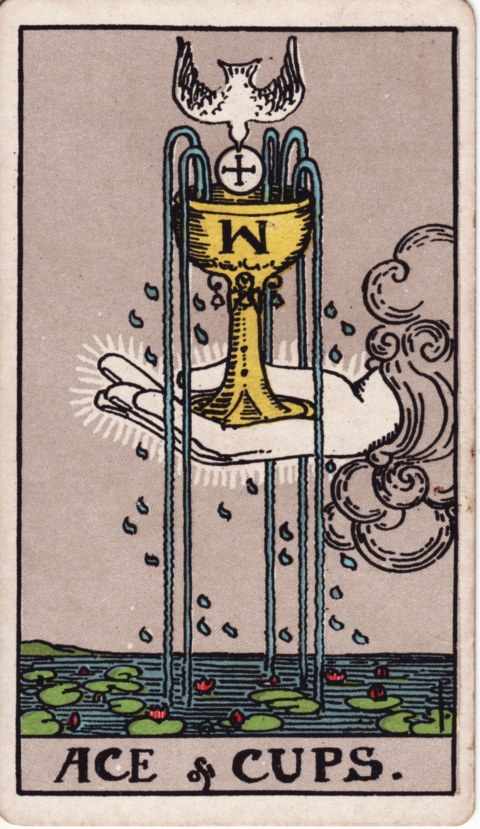
Ace of Cups upright: is it a good card?
The Ace of Cups is one of the kindest cards in the deck. The water is clean, the cup is full, and nothing in the picture asks you to pay. What it offers is a start. A feeling that had gone quiet starts up again, whether that is a new attachment, a softening toward someone, or an urge to make something. Tarot.com puts the limit well: the card "does offer openings."
Waite's words for the card sound like a household more than a mood: "House of the true heart," then "abode, nourishment, abundance, fertility." Book T agrees about the generosity. It says the card symbolizes "Fertility" and gives "productiveness, beauty, pleasure, happiness." So we read the upright Ace as feeling that feeds something, a relationship, a home or a piece of work. Joy that stays in one head is the thinner reading.
Biddy Tarot writes that "As with all Aces in the Tarot, this card comes as an invitation." An invitation can sit unopened, so in practice the card asks for one small act: answer the message, accept the coffee, sign up for the class you keep skipping.
Reversed Ace of Cups: blocked, or holding back?
Turn the card over and, in Labyrinthos's words, "the waters pour out of the cup, it becomes empty." Readers hear two things in that. One is a heart shut on purpose. Biddy Tarot says the reversed card may mean "you are repressing your emotions," and, more kindly, calls it "the self-love card of the Tarot deck." The other is a dry stretch. Nothing stirs. A hobby has gone flat and affection takes effort.
Waite's reversed line is "House of the false heart, mutation, instability, revolution." Here the household has gone wrong. A false heart can mean warm words without the feeling behind them, from you or toward you. We would read that one slowly before accusing anyone.
With one card in your hand there is a quick way to sort guarded from dry. Name one thing from the past week that moved you, even something small like a song or a stranger holding a door. If you can name it but told nobody, the cup is guarded: you feel plenty and keep it in. If you draw a blank, the cup is dry, and the card is closer to a prompt for rest and ordinary care than to a verdict on your love life.
If you asked whether a lost love is "delayed" or will return, the reversed Ace answers about your side of the table, meaning how open you are. The other person's choices do not appear in the picture.
Is the Ace of Cups a yes or no card?
| Position | Answer |
|---|---|
| Upright | Yes |
| Reversed | Not yet, open up first |
Upright, the Ace of Cups answers yes to questions about feeling and beginning: should I reply, should I say it, should I start the project. Tarot.com lists it as a yes too. The yes covers the start only. How long anything lasts is a separate question that the Ace leaves open.
Reversed, the card says to hold off. The question may be fine. The person asking is closed or tired. The old sources attach no yes or no to any card, so this reading is a convention of our own.
Ace of Cups, new love and friendship: single, couples, feelings
In a relationship
Within a relationship the Ace marks a fresh start inside the old story. It looks like tenderness back after months of logistics, a talk that finally gets honest, a step toward more closeness. It shows up more often when both people are willing to be soft than when one waits for the other to go first. Ask what you could pour into the relationship this week, instead of what you are waiting to receive.
Single
Single, you get an opening from this card and no face. The cup is held out in the picture, but nobody stands behind the hand. The opening might be a date, a friendship, or simply interest in people returning after a flat spell. It shows readiness. We would not take it as proof that someone is about to arrive.
As feelings
As someone's feelings, the Ace of Cups is warmth that is new or newly allowed: affection, curiosity, relief. Young is the key word. The feeling is real. It can grow or fade depending on what happens next. Whether the person says it aloud is a separate matter.
A friend offers you their spare room
After a breakup or a lease that fell through, a friend says: take the spare room. That open door is the Ace of Cups. Waite's upright list begins "House of the true heart", and it fits a friend who gives you a roof and keeps the advice to themselves. Accept it gladly.
Reversed, Waite turns the house false and unstable: help with strings attached, a stay that outlasts its welcome, or you taking more than you give. Name the end date you have in mind. Cook one dinner a week, and say thank you in words as well as dishes.
Reversed in love
When the Ace lands upside down in a relationship question, it often shows someone guarding their heart after a hurt, or a couple whose affection has dried. Many readers call it new love delayed. We would put it another way: the cup is tipped, and the first move belongs to you rather than to circumstances. With an ex, it asks whether you can take in anything new while you hold the old story so tightly.
Ace of Cups at work and with money
At work the Ace of Cups is the first day of something you care about: a role with people you like, a project that sparks you, a creative commission. It favors work that feeds others, since Book T ties the card to "productiveness." The practical move is to say yes to the offer that interests you, even if the title is smaller than you hoped.
With money the card is gift-shaped: a bonus, help from family, a raise nobody made you ask for. Waite's list includes "abundance," the nearest he comes to money. For a sober money question, look at the Pentacles beside it. The Ace of Cups alone tells you how it feels and says little about how much.
Ace of Cups as advice and as a person
Taken as advice, the card says: let the feeling start, then give it somewhere to go. Pick one small thing this week, write the letter, book the trip, apologize first, and do it before you have decided whether it will pay off.
As a person, the Ace of Cups is someone newly open. It might be a friend coming out of a long grief who suddenly laughs at dinner, or a new coworker who has learned everyone's name by Friday. Picture someone who stopped painting after a breakup and signs up for an evening class. She has no idea whether it will lead anywhere, and that is the Ace.
How to read the Ace of Cups in a spread
Placed in the past, the Ace of Cups marks where the matter began: the first date, the first sketch, the day the feeling arrived. In the present the cup is being held out right now, and the question is whether you pick it up. As a future or outcome card it gives an opening and nothing more, so the neighbors have to say what the opening leads to.
More Cups beside the Ace turn the volume of feeling up. Book T finds Wands "inimical to Cups," so a Wand next to the Ace usually brings hurry or friction to a tender start. A Sword neighbor sits well with Cups in Book T and brings words and clear thinking, and those help a feeling find its shape. Book T gives no rule for Pentacles and Cups, so for them we go by sense: a start that lands in a home, a job or a budget.
Book T names the Two of Cups the Lord of Love, and beside it the start becomes mutual. With the Five of Cups, fresh feeling arrives alongside something still being grieved. With the Three of Swords, the heart opens in the spot where it was cut.
The Ace of Cups among the Cups
Nothing comes before the Ace in the suit, and Book T gives it a different kind of name from the numbered cards: not a "Lord of" something but the "Root of the Powers of Water." Its picture has something the others lack. The water comes out of the cup itself: "From it rises a fountain of clear and glistening water." In most of the numbered cards that follow, Book T has the water fall from lotus flowers held in the hand instead.
So the Ace is the source and the later Cups show the water passing through other hands. In the Five the lotuses drop their flowers and "no water flows." In the Seven none falls into the cups. In the Eight two flowers pour again, in the Nine each cup has a flower over it, and in the Ten they all run over. Read that way, the suit is a long argument about what happens to a gift once someone has to tend it.
- Ace of Cups
- Two of Cups · Love
- Three of Cups · Abundance
- Four of Cups · Blended Pleasure
- Five of Cups · Loss in Pleasure
- Six of Cups · Pleasure
- Seven of Cups · Illusionary Success
- Eight of Cups · Abandoned Success
- Nine of Cups · Material Happiness
- Ten of Cups · Perfected Success
- Page of Cups
- Knight of Cups
- Queen of Cups
- King of Cups
Titles after the numbered cards are the Golden Dawn's names for them in Book T.
Symbolism of the Rider–Waite–Smith card
- The streams. Waite describes the picture with "four streams," while the card as drawn shows five, and modern guides count five. Tarot.com and Biddy Tarot both read the five streams as the five senses. That count is a modern reading and appears in neither Book T nor Waite.
- The dove and the wafer. A white dove carries a wafer marked with a cross toward the cup. Waite himself calls it a "Host" in his description. Book T has no dove at all, so the dove and the Host belong to Waite's text and Smith's card alone.
- The hand from the cloud. A hand holds the cup out of a cloud with no body or face. Book T uses the same hand and calls it "Angelic." We read it as a gift with no giver you can name.
- The pond with lilies. Below the cup lie calm water and water lilies. Book T has "Lotuses and Water-lilies" in its pond too. The cup overflows into still water, so what pours out is not lost.
- The letter on the cup. The cup bears a large letter. Book T puts a letter into the spray of its fountain and calls it "the great Letter of the Supernal Mother." Both pictures mark the Ace with a letter. We can say that much and no more about whether they are related.
What the oldest sources say
“House of the true heart, joy, content, abode, nourishment, abundance, fertility; Holy Table, felicity hereof. Reversed: House of the false heart, mutation, instability, revolution.”
“Inflexible will, unalterable law. Reversed: Unexpected change of position.”
Waite gives the Ace two different sets of words. The main list in the divinatory section is about a home and a heart: house, abode, nourishment, "Holy Table." In the shorter list of additional meanings he gives "Inflexible will, unalterable law" for the upright card, vocabulary that sounds like another suit. We cannot say where it came from, and we would not build a reading on it. His description of the picture ends with a different note: "an intimation of that which may lie behind the Lesser Arcana."
Book T calls the four Aces "the Force of the Spirit" and "the Radical Forces." The reading concerns root and source more than any single feeling. The "Fertility" it names for the Ace of Cups is closer to productiveness than to romance, although love fits easily inside it.
Ace of Cups and Water
| Suit and element | Cups, Water (Major Arcana card of water: The Hanged Man) |
|---|
Attributions from Book T (Golden Dawn, c. 1892; printed 1912).
The Ace of Cups has no zodiac slice. Book T gives each numbered card a ten-degree stretch of a sign, and the Aces stand outside that scheme. It says "The Ace of Cups is called the Root of the Powers of Water," and that the Aces are "placed on the North Pole of the Universe" where they revolve and govern its revolution. Its element is water, and the Hanged Man is the Major Arcana trump for water.
The nearest the zodiac comes is through the court. Book T says the Princesses "rule the Four Parts of the Celestial Heavens which lie around the north Pole, and above the respective Cherubic Signs of the Zodiac," and that they form the thrones of the Aces. The Princess of Cups is the "Throne of the Ace of Cups." Reading "Cherubic Signs" as the four fixed signs is our interpretation, not a gloss from Book T. If that is right, the sign above the Princess of Cups is Scorpio, the fixed water sign.
Because the Ace has no slice, the page shows no Sun dates and no birth-date tool for it. The numbered Cups divide the three water signs between them: Two to Four in Cancer, Five to Seven in Scorpio, Eight to Ten in Pisces. The Ace belongs to all of them as the common root. If you want a link to the sky, that makes it a loose fit for any water-sign birthday, which is our reading and not a rule from Book T.
Questions about the Ace of Cups
Is the Ace of Cups a good card?
Yes, and among the gentlest in the deck. It offers a start and makes no promises about how it ends. In Book T it is the root of the whole suit.
Does the Ace of Cups mean new love?
It can. The card shows an opening of the heart, and a new attachment is one of the common ways that appears. It might equally be a friendship, a creative project or warmth returning to an old bond.
Does the Ace of Cups mean pregnancy?
Biddy Tarot says the card "can signify conception, pregnancy or birth," and the Waite list mentions fertility. A card cannot tell you whether you are pregnant. A test or a doctor can.
What does the Ace of Cups mean as feelings?
Someone's feelings are new, warm and still young. They may be curious or relieved, or newly allowed to care. Reversed, the person is guarding them.
Does the Ace of Cups say yes?
Upright it does, for questions about starting or opening up. Reversed it says to hold off. The old sources attach no yes or no to any card, so the pairing is ours.
What zodiac sign is the Ace of Cups?
None in Book T. It is the Root of the Powers of Water and sits at the pole of the sky rather than in a sign. Its element is water, so Cancer, Scorpio and Pisces are the signs that sit nearest.
When will the Ace of Cups happen?
The cards give no dates, and the Ace has no slice of the zodiac that could stand in for a Sun period. Treat it as something you can start now.
Sources
- Astronomy Engine: the open-source ephemeris library behind our planet positions, dates and statistics
- A. E. Waite, The Pictorial Key to the Tarot (1911), Wikisource: the divinatory meanings we quote, upright and reversed
- Book T (Golden Dawn), as printed in The Equinox I:8, 1912: the zodiac sign, Hebrew letter, title and short meaning of each card
- Wikimedia Commons: Rider–Waite–Smith tarot deck: Pamela Colman Smith's 1910 card drawings, public domain
- How we create our readings: our own calculation of sign dates, positions and the 1930 to 2025 statistics
Next to the Ace of Cups
In the suit of Cups: Ace of Cups → Two of Cups.
All 22 Major Arcana with their signs and planets, and the minor cards written so far: tarot card meanings.
Written by The Zodiac Atlas editorial team with the help of AI and edited by a person. Quotations are from Waite's Pictorial Key to the Tarot and the Golden Dawn's Book T, both in the public domain; the card picture is a 1910 printing of Pamela Colman Smith's drawing for the 1909 deck. Sun dates and planet positions come from the astronomy-engine ephemeris (tropical zodiac). Tarot and astrology are symbolic traditions; they do not predict events.