Five of Cups meaning: the spilled and the standing
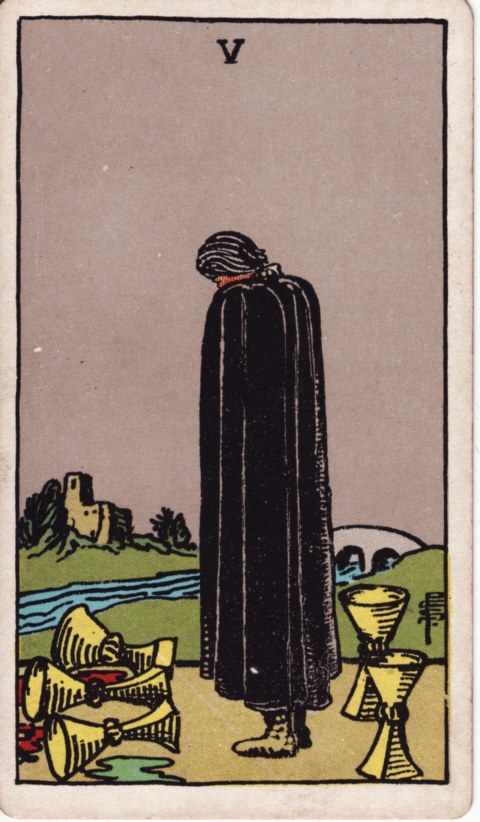
The scene is quiet. A figure in a black cloak looks down at three cups on their sides. The liquid is on the ground. Waite's key line is "three have been taken, but two are left." Most of what is written about this card comes down to the count: three spilled cups are the loss, two upright cups are what remains, and the figure faces the wrong way to see them.
Waite lists more than sadness. He calls it "a card of loss" and "a card of inheritance, patrimony, transmission, but not corresponding to expectations." Something is handed down. It is less than hoped. That fits a job offer with a smaller salary, a will that disappoints, or a friendship that ended with half an apology. The loss is real. So is whatever was left.
Tarot.com stresses that this is "not a card of collapse -- it's a card of choice." We agree with the direction, with one change in tone: the card does not make the choice for you. Upright, it asks you to grieve the spilled cups on purpose and for a set time, then count the standing ones once. Biddy Tarot puts the time limit bluntly, telling you to "set yourself a time limit for your self-pity."
Five of Cups reversed: moving on or stuck in grief?
Reversed, the Five of Cups reads two ways, and which one you are in matters more than the card. In the first the figure turns around, sees the two standing cups and starts to move. In the second the cloak stays on and the grief has become a place to live. Tarot.com names that second state well: stuck "because the pain has become a familiar shelter."
Waite's reversed list is of another kind: "News, alliances, affinity, consanguinity, ancestry, return, false projects." Read next to the upright list it is almost a different card. People, family and relatives come back into the picture. His later list says it outright, "Return of some relative who has not been seen for long." So a reversed Five can mean a reconnection with family, or with the history you had cut off.
To decide between them with a single card, run the retelling test. Think of the loss and say aloud how you would tell it to a stranger. Has the story changed since the last time? A new detail or a lighter ending means you are turning around. The same words, the same order and the same blame mean the cloak is still on. Then do one thing: write two lists, what spilled and what still stands, and do not stop writing the second until it has as many lines as the first.
Asking whether an ex returns? Waite's "return" is a relative, not a lover, and the card is about the person holding the cups. It describes whether you are still staring at the spill. Whether someone else walks back across the bridge is up to them. The card does not say.
Is the Five of Cups a yes or no card?
| Position | Answer |
|---|---|
| Upright | No, not while grieving |
| Reversed | Yes, once you look up |
Upright, we read the Five of Cups as a no for now. Whatever you are asking about has already cost something. A decision made while looking only at the spilled cups tends to repeat the loss. If the question is whether something can be saved, the picture answers with a count: part of it can.
Reversed, we read it as yes once you look up. Recovery pulls harder than regret here, so take the step that uses the two standing cups. The yes and no values here come from later practice and from us; neither Waite nor the Golden Dawn text set them.
Five of Cups in love and friendship: breakup, single and what they feel
In a relationship
Between partners, the card shows one of you, or both, mourning something that went wrong: a broken promise, a lost trust, a plan that did not happen. Labyrinthos names the other half, that you may be "overlooking what is still salvageable, and what has survived." Ask what is still standing in the relationship before deciding it is over. If the answer is nothing, the card says so.
Single
Single, the card usually points back at the last relationship, the spill you are still looking at. It can also mean grief over a relationship you hoped for that never arrived. A new date does not repair that. A conversation with a friend about what went wrong often does more, and dating can wait.
As feelings
As someone's feelings, the Five of Cups is sorrow, regret or disappointment, often with themselves as the target. They may feel they lost something. They are not ready to talk about it. The card does not say the loss is you. It can be a job, a person they miss, or an earlier hurt that your situation woke up.
A friend let you down: who showed up instead?
A friend skipped your big day, the move or the hospital visit, and you keep replaying it. The Five of Cups is that stare at the spill. Book T lists "unkindness of a friend; loss of friendship" under it, so a hurt that feels like an ending is the plain reading. Behind the figure, two more cups stay upright. Here they are the people who did come.
Reversed, you turn around and count them, or the story gets retold the same way for months. Why your friend stayed away is not in the picture. Tell them once, in a sentence, what it felt like. Thank one person who showed up.
Reversed in love
Flipped in a love spread, it can mean forgiving, of the other person or of yourself, and turning back toward the dating pool or the partner. It can also mean mourning that never ends, kept alive to avoid an uncertain future. The question of a former partner is answered under the reversed meaning.
Five of Cups at work and with money
At work the card marks a letdown: a project cancelled, a promotion that went to someone else, a layoff, a deal that fell through. Labyrinthos lists job and business loss among its readings. The picture suggests taking stock of what you still hold, such as skills, contacts and savings, before you decide the whole field is lost.
With money, Waite's "inheritance, patrimony, transmission, but not corresponding to expectations" is the most specific line anywhere on the card. It fits a payout, a settlement or a family inheritance that comes in short. His later list even adds "legacies, gifts, success in enterprise," so the same card can describe money arriving. Read it as money that comes with a disappointment attached.
Five of Cups as advice and as a person
As advice, the card is a count and a turn. Say what was lost, once, plainly. Then name the cups still standing and pick one to act on this week. Tarot.com says healing "begins the moment you look up," which is as close to a practical instruction as the card gets.
As a person, the Five of Cups is someone in mourning who has not yet noticed what they have left. Picture a man whose business closed in the spring: he knows to the dollar what he lost, and he has not mentioned that his two best employees offered to work for him at the next place. Book T would call this "disappointment, sorrow and loss in those things from which pleasure is expected," and add the habit: sad, slow to see help.
How to read the Five of Cups in a spread
As a past card it marks a loss that shaped the question, and the thing to read is how you still carry it. In the present spot it means you are in grief or regret now. As the outcome it is a warning: the road you asked about ends in disappointment, though something remains to build on. As advice it says look at what remains.
Book T rates a card as well or ill dignified by the cards on either side of it. More Cups beside it deepen the feeling, for good or for ill. A Wand beside the Five tends to weaken it, because Wands are "inimical to Cups" in that system. That is action cutting across the mourning, for better or worse. A Sword brings in the facts and the arguments of the loss.
Next to the Four of Cups (Blended Pleasure in Book T), the loss comes after a flat stretch. Next to the Six of Cups, Lord of Pleasure, the card shows a turn toward gain. Next to Death, the Major Arcana card of Scorpio, an ending is final, and what to plant afterward is the open point.
The Five of Cups among the Cups
Book T places the Five of Cups between the Four and the Six. The Four, Lord of Blended Pleasure, sits with the Moon in Cancer and means "Success or pleasure approaching their end." The Five follows with "Death, or end of pleasure." The Six, Lord of Pleasure, is Sun in Scorpio: "Commencement of steady increase, gain and pleasure; but commencement only." The Seven, Lord of Illusionary Success, is Venus in Scorpio.
So the Five is the low point between the ending the Four saw coming and the small restart in the Six. The Five, Six and Seven all sit in Scorpio, the sign of endings and rebirth; the Six carries on after the Five instead of undoing it. That is our way of reading the run. It shows the Five as a station, which the Golden Dawn drew as the middle of three.
- Ace of Cups
- Two of Cups · Love
- Three of Cups · Abundance
- Four of Cups · Blended Pleasure
- Five of Cups · Loss in Pleasure
- Six of Cups · Pleasure
- Seven of Cups · Illusionary Success
- Eight of Cups · Abandoned Success
- Nine of Cups · Material Happiness
- Ten of Cups · Perfected Success
- Page of Cups
- Knight of Cups
- Queen of Cups
- King of Cups
Titles after the numbered cards are the Golden Dawn's names for them in Book T.
Symbolism of the Rider–Waite–Smith card
- Three spilled cups. Three cups lie on their sides in front of the figure with liquid on the ground. Waite counts them as what "have been taken." The figure looks only at these.
- Two standing cups. Two upright cups stand behind the figure, out of sight. Tarot.com reads them as "remaining love, possibility, or perspective that's easy to miss." Waite's own words for them are "two are left."
- The black cloak. A long dark cloak covers the whole figure and hides the face. Waite calls it "a dark, cloaked figure." As we read it, the cloak is mourning dress and also a way of not seeing anyone.
- River, bridge and keep. A river runs behind the figure, with a bridge leading to a small castle. Waite mentions a bridge "leading to a small keep or holding." We read the bridge as a way out, and the figure has his back to it.
- Book T's empty cups. Book T draws no figure. Its hand holds lotuses with falling flowers, and "neither is there water in any of the cups." Its description has no count of three spilled and two left; that count comes from the Rider-Waite picture.
What the oldest sources say
“It is a card of loss, but something remains over; three have been taken, but two are left; it is a card of inheritance, patrimony, transmission, but not corresponding to expectations; with some interpreters it is a card of marriage, but not without bitterness or frustration. Reversed: News, alliances, affinity, consanguinity, ancestry, return, false projects.”
“Generally favourable; a happy marriage; also patrimony, legacies, gifts, success in enterprise. Reversed: Return of some relative who has not been seen for long.”
“Death, or end of pleasure: disappointment, sorrow and loss in those things from which pleasure is expected. Sadness, treachery, deceit; ill-will, detraction; charity and kindness ill requited; all kinds of anxieties and troubles from unsuspected and unexpected sources.”
On marriage, Waite contradicts himself. The main entry says "with some interpreters it is a card of marriage, but not without bitterness or frustration." Later in the book, in a second pass over each card, the upright line is "Generally favourable; a happy marriage; also patrimony, legacies, gifts, success in enterprise." That is the opposite of the modern reading, and Waite does not comment on it. The two lists cannot both be right, and this page uses the first, which fits the picture.
Book T is darker still. It names the card "Lord of Loss in Pleasure," says "Death, or end of pleasure," and under the sphere Geburah gives "Disappointment in love, marriage broken off, unkindness of a friend; loss of friendship." Where Waite's two lists argue over whether the marriage is happy, Book T has already ended it. Book T also lists "charity and kindness ill requited," a line that describes the sadness in kindness that is not returned.
Five of Cups and Mars in Scorpio: the card's decan
| Suit and element | Cups, Water (Major Arcana card of water: The Hanged Man) |
|---|---|
| Decan | 0° to 10° ♏︎ Scorpio, the first ten degrees of the sign |
| Planet of the decan | Mars (Major Arcana: The Tower) |
| Major Arcana card of Scorpio | Death |
| Golden Dawn title | The Lord of Loss in Pleasure |
| Place on the Tree of Life | Geburah (Book T: “Disappointment in love, marriage broken off, unkindness of a friend; loss of friendship”) |
Attributions from Book T (Golden Dawn, c. 1892; printed 1912).
Book T opens Scorpio with this card, covering its first ten degrees, and Mars rules the span; Book T sets the signs of Mars and Scorpio above and below its cups. Scorpio is a water sign, as Cups are a water suit. Death is the sign's Major Arcana card, Mars has The Tower, and water has The Hanged Man.
Mars is the traditional ruler of Scorpio. The planet sits at home. As we read it, that explains why the loss here is sudden and cutting. The pair fits "Death, or end of pleasure" and "marriage broken off." Book T does not draw the link. The reading is ours.
When the Sun is in the Five of Cups stretch
| Year | Sun enters 0° | Sun leaves (reaches 10° Scorpio) |
|---|---|---|
| 2026 | Oct 23 | Nov 2 |
| 2027 | Oct 23 | Nov 2 |
| 2028 | Oct 22 | Nov 1 |
| 2029 | Oct 22 | Nov 1 |
This year the Sun crossed the Five of Cups stretch of the zodiac (0° to 10° Scorpio) from October 23 to November 2, 2026. Next time: October 23 to November 2, 2027 (US Eastern dates).
Dates are US Eastern, from the astronomy-engine ephemeris. Across 35,064 dates from 1930 to 2025, the Sun is in this stretch on 2.7% of them, and at least one of the ten planets is on 26.8%.
Saturn last stood in this decan in 2012 and 2013 and returns in 2041 and 2042, by our calculation, and Pluto was in it for most of 1984 to 1987. The Sun crosses those first degrees of Scorpio between about October 23 and November 2. A birthday there earns this card as a personal marker, with no forecast attached.
Is the Five of Cups in your birth chart?
Enter your birth date. We show which of the ten planets stood between 0° and 10° Scorpio that day, the slice of sky Book T gives this card; add the time if a planet was near the edge.
Enter your birth date above to see your result.
Every planet, angle and house from your birth time: birth chart calculator.
Questions about the Five of Cups
Is the Five of Cups a bad card?
Sad, yes, but the picture has two full cups in it, and Waite's later list calls it "Generally favourable." Book T is harsher: "Death, or end of pleasure." We read it as loss with something left.
What does the Five of Cups mean for grief?
It is the card of grieving with a split view: three cups gone, two remaining. Tarot.com says the grief "is real and valid." The card asks you to feel it. Then look at what is left. If grief is heavy or long, see a counselor or doctor, not a card.
Does the Five of Cups mean cheating?
Rarely on its own. Book T lists "treachery, deceit" and "unkindness of a friend" among its words, so a betrayal can be in play. Most modern readings treat it as disappointment and regret, so check the neighboring cards before reading it as an affair.
What does the Five of Cups mean as feelings?
Sadness and regret, often turned inward. The person feels they lost something and may be fixed on it. Reversed, they are starting to forgive and look toward what remains.
Is the Five of Cups yes or no?
No for now when upright, since the loss is still being felt. Yes when reversed, once you turn to what is left.
What zodiac sign is the Five of Cups?
Scorpio, where Book T gives it the opening ten degrees and Mars as ruler. The Sun passes that span between about October 23 and November 2.
When will things get better after the Five of Cups?
The cards name no dates. The card suggests the change begins when you look up, which is up to you. If you want a calendar, the Sun's stay in the card's sign segment, October 23 to November 2, works as a marker. That is our suggestion; the old sources give none.
Sources
- Astronomy Engine: the open-source ephemeris library behind our planet positions, dates and statistics
- A. E. Waite, The Pictorial Key to the Tarot (1911), Wikisource: the divinatory meanings we quote, upright and reversed
- Book T (Golden Dawn), as printed in The Equinox I:8, 1912: the zodiac sign, Hebrew letter, title and short meaning of each card
- Wikimedia Commons: Rider–Waite–Smith tarot deck: Pamela Colman Smith's 1910 card drawings, public domain
- How we create our readings: our own calculation of sign dates, positions and the 1930 to 2025 statistics
Next to the Five of Cups
In the suit of Cups: Four of Cups ← Five of Cups → Six of Cups.
Scorpio on this site: Scorpio zodiac sign · Death, the card of Scorpio · your full birth chart.
All 22 Major Arcana with their signs and planets, and the minor cards written so far: tarot card meanings.
Written by The Zodiac Atlas editorial team with the help of AI and edited by a person. Quotations are from Waite's Pictorial Key to the Tarot and the Golden Dawn's Book T, both in the public domain; the card picture is a 1910 printing of Pamela Colman Smith's drawing for the 1909 deck. Sun dates and planet positions come from the astronomy-engine ephemeris (tropical zodiac). Tarot and astrology are symbolic traditions; they do not predict events.