What does the Two of Cups mean in a reading?
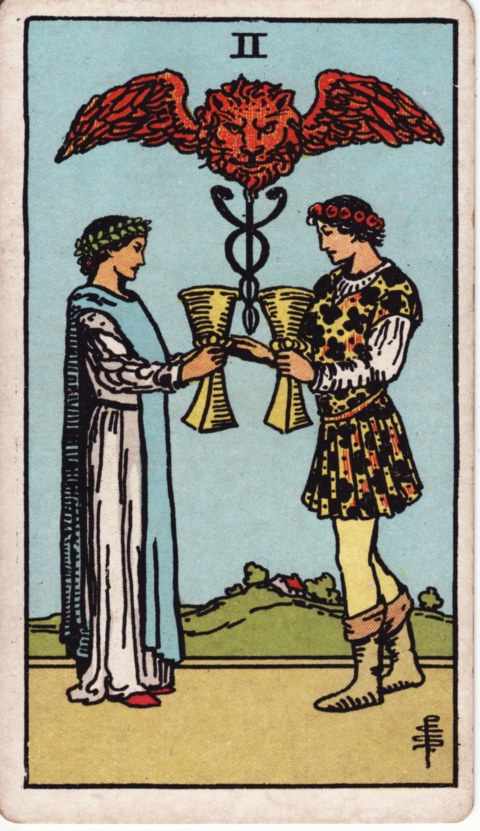
The picture is a toast and a promise in one. Waite writes that "A youth and maiden are pledging one another," and the drawing shows it: two figures in wreaths, cups at the same height, hands almost touching. Nobody in the scene is alone, and nobody leads. The card begins where the Ace of Cups ends, with a feeling that was one person's and is now passed across a table.
Waite's list is broader than romance: "Love, passion, friendship, affinity, union, concord, sympathy." Friendship sits in the middle of it, so a business partner, a close friend or a sibling can be the second cup. Biddy Tarot puts the idea in one line: "the flow of love between two people." The word to hold on to is flow, which means the movement goes both ways.
Book T adds a condition the modern pages leave out. Its Two is "Harmony of masculine and feminine united," and the same entry warns that an ill-dignified Two brings "folly, dissipation, waste, silly actions." So the pull is real, and it can still be foolish when the cards around it are poor. Mutual is the key word of the upright card, and a crush is not yet mutual.
Two of Cups reversed: what did Waite leave out?
Here the old books say little. Waite's main list for the Two of Cups has no reversed meaning at all, and his shorter list gives one word for the card turned over: "Passion." That is all the primary text offers. The longer reversed readings you see online (breakup, imbalance, codependency) are modern, and Labyrinthos is typical in naming "uneven power dynamics."
The one word is still useful. Passion without the rest of the upright list is heat with no concord, friendship or sympathy behind it. Put the modern reading next to it and you get a card about a pull that has outrun the pairing: one person leaning in, the other not, or two people attracted and not yet kind to each other. Read as an inner matter, the reversed card can also mean that you have been giving a relationship more than you give yourself.
For a single-card draw, try a count: list the last five things you did for this person, then the last five they did for you. Count actions only; feelings and intentions stay out of it. Two lists of similar length and weight point to a lull. If one list is much longer, the imbalance is concrete; say so plainly and see what changes over a few weeks.
If you asked whether someone loves you, or whether a former partner will return, the reversed card does not answer for them. It reports on the reciprocity you can observe. For a person who has not been in touch, it can only say that the cups are not meeting right now.
Is the Two of Cups a yes or no card?
| Position | Answer |
|---|---|
| Upright | Yes, if both mean it |
| Reversed | Not yet, talk first |
Upright, the Two of Cups says yes to a question about a partnership, an agreement, a reconciliation or a first honest conversation. Tarot.com's yes/no line says "the answer is YES." A condition from Book T goes with it: yes if both sides are really in it.
Reversed, it means not yet. Talk before you decide, and check the balance. Waite and Book T hand out no verdicts, so the ones here are a modern habit.
Two of Cups in love and friendship: is it mutual, and is it a soulmate?
In a relationship
Between partners the card is mutual regard that shows up in small even exchanges: who calls, who plans, who apologizes first. It is a good moment to renew a promise, move in together or say what you want, because the cups are level. The relationship still needs work, and here the work is shared.
Single
Single, the card describes the kind of bond you are ready for, or a specific connection with a rhythm of give and take already in it. Pay attention to how someone treats you after the first excitement, because Book T's ill-dignified Two is "silly actions," and early heat can pass for harmony. Friendship counts here too: Waite lists it in the main entry.
As feelings
Read as what someone feels, the Two of Cups is affection that wants an answer: attraction, respect and a wish for something shared. The card names the feeling and is silent on timing and on any move they might make. If it is real you will see matching action as well as warmth on a good evening.
Soulmate or twin flame?
The card has been made a soulmate card by modern readers, Tarot.com lists "soul mates" among its examples, and Labyrinthos stays with a balanced partnership. Waite's phrase is more sober: "desire which is not in Nature, but by which Nature is sanctified." That reads as a bond that consecrates ordinary desire. A good pairing is chosen by two people, over time.
Is this friendship one-sided?
Waite's upright words for this card include "friendship, affinity", ahead of union and concord, so it can describe two friends who match. In the picture, two people pledge at the same height. Upright, ask whether you two give about the same. Who calls, who travels, who listens?
Waite gives no reversed text for this card, so the reversed reading here is ours: the cups tilt and one of you pours more. That does not make your friend careless. Pick the next plan and let them make the first move. Wait a week. See whether they reach out.
Two of Cups at work and with money
At work the Two of Cups is a fair agreement between two parties: a co-founder, a client who pays on time, a colleague you can finish each other's sentences with. Book T's "Harmony, pleasure, mirth, subtlety" fits a negotiation that both sides leave satisfied. Waite's §4 line is "Favourable in things of pleasure and business, as well as love; also wealth and honour," the most direct money line on the card. Put terms in writing even when the mood is warm.
On a job or pay question with the card upside down, look for a deal that tilts. One person carries the work, or a handshake has no paper behind it. Name the split out loud before it hardens.
Two of Cups as advice and as a person
As advice, offer something and ask for something in the same breath. A cup is only half a gesture until someone lifts the other. Say what you want to a friend, a partner or a coworker, and say what you can give back.
As a person, the Two of Cups is someone who makes an even match. Imagine an invented example, a man we'll call Daniel, who opens a bakery with an old classmate: he sets the recipes, she sets the books, and they split the hours down the middle. Reversed, the advice is to stop filling a cup nobody fills back. Ask for what you have been giving without a request.
How to read the Two of Cups in a spread
Alone in a spread, the Two of Cups asks whether a bond is mutual, because the picture is a pair and nothing else. Looking back, it marks a pledge or a partnership the question grew from. In the present it says two cups are in play. As an outcome it points to an agreement or closeness, if both sides keep their end.
Under Book T's dignity rules, Cups beside it strengthen the bond for good or ill. A Wand beside the Two brings heat that scorches, and "Wands are inimical to Cups" is the rule behind it. Swords nearby are friendly to Cups and add words, which can clarify or cut. Beside the Three of Cups the pair becomes a circle of friends. Beside the Five, one cup is the grief. Beside The Lovers, the bond becomes a choice.
The Two of Cups among the Cups
In the suit the Two stands right after the Ace. The Ace is one cup and a gift; the Two is two cups and an exchange. That is the first thing that can go wrong in the suit too, because giving takes a second person.
Book T's Two is a pair of overflowing cups. Its "two dolphins, Argent and Or" take the white water and pour it "like jets of gold and silver, into two cups; which in their turn overflow." The Three that follows is called Abundance, and the Four, Blended Pleasure, is the first where the water stops flowing evenly. The Two is the moment when the supply is generous and the balance is still level.
- Ace of Cups
- Two of Cups · Love
- Three of Cups · Abundance
- Four of Cups · Blended Pleasure
- Five of Cups · Loss in Pleasure
- Six of Cups · Pleasure
- Seven of Cups · Illusionary Success
- Eight of Cups · Abandoned Success
- Nine of Cups · Material Happiness
- Ten of Cups · Perfected Success
- Page of Cups
- Knight of Cups
- Queen of Cups
- King of Cups
Titles after the numbered cards are the Golden Dawn's names for them in Book T.
Symbolism of the Rider–Waite–Smith card
- Two cups at the same height. The cups meet at the middle of the card with the hands almost touching. Waite calls it "pledging," and the matched height reads as equal footing between the two.
- The caduceus and the lion. A winged staff with two snakes rises between the cups, topped by a red lion's head. Waite says the lion's head is "a variant of a sign which is found in a few old examples of this card" and adds that its "curious emblematical meanings" do not concern him here. Biddy Tarot reads the lion as passion. We read it as the heat above the exchange.
- The wreaths. The man wears a wreath of red flowers and the woman a green one. Waite does not describe them. As we read it, red is the warm side of attraction and green is the steady side.
- The hills and the little house. Green hills roll behind the pair and a red-roofed house sits on one of them. There is no crowd, only a modest home in the distance, so the card is private in tone and points at a life that could be built.
- The dolphins in Book T. Book T has no couple. Water falls from a lotus onto two dolphins and then into two overflowing cups. Smith's card keeps two cups and drops the fountain, the dolphins and the lotus.
What the oldest sources say
“Love, passion, friendship, affinity, union, concord, sympathy, the interrelation of the sexes, and—as a suggestion apart from all offices of divination—that desire which is not in Nature, but by which Nature is sanctified.”
“Favourable in things of pleasure and business, as well as love; also wealth and honour. Reversed: Passion.”
“Harmony of masculine and feminine united. Harmony, pleasure, mirth, subtlety: but if ill dignified --- folly, dissipation, waste, silly actions.”
Waite's main list for this card stops at the upright meanings, and the Two of Cups is the only card in the Minor Arcana with no reversed line there. Waite's second, shorter list fills part of the gap: upright "Favourable in things of pleasure and business, as well as love; also wealth and honour," reversed "Passion." Waite also leaves out the meaning of the lion's head on purpose, writing that its "emblematical meanings" do not concern him there. The longer reversed readings on the modern sites checked here are not in Waite.
Book T supplies the missing darkness, though not as a reversed card. Its entry for the Two reads "Harmony of masculine and feminine united. Harmony, pleasure, mirth, subtlety," and, if ill dignified, "folly, dissipation, waste, silly actions." That is an ill-dignified Two, so the poor reading depends on the neighbors; turning the card over has no part in it. It also lists Chokmah, glossed "Marriage, love, pleasure," so even the Golden Dawn's summary line leans to marriage.
Two of Cups and Venus in Cancer: the card's decan
| Suit and element | Cups, Water (Major Arcana card of water: The Hanged Man) |
|---|---|
| Decan | 0° to 10° ♋︎ Cancer, the first ten degrees of the sign |
| Planet of the decan | Venus (Major Arcana: The Empress) |
| Major Arcana card of Cancer | The Chariot |
| Golden Dawn title | The Lord of Love |
| Place on the Tree of Life | Chokmah (Book T: “Marriage, love, pleasure”) |
Attributions from Book T (Golden Dawn, c. 1892; printed 1912).
Book T hands the Two of Cups the opening ten degrees of Cancer, ruled by Venus, with "Venus and Cancer above and below" in the Book T drawing. The card is named the Lord of Love. Cancer is water, like the suit, and Venus is the planet of attraction and pleasure. The pairing of a planet of attraction with a sign of home is a neat match for the card. Book T is silent on the pairing; the match is ours.
The card belongs to Chokmah, which Book T glosses "Marriage, love, pleasure." The slice falls inside the Queen of Cups' region of the sky, from late Gemini to late Cancer. Its Major Arcana cards are The Chariot for Cancer, The Empress for Venus and, standing for water, The Hanged Man.
When the Sun is in the Two of Cups stretch
| Year | Sun enters 0° | Sun leaves (reaches 10° Cancer) |
|---|---|---|
| 2026 | Jun 21 | Jul 1 |
| 2027 | Jun 21 | Jul 1 |
| 2028 | Jun 20 | Jul 1 |
| 2029 | Jun 20 | Jul 1 |
This year the Sun crossed the Two of Cups stretch of the zodiac (0° to 10° Cancer) from June 21 to July 1, 2026. Next time: June 21 to July 1, 2027 (US Eastern dates).
Dates are US Eastern, from the astronomy-engine ephemeris. Across 35,064 dates from 1930 to 2025, the Sun is in this stretch on 2.9% of them, and at least one of the ten planets is on 18.9%.
From about June 21 to July 1 the Sun is in this decan, so it opens at the June solstice, the day the Sun enters Cancer. Saturn stood in the decan in 1973 and 1974, 2003 and 2004, and returns in 2032 and 2033, by our ephemeris, and Uranus is there in 2032 to 2035. These are dates of position and carry no forecast.
Is the Two of Cups in your birth chart?
Enter your birth date. We show which of the ten planets stood between 0° and 10° Cancer that day, the slice of sky Book T gives this card; add the time if a planet was near the edge.
Enter your birth date above to see your result.
Every planet, angle and house from your birth time: birth chart calculator.
Questions about the Two of Cups
Is the Two of Cups one of the lucky cards?
Yes, among the best in the suit. Waite lists love, friendship and concord, and his §4 line adds business, wealth and honour. Book T warns that an ill-dignified Two turns to "folly, dissipation, waste."
What does the Two of Cups mean as feelings?
Affection and attraction that expect to be returned. It shows the feeling and not the timing. Reversed, the feeling is lopsided or heated without much underneath.
Is the Two of Cups a soulmate card?
Plenty of modern readers call it one. Waite's list includes "affinity, union, concord, sympathy." The card describes a mutual bond, and what makes it last is what two people do after the toast.
Does the Two of Cups mean friendship?
Yes. Waite's list names friendship directly, and the card works for a close friend, a sibling or a business partner as well as a lover.
What does the Two of Cups reversed mean?
Waite gives it no reversed meaning in his main list and one word, "Passion," in the shorter one. Modern readers say imbalance or strain. Use the give-and-take count on this page to see whether it applies.
Does the Two of Cups mean yes or no?
Upright answer: yes, provided both sides mean it. Reversed, hold on. The old sources pair no card with a verdict; the verdict here is a habit of present-day readers.
Which sign does the Two of Cups belong to?
Cancer, the opening ten degrees, with Venus as ruler in Book T. The Sun is there between about June 21 and July 1, a fact about the sky that says nothing about your own timing.
Sources
- Astronomy Engine: the open-source ephemeris library behind our planet positions, dates and statistics
- A. E. Waite, The Pictorial Key to the Tarot (1911), Wikisource: the divinatory meanings we quote, upright and reversed
- Book T (Golden Dawn), as printed in The Equinox I:8, 1912: the zodiac sign, Hebrew letter, title and short meaning of each card
- Wikimedia Commons: Rider–Waite–Smith tarot deck: Pamela Colman Smith's 1910 card drawings, public domain
- How we create our readings: our own calculation of sign dates, positions and the 1930 to 2025 statistics
Next to the Two of Cups
In the suit of Cups: Ace of Cups ← Two of Cups → Three of Cups.
Cancer on this site: Cancer zodiac sign · The Chariot, the card of Cancer · your full birth chart.
All 22 Major Arcana with their signs and planets, and the minor cards written so far: tarot card meanings.
Written by The Zodiac Atlas editorial team with the help of AI and edited by a person. Quotations are from Waite's Pictorial Key to the Tarot and the Golden Dawn's Book T, both in the public domain; the card picture is a 1910 printing of Pamela Colman Smith's drawing for the 1909 deck. Sun dates and planet positions come from the astronomy-engine ephemeris (tropical zodiac). Tarot and astrology are symbolic traditions; they do not predict events.