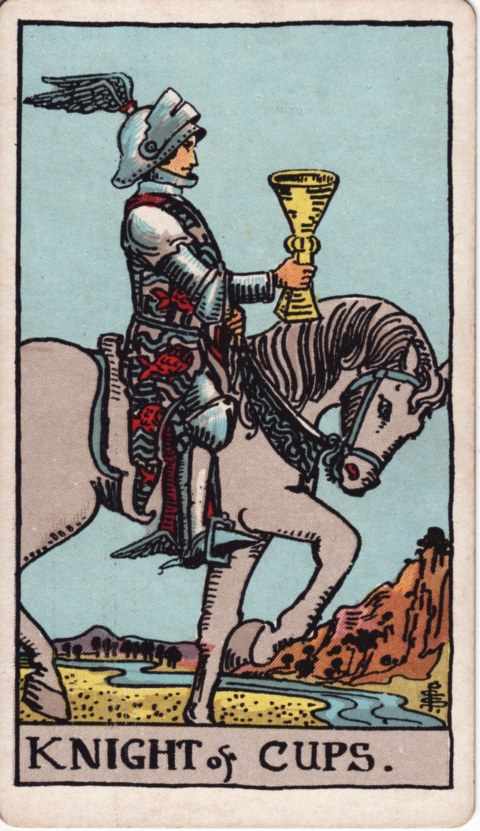
What does the Knight of Cups mean upright?
Is the Knight of Cups a good card? On the whole, yes. Waite draws him as "Graceful, but not warlike," and the horse goes at a walk. Biddy Tarot calls him "the classic romantic of the Tarot deck." Think of a proposal, an invitation, a letter, a person turning up at the door with something to give.
Waite's list is all motion toward someone: "Arrival, approach," then "advances, proposition, demeanour, invitation, incitement." We take "proposition" to mean any offer put forward, so we read it as wide enough for a marriage proposal or a job offer. Tarot.com says the knight rides "not to conquer, but to connect," which is a fair summary of the picture. This card is about something being brought to you, or by you.
There is a second note in Waite's picture text: "He too is a dreamer, but the images of the side of sense haunt him in his vision." So the sweetness has a body. He is moved by beauty, taste, touch. Biddy Tarot adds a condition we agree with: "true imagination feeds on action." A dream that never gets a date stays a dream, and this knight is the card that says so.
Knight of Cups reversed: empty promises or just a mood?
Reversed, Waite's list turns hard: "Trickery, artifice, subtlety, swindling, duplicity, fraud." Modern readers soften it. Labyrinthos lists moodiness, tantrums and avoiding conflict, and describes a partner who is "passive aggressive" under the charm. Our reading sits between them. Fraud is the extreme case. The usual one is a gap between what is said and what gets done.
Tarot.com asks the question to keep: "Is this love, or is it performance?" The reversed knight can be a person who says all the right things, or it can be you, retreating into a daydream when the real step is a phone call. In both cases the horse has stopped walking.
One card is enough for a self-check. Write down the last three things the person (or you) promised, and next to each one write what was actually done and when. Three blanks means the empty-promise side. Two or three filled lines means the card is only showing nerves or mood, and the plan itself is sound. It takes five minutes and needs no other cards.
Asking whether an ex will ride back? Upright, the knight is a card of arrival, and it is tempting to hope it names one particular rider. Nothing on it does. Reversed, it describes charm that costs nothing, so an ex who reappears with warm messages and no plan gets the same three-promises test. The card shows you whether your own mood is steering; the other person's direction stays outside the frame.
Is the Knight of Cups a yes or no card?
| Position | Answer |
|---|---|
| Upright | Yes |
| Reversed | Not as offered, ask for details |
Upright, the Knight of Cups answers yes. Tarot.com says "the answer is YES," and our reading agrees when the question is about making an offer, saying something you feel, accepting an invitation or starting something creative. Book T calls him "indolent, but enthusiastic if roused," so for questions about money, stability or speed we would lower the yes to a "probably, if you do the work."
Reversed, the answer is not as offered. Ask for specifics before you agree. Yes or no lies outside Waite and Book T altogether; these answers are our own judgement.
Knight of Cups in love and friendship: is he serious?
In a relationship
For two people already together, the card brings romance back into the room: a surprise date, an apology that is meant, a proposal of something new such as moving in or marrying. Waite's word is "proposition," which is wide, so the card shows that something is being offered and leaves its size open. Book T's knight is "Venusian" and "poetic." Gestures come easily to him, so look for the plan behind the gesture too.
Single
For a single person the card says someone is approaching, or that you are the one who should ride. A romantic opening tends to start small. It is a message, an invitation, a friend of a friend. Because this knight loves the idea of love, the risk is falling for the way someone shows up rather than for the person. Spend a few ordinary hours with them, on a Tuesday, before deciding what you have.
As feelings
As someone's feelings for you, the Knight of Cups means real warmth and a wish to express it. They want to give you something or say something. The feeling can be as much about the story as about you, so watch whether it shows up in ordinary acts as well as big ones.
A friend asks you to be best man or maid of honor
A close friend asks you to be their best man or maid of honor. The Knight of Cups arrives with an offer, and Waite lists "invitation" among his words. Upright, the ask is sincere, if a little grand. The honest answer is a warm yes with questions attached: what does the role include, what does it cost, which dates?
Reversed, charm runs ahead of the details. The friend gushes, you say yes to be kind, and then nobody can say who pays for the dress or the party. Careless or only excited? The picture cannot show. Get the practical list before you answer. Agree only to what you can really do.
Reversed in love
Reversed, the card points to mixed signals: warm one week, cool the next, lovely promises that do not land. Labyrinthos calls the type "passive aggressive, and full of empty promises." It can also be you, sulking instead of asking for what you want. Either way the fix is the same: say the plain sentence out loud, and see whether it gets a plain answer.
Knight of Cups at work and with money
At work the Knight of Cups brings an offer that comes through relationships and taste: an invitation to collaborate, a creative project, a role where tact counts for more than speed. He is a good mediator. Deadlines are another matter. Book T gives him "indolent, but enthusiastic if roused," and that is also a fair note on how the project goes.
Money is not where this card is strongest. Waite's extra list includes "A visit from a friend, who will bring unexpected money," an old line we would read as help arriving through a person. Reversed, the pretty offer with vague terms is the thing to look at. Get the details in writing before you say yes.
Knight of Cups as advice and as a person
As advice, the card says make the move, with a date attached. Send the invitation, say the thing, start the piece of work that has been circling. Then give it a time: Friday, the first of the month. A gesture with a date is an offer; one without is a mood.
As a person, the Knight of Cups is the charming, imaginative one who is sensitive to beauty and hates a fight. Take a friend who texts you a poem at 11 p.m. and promises to come to dinner on Friday. If he turns up on Friday with wine, that is the upright knight. If Friday passes in silence and the next poem arrives on Sunday, that is the reversed one. The same person can be both, depending on the week.
How to read the Knight of Cups in a spread
Read as the past, it marks an offer or an approach made earlier, often the start of what you are asking about. In the present it names an invitation or a feeling on the table now. As an outcome it is an approach still on its way, and the result is yet to come.
Dignity rules matter for a feeling card. Book T rates a card "well dignified or ill dignified" by its neighbours, and more Cups beside the knight make the feeling louder. A Swords card beside him brings words and clear thinking to the feeling, since Book T counts Swords as friendly to Cups. A Wands card next to him tends to cool or contradict the mood, as fire does with water, because in Book T Wands are enemies of Cups.
Book T gives a rule for knights as a group: in a spread, "Knights, in general, shew news." Two or three of them together read as a flurry of arrivals, while Book T's lists give three Knights "Unexpected meetings." Beside the Eight of Cups, an approach meets someone who is leaving. Beside the Three of Swords, an offer arrives into a sore place.
The Knight of Cups among the Cups
Book T gives each Cups court card a zone of sky, and the pattern is easy to miss. The Queen rules "from 20 Degree Gemini to 20 Degree Cancer" and is Water of Water. The King (Book T's Prince) covers 20° Libra through 20° Scorpio as Air of Water. The Knight rules 20° Aquarius to 20° Pisces. Each of the three starts at 20° of an air sign and ends at 20° of a water sign.
The Knight's element is Fire of Water. The Queen is water throughout and the King is air moving over water, but the Knight is the one spark in the suit. That fits a rider who is on the move when the Queen sits on a throne and the King sits in a chariot over still water. The Page, in Book T the Princess, is Earth of Water, the ground the others stand on.
- Ace of Cups
- Two of Cups · Love
- Three of Cups · Abundance
- Four of Cups · Blended Pleasure
- Five of Cups · Loss in Pleasure
- Six of Cups · Pleasure
- Seven of Cups · Illusionary Success
- Eight of Cups · Abandoned Success
- Nine of Cups · Material Happiness
- Ten of Cups · Perfected Success
- Page of Cups
- Knight of Cups
- Queen of Cups
- King of Cups
Titles after the numbered cards are the Golden Dawn's names for them in Book T.
Symbolism of the Rider–Waite–Smith card
- The golden cup held out. He carries the cup in front of him like something to hand over. Book T draws a different cup: a crab comes out of it. In Pamela Colman Smith's picture the cup is plain, which suits the messenger reading.
- The winged helmet. Waite says the winged helmet refers to "those higher graces of the imagination which sometimes characterize this card." Book T also winged the rider, but its helmet carries a peacock, and the horse is explicitly not winged.
- Fish on the tunic. The tunic is patterned with red fish. Fish are creatures of water, and water is the suit of feeling. That is a plain reading, and it is ours: the feeling is worn on the outside.
- The walking horse. The pale horse goes at a walk. Where the Knights of Wands and Swords charge, this one goes slowly enough to deliver something carefully.
- The river and the hills. A river winds through sandy ground beside him, with a rocky crag on one side and low hills far off. We read it as feeling finding a way through ground that looks unpromising. The picture does not say where the river leads.
What the oldest sources say
“Arrival, approach—sometimes that of a messenger; advances, proposition, demeanour, invitation, incitement. Reversed: Trickery, artifice, subtlety, swindling, duplicity, fraud.”
“A visit from a friend, who will bring unexpected money to the Querent. Reversed: Irregularity.”
Waite gives the Knight of Cups two different faces. The upright list is gentle: arrival, approach, invitation. The reversed list is harsh, with swindling and fraud. His picture text carries the same split: "Graceful, but not warlike" on one side, and a dreamer haunted by "the images of the side of sense" on the other. The modern pages we read keep the first and soften the second to moodiness, a reasonable choice that Waite himself did not make.
Book T names him "The Lord of the Waves and the Waters; the King of the Hosts of the Sea" and describes his temperament in two lines: "Graceful, poetic, Venusian, indolent, but enthusiastic if roused," and ill dignified, "sensual, idle and untruthful." The sympathetic and the wary reading sit side by side there too. What modern sites call a romantic, Book T calls a charming man who needs a push.
Knight of Cups in the zodiac: Aquarius to Pisces
| Suit and element | Cups, Water (Major Arcana card of water: The Hanged Man) |
|---|---|
| Part of the zodiac | 20° Aquarius to 20° Pisces |
| Book T | Fire of Water |
Attributions from Book T (Golden Dawn, c. 1892; printed 1912).
Book T does not give a court card a decan. It gives him a zone of the sky: the Knight of Cups "rules the heavens from above 20 Degree of Aquarius to 20 Degree of Pisces, thus including the greater part of Pegasus." That is 30 degrees, from the last third of Aquarius through the first two thirds of Pisces, so the zone crosses from air into water. His Book T elemental title is Fire of Water. Aquarius has The Star as its Major Arcana card, Pisces has The Moon, and water as a whole belongs to The Hanged Man.
The zone fits the card in a few ways, and these links are our reading, not lines from Book T. Pisces is the sign where Venus is exalted in traditional astrology, and Book T calls the knight "Venusian." Pegasus is the winged horse of myth, yet Book T gives this knight a horse that "is not winged," with the wings on the rider instead. Neptune, the modern ruler of Pisces, spent nearly all the years from 2007 to early 2021 in this zone, by our calculation.
When the Sun is in the Knight of Cups stretch
| Year | Sun enters 20° Aquarius | Sun leaves (reaches 20° Pisces) |
|---|---|---|
| 2026 | Feb 8 | Mar 10 |
| 2027 | Feb 8 | Mar 10 |
| 2028 | Feb 9 | Mar 9 |
| 2029 | Feb 8 | Mar 10 |
This year the Sun crossed the Knight of Cups stretch of the zodiac (20° Aquarius to 20° Pisces) from February 8 to March 10, 2026. Next time: February 8 to March 10, 2027 (US Eastern dates).
Dates are US Eastern, from the astronomy-engine ephemeris. Across 35,064 dates from 1930 to 2025, the Sun is in this stretch on 8.2% of them, and at least one of the ten planets is on 55.3%.
The Sun crosses the zone from about February 8 to March 10. It is a loose fit, since the zone covers a month, and the Knight of Cups is better treated as a theme in the birth chart than as a verdict on a person. Pluto is in the zone from 2037 to 2058, by our calculation.
Is the Knight of Cups in your birth chart?
Enter your birth date. We show which of the ten planets stood between 20° Aquarius and 20° Pisces that day, the slice of sky Book T gives this card; add the time if a planet was near the edge.
Enter your birth date above to see your result.
Every planet, angle and house from your birth time: birth chart calculator.
Questions about the Knight of Cups
Is the Knight of Cups a good card?
On the whole he is. He brings an offer, romance or creative spark. The warning is in the reversed position and in Book T's line that he is "indolent": the feeling can be real and the follow-through weak.
What does the Knight of Cups mean as a person?
A charming, sensitive, imaginative person who leads with feeling and cares about beauty. He can be a lover, an artist, a mediator or a messenger. Book T adds that he is energetic only "if roused."
Does the Knight of Cups mean a proposal?
It can. Waite lists "proposition" and "invitation" among its meanings, and we read "proposition" as covering any offer. It might be a marriage proposal, a job offer or an invitation, so read the neighbouring cards for the kind.
Does the Knight of Cups mean someone is cheating or playing games?
Not upright. Reversed, Waite lists duplicity, and modern sites describe charm that does not match action. Use the three-promises test in the reversed section: compare what was said with what was done.
Is the Knight of Cups yes or no?
Mostly yes. Upright, Tarot.com also says YES. Reversed, it is not as offered, so ask for details first.
What zodiac sign is the Knight of Cups?
Book T gives the Knight of Cups a zone from 20° Aquarius to 20° Pisces, with the elemental title Fire of Water. The Sun crosses it from about February 8 to March 10.
When will the Knight of Cups arrive?
The cards carry no dates. Book T says only that knights "shew news" and that four of them together mean speed. Treat February 8 to March 10, the days the Sun spends in the knight's zone, as a calendar match and no forecast.
Sources
- Astronomy Engine: the open-source ephemeris library behind our planet positions, dates and statistics
- A. E. Waite, The Pictorial Key to the Tarot (1911), Wikisource: the divinatory meanings we quote, upright and reversed
- Book T (Golden Dawn), as printed in The Equinox I:8, 1912: the zodiac sign, Hebrew letter, title and short meaning of each card
- Wikimedia Commons: Rider–Waite–Smith tarot deck: Pamela Colman Smith's 1910 card drawings, public domain
- How we create our readings: our own calculation of sign dates, positions and the 1930 to 2025 statistics
Next to the Knight of Cups
In the suit of Cups: Page of Cups ← Knight of Cups → Queen of Cups.
Aquarius on this site: Aquarius zodiac sign · The Star, the card of Aquarius · your full birth chart.
All 22 Major Arcana with their signs and planets, and the minor cards written so far: tarot card meanings.
Written by The Zodiac Atlas editorial team with the help of AI and edited by a person. Quotations are from Waite's Pictorial Key to the Tarot and the Golden Dawn's Book T, both in the public domain; the card picture is a 1910 printing of Pamela Colman Smith's drawing for the 1909 deck. Sun dates and planet positions come from the astronomy-engine ephemeris (tropical zodiac). Tarot and astrology are symbolic traditions; they do not predict events.