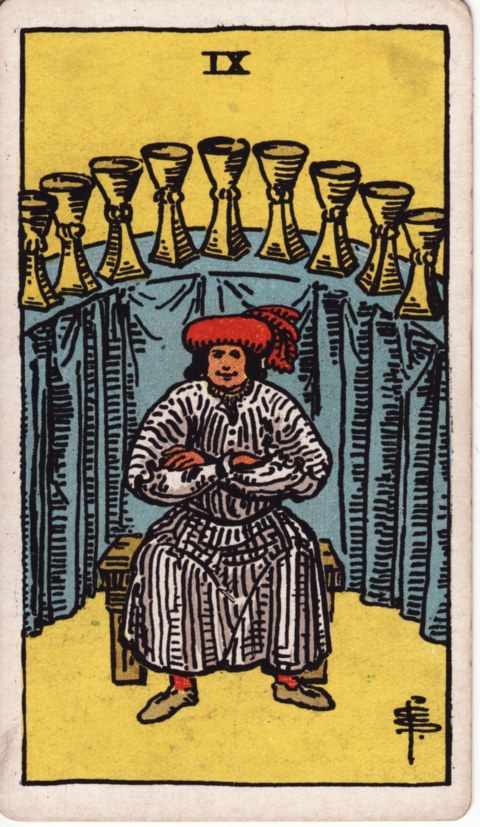
Nine of Cups upright: the wish card, or only a good meal?
Upright, the Nine is about having enough. Waite says the man "has feasted to his heart's content, and abundant refreshment of wine is on the arched counter behind him, seeming to indicate that the future is also assured." Nothing is asked of him: his arms are folded and the cups stand behind him, already poured. Biddy Tarot says the card is "often called the wish card." On the job this week, put the result you are proudest of in front of the person who decides, in one page or one email, and ask for what it has earned.
Waite's list is "Concord, contentment, physical bien-être; also victory, success, advantage; satisfaction for the Querent or person for whom the consultation is made." Bien-être is French for well-being, and placing it after "physical" makes the Nine a card of the body: a good meal, a comfortable chair. The last clause allows the card to describe someone else who is simply doing well. He adds: "The picture offers the material side only, but there are other aspects." He never lists the aspects, so the card is silent on whether the man is also content in his mind.
Book T agrees on the fullness and adds a drawback. It calls the result "almost perfect" and draws a person "much talking of self, yet kind and lovable," who is "Apt to be maligned through too much self-assumption." The old text expects a man who enjoys his luck aloud and gets spoken ill of for it. That is a milder warning than the modern one about complacency, and it comes with affection.
Is the Nine of Cups reversed bad news, or the truth?
Reversed, the old and new readings barely meet. Waite gives "Truth, loyalty, liberty; but the readings vary and include mistakes, imperfections, etc.," and his short table adds "Good business." Tarot.com reads the turned card as pointing to "hollow wins or emotional disconnect." Both can describe one situation: the thing you wanted arrived, and an honest look shows it is smaller than the wish. Within a week, write down what the raise, title or deal was meant to give you, and ask the person in charge for the one item it left out.
Three readings fit. One is hollow: the wish was granted and the feeling never came, or lasted a day. Another is vain: Book T's "vanity, conceit" and the reversed keywords at Labyrinthos, "arrogance, snobbery," describe a contentment that needs an audience. The third is honest: Waite's "mistakes, imperfections" leave room for a person who stops performing satisfaction and admits them. None of the popular modern guides offers that third reading, though the old book supports it.
Try the day-after test on a lone card. Write the wish in one line. Under it, finish the sentence "The day after this is granted, I will want ___." If the blank fills at once with a new wish, the card is about appetite: the win is real and the goalpost has already moved. If the blank stays empty, the wish is carrying more weight than any single thing can bear, and the task is to work out what you actually lacked. If you write something small and ordinary, such as a quiet morning, you may already have what you wanted and have not noticed.
Because this is the wish card, people ask whether a wish will be granted, whether an ex will return or whether a pregnancy will come. The reversed card describes how satisfied or unsatisfied you are right now. It carries no promise about another person or a date, and a pregnancy question is for a test and a doctor.
Is the Nine of Cups a yes or no card?
| Position | Answer |
|---|---|
| Upright | Yes, and enjoy it |
| Reversed | Pause, ask what the wish was for |
Upright, the Nine of Cups is a yes: the picture shows a person with nothing left to ask, and Tarot.com's page gives a flat YES as well. It is a firmer yes for questions about rewards, pleasure and comfort than for growth, since the man is sitting still.
When reversed, ask what the wish was for before you decide. No verdict for this card appears in Waite or Book T, and both answers here are working conventions.
Nine of Cups in love and friendship: an easy season or a smug one?
In a relationship
Together, the card is the easy season: shared meals, no score kept, both people glad to be where they are. Book T's "kind and lovable" fits a partner who talks a little too much about himself or herself and is forgiven for it. One check is worth making: a man with folded arms alone on his bench can be comfortable while the other person is not, so ask your partner what they would add to the evening.
Single
Alone, the card tends to show someone content with things as they are, with friends and a calendar that suits. One modern page sends single readers to parties, and the picture says nothing about going out. If your wish is for love, the card describes the wish and satisfaction with life; it does not show a person on the way.
As feelings
Read as what someone feels for you, this is a happy, self-assured person who is not hungry for more. Book T's "much talking of self" applies: some of the glow may be about them. Judge by whether they ask about your day.
Warm friends who never ask about you
Some friends are warm, generous and easy to love, and you leave dinner knowing every detail of their week and none of yours. Book T draws the Nine's person as "much talking of self, yet kind and lovable", which fits. Upright, it is contentment with a flaw you can forgive.
Reversed, the satisfaction turns hollow for one of you, or the truth comes out: you have been the audience for years. Whether they mean it is not in the picture. Open the next meeting with your own news before they start, and say you want to tell it.
Reversed in love: content on paper, thin at the table
Reversed, the bond looks fine and feels thin, or one of you is more pleased with the relationship than the other is. Waite's "Truth, loyalty, liberty" gives another turn: an honest talk, loyalty put to a test, or a wish for more room. If your mind is on an ex, the card reports your own satisfaction today and cannot say whether they will come back.
Nine of Cups at work and with money
At work the Nine is recognition: a project that landed, a review that says so, a client who is plainly happy. Waite's "victory, success, advantage" reads like the list of a good quarter. It is a card for sitting down and collecting, so ask for the credit, the raise or the reference while the result is fresh.
On money, the picture of wine and plenty fits a comfortable position, a bonus, or spending that gives pleasure without worry. Book T calls the person "High-minded, not easily satisfied with small and limited ideas," a phrase that suits a budget that grows to meet taste. Set the ceiling before the party.
Reversed at work, a promotion or contract that arrived can feel smaller than the picture of it. Compare the real duties with the title before you celebrate. Reversed on money, check the spending that buys comfort and leaves nothing behind. Waite's second list gives the turned card "Good business," so the fix is a review of the numbers.
Nine of Cups as advice and as a person
Stop and take the meal. Name the one result of the past year you have not marked, celebrate it with a dinner or a day off, and tell one person why it mattered. Decide what comes next after that.
The Nine as a person is the host, the satisfied one who is good company. Picture Dara, an invented restaurateur who has just paid off her second location and talks about it all through dinner. She is generous and a little loud, and Book T's "kind and lovable, and may be self-denying therewith" fits her. Reversed as advice, ask what the win is missing: write that one item on a card and take it to the person who can supply it. At work, that means asking your manager for the specific thing the title left out.
How to read the Nine of Cups in a spread
As the only card, the Nine says the matter is closer to enough than it feels, so look at what you already have before you ask for more. Across a longer spread it is a satisfied past, a present worth savoring, or a last card that reads as contentment; no position in a spread supplies a date.
A Wand beside the Nine brings ambition to the table, since Book T lists "Wands are inimical to Cups." Next to the Eight of Cups it is the pleasure the Eight is about to leave. Beside the Ten, the contentment of one table spreads to a household.
The Nine of Cups among the Cups
Nines in tarot sit one step short of the end of the count; Book T files all four under Yesod, the ninth sephira. Their titles differ widely: "Despair and Cruelty" for the Nine of Swords, "Great Strength" for the Nine of Wands, "Material Gain" for the Nine of Pentacles and "Material Happiness" here. In Cups the Nine is the high point of private pleasure. Book T makes the Ten the less sensual of the pair; the Ten of Cups page quotes the line.
Golden Dawn teaching gives Yesod to the Moon, the body that is full for one night and then shrinks. Setting that beside a card of full cups is our observation, because Book T draws Jupiter and Pisces on this card. The suit gives it some support: the Eight just before is Abandoned Success, a person leaving a full table, and the Nine is the table that stays.
- Ace of Cups
- Two of Cups · Love
- Three of Cups · Abundance
- Four of Cups · Blended Pleasure
- Five of Cups · Loss in Pleasure
- Six of Cups · Pleasure
- Seven of Cups · Illusionary Success
- Eight of Cups · Abandoned Success
- Nine of Cups · Material Happiness
- Ten of Cups · Perfected Success
- Page of Cups
- Knight of Cups
- Queen of Cups
- King of Cups
Titles after the numbered cards are the Golden Dawn's names for them in Book T.
Symbolism of the Rider–Waite–Smith card
- The folded arms and the wooden bench. The man sits square to the viewer with his arms crossed over his chest and a faint smile. Waite calls him "A goodly personage." The bench is plain wood. Crossed arms read as pride or as a closed posture, and which one it is depends on the question. That reading is ours.
- Nine cups in an arc. Nine gold cups stand in a curve on what Waite calls "the arched counter." A blue cloth drapes the shelf. Book T draws something else: nine cups "arranged in three rows of 3," with a hand holding lotus flowers over them, "from it a white water pours." Smith removed the hand and the water and kept the display.
- The red cap and striped robe. He wears a red cap with a twist of cloth at one side, a long robe with dark stripes and red stockings. The clothing gets no comment from Waite or Book T. The red cap is the strongest color on the card and sits at the top of the figure, next to the cups.
- The empty yellow ground. There is no landscape, no second person, no house. Behind the man hang dark curtain folds, and the floor and sky are one flat yellow. This bare staging suits Waite's caveat about the material side: it shows the table and the man, and the other aspects are left off the card.
- The numeral IX. The numeral stands at the top. Nine cups complete the arc, one short of the ten that fill the arch in the next card. That is a counting observation of ours; neither old source comments on the numeral.
What the oldest sources say
“Concord, contentment, physical bien-être; also victory, success, advantage; satisfaction for the Querent or person for whom the consultation is made. Reversed: Truth, loyalty, liberty; but the readings vary and include mistakes, imperfections, etc.”
“Of good augury for military men. Reversed: Good business.”
“Complete and perfect realization of pleasure and happiness, almost perfect; self-praise, vanity, conceit, much talking of self, yet kind and lovable, and may be self-denying therewith. High-minded, not easily satisfied with small and limited ideas. Apt to be maligned through too much self-assumption. A good and generous, but sometimes foolish nature.”
For the Nine of Cups meaning, Waite's upright list is bodily and social. His second list is the surprise, "Of good augury for military men," a line with no clear tie to a man at ease after a feast, best read as a period remark. Reversed, both of his lists lean friendly, and none of the three big modern guides uses the words loyalty or liberty.
Book T's title for the card is Lord of Material Happiness, glossed as "Complete success, pleasure and happiness, wishes fulfilled." The modern nickname "wish card" matches that last phrase; we cannot show that it comes from there. The portrait in the long list is more interesting than the gloss: someone "almost perfect" who talks about himself, is lovable, and gets maligned for it. The leaders keep the satisfaction and drop the personality.
Nine of Cups and Jupiter in Pisces: the card's decan
| Suit and element | Cups, Water (Major Arcana card of water: The Hanged Man) |
|---|---|
| Decan | 10° to 20° ♓︎ Pisces, the second ten degrees of the sign |
| Planet of the decan | Jupiter (Major Arcana: Wheel of Fortune) |
| Major Arcana card of Pisces | The Moon |
| Golden Dawn title | The Lord of Material Happiness |
| Place on the Tree of Life | Yesod (Book T: “Complete success, pleasure and happiness, wishes fulfilled”) |
Attributions from Book T (Golden Dawn, c. 1892; printed 1912).
The Golden Dawn scheme puts the Nine of Cups in the middle decan of Pisces, 10° to 20°, under Jupiter, and titles it Lord of Material Happiness. Pisces is water, like the suit. The Moon is Pisces' Major Arcana card, The Hanged Man stands for water, and Jupiter's card is the Wheel of Fortune. Jupiter is the traditional ruler of Pisces, so by tradition the planet of this decan is in its own sign.
This decan sits at the end of the Knight of Cups zone, a stretch that starts at 20° of Aquarius and stops at 20° of Pisces. The Eight of Cups, Saturn's decan, opens Pisces just before it, and the Ten of Cups, Mars in the last ten, follows. The Sun crosses these degrees at the very end of winter.
When the Sun is in the Nine of Cups stretch
| Year | Sun enters 10° | Sun leaves (reaches 20° Pisces) |
|---|---|---|
| 2026 | Feb 28 | Mar 10 |
| 2027 | Feb 28 | Mar 10 |
| 2028 | Feb 28 | Mar 9 |
| 2029 | Feb 28 | Mar 10 |
This year the Sun crossed the Nine of Cups stretch of the zodiac (10° to 20° Pisces) from February 28 to March 10, 2026. Next time: February 28 to March 10, 2027 (US Eastern dates).
Dates are US Eastern, from the astronomy-engine ephemeris. Across 35,064 dates from 1930 to 2025, the Sun is in this stretch on 2.7% of them, and at least one of the ten planets is on 23.2%.
This year the Sun was here from February 28 to March 10, and next year it is the same. Slow planets leave a longer record. Saturn sat in this decan from March 3, 2024 to February 24, 2025, by our ephemeris, and returns in 2053 and 2054. Jupiter was here from February 14 to March 28, 2022 and comes back from January 28 to March 11, 2034. Neptune stayed from March 2016 to February 2021, with breaks, and Uranus between 2005 and early 2009, with breaks. Pluto arrives in 2050. Those are sky records, and they predict nothing.
Is the Nine of Cups in your birth chart?
Enter your birth date. We show which of the ten planets stood between 10° and 20° Pisces that day, the slice of sky Book T gives this card; add the time if a planet was near the edge.
Enter your birth date above to see your result.
Every planet, angle and house from your birth time: birth chart calculator.
Questions about the Nine of Cups
Is the Nine of Cups a lucky card?
It is among the happiest in the deck. Waite lists "Concord, contentment," and Book T gives "Complete success, pleasure and happiness, wishes fulfilled." Both add a caveat: Waite says the picture shows "the material side only."
What does the Nine of Cups show about how someone feels?
Someone who is happy with you and with their life, and a little pleased with themselves. Reversed, the pleasure shows on the surface while the closeness is thin.
Is the Nine of Cups a yes or a no?
A yes when upright; when reversed, ask what the wish was for. The old texts print no verdict, so treat this as convention.
Is the Nine of Cups reversed a hollow win or a good sign?
Waite writes "Truth, loyalty, liberty" and warns that readings vary. Modern pages read a hollow win or vanity. The day-after test in the reversed section sorts the two.
Does the Nine of Cups mean my wish will come true?
It is called the wish card, and Book T's gloss includes "wishes fulfilled." A card still cannot confirm an outcome or give a date. It shows that you feel a wish is met or near.
Which sign holds the Nine of Cups?
Pisces, the middle third, with Jupiter as its decan planet. The Sun runs through them from about February 28 to March 10.
How soon does the Nine of Cups bring a result?
No day belongs to the card. The Sun crosses the decan from February 28 to March 10, which places it on the calendar and says nothing more. If you are waiting for a wish, a written step with a day beside it is more useful than a date from a card.
Sources
- Astronomy Engine: the open-source ephemeris library behind our planet positions, dates and statistics
- A. E. Waite, The Pictorial Key to the Tarot (1911), Wikisource: the divinatory meanings we quote, upright and reversed
- Book T (Golden Dawn), as printed in The Equinox I:8, 1912: the zodiac sign, Hebrew letter, title and short meaning of each card
- Wikimedia Commons: Rider–Waite–Smith tarot deck: Pamela Colman Smith's 1910 card drawings, public domain
- How we create our readings: our own calculation of sign dates, positions and the 1930 to 2025 statistics
Next to the Nine of Cups
In the suit of Cups: Eight of Cups ← Nine of Cups → Ten of Cups.
Pisces on this site: Pisces zodiac sign · The Moon, the card of Pisces · your full birth chart.
All 22 Major Arcana with their signs and planets, and the minor cards written so far: tarot card meanings.
Written by The Zodiac Atlas editorial team with the help of AI and edited by a person. Quotations are from Waite's Pictorial Key to the Tarot and the Golden Dawn's Book T, both in the public domain; the card picture is a 1910 printing of Pamela Colman Smith's drawing for the 1909 deck. Sun dates and planet positions come from the astronomy-engine ephemeris (tropical zodiac). Tarot and astrology are symbolic traditions; they do not predict events.