Six of Cups upright: why is the past coming back?
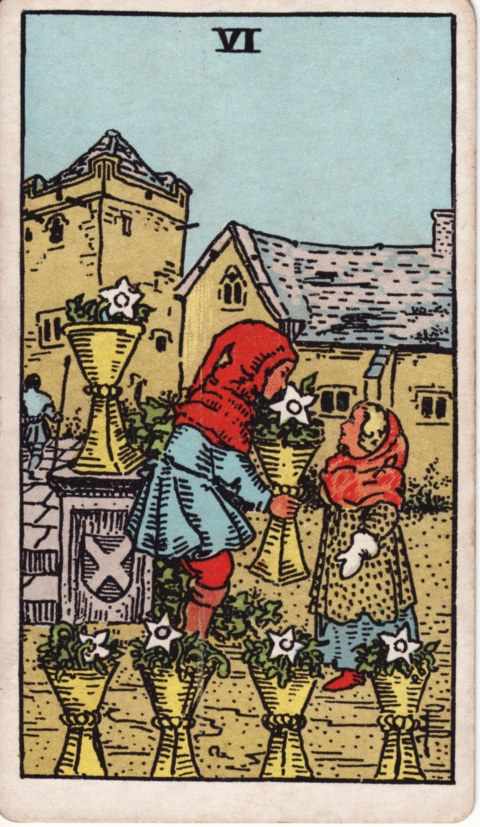
Waite's picture text is one line: "Children in an old garden, their cups filled with flowers." The list that follows opens with "A card of the past and of memories." In the drawing, a child in a red hood bends to hand a cup of white blossoms to a smaller child, and nothing in the scene is in a hurry. Childhood is Waite's own example, so the first question the card asks is what you are remembering and why it surfaced now.
Waite adds a second reading that is easy to miss: "Another reading reverses this, giving new relations, new knowledge, new environment." In that version the children stand in a place they do not know yet. So the same picture can show an old friend or a new acquaintance who feels familiar. Biddy Tarot lists the first kind: "A teenage sweetheart or past lover may turn up again." The card names the pull of the past, and whether anyone actually turns up is left open.
Labyrinthos supplies the usual caution: "while we may look upon the past with a happy eye, we must avoid living in it." Book T backs that from another side. Its Six is "Commencement of steady increase, gain and pleasure; but commencement only." Good things, early and small, which is a plainer mood than the golden-age glow the card gets in much modern writing.
Six of Cups reversed: stuck in the past, or ready for what is next?
Reversed, the card divides on one point: which way the children face. Modern pages, Biddy Tarot among them, read it as nostalgia gone stale, a wish for how things used to be that costs you the present. Waite says the opposite: "The future, renewal, that which will come to pass presently." Both readings are in circulation, and only the first is on the other sites.
They can be true of the same person in the same month. Looking back is fine; trouble starts when a memory has stopped producing anything. Waite's shorter list ends, for the reversed card, with "Inheritance to fall in quickly." He had already used the word for the Five of Cups, where what is handed down falls short. Here it is to fall in quickly, which suits his forward-pointing version: what the past leaves you shows up in the present. Don't plan a budget around it.
Try this with a single draw: finish two sentences on paper. First, "What I miss about then is..." Second, "A version of that I could have this month is..." If the second one comes easily (a Sunday call to your sister, a card game with the old crowd, your grandmother's recipe cooked in your own kitchen), the card is renewal, and the past is feeding the present. If it will not come, or every version you write needs the same person to return, you are facing backward. Then pick one version that depends only on you and put a date next to it.
If you asked about an ex or a childhood sweetheart, the card says nothing about whether they will come back. It describes how you are holding the memory. Waite's forward line fits a different question: what you want to build from what you learned there. What the other person decides is outside the picture.
Is the Six of Cups a yes or no card?
| Position | Answer |
|---|---|
| Upright | Yes, softly |
| Reversed | Wait, if it means going back |
Upright, the Six of Cups is a soft yes to questions about reconnecting, visiting, forgiving or going back to something familiar. Tarot.com is blunt about it: "the answer is YES." Book T's "commencement only" works as a brake. Yes to a first step, not yet to a large commitment.
Reversed, the answer depends on direction. If the question is about going back to something that ended, wait and do the two-sentence exercise from the reversed section before anything else. If it is about starting something new, the reversed Six leans with Waite toward yes. Waite and Book T attach no verdict to this card, so these answers come from modern habit.
Six of Cups in love and friendship: ex, old flame or fondness?
In a relationship
For a couple the card is shared history: the first apartment, the old jokes, the trip you still bring up. It suits a pair reaching back for early warmth, and a better use of it is to repeat something from that time. It can also describe a partner you knew as a friend first or met young. If the memories are the only warm thing left, say so plainly.
Single
Single, the card often puts someone from your past in the frame: a school friend, a first love, a person from your hometown. More often it describes a taste for the familiar. A new person who feels oddly easy to talk to may be the "new relations" of Waite's second reading. Feeling at home with someone is a good sign, and it is still worth finding out who they are today.
As feelings
As someone's feelings, the Six of Cups is fondness: warmth built on shared history, a soft spot they would admit to. Affection for the past is a different thing from wanting the present, and the card does not say they want to start again. Listen for whether they talk about what you could do next or only about what you used to do.
Does it mean an ex will return?
Upright, the card makes an old tie plausible without promising it. Reversed, it asks whether you are keeping an old story warm so you do not have to face a new one. Either way it describes your state. A reunion needs two people and a present-day reason, and the card shows neither.
Old friends and a group chat that only looks back
The school group chat wakes up for birthdays and the same stories from years ago, and you feel warm and slightly shut in. That is the Six of Cups among friends: children in a garden handing each other flowers. Upright, it is real fondness, and old friends have earned the retelling.
Reversed, the card splits. Modern pages say stuck. Waite says "The future, renewal, that which will come to pass presently." One group can fit either. Post a question that has nothing to do with the past, such as what everyone is working on now, and answer the first reply properly.
Six of Cups at work and with money
At work the Six of Cups is the familiar: a former colleague who calls, an old employer that is hiring, a mentor from years back, a job near where you grew up. Book T's "commencement only" fits the money side, early and modest, such as a first payment from a returning client. Biddy Tarot also reads the children as children in your own life. Waite's only money line is the §4 reversed "Inheritance to fall in quickly," a fortune-teller's phrase, so treat a family gift or a small windfall as a possibility and nothing firmer.
With a job or pay question and the card upside down, check whether you are comparing every offer to a past job. Name what you miss about it, then see whether the new role can give that back in some form.
Six of Cups as advice and as a person
As advice, make contact with one old thing on purpose: send the message, walk the old street, cook the dish. Then ask what it gave you that is missing now. Keep it to an afternoon. In Book T the cups are "not yet full," and the card does not promise a flood.
As a person, the Six of Cups is the loyal one who keeps old friends. Picture an invented example, a woman we'll call Priya, who has sent her school friends a note on every birthday for twenty years and organizes the reunion each time. Her risk is that every new group gets measured against that one. Reversed as advice: stop rehearsing the past and give the next small plan a date. Waite's reversed line points ahead.
How to read the Six of Cups in a spread
With one card, the Six of Cups tells you to examine what you are remembering, since it is shaping the question. In a past position it marks a time or a person the matter grew from. Right now, it means the familiar is tugging at you. Landing in the outcome spot, it points to a return to something known, or a start that feels like one.
Book T's dignity rules apply here, but all they give here is that Cups have Wands as foes and Swords as friends. In our view, Swords bring facts into the memory, and Pentacles bring the practical side, a house or a budget. A Wand beside the Six tends to hurry a gentle card, in line with "Wands are inimical to Cups." Book T gives them the awkward seat. After a Five of Cups the Six is what is left once the grief settles. Before a Seven of Cups it can be the memory that turns into fantasy. Next to Death, the trump Book T gives to Scorpio, a finished chapter is the reason the memory is precious.
The Six of Cups among the Cups
In Book T the Cups run dry and fill like a tide. In the Five, "neither is there water in any of the cups." The Seven has cups "all quite empty." Between them sits the Six, where water is running again, from six flowers into six cups, "but they are not yet full."
That makes the Six a thin point in the suit, a restart wedged between two losses, which is why "commencement only" matters. The pleasure is a trickle. Smith's picture is warmer than Book T's: the sunny mood belongs to her children and blossoms.
- Ace of Cups
- Two of Cups · Love
- Three of Cups · Abundance
- Four of Cups · Blended Pleasure
- Five of Cups · Loss in Pleasure
- Six of Cups · Pleasure
- Seven of Cups · Illusionary Success
- Eight of Cups · Abandoned Success
- Nine of Cups · Material Happiness
- Ten of Cups · Perfected Success
- Page of Cups
- Knight of Cups
- Queen of Cups
- King of Cups
Titles after the numbered cards are the Golden Dawn's names for them in Book T.
Symbolism of the Rider–Waite–Smith card
- The hooded child and the cup. The larger child, in a red hood and light-blue tunic, bends to offer a cup of white blossoms to a smaller child who looks up. Waite's picture line mentions neither a hood nor a handing over. Our reading is a gift passing from the bigger to the smaller, a memory handed on.
- Six cups of white flowers. One cup is in the offering hands, four stand in a row at the front and one sits on a stone block. Each holds white star-shaped flowers. Waite has "their cups filled with flowers." Book T has six lotus flowers over six cups and water instead of blossoms, so the flowers in the cups come from Waite and Smith, not from Book T.
- The tower and the house. A yellow stone tower stands at the left and a larger house with a slate roof fills the back. They make the "old garden" a closed, sheltered place. The walls say the memory is safe, and also that it is a place you have to leave to go anywhere.
- The stone block with a cross. The sixth cup rests on a gray block carrying a shield marked with a white X. Waite's picture line and Book T do not mention it, so it is Smith's detail, and no meaning for it is given in the sources used here.
- Old paving and a flat sky. The courtyard floor is drawn with stippled cobbles and the sky is a plain pale blue. Nothing in the scene says what year it is, which suits a card about memory.
What the oldest sources say
“A card of the past and of memories, looking back, as—for example—on childhood; happiness, enjoyment, but coming rather from the past; things that have vanished. Another reading reverses this, giving new relations, new knowledge, new environment, and then the children are disporting in an unfamiliar precinct. Reversed: The future, renewal, that which will come to pass presently.”
“Pleasant memories. Reversed: Inheritance to fall in quickly.”
“Commencement of steady increase, gain and pleasure; but commencement only. Also affront, detection, knowledge, and in some instances contention and strife arising from unwarranted self-assertion and vanity. Sometimes thankless and presumptuous; sometimes amiable and patient. According to dignity as usual.”
Waite's two lists for the Six of Cups point in different directions. The main entry is mostly backward: the past, memories, "things that have vanished." Then it turns: "new relations, new knowledge, new environment." The reversed line, "The future, renewal, that which will come to pass presently," turns the modern "stuck" reading around, and Waite gives no hint that he saw a conflict. The §4 lines are shorter still: "Pleasant memories" upright, and for the reversed card "Inheritance to fall in quickly." Read together, the card is about whatever the past hands on, and whether it arrives by memory or by money.
Book T draws no children and no courtyard. Its hand holds lotus stems "from which six flowers bend, one over each cup." The meaning list is also less sweet than the modern card. After the "commencement only" line it goes on to "affront, detection, knowledge, and in some instances contention and strife arising from unwarranted self-assertion and vanity," then settles on "Sometimes thankless and presumptuous; sometimes amiable and patient." Nostalgia and childhood are Waite and Smith. The Golden Dawn card is about early, modest pleasure that can still turn vain or quarrelsome, and "According to dignity" decides which.
Six of Cups and Sun in Scorpio: the card's decan
| Suit and element | Cups, Water (Major Arcana card of water: The Hanged Man) |
|---|---|
| Decan | 10° to 20° ♏︎ Scorpio, the second ten degrees of the sign |
| Planet of the decan | Sun (Major Arcana: The Sun) |
| Major Arcana card of Scorpio | Death |
| Golden Dawn title | The Lord of Pleasure |
| Place on the Tree of Life | Tiphareth (Book T: “Beginning of wish, happiness, success, or enjoyment”) |
Attributions from Book T (Golden Dawn, c. 1892; printed 1912).
Book T gives the Six of Cups the central ten degrees of Scorpio, under the Sun, and Book T draws "Sun and Scorpio referring to the Decan." Its Book T name is Lord of Pleasure. Scorpio and the suit share the element of water, and the Sun brings warmth to a sign tied to endings. Pleasure that survives a loss fits the card, with the Five of Cups in the same sign just before it. The Golden Dawn text is silent on the point.
The card belongs to Tiphareth, which Book T glosses "Beginning of wish, happiness, success, or enjoyment." In Golden Dawn teaching Tiphareth is the sphere of the Sun, so the sphere and the decan planet agree, and both say beginnings. The decan also sits inside the zone of the King of Cups, which begins at the end of Libra and runs into Scorpio. On the Major Arcana side that is Death for the sign, The Sun for the planet and The Hanged Man for the element.
When the Sun is in the Six of Cups stretch
| Year | Sun enters 10° | Sun leaves (reaches 20° Scorpio) |
|---|---|---|
| 2026 | Nov 2 | Nov 12 |
| 2027 | Nov 2 | Nov 12 |
| 2028 | Nov 1 | Nov 11 |
| 2029 | Nov 1 | Nov 11 |
The Sun is in the Six of Cups stretch of the zodiac right now: it entered 10° on November 2 and leaves on November 12, 2026 (US Eastern dates).
Dates are US Eastern, from the astronomy-engine ephemeris. Across 35,064 dates from 1930 to 2025, the Sun is in this stretch on 2.7% of them, and at least one of the ten planets is on 27.4%.
Saturn stood in this decan in 1954 and 1955, 1983 and 1984, and 2013 and 2014, and returns in 2042 and 2043, by our ephemeris. Neptune was there from 1960 to 1966 and Pluto from 1987 to 1991. The Sun makes its yearly pass through the decan from about November 2 to November 12. Those are calendar facts and carry no forecast.
Is the Six of Cups in your birth chart?
Enter your birth date. We show which of the ten planets stood between 10° and 20° Scorpio that day, the slice of sky Book T gives this card; add the time if a planet was near the edge.
Enter your birth date above to see your result.
Every planet, angle and house from your birth time: birth chart calculator.
Questions about the Six of Cups
Is the Six of Cups lucky or just sentimental?
Mostly, yes. Waite's §4 line is "Pleasant memories," and Book T calls the card Pleasure. The caution is in Book T: "commencement only." It is a warm card that is still at its start.
Will an ex return when the Six of Cups shows up?
It can describe a pull toward an old tie, and Biddy Tarot allows that a past lover may reappear. The card cannot say that anyone will. It shows what you feel about the past. Another person's choice is not in it.
What does the Six of Cups mean as feelings?
Fondness and warmth built on shared history. The person may be thinking of you kindly. Whether they want to start again is a separate question the card does not settle. Reversed, the feeling is stuck in memory or is turning toward something new.
Is the Six of Cups a yes or no?
Upright, a soft yes. Reversed, wait if the question is about going back, and lean yes if it is about starting something. No verdict comes from Waite or Book T, so this one is our modern convention.
Does the Six of Cups mean a childhood friend?
It can. Waite uses childhood as his example, and Biddy Tarot lists reconnecting with childhood friends. Waite's second reading also allows a new person who feels familiar. Treat both as possibilities and ask who is in your mind.
What zodiac sign is the Six of Cups?
Scorpio. In Book T it holds the second ten degrees, 10° to 20°, with the Sun as ruler.
When will the Six of Cups happen?
The card gives no dates. As a calendar convention the Sun crosses its decan from about November 2 to November 12 each year, and that marks nothing about your own timing. The reversed test in this page is quicker than waiting for a date.
Sources
- Astronomy Engine: the open-source ephemeris library behind our planet positions, dates and statistics
- A. E. Waite, The Pictorial Key to the Tarot (1911), Wikisource: the divinatory meanings we quote, upright and reversed
- Book T (Golden Dawn), as printed in The Equinox I:8, 1912: the zodiac sign, Hebrew letter, title and short meaning of each card
- Wikimedia Commons: Rider–Waite–Smith tarot deck: Pamela Colman Smith's 1910 card drawings, public domain
- How we create our readings: our own calculation of sign dates, positions and the 1930 to 2025 statistics
Next to the Six of Cups
In the suit of Cups: Five of Cups ← Six of Cups → Seven of Cups.
Scorpio on this site: Scorpio zodiac sign · Death, the card of Scorpio · your full birth chart.
All 22 Major Arcana with their signs and planets, and the minor cards written so far: tarot card meanings.
Written by The Zodiac Atlas editorial team with the help of AI and edited by a person. Quotations are from Waite's Pictorial Key to the Tarot and the Golden Dawn's Book T, both in the public domain; the card picture is a 1910 printing of Pamela Colman Smith's drawing for the 1909 deck. Sun dates and planet positions come from the astronomy-engine ephemeris (tropical zodiac). Tarot and astrology are symbolic traditions; they do not predict events.