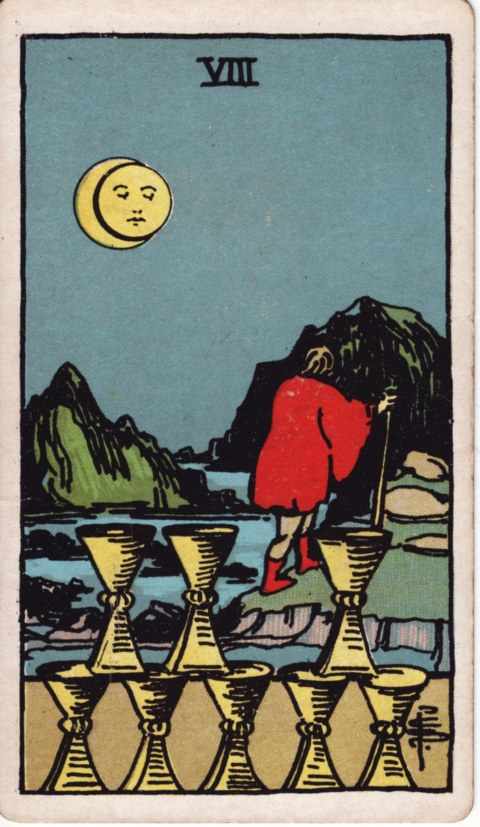
What does the Eight of Cups mean when you draw it?
The Eight of Cups is a sad card, though a fair one. Nothing has been taken from the figure. The cups are all there, upright and neatly stacked. He still goes. That is the card: leaving something that has not failed on paper but no longer gives you anything. Tarot.com puts it as walking away "not because you don't care, but because you care enough to stop settling."
Waite is more cautious than most of his readers. He says the man is "deserting the cups of his felicity, enterprise, under-taking or previous concern," and adds that other readings are "entirely antithetical." In practice, he says, the card shows "the decline of a matter," or a matter "thought to be important" that "is really of slight consequence." Both fit the picture, since the figure has plainly weighed the cups and found them light.
Look at the stick and the dark hills and you get the part the soft readings skip. He goes alone, at night, and the card names no destination. Biddy Tarot hears an escape in that, and it is a fair point. Leaving can be a decision or an avoidance, and from outside they look the same.
Eight of Cups reversed: stay, go or drift?
Reversed, the man turns around. Or he never leaves. Biddy Tarot frames the question as "Do I stay or do I go?" and Labyrinthos sees the card as "stuck in limbo," tied to a place by fear of losing the comfort already built. A third reading is the opposite of the first: constant leaving. The restless person who quits every cup before it fills is never satisfied.
Waite's reversed line is "Great joy, happiness, feasting." It sounds like a different card. In his scheme a reversal often does. It might be the cups finally being enjoyed, because the hunt for something better has stopped. We offer that as our reading and not as his.
A quick test for a one-card pull: say "I am staying because" out loud. Finish it three times. If the endings are about what you want, such as the people, the work or the place, you are probably choosing to stay. If every ending is a fear, such as being alone, being judged or losing what you built, the reversed card is describing a trap.
For an ex, the reversed Eight says little about whether he or she will come back. It speaks to your own pull between going and staying. If you keep returning to try once more, ask what would have to change for the next attempt to differ from the last.
Is the Eight of Cups a yes or no card?
| Position | Answer |
|---|---|
| Upright | Yes, to leaving |
| Reversed | Not yet, decide first |
For yes or no questions the upright Eight of Cups is a yes when the question is about leaving: quit the job, end the arrangement, step back. Tarot.com gives it a YES for the same reason. If you asked whether a situation will improve, the card leans the other way. It shows someone who has stopped waiting.
Reversed, the card says wait: the decision is half-made and fear is doing the deciding. Neither old source puts a yes or no on this card; the pairing is modern practice and ours.
Eight of Cups in love and friendship: ending, feelings, single
In a relationship
In a partnership the Eight describes a bond that is intact on the surface and hollow underneath. Nobody cheated or shouted, and one or both of you has stopped being fed. Tarot.com says the cups here are upright, "Nothing's broken. And still … something's missing." Before you decide to go, say that sentence to your partner out loud. Some couples are only one honest talk away from a refill, and others hear it and know.
Single
Single, you will usually find the Eight of Cups looking back. It can mean stepping away from dating apps, from a situationship, or from someone who gives you the minimum. Or it may describe you as the one who always leaves at the point when things become real. Ask which of the two sounds like your last three starts.
As feelings
As someone's feelings, the card means they are pulling away, tired, or questioning whether the bond is enough. They may not have decided. Many readers find a note of sadness in it, since this is the departure of a person who tried. It is a reading of mood. They may well still be there.
Stepping back from a friendship you always carried
You are the one who texts first, books the table and remembers the birthday, and nothing is wrong on paper. The Eight of Cups walks away from cups that are still neatly stacked. Book T's phrase is "decline of interest", which fits: no anger, only less pull. Stepping back is allowed.
Reversed, you stay for fear of the silence, or you leave at the first chill and call it freedom. Whether your friend notices is open. Let one invitation go unsent and see whether they reach out. If they do not, say so kindly.
Reversed in love
Upside down and asked about love, the Eight shows staying for the wrong reasons, or a couple who split and keep reopening the question. Labyrinthos reads its reversed love meaning as staying in a bad relationship out of fear of being alone. We would add the mirror case: a person who leaves each time it gets close and calls it freedom. Either pattern asks for a plain look at what you are afraid of.
Eight of Cups at work and with money
At work the Eight of Cups is the good job you cannot explain wanting to leave: the pay is fine, the colleagues are fine, and you feel nothing on Monday. The card gives no order to resign. It says the interest has gone, as Book T puts it: "Success abandoned; decline of interest." A fair step is a trial run, such as a side project, a course, or a conversation with someone doing the thing you imagine.
With money, take the picture seriously. He leaves with only a staff and a cloak. Book T lists "Seeking after riches" and "Instability" among the card's meanings. If the question is about giving up a salary, the card sees the wish to go clearly and tells you nothing about the cost. Do the arithmetic first.
Eight of Cups as advice and as a person
As advice, the card says that if you already know, stop collecting evidence. Say it to one person. Set a date. Plan the leaving as carefully as you built the thing. Walk toward something as well as away, because the figure on the card has mountains in front of him.
As a person, the Eight of Cups is someone mid-departure: a friend who has gone quiet in the group chat before a move, a manager who has stopped bothering with meetings, or you at the end of a long commitment. Picture someone who finished a degree chosen at eighteen and now keeps looking at job listings in a different field. He has not quit. The card is not telling him to. It is telling him that the question has stopped being a daydream.
How to read the Eight of Cups in a spread
Read as the past, the card marks something you already walked away from, or a part of you that has moved on without you noticing. In the present it says the leaving is under way, in the head if not yet in the calendar. As an outcome it says the path asked about will not hold you, which is different from proof that you will leave.
More Cups beside the Eight add weight to the feeling that something is missing. Wands work against Cups in Book T, and a Wand next to it often brings the push that makes the leaving happen, or a quarrel over it. Swords get a friendly word from Book T and suit the cold, clear thinking this card needs. Pentacles beside it tie the question to home, money or a contract.
The Seven of Cups is Illusionary Success in Book T, and beside it the fantasy has finally worn thin. The Nine of Cups, the Lord of Material Happiness, makes the contrast sharp: Book T gives the Nine "Complete and perfect realization of pleasure," and the Eight is the card where a person gets that far and leaves anyway. With the Five of Cups, the leaving is mixed with grief for what you lose.
The Eight of Cups among the Cups
Book T draws the Eight of Cups as a middle point in a slow filling. In the Five "no water flows" from the lotuses and none of the cups holds any. In the Seven the cups are "all quite empty." Then in the Eight two flowers "bend over the two central cups, pouring into them a white water which fills them and runs over into the three lowest." The Nine has a flower over every cup, and in the Ten the cups "all run over."
So the Eight is where the water returns after the dry Seven, and it is also the card the Golden Dawn titles Abandoned Success. Here in the suit the success is already won, and what remains open is what to do when it does not satisfy.
- Ace of Cups
- Two of Cups · Love
- Three of Cups · Abundance
- Four of Cups · Blended Pleasure
- Five of Cups · Loss in Pleasure
- Six of Cups · Pleasure
- Seven of Cups · Illusionary Success
- Eight of Cups · Abandoned Success
- Nine of Cups · Material Happiness
- Ten of Cups · Perfected Success
- Page of Cups
- Knight of Cups
- Queen of Cups
- King of Cups
Titles after the numbered cards are the Golden Dawn's names for them in Book T.
Symbolism of the Rider–Waite–Smith card
- The stack of cups. Eight golden cups stand in a tall arrangement, five below and three above with a gap. Biddy Tarot reads the gap as "a sign that emotional fulfilment and wholeness is lacking." It is a common reading in modern guides and appears in no old source.
- The walking figure. A figure in a red cloak with a staff turns away from us and climbs toward the hills. Waite calls him "a man of dejected aspect" who is "deserting" the cups. Nobody chases him and no cup is broken.
- The moon with a face. A large moon hangs over the scene with a face drawn in it. Tarot.com writes of an "eclipse or waning moon." We see a moon that is partly dark. It is one more sign that the departure happens at night.
- The water and the mountains. A stream runs between the cups and the hills, and the path leads up into barren rock. Biddy Tarot reads the river as emotion and the mountains as the awareness that the journey will not be easy. Those are modern readings.
- The Book T lotuses. Book T shows none of this. Its card has a hand with lotus stems and two flowers pouring white water into cups, which pictures success arriving. Pamela Colman Smith drew the departure that the title "Abandoned Success" only implies.
What the oldest sources say
“The card speaks for itself on the surface, but other readings are entirely antithetical—giving joy, mildness, timidity, honour, modesty. In practice, it is usually found that the card shews the decline of a matter, or that a matter which has been thought to be important is really of slight consequence—either for good or evil. Reversed: Great joy, happiness, feasting.”
“Marriage with a fair woman. Reversed: Perfect satisfaction.”
“Temporary success, but without further results. Thing thrown aside as soon as gained. Not lasting, even in the matter in hand. Indolence in success. Journeying from place to place. Misery and repining without cause. Seeking after riches. Instability.”
Waite hedges here more than on most cards. His main entry says the card "speaks for itself on the surface," then lists readings "entirely antithetical" to leaving, among them "joy, mildness, timidity, honour, modesty." His reversed meaning, "Great joy, happiness, feasting," goes further in the same direction. In the additional list he gives "Marriage with a fair woman" as the upright reading and "Perfect satisfaction" reversed. These sit oddly beside a man walking into the dark.
Book T is harsh and brief: "Temporary success, but without further results. Thing thrown aside as soon as gained." The last words describe a person who gets what he wanted and discards it. It is less romantic than the modern reading of leaving for a higher purpose. Two items, "Journeying from place to place" and "Misery and repining without cause," read as the Golden Dawn's warning that the walker may be restless more than wise. We would hold both ideas at once.
Eight of Cups and Saturn in Pisces: the card's decan
| Suit and element | Cups, Water (Major Arcana card of water: The Hanged Man) |
|---|---|
| Decan | 0° to 10° ♓︎ Pisces, the first ten degrees of the sign |
| Planet of the decan | Saturn (Major Arcana: The World) |
| Major Arcana card of Pisces | The Moon |
| Golden Dawn title | The Lord of Abandoned Success |
| Place on the Tree of Life | Hod (Book T: “Success abandoned; decline of interest”) |
Attributions from Book T (Golden Dawn, c. 1892; printed 1912).
Book T gives the Eight of Cups the first decan of Pisces, the span from 0° to 10°, under Saturn: "At the top and bottom of the card are symbols Saturn and Pisces." Its title is the Lord of Abandoned Success. Pisces belongs to water like the suit, and the Moon is the Major Arcana card assigned to Pisces. The Moon hangs over the walking figure in Smith's drawing, and that match is ours to notice, not Book T's, since Book T draws no moon here.
Saturn is the planet of limits and endings, and Pisces is the sign of the dissolving edge. In our reading, that is a fair description of a man who sets down a finished structure and walks into a landscape with no map. Both links are our interpretation and not lines from Book T.
When the Sun is in the Eight of Cups stretch
| Year | Sun enters 0° | Sun leaves (reaches 10° Pisces) |
|---|---|---|
| 2026 | Feb 18 | Feb 28 |
| 2027 | Feb 18 | Feb 28 |
| 2028 | Feb 18 | Feb 28 |
| 2029 | Feb 18 | Feb 28 |
This year the Sun crossed the Eight of Cups stretch of the zodiac (0° to 10° Pisces) from February 18 to February 28, 2026. Next time: February 18 to February 28, 2027 (US Eastern dates).
Dates are US Eastern, from the astronomy-engine ephemeris. Across 35,064 dates from 1930 to 2025, the Sun is in this stretch on 2.7% of them, and at least one of the ten planets is on 23.5%.
Saturn itself crossed this decan from March 9, 2023 to March 3, 2024, by our calculation, and returns in 2052 to 2054. If you were thinking in those years about leaving something, the timing is a coincidence worth noticing and not a prediction. The Sun is in this stretch of Pisces around February 18 to 28.
Is the Eight of Cups in your birth chart?
Enter your birth date. We show which of the ten planets stood between 0° and 10° Pisces that day, the slice of sky Book T gives this card; add the time if a planet was near the edge.
Enter your birth date above to see your result.
Every planet, angle and house from your birth time: birth chart calculator.
Questions about the Eight of Cups
Is the Eight of Cups a negative card?
Sad, yes, though with a good side: someone leaves because the cups stopped feeding them. Waite also lists readings of "joy" and "modesty" for it.
Does the Eight of Cups mean walking away?
Yes. That is the picture. Whether it is a wise leaving or an escape is something the card leaves open. Biddy Tarot warns it can be avoidance, and Tarot.com reads it as self-respect.
What does the Eight of Cups mean as feelings?
Someone feels that something is missing and is stepping back or considering it. Reversed, they are torn and unsure whether to go or stay.
Does the Eight of Cups mean an ex is coming back?
Not by itself. The card shows someone leaving. Reversed it can show going back to try again, which describes the mood of the person asking and does not promise that the other one will return.
Does the Eight of Cups mean yes?
Yes, when the question is about leaving or letting go, and Tarot.com gives it a YES. Reversed, it says wait. Neither old source gives it a yes or no, so the pairing is modern.
What zodiac sign is the Eight of Cups?
Pisces. Book T gives the card to the first decan of Pisces, 0° to 10°, ruled by Saturn. The Sun crosses that decan around February 18 to 28.
When will I leave, or when will it end?
The card names no time. If you want a date to hang the question on, the Sun dates of the decan, February 18 to 28, are one choice, but that is only a convenience.
Sources
- Astronomy Engine: the open-source ephemeris library behind our planet positions, dates and statistics
- A. E. Waite, The Pictorial Key to the Tarot (1911), Wikisource: the divinatory meanings we quote, upright and reversed
- Book T (Golden Dawn), as printed in The Equinox I:8, 1912: the zodiac sign, Hebrew letter, title and short meaning of each card
- Wikimedia Commons: Rider–Waite–Smith tarot deck: Pamela Colman Smith's 1910 card drawings, public domain
- How we create our readings: our own calculation of sign dates, positions and the 1930 to 2025 statistics
Next to the Eight of Cups
In the suit of Cups: Seven of Cups ← Eight of Cups → Nine of Cups.
Pisces on this site: Pisces zodiac sign · The Moon, the card of Pisces · your full birth chart.
All 22 Major Arcana with their signs and planets, and the minor cards written so far: tarot card meanings.
Written by The Zodiac Atlas editorial team with the help of AI and edited by a person. Quotations are from Waite's Pictorial Key to the Tarot and the Golden Dawn's Book T, both in the public domain; the card picture is a 1910 printing of Pamela Colman Smith's drawing for the 1909 deck. Sun dates and planet positions come from the astronomy-engine ephemeris (tropical zodiac). Tarot and astrology are symbolic traditions; they do not predict events.