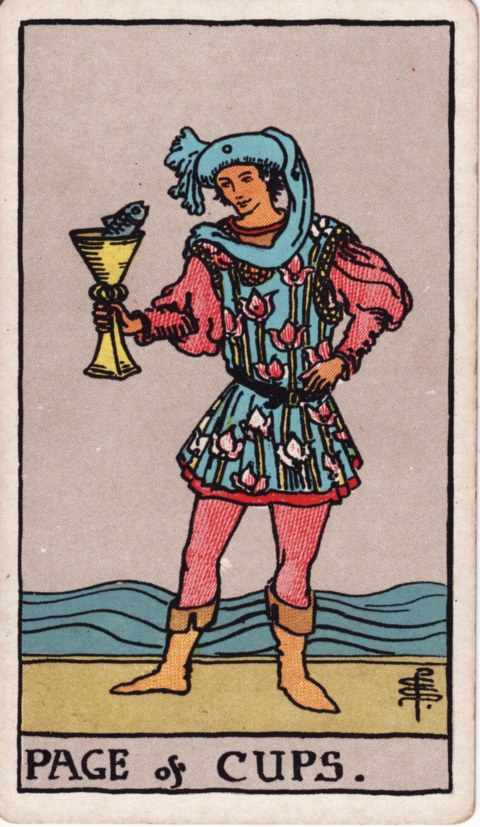
What is the Page of Cups trying to tell you?
Surprise is the point of this card. A fish has no business in a cup, and the page looks amused. Biddy Tarot reads the scene as showing that "creative inspiration often comes out of the blue and only when you are open to it." Labyrinthos adds a detail most summaries skip: the figure "can neither drink nor toast with the cup as the fish stares at her." Whatever arrived cannot be drunk or toasted; it has to be looked at.
Waite's list starts with a person, "Fair young man, one impelled to render service," and then moves to "news, message; application, reflection, meditation." So the card can be a young helper, a note on its way, or a quiet hour of thinking. His picture line ties the three together: the fish is "the pictures of the mind taking form." A mood that had no shape is turning into something you can see.
In daily life that looks like a text kinder than you expected, an apology, an odd idea you keep returning to, or an invitation to make something with no commercial point. Tarot.com sums it up with "Don't overthink. Just feel it." Instead of a plan, the Page wants you to look at the fish for a moment before deciding what it is.
Page of Cups reversed: a secret, a block, or sulking?
Waite's reversed list is "Taste, inclination, attachment, seduction, deception, artifice." Most of that list, from seduction to artifice, concerns charm used on somebody. Modern pages read the same upside-down card as something that happens inside you. Biddy Tarot describes "keeping your creative inspirations and ideas secret," and Tarot.com speaks of "feelings you're not quite ready to acknowledge." Both fit the picture: the fish is there, and either it is shown falsely or it is hidden.
A second modern thread is age of heart. Biddy Tarot adds that it may show someone "emotionally immature," dramatic or dreamy past the point of being grounded. Read that as a description of a mood. Anyone can sulk, over-share or daydream instead of acting when a feeling is new.
A short test works with one card on the table. Set a timer for two minutes and write down the oddest thought or feeling that came up today, without fixing it. If nothing comes, you are in a dry patch, and the remedy is input: a walk, a song, a book. If a lot comes and you cover the page with your hand, the fish is being hidden. Then pick one safe person and read them a single line of it before the day ends.
Waiting on a message from one particular person? The reversed Page says little about their phone and more about how ready you are to hear a reply and to answer honestly. If you asked about pregnancy, the card is silent; only a test and a doctor settle it.
Is the Page of Cups a yes or no card?
| Position | Answer |
|---|---|
| Upright | Yes, gently |
| Reversed | Not yet |
Tarot.com files the Page under a plain "YES." Our version is softer: yes, gently. It suits questions about reaching out, trying a creative idea, saying a kind thing or asking a question. It does not promise that the thing will last.
Turned over, the card asks you to wait a day. Perhaps the idea is not shaped, perhaps you are braced for a reply you cannot take yet. The old books list no yes or no for the Page; every verdict here is a later habit.
Page of Cups in love and friendship: a crush, a message, mixed signals
In a relationship
Inside a couple the Page brings back play. A note left in a coat pocket, a song sent at noon, a question like "what were you like at nine?" It is the card of small, sincere gestures, and it shows up when one person is ready to be a little foolish for the other. Tarot.com ties it to "a heartfelt note, apology, or invitation." The size of the gesture matters less than whether it is meant.
If you are single
On your own, the Page often means a quiet infatuation, or a first message from someone nervous about sending it. It can also mean that you are ready to be curious about people again after a closed stretch. The card names a feeling at its start. A shy start can be real and still be slow, so give it a few exchanges before deciding what it is.
As their feelings
Taken as the other person's heart, the Page means sweetness, shyness and wonder. The person finds you interesting and may not know what to do about it. Waite's §4 line adds a sadder possibility: "a young man who is unfortunate in love." Then the feeling is sincere and the timing or the courage is missing.
A kind text from a friend you had half lost
A friend you had half lost sends a goofy voice note, or an apology you did not expect. That is the Page of Cups. Waite gives "news, message" among its words, and between friends it is small and sincere, with no plan behind it. Take it as it comes. Answer in kind, and do not audit it.
Reversed, the message stays unsent. You have a draft to a friend that is six versions deep, or you sulk and wait for them to write first. This card shows your side only. Whether they want to hear from you is a separate matter. Send the shortest honest version before tonight: I thought of you, how are you?
Reversed in love
Upside down, you get unsent messages and crossed wires: an infatuation kept secret, a text drafted six times and deleted, or a partner who sulks instead of speaking. Waite's "seduction, deception, artifice" is the harsh version, charm that is playing a part. With an ex, read the reversed Page as your own readiness to speak plainly. It gives no verdict on whether they will write.
Page of Cups at work and with money
At work the Page of Cups is the first creative idea for a project, a new colleague who is eager and sensitive, or an offer that comes through someone's good opinion of you. Waite's list ends with "also these things directed to business," so study and thought count here: a course, a portfolio piece, a draft you show to a friend first. Tarot.com calls it "your muse showing up with a wink."
Money is a minor subject for this card. Labyrinthos warns of "daydreams without putting in effort" when the Page meets finances, and the warning is fair: an idea is not income yet. Upside down at work, the idea is hidden or doubted. Show it to one trusted person this week, or put it on paper in a form that someone else could read.
Page of Cups as advice and as a person
Let the odd idea speak. Write down what surfaced, answer the kind message, say the small sincere thing. Do it without a campaign behind it, since the Page gives a first step and no schedule.
As a person, the Page is a gentle, imaginative younger soul. Picture an invented intern named Mika who stays late to redraw the office plant chart as a map and shows it to nobody until someone asks. She is easy to underrate, and she is often the one whose idea gets used in the end.
Reversed as advice: stop rehearsing and show it. Choose the smallest audience you trust, share the unfinished thing, and ask one question about it.
How to read the Page of Cups in a spread
If this is the only card you drew, it says that something in you wants a form. A thought, a feeling or a bit of news is just becoming clear, and the next step is to look at it without judging it. Book T's table says "The Princesses shew opinions, thoughts, ideas," which is a close match.
In a longer spread, the Page in the past marks the first stir of the matter, in the present a new feeling or message on the table, and as an outcome a message that has not yet come in. Book T counts Wands as inimical to Cups, so a Wands card beside her tends to rush or cool the feeling, while Swords give it words. Next to the Ace of Cups she sits on her own throne; next to the Knight of Cups the message has a messenger. Beside the Three of Swords, the news carries a sting.
The Page of Cups among the Cups
The Page comes straight after the Ten of Cups, which Book T names Perfected Success, so the suit restarts from a small figure after a complete cycle. Book T links her back to the beginning on purpose: she holds the title "Throne of the Ace of Cups," the seat the first gift rests on.
She also differs from her suit-mates in how she stands. The Knight rides, the Queen sits and the King is borne in a chariot, while the Page stands on her own feet. Book T says of the Princesses that they stand "firmly of themselves," and that is the easiest way to remember the card: a feeling that has not been handed to anyone yet.
- Ace of Cups
- Two of Cups · Love
- Three of Cups · Abundance
- Four of Cups · Blended Pleasure
- Five of Cups · Loss in Pleasure
- Six of Cups · Pleasure
- Seven of Cups · Illusionary Success
- Eight of Cups · Abandoned Success
- Nine of Cups · Material Happiness
- Ten of Cups · Perfected Success
- Page of Cups
- Knight of Cups
- Queen of Cups
- King of Cups
Titles after the numbered cards are the Golden Dawn's names for them in Book T.
Symbolism of the Rider–Waite–Smith card
- The fish in the cup. Waite says the page "contemplates a fish rising from a cup to look at him." The fish is the unexpected visitor, and Biddy Tarot reads it as inspiration out of the blue. Book T gives a turtle in its place, so the old writers did not agree on the creature. Our reading is that any small animal from the depths works, as long as it looks back.
- The sea behind. A band of blue water with gentle dark waves runs across the card, with a strip of sand in front. The sea is calm, a fit for the first stir of a feeling. Tarot.com reads it as the subconscious, and that is a common modern reading.
- Flowers on the tunic. The blue tunic carries rows of pale flowers that can be read as lotuses, a water flower. Book T puts a lotus in the Princess's hand and calls her "the Lotus of the Palace of the Floods." We take the pattern as a quiet nod to that title.
- The hat, scarf and posture. A floppy blue cap, a long scarf, one hand on the hip and the head slightly tilted: the stance of someone who is relaxed and amused by what has turned up. Labyrinthos calls the look "bohemian." It reads as curiosity, with no fear in it.
What the oldest sources say
“Fair young man, one impelled to render service and with whom the Querent will be connected; a studious youth; news, message; application, reflection, meditation; also these things directed to business. Reversed: Taste, inclination, attachment, seduction, deception, artifice.”
“Good augury; also a young man who is unfortunate in love. Reversed: Obstacles of all kinds.”
Two Waite lists cover this card, and they share little. The main one is about a person and a message, a studious youth who serves the Querent, with "application, reflection, meditation" next to him. The §4 line is shorter and odder: "Good augury; also a young man who is unfortunate in love." Reversed it says "Obstacles of all kinds." Waite also calls the figure "somewhat effeminate," a period phrase worth passing over: on Smith's card the young person can be read as a boy or a girl, and modern pages vary between "he," "she" and "they."
Book T paints another picture: a "BEAUTIFUL Amazon-like figure" on a foaming sea, a dolphin at her side, a swan on her crest, a turtle in her cup. Its temperament list is "Sweetness, poetry, gentleness and kindness. Imaginative, dreamy, at times indolent, yet courageous if roused," and when ill dignified she is "selfish and luxurious." Book T's general section gives the Princess a far higher rank, "a Queen of Queens --- an Empress," a figure of power that "existeth not, save by reason of the others." That is a long way from a beginner. The sweet young messenger of today and the Empress of the Undines agree on the water and the dreaminess, and on little else.
Page of Cups and Water
| Suit and element | Cups, Water (Major Arcana card of water: The Hanged Man) |
|---|
Attributions from Book T (Golden Dawn, c. 1892; printed 1912).
Book T gives the Page of Cups no decan and no stretch of the zodiac. She is named "The Princess of the Waters: the Lotus of the Palace of the Floods," carries the elemental label Earth of Water, and is given "Princess and Empress of the Nymphs or Undines." She "rules a quadrant of the heavens around Kether," the crown of the Tree of Life, and she carries the title "Throne of the Ace of Cups." Among the Major Arcana, The Hanged Man stands for the element.
The quadrants are not worded alike across the four suits. The Princesses of Cups and Swords rule "around Kether," the Princess of Wands gets a portion "around the North Pole" while the Princess of Pentacles has a quadrant "around the North Pole of the Ecliptic." Book T also says the Princesses sit "above the respective Cherubic Signs of the Zodiac." If those signs are the four fixed ones, which is a modern gloss that Book T does not state, the water Princess stands over Scorpio.
Water is the element that takes the shape of what holds it, and Earth of Water is the part of that element that can be held in the hand: a cup, a shore, a small fish. The three water signs are Cancer, Scorpio and Pisces, and the numbered Cups split them among themselves. The Page is what is left when the whole suit is poured into one gesture.
Questions about the Page of Cups
Is the Page of Cups lucky or unlucky?
Good in most readings. It brings a message, a soft start or a creative idea. Waite's §4 line says "Good augury," with the side note that a young man may be unfortunate in love.
What does the Page of Cups mean as feelings?
Sweetness, shyness and curiosity. The person finds you interesting and may be nervous about showing it. Reversed, the feeling is hidden, mixed or sulking.
Does the Page of Cups mean pregnancy?
Not on its own. Biddy Tarot lists "the birth of a baby" among possible messages, but no old source says so. Only a test and a doctor settle that.
Who is the Page of Cups when she is a person?
A gentle, imaginative, often younger person who is sensitive and creative. Waite lists "a studious youth" and "one impelled to render service." It can also be the young part of you that wants to play.
Does the Page of Cups mean a message or a text from someone?
Waite lists "news, message" for it, so a message is the classic meaning. The card gives no sender, no wording and no day. Treat it as a hint to be ready for one, with no promise that it will arrive.
Does the Page of Cups answer yes or no?
Gently yes when upright, in line with Tarot.com. Upside down it suggests waiting. These are modern habits, since neither old source gives any.
Which sign does the Page of Cups belong to?
None. Book T gives the Page of Cups no decan or zone, only a quadrant "around Kether." Her element is water, which points loosely to Cancer, Scorpio and Pisces. Because there is no zone, there are no dates for her either.
Sources
- Astronomy Engine: the open-source ephemeris library behind our planet positions, dates and statistics
- A. E. Waite, The Pictorial Key to the Tarot (1911), Wikisource: the divinatory meanings we quote, upright and reversed
- Book T (Golden Dawn), as printed in The Equinox I:8, 1912: the zodiac sign, Hebrew letter, title and short meaning of each card
- Wikimedia Commons: Rider–Waite–Smith tarot deck: Pamela Colman Smith's 1910 card drawings, public domain
- How we create our readings: our own calculation of sign dates, positions and the 1930 to 2025 statistics
Next to the Page of Cups
In the suit of Cups: Ten of Cups ← Page of Cups → Knight of Cups.
All 22 Major Arcana with their signs and planets, and the minor cards written so far: tarot card meanings.
Written by The Zodiac Atlas editorial team with the help of AI and edited by a person. Quotations are from Waite's Pictorial Key to the Tarot and the Golden Dawn's Book T, both in the public domain; the card picture is a 1910 printing of Pamela Colman Smith's drawing for the 1909 deck. Sun dates and planet positions come from the astronomy-engine ephemeris (tropical zodiac). Tarot and astrology are symbolic traditions; they do not predict events.