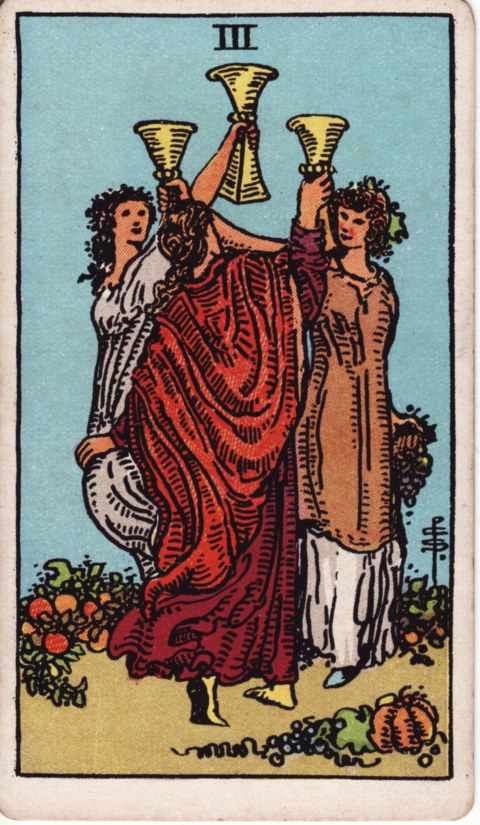
What does the Three of Cups mean? Friends, a toast, a feast
Waite's picture is a single line: "Maidens in a garden-ground with cups uplifted, as if pledging one another." Pledging is the word that matters. Cups raised together are a toast, and a toast is a promise made out loud with witnesses. Nobody sits alone with a cup, as in the Four, and nobody pours for one other person, as in the Two. If a piece of work needs a crowd to count, tell the people who helped what came of it, and ask one of them for a favor you have been holding back.
His list for the upright card is close to a party invitation: "The conclusion of any matter in plenty, perfection and merriment; happy issue, victory, fulfilment, solace, healing." Notice that it opens with a conclusion: the moment after the effort, when the matter is closed and everyone is fed. "Solace, healing" at the end of his list means the party can also be what a hard stretch needed.
Book T has no women at all, only a hand with lotuses that spill white water, and its short line for the sephira reads "Plenty, hospitality, eating and drinking, pleasure, dancing, new clothes, merriment." New clothes is an oddly specific item, and it fits a feast day: you dress for it. Taken together, the card is about showing up for an occasion that was prepared for, with your hands free.
Three of Cups reversed: finished fast, too much, or a third person?
Look at how Waite turns the card over: "Expedition, dispatch, achievement, end. It signifies also the side of excess in physical enjoyment, and the pleasures of the senses." The first four words are about speed and finishing, with no quarrel in them. Only then does he add excess. The "third person" and the falling-out come from modern pages: Biddy Tarot says "the reversed Three of Cups can sometimes appear when a third person is involved," and Waite lists nothing of the sort. At work, with the card reversed, look at what you are spending to keep the team happy, and trim one recurring cost before you add another.
To tell which side of the reversed card you are on, run the next-morning check. After the next time you spend an evening with friends, colleagues or family, write three lines before breakfast: how your energy is on a scale of 1 to 5, what the evening cost in money and hours, and whether you wanted to be there. Two evenings that cost more than they gave point to Waite's excess. An evening you wished you had skipped, in a group that no longer fits, is the modern drained version. If there has been no evening at all for weeks, the reversed card may be describing the quiet, and the first move is one message proposing coffee for two.
The "end" in Waite's list deserves a second look. His second pass for the reversed card opens with "Consolation" and closes on "end of the business." The lowercase "end" is in the source. So the reversed Three of Cups can be a matter wrapped up, a bill settled or a worry eased, which is far from what most web pages say about it.
Worried that a reversed card means a partner is unfaithful? It cannot say. It shows the mood and company around you and nothing about what one particular person did. Facts about someone else come from what they say and do, and from you asking.
Is the Three of Cups a yes or no card?
| Position | Answer |
|---|---|
| Upright | Yes, with company |
| Reversed | Yes, check the cost |
Upright, the Three of Cups is a yes for questions about gatherings, reunions, friendships and shared projects. Tarot.com's yes-or-no entry reads "the answer is YES." Verdicts are absent from Waite and from Book T, so this is later practice. A yes is strongest when other people are involved and glad about it.
With the card turned, the answer holds once the price is checked. Waite's "Expedition, dispatch" favors finishing quickly, and "excess" asks what the quick yes would cost you.
Three of Cups in love and friendship: a group, a spark or a worry?
In a relationship
Between partners, the card is the social side of love: dinners with friends, a wedding you both attend, an evening where you see each other happy among people. It is also a prompt to look after the friendships around the pair. Waite lists "happy issue" and "solace," which suits a bond that has just come through something hard and wants to be seen enjoying itself.
Single
Single, the card sends you to where the toasts are. Parties, groups and a friend's friends are the likely start, and the Waite-Smith picture shows no couple at all, only a circle. Book T's "love, gladness, kindness, liberality" is a good standard for the first meeting: look for generosity. Friendship that turns romantic is a modern reading, and plausible, but the card does not promise it.
As feelings
As a partner's feeling, the Three of Cups is goodwill and a wish to include you. They may enjoy your company in a group more than they have said in private. Book T's "sensuality" appears in its list, so the warmth can be physical too. The card shows the mood of the evening and says little about what comes after it.
Friends at a table that has turned to gossip
Three raised cups are a toast, and Waite's picture calls it "pledging one another". The promise is to the people in the room. Upright, the card asks a group whether it still means it. Say the dinners have become forty minutes on whoever is absent, and nobody has quarreled, yet the cups have gone sour.
Reversed, the card leans to Waite's excess: too many rounds, too fast, nothing finished. It cannot tell you who started the habit. You may be feeding it. At the next dinner, change the subject once when an absent friend comes up. See who follows.
Reversed in love: is there a third person?
Reversed, modern sites often read a third person, an affair or gossip, and Tarot.com says "it can flag third-party entanglements or mixed intentions in romance." Waite does not say that. His reversed card is finishing and excess. If the worry is real, look at plain facts: secrecy, changed habits, answers that do not fit. The card describes your situation and your nerves, and proves nothing about anyone else.
Three of Cups at work and with money
At work the Three of Cups is the team that works, a launch party, a project closed with everyone in the room. Book T's "Abundance, plenty, success" and Waite's "conclusion of any matter" fit a deal that ends well for all parties. On money, it points to a fair share and a good season, and the fruit in the picture stands for the harvest. It gives no amount and no date.
Reversed, either a project is being rushed to a close, as in Waite's "dispatch," or the office socializing has become a cost. Check the budget for team dinners and rounds, and make sure a quick finish has not skipped a step. If you are being left out of the group, ask directly what the plan is, once.
Three of Cups as advice and as a person
As advice, gather people. Book a table, send the invitation, mark the finish of something with those who helped. Bring a dish, and let someone else pour. Reversed, hold back on the next round and clear one task that has dragged on, as the card says to dispatch it.
In person form, the Three of Cups knows everyone and remembers the birthdays. An invented example: Lena's team has shipped a product after a long autumn, and she books a long table at a cheap restaurant on a Thursday, pays for the first round and writes each person a line of thanks. Reversed, she would notice that the table has been booked every Thursday for two months and that the bill is hers.
How to read the Three of Cups in a spread
Drawn alone, the Three of Cups tells you to look at your company. Ask who is in the circle around the question, and whether you are drinking to something finished.
In a past slot it shows a gathering that set the scene. In a present slot you stand in the thick of the company. Put last, it points to a celebration and a closed matter, if you invite people. A Wand beside it heats the party, and Book T warns that "Wands are inimical to Cups," so expect friction in the room. A Sword nearby sits easier with the cups and brings a straight word at the table. After the Two of Cups the pair has become a group; the Four of Cups, Book T says, "does not mean love and marriage so much as the previous symbol," and that symbol is this one. With The Chariot, the Cancer trump, nearby, the party has somewhere to go.
The Three of Cups among the Cups
In the suit of Cups the Three is where the water first spills over. Book T's Two has two cups that overflow, and its Three reads "All the cups overflow; the topmost into the two others, and these upon the lower part of the card." Three cups in a triangle share one stream, with the top cup feeding the rest. The Ace gives the cup, the Two pairs it, and the Three makes a table.
That makes the Three the full point of the early cups, called Abundance and set in Cancer. The Four turns to the next stage, Blended Pleasure, in which the flow slows. The Waite-Smith picture turns Book T's falling water into raised cups, and a pumpkin and grapes add the harvest.
- Ace of Cups
- Two of Cups · Love
- Three of Cups · Abundance
- Four of Cups · Blended Pleasure
- Five of Cups · Loss in Pleasure
- Six of Cups · Pleasure
- Seven of Cups · Illusionary Success
- Eight of Cups · Abandoned Success
- Nine of Cups · Material Happiness
- Ten of Cups · Perfected Success
- Page of Cups
- Knight of Cups
- Queen of Cups
- King of Cups
Titles after the numbered cards are the Golden Dawn's names for them in Book T.
Symbolism of the Rider–Waite–Smith card
- Three raised cups. Three gold cups are lifted together at the top of the card, the tallest in the middle. Waite writes "cups uplifted, as if pledging one another." Book T's cups are a triangle of overflowing water. The meeting of the three at one point is the picture's toast.
- The wreaths. Wreaths of leaves sit in the hair of at least two of the women. Waite does not describe them. Labyrinthos links wreaths with success and victory, a fair reading, and the feast-day look fits Book T's "new clothes."
- The woman with her back turned. The central figure in a crimson robe faces away from us, and her face is hidden, while the other two look inward at her. Waite says nothing about it. It makes the toast about the three of them, and we, the viewers, stand outside the circle.
- Pumpkin, grapes and fruit. At the women's feet lie a pumpkin, grapes and round orange fruit. Waite does not list them. Together they make a harvest, which matches his "conclusion of any matter in plenty." Grapes also point to wine, as in Book T's "eating and drinking."
- The open sky. Above the dancers the sky is pale blue and empty, with no house, road or crowd. The scene is a garden, as Waite says, and the feast belongs to these three.
What the oldest sources say
“The conclusion of any matter in plenty, perfection and merriment; happy issue, victory, fulfilment, solace, healing. Reversed: Expedition, dispatch, achievement, end. It signifies also the side of excess in physical enjoyment, and the pleasures of the senses.”
“Unexpected advancement for military man. Reversed: Consolation, cure. end of the business.”
“Abundance, plenty, success, pleasure, sensuality, passive success, good luck and fortune; love, gladness, kindness, liberality.”
Waite's two lists run on one idea, which is closing. The main entry is "The conclusion of any matter in plenty, perfection and merriment." The reversed line begins with "Expedition, dispatch, achievement, end" and only then adds excess. His second pass gives "Unexpected advancement for military man" upright, and turned over a line that starts "Consolation" and ends "end of the business." Taken as a set, Waite sees a matter completed with a feast, and when reversed he sees it completed in a hurry or mended. The betrayal and third-wheel themes are not in his lists.
Book T draws lotuses in a hand, with no women, and calls the card "Abundance, plenty, success, pleasure, sensuality, passive success, good luck and fortune; love, gladness, kindness, liberality." Passive success means it arrives without a fight. The sephira line, Binah, lists "eating and drinking, pleasure, dancing, new clothes, merriment," a feast-day inventory. Nothing in it speaks of friendship as such, so the friend-group reading is Smith's picture and the modern sites.
Three of Cups and Mercury in Cancer: the card's decan
| Suit and element | Cups, Water (Major Arcana card of water: The Hanged Man) |
|---|---|
| Decan | 10° to 20° ♋︎ Cancer, the second ten degrees of the sign |
| Planet of the decan | Mercury (Major Arcana: The Magician) |
| Major Arcana card of Cancer | The Chariot |
| Golden Dawn title | The Lord of Abundance |
| Place on the Tree of Life | Binah (Book T: “Plenty, hospitality, eating and drinking, pleasure, dancing, new clothes, merriment”) |
Attributions from Book T (Golden Dawn, c. 1892; printed 1912).
Book T sets the Three of Cups in the middle ten degrees of Cancer, 10° to 20°, ruled by Mercury and titled Abundance. Cancer is water, like the Cups. Mercury is the planet of trade and talk, which suits a card of company and conversation, and Book T leaves that pairing unsaid. For the trumps, think of The Chariot (Cancer), The Magician (Mercury) and The Hanged Man (water).
The sphere is Binah, whose gloss lists "Plenty, hospitality, eating and drinking, pleasure, dancing, new clothes, merriment." The Sun spends about July 1 to 12 here, in early summer. The ten degrees fall inside the Queen of Cups' stretch of sky, between the Two of Cups before it and the Four of Cups after it.
When the Sun is in the Three of Cups stretch
| Year | Sun enters 10° | Sun leaves (reaches 20° Cancer) |
|---|---|---|
| 2026 | Jul 1 | Jul 12 |
| 2027 | Jul 1 | Jul 12 |
| 2028 | Jul 1 | Jul 11 |
| 2029 | Jul 1 | Jul 11 |
This year the Sun crossed the Three of Cups stretch of the zodiac (10° to 20° Cancer) from July 1 to July 12, 2026. Next time: July 1 to July 12, 2027 (US Eastern dates).
Dates are US Eastern, from the astronomy-engine ephemeris. Across 35,064 dates from 1930 to 2025, the Sun is in this stretch on 2.9% of them, and at least one of the ten planets is on 20.1%.
By our ephemeris Jupiter stood in the decan from January 12 to May 10, 2026, earlier this year, and it is not there now. Saturn was here from 1974 to 1975 and 2003 to 2004, and returns from 2033 to 2034. Uranus stayed from 1951 to 1954 and comes back from 2034 to 2037. Nothing here is a forecast.
Is the Three of Cups in your birth chart?
Enter your birth date. We show which of the ten planets stood between 10° and 20° Cancer that day, the slice of sky Book T gives this card; add the time if a planet was near the edge.
Enter your birth date above to see your result.
Every planet, angle and house from your birth time: birth chart calculator.
Questions about the Three of Cups
Is the Three of Cups a bad omen?
No, it is among the happiest cards. Waite writes "plenty, perfection and merriment; happy issue, victory, fulfilment, solace, healing." Book T puts sensuality beside the abundance, so watch the amount.
What is the Three of Cups meaning as feelings?
Goodwill, warmth and a wish to include you. It reads a mood in company, and says little about private intent.
Should I read the Three of Cups as a yes?
Upright, yes, most of all for shared or social questions. Reversed, yes with the price checked. Verdicts are a present-day habit.
What does the Three of Cups reversed mean?
Waite starts with "Expedition, dispatch, achievement, end" and then excess. Modern pages add isolation and gossip. Try the next-morning check: energy, cost and whether you wanted to be there.
Does a reversed Three of Cups mean an affair?
Some modern pages read a third person into it. Waite does not, and no card can show what another person does. It describes your mood and your circle.
Does the Three of Cups mean pregnancy?
Waite's lists do not mention it, and Book T's do not either. The picture is a celebration. For that question you need a test or a clinician.
Which sign is the Three of Cups, and when is its season?
Cancer, at 10° to 20°, under Mercury in Book T. By convention the Sun is there around July 1 to 12, which gives no date for your own question.
Sources
- Astronomy Engine: the open-source ephemeris library behind our planet positions, dates and statistics
- A. E. Waite, The Pictorial Key to the Tarot (1911), Wikisource: the divinatory meanings we quote, upright and reversed
- Book T (Golden Dawn), as printed in The Equinox I:8, 1912: the zodiac sign, Hebrew letter, title and short meaning of each card
- Wikimedia Commons: Rider–Waite–Smith tarot deck: Pamela Colman Smith's 1910 card drawings, public domain
- How we create our readings: our own calculation of sign dates, positions and the 1930 to 2025 statistics
Next to the Three of Cups
In the suit of Cups: Two of Cups ← Three of Cups → Four of Cups.
Cancer on this site: Cancer zodiac sign · The Chariot, the card of Cancer · your full birth chart.
All 22 Major Arcana with their signs and planets, and the minor cards written so far: tarot card meanings.
Written by The Zodiac Atlas editorial team with the help of AI and edited by a person. Quotations are from Waite's Pictorial Key to the Tarot and the Golden Dawn's Book T, both in the public domain; the card picture is a 1910 printing of Pamela Colman Smith's drawing for the 1909 deck. Sun dates and planet positions come from the astronomy-engine ephemeris (tropical zodiac). Tarot and astrology are symbolic traditions; they do not predict events.