Who is the King of Cups, and what does he mean?
Is it a good card? Yes, with one footnote that Book T supplies later on this page. The upright King of Cups is the person in the room who has feelings and does not hand them to everyone else. Tarot.com sums him up as "calm in chaos, kind without coddling." Waite's list for him is about work: "Fair man, man of business, law, or divinity; responsible, disposed to oblige the Querent." None of those words is soft. This king is a professional. He keeps office hours.
Picture a hospice nurse who has sat with a hundred families, or a divorce mediator who lets both sides finish a sentence. Neither is cold. Both learned to feel something and still speak slowly. If a reading puts such a person in your life, the card points at them. If you are the one in the chair, it asks you to feel first and then choose, with the feeling fully admitted and kept out of the driver's seat.
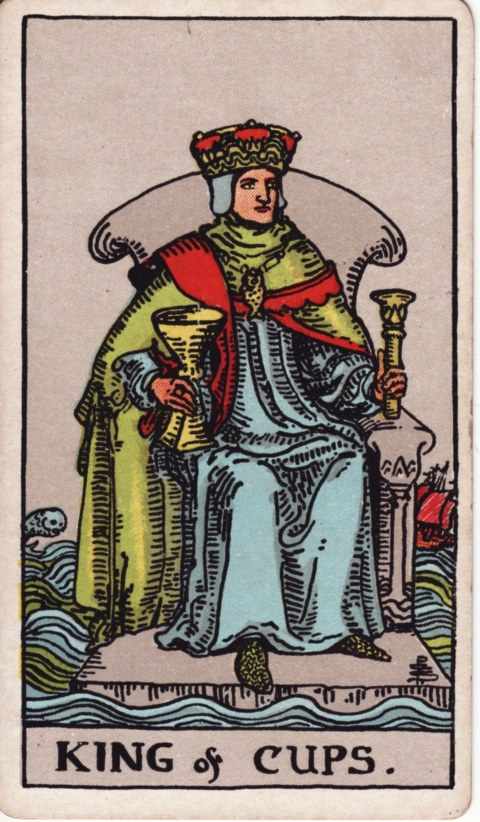
The picture says the same thing. His throne stands in open water, a fish leaps on one side, a ship rides on the other, and he sits facing us. Waite adds "creative intelligence" to the upright list, so the card also fits a counselor, lawyer, doctor, artist or teacher whose craft is people.
King of Cups reversed: moody, or just charming?
Reversed, Waite's list turns hard: "Dishonest, double-dealing man; roguery, exaction, injustice, vice, scandal, pillage, considerable loss." That is far from the calm king. Labyrinthos reads the same turn in modern terms as "volatility, emotional manipulation and moodiness," and Biddy Tarot says the worst version "uses emotional blackmail to get his way."
With a single card, the reversal splits by who it describes. When it points at someone else, the sign is a gap between how they sound and what they do: warm words, then a request that costs you. When it points at you, the sign is a mood that has started making decisions for you. Either one can be spotted without any other card on the table, because behavior gives it away.
Run this check before you pick. Recall the last three times the person (or you) said "I'm fine" or "it's nothing." Then look at what happened afterward: a favor withheld, a cold shoulder that lasted a week, a bill left for you to pay. If the actions changed and the words did not, you are reading the double-dealing side. If nothing changed, you are reading plain overload, and the remedy is sleep, a walk and one honest talk.
Asking about an ex or a former partner? A reversed king cannot answer that. It sketches the emotional weather: who is withholding, who is steering the mood. A person acting from the second face is a poor bet for a reunion, and a person who is simply flooded needs time. Neither reading carries a date. Both describe weather.
Is the King of Cups a yes or no card?
| Position | Answer |
|---|---|
| Upright | Yes, if you can answer calmly |
| Reversed | Not yet, check the mood first |
Upright, the King of Cups is a yes with a condition: yes if you can ask from a calm place, and yes to a plan that treats everyone fairly. Tarot.com agrees with a plain yes: "the answer is YES." If you wanted to know whether to speak to a relative, accept a mediator's role or sign an agreement both sides can live with, the card leans toward it.
Reversed, the answer here is not yet. Wait until the mood that framed the question has passed, or until you have checked what a smooth offer really costs. Neither Waite nor Book T lists yes or no values, so every answer on this page is modern practice, ours included.
King of Cups in love and friendship: as a man, as feelings
As a man, in a relationship
In a couple the king describes a partner, or a phase, of steadiness: disagreements get talked through and nobody needs a scene to feel loved. The card can also ask you to be that partner. A simple gauge is whether a fight can end the same evening, with both of you still speaking in your normal voice.
Single
For someone single, the card often points to a person older in manner than in years, met through work, family or friends, who listens more than performs. It may also say you are ready for a calmer sort of love than the one that left you drained. It describes a type. Whether such a person turns up is another matter.
As feelings
As feelings, the upright king means care that shows in actions: they remember, they call back, they do not play games. It is rarely loud and always steady. Someone with this card may be slow to say the words, because they treat the words as a commitment.
A friend guilt-trips you: how the King of Cups answers
A friend says that if you really cared, you would drop your plans and come over. The King of Cups feels the pull. He does not hand it back as heat. Upright, he says no with warmth and leaves the door open. Biddy Tarot says his worst side "uses emotional blackmail to get his way", and that is the reversed card: a mood used as a lever, by them or by you.
Whether this friend means it, you cannot tell from the card. Decline in one sentence. Name a day you can do and skip the explanation. Then watch whether the next invitation arrives plain or with a hook.
Reversed in love
Turned over in a love question, the King has two faces. One is a partner who goes quiet, answers "nothing" when you ask what is wrong, and makes you pay for it later. The other is you, swallowing every feeling until it leaks out sideways. If someone's help always arrives with strings attached, hold that thought against Waite's extra line in the sources section below. It fits.
King of Cups at work and with money
At work the king is the manager, mentor, mediator, lawyer or teacher people trust because nobody has seen him lose his temper. Waite lists "art and science" among his fields, which suits any job where rules and feelings both matter. For you the card advises taking the role people bring their problems to, while keeping your own limits on hours and favors.
With money the card favors steady, fair dealing: a contract everyone can live with, a family loan written down, a fee for a service that rests on trust. Reversed, Waite lists "exaction" and "considerable loss," so be careful with anyone who is warm and vague about terms at the same time. This is not financial advice. Have a professional read any contract.
King of Cups as advice and as a person
As advice the king says answer later. When the message that stung arrives, wait until the next morning, then write the reply you would be willing to have read aloud. Tarot.com's version is "Lead with heart, not heat."
As a person, picture an imaginary clinic manager named Dana. Two nurses are feuding. She hears each one alone, says little, and the next week the schedule quietly changes so they no longer share a shift. That is the upright king: the feeling was taken in, and the decision came after.
How to read the King of Cups in a spread
Read by position, the king looks backward as a person or a period whose steadiness shaped the question. Where the present sits, he says you have what you need to answer calmly. As an outcome he suggests a settled, fair result, provided the neighbors agree. Drawn as advice, he asks for a pause before you act.
Neighbors change how he reads. A second Cups card nearby, such as the Queen of Cups, turns the feeling up, for good or ill. A Wands card nearby is an irritant, the one Book T marks with the word "inimical," and we read it as impatience or ego leaning on his calm. Swords get friendlier treatment in Book T, which counts them as allies of both suits, so a Swords card reads as clear speech and a fair judgment.
Beside the Four of Swords, the king reads as rest chosen on purpose. Beside the Five of Cups, he is the one who stays steady while others grieve. Beside The Hanged Man, which Book T pairs with water, the pause is the whole action. Waiting is what the situation asks for.
The King of Cups among the Cups
Book T names the court cards differently from the modern deck. The rider we call the Knight is its "King," the Queen is the same, and the card we call the King of Cups is "The Prince of the Chariot of the Waters." Book T calls the Princes "the Mighty Son of the King and Queen," and adds a warning: "Yet is his power vain and illusionary, unless set in Motion by his Father and Mother."
The king closes the suit and spreads it across the sky. Book T gives the Knight 20° Aquarius to 20° Pisces ("Fire of Water"), the Queen 20° Gemini to 20° Cancer ("Water of Water"), the King 20° Libra to 20° Scorpio ("Air of Water"), and the Princess a quadrant of the heavens around Kether ("Earth of Water"). So he is the airy member of the water family. Our reading is that this fits a counselor, who thinks about feelings for a living.
- Ace of Cups
- Two of Cups · Love
- Three of Cups · Abundance
- Four of Cups · Blended Pleasure
- Five of Cups · Loss in Pleasure
- Six of Cups · Pleasure
- Seven of Cups · Illusionary Success
- Eight of Cups · Abandoned Success
- Nine of Cups · Material Happiness
- Ten of Cups · Perfected Success
- Page of Cups
- Knight of Cups
- Queen of Cups
- King of Cups
Titles after the numbered cards are the Golden Dawn's names for them in Book T.
Symbolism of the Rider–Waite–Smith card
- The throne on the sea. A stone throne stands in open water. Biddy Tarot describes him as "floating on a granite block in the middle of a turbulent sea." Stone in motion is our reading of steadiness among waves.
- Cup and scepter. Waite writes: "He holds a short sceptre in his left hand and a great cup in his right." Feeling in one hand and authority in the other, with neither one dropped.
- Fish pendant and leaping fish. A fish hangs on his chest and another leaps beside the throne (Waite writes "a dolphin is leaping"). We read the pendant as feeling worn openly as part of his authority.
- The ship. A ship with a red sail rides on the other side. Our reading: work and travel go on beside the emotional world while he stays seated.
- The king in Book T. Book T draws a winged king in a chariot drawn by an eagle, a scorpion on the wheel, a serpent coming out of his cup and a "calm and stagnant" lake below. That is a much more dangerous picture than the one on the card above.
What the oldest sources say
“Fair man, man of business, law, or divinity; responsible, disposed to oblige the Querent; also equity, art and science, including those who profess science, law and art; creative intelligence. Reversed: Dishonest, double-dealing man; roguery, exaction, injustice, vice, scandal, pillage, considerable loss.”
“Beware of ill-will on the part of a man of position, and of hypocrisy pretending to help. Reversed: Loss.”
Waite's two lists differ about the same man. The main list, quoted above, opens with "Fair man" and ends with "creative intelligence." The shorter list in the later section opens with a warning even on the upright card: "Beware of ill-will on the part of a man of position, and of hypocrisy pretending to help." For the reversed card that list gives only "Loss." So Waite kept the calm king and a second look at the same card side by side.
The court cards in Book T come as portraits, with no numbered list. For this one the portrait says: "He is subtle, violent, crafty and artistic; a fierce nature with calm exterior." It continues: "Powerful for good or evil but more attracted by the evil if allied with apparent Power or Wisdom. If ill dignified, he is intensely evil and merciless." The modern reading keeps the calm surface and drops what it covers. Waite's warning about "hypocrisy pretending to help" sits closer to Book T than to the gentle king of today, and that is the footnote promised at the top.
King of Cups in the zodiac: Libra to Scorpio
| Suit and element | Cups, Water (Major Arcana card of water: The Hanged Man) |
|---|---|
| Part of the zodiac | 20° Libra to 20° Scorpio |
| Book T | Air of Water |
Attributions from Book T (Golden Dawn, c. 1892; printed 1912).
Book T gives the King of Cups a stretch of sky and no single decan: "He rules from 20 Degree Libra to 20 Degree Scorpio." The zone covers the end of Libra, which is air, and the start of Scorpio, which is water, and Book T labels him "Air of Water Prince and Emperor of Nymphs or Undines." In the Major Arcana, Justice goes with Libra, Death with Scorpio in Book T, and The Hanged Man with water.
Counted by Book T's decan list, the zone holds the last decan of Libra and the first two of Scorpio: the Four of Swords (Rest from Strife), the Five of Cups (Loss in Pleasure) and the Six of Cups (Pleasure). Our reading is that the king sits over a stretch that runs from rest through loss to pleasure, and he is the one who can hold a loss without losing the rest. The Seven of Cups lies just past it. The Sun takes from about October 13 to November 12 to cross the whole zone.
When the Sun is in the King of Cups stretch
| Year | Sun enters 20° Libra | Sun leaves (reaches 20° Scorpio) |
|---|---|---|
| 2026 | Oct 13 | Nov 12 |
| 2027 | Oct 13 | Nov 12 |
| 2028 | Oct 12 | Nov 11 |
| 2029 | Oct 12 | Nov 11 |
The Sun is in the King of Cups stretch of the zodiac right now: it entered 20° Libra on October 13 and leaves on November 12, 2026 (US Eastern dates).
Dates are US Eastern, from the astronomy-engine ephemeris. Across 35,064 dates from 1930 to 2025, the Sun is in this stretch on 8.2% of them, and at least one of the ten planets is on 59.5%.
Slow planets leave their own marks on the zone. By our calculation Saturn stood here from October 2011 to December 2013, with another stay in mid-2014, and returns from late 2040 to late 2043. Pluto was in the zone from late 1979 to late 1991, with short breaks in 1980 and 1991. The tool below checks all ten planets for your birth date, since a zone this wide often catches one.
Is the King of Cups in your birth chart?
Enter your birth date. We show which of the ten planets stood between 20° Libra and 20° Scorpio that day, the slice of sky Book T gives this card; add the time if a planet was near the edge.
Enter your birth date above to see your result.
Every planet, angle and house from your birth time: birth chart calculator.
Questions about the King of Cups
Is the King of Cups a good or a bad card?
Good when upright: a calm, fair person who decides well. Reversed it warns of moods or manipulation. Book T draws him as "a fierce nature with calm exterior," so the calm is the part to check.
What does the King of Cups mean as a man?
A mature, steady man who handles feelings well, often in a helping or advising job. In a reading it can also be a woman or a part of you. Reversed, Waite's list reads "Dishonest, double-dealing man."
Does the King of Cups mean cheating?
Reversed he can point to double-dealing, since Waite lists it, but a single card proves nothing. Check behavior and the neighbors before you accuse anyone.
What does the King of Cups mean as feelings?
Steady care that shows in what a person does. Reversed, the feelings are held back, mixed up or used as leverage.
Is the King of Cups yes or no?
Upright he answers yes to a calm question, and Tarot.com agrees. Reversed it is a not yet. Both are modern answers, since the old sources attach no such values.
What zodiac sign is the King of Cups?
Book T gives him the zone from 20° Libra to 20° Scorpio, so two signs share him, and calls him "Air of Water." The Sun spends October 13 to November 12 in his zone.
When will it happen, if the King of Cups shows up?
Cards do not come with dates. Our calendar hook is the Sun's stay in his zone, October 13 to November 12, a house custom that predicts nothing.
Sources
- Astronomy Engine: the open-source ephemeris library behind our planet positions, dates and statistics
- A. E. Waite, The Pictorial Key to the Tarot (1911), Wikisource: the divinatory meanings we quote, upright and reversed
- Book T (Golden Dawn), as printed in The Equinox I:8, 1912: the zodiac sign, Hebrew letter, title and short meaning of each card
- Wikimedia Commons: Rider–Waite–Smith tarot deck: Pamela Colman Smith's 1910 card drawings, public domain
- How we create our readings: our own calculation of sign dates, positions and the 1930 to 2025 statistics
Next to the King of Cups
In the suit of Cups: Queen of Cups ← King of Cups.
Libra on this site: Libra zodiac sign · Justice, the card of Libra · your full birth chart.
All 22 Major Arcana with their signs and planets, and the minor cards written so far: tarot card meanings.
Written by The Zodiac Atlas editorial team with the help of AI and edited by a person. Quotations are from Waite's Pictorial Key to the Tarot and the Golden Dawn's Book T, both in the public domain; the card picture is a 1910 printing of Pamela Colman Smith's drawing for the 1909 deck. Sun dates and planet positions come from the astronomy-engine ephemeris (tropical zodiac). Tarot and astrology are symbolic traditions; they do not predict events.