What does the Ten of Cups mean when the house is quiet?
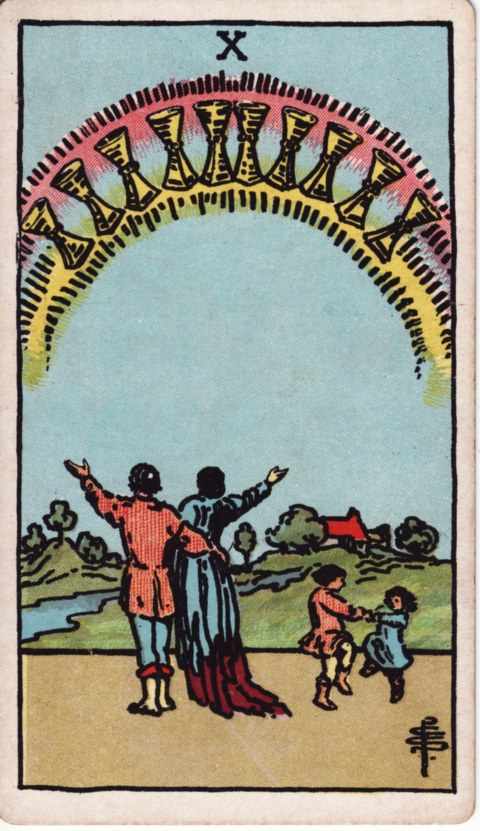
Most cards ask something of you. This one shows what it looks like when the asking stops. Waite opens his list with "Contentment, repose of the entire heart," and nobody in the picture is doing anything: two adults point at the sky, two children dance, the house waits. Tarot.com calls it "the emotional endgame."
Waite's list does not stop at the couple. It runs on to "also perfection of human love and friendship; if with several picture-cards, a person who is taking charge of the Querent's interests; also the town, village or country inhabited by the Querent." The card can then be a place, the neighborhood or country where you belong, or a trusted person looking after your side. The "home-scene beyond" he describes belongs to the card and is more than backdrop.
Book T gives the same idea a different picture and a surprising reason. The happiness is "because inspired from above," and the lotus at the top fills the cups until they "all run over." The card is "Not so sensual" as the Nine, "yet almost more truly happy." The practical reading is that this kind of good is received and passed down from one cup to the next. The reader's job is to keep the channel open, so thank two specific people this week, out loud.
Ten of Cups reversed: false calm, quarrel or just tired?
Reversed, the sources agree on a gap between how things look and how they are. Waite's list is blunt: "Repose of the false heart, indignation, violence," and his short list adds "Sorrow; also a serious quarrel." "False heart" is a moral phrase, and we read it as a calm that is put on. Biddy Tarot's reversed keywords, "Disconnection, misaligned values, struggling relationships.", turn it into distance between people who look fine from the street.
Labyrinthos locates the cause outside the pair and names "meddling relatives" among its reversed love meanings. So a family that disapproves, or a group that expects the happy picture to continue, can be the force behind a reversed Ten. The card does not say who made the gap, and it leaves room for tiredness and an ordinary bad month.
Try a photo test, with a pen. Picture a photo of your household or your group taken this week, then list what it shows and what it hides. If the hidden list is empty, the reversal is probably fatigue or a rough patch, and the remedy is rest. If it holds a topic nobody has said aloud, the card is Waite's "false heart," calm bought with silence. Pick one item and say it to the one person it concerns, in a sentence, without a verdict attached.
If you asked whether a marriage will last, an ex will return or a family will make peace, the card describes how things feel inside the situation. It gives no outcome and no date, and it says nothing of another person's plans. Waite's "serious quarrel" is a period line and a forecast of nothing. Book T's note about drug habits, quoted below, is a matter for a doctor or a counselor; a card is not one.
Is the Ten of Cups a yes or no card?
| Position | Answer |
|---|---|
| Upright | Yes, if it suits the household |
| Reversed | Wait, say the unsaid thing |
Upright, yes, and Tarot.com's page ends its answer in capitals, "YES." The yes fits questions about home, family, belonging and a place to settle. It suits questions about ambition or risk less well, since the card has little to say about them.
Reversed, wait a little. Check what has gone unsaid first. Nobody in the old books wrote a verdict for it, so both answers here come from present-day practice.
Ten of Cups in love and friendship: marriage, family or both?
In a relationship
In a couple it is the settled phase: you are on the same side, the house runs on shared habits, and the question of "are we okay" has gone quiet. Waite's §4 line is for a male Querent, "a good marriage and one beyond his expectations," a period remark about men and marriage. In modern terms it points at a bond that has outgrown what you planned for. One check is worth making: would both of you describe the relationship in the same words?
Single
Single, the card often shows what you want, a home that holds people. It can also mean you already have it through friends, siblings or a chosen family, and love is not the missing piece. Whether anyone is on the way is not in the picture.
As their feelings
As feelings, it means committed, steady affection with a future in it: they picture ordinary years with you, holidays included. Book T ends its list with "according to dignity," so the same card can mean kindness or waste. Judge by how the person behaves on a dull Tuesday.
Friends as family at a holiday table
Waite's list for the Ten of Cups includes "perfection of human love and friendship", so the card may be a table of friends rather than relatives. Picture a holiday with the people you chose: someone brings the pie, someone sleeps on the couch, nobody performs. Upright, that is belonging.
Reversed, the picture is staged. Everyone says how lucky you are while one guest quietly dreads the day. Which guest it is stays hidden. Before the next holiday, ask each guest what they would like the day to look like, and ask the quiet one first.
Reversed in love
Reversed, love looks right and feels wrong: a couple who post the photo and sleep apart, or relatives standing between you. Waite's "indignation, violence" is harsher, and a relationship with fear in it needs a person you trust or a professional; a card cannot help there. If your thoughts are on an ex, the card is about the happy picture you still carry, and what they plan is outside it.
Ten of Cups at work and with money
At work it is belonging: a team where people know each other's lives, a boss who treats you as a person, a job that leaves room for home. Labyrinthos ties the card to colleagues who get along. It is no ambition card. On a promotion question it says only that the setting is sound.
With money, Waite's "also the town, village or country inhabited by the Querent" hints at a home base: property, a mortgage you can carry, family finances that no longer start fights. Treat this as a mood, and take any large decision to a licensed adviser.
If it came up reversed at work, look for a friendly surface over strain: a team that smiles in meetings and complains afterward, or a household budget nobody discusses. Name one unresolved topic and bring it to one person. Do the same with money: one number, said aloud.
Ten of Cups as advice and as a person
As advice, protect what is already good before improving it. Name two things that are working and tell the people involved. Put the next improvement on a list for later.
As a person, imagine a man we'll call Luis, an invented example, who hosts Sunday lunch for his mother, his sister's family and two neighbors without being asked. Nothing remarkable is said. The table is full and the dishes pile up. That is the upright card: whoever keeps such a place going and is glad of how little drama there is. Waite's "a person who is taking charge of the Querent's interests" fits someone like him.
Reversed as advice: stop rehearsing happy and say one true thing. Lower the bar for what counts as a good week, and give the household an ordinary evening with no performance.
How to read the Ten of Cups in a spread
Alone, this card says that what you have may already be enough, so look at it before reaching for more. In a longer spread, the Ten in the past marks a time of belonging, in the present a settled phase worth protecting, and as an outcome contentment, with the caution that an outcome card names a state and gives no date.
Book T's dignity rules include "Wands are inimical to Cups," so a Wands card beside it brings ambition or restlessness into the house. The nearest relation is the Queen of Wands, whose zone contains this card's decan: a Cups card settled under a fire queen. With the Three of Swords nearby, the pair is happiness with a wound still open. Beside the Ten of Pentacles, home and money are both in order.
The Ten of Cups among the Cups
In the Cups the Ten is the end of the numbers. The Ace is a gift from a hand in a cloud, the Nine a contented person alone, and the Ten adds the others. Book T calls the Nine "Lord of Material Happiness" and the Ten "Not so sensual," yet "almost more truly happy": the satisfaction of one becomes the shared happiness of many.
The suit continues past happiness. After the Ten comes the Page of Cups, a first small stir of feeling, so the suit starts over as a person. The Ten asks what you will do with a full cup, and the Page answers that it may begin again.
- Ace of Cups
- Two of Cups · Love
- Three of Cups · Abundance
- Four of Cups · Blended Pleasure
- Five of Cups · Loss in Pleasure
- Six of Cups · Pleasure
- Seven of Cups · Illusionary Success
- Eight of Cups · Abandoned Success
- Nine of Cups · Material Happiness
- Ten of Cups · Perfected Success
- Page of Cups
- Knight of Cups
- Queen of Cups
- King of Cups
Titles after the numbered cards are the Golden Dawn's names for them in Book T.
Symbolism of the Rider–Waite–Smith card
- The rainbow of ten cups. Ten gold cups stand in an arch across the sky, the center ones nearly upright and the outer ones tilting outward. Waite writes "Appearance of Cups in a rainbow." Book T draws something else, cups poured into one another from a lotus, with "The uppermost cup... held sideways by a hand." Smith kept the abundance and removed the hand.
- The raised arms. The man and woman stand with their backs to us. Waite writes "His right arm is about her; his left is raised upward; she raises her right arm." Seen from behind, the viewer looks at the rainbow with them, so the card feels like a shared view.
- The dancing children. Two children dance hand in hand beside the adults. Waite says they "have not observed the prodigy but are happy after their own manner." They suggest that happiness does not have to notice itself to be real.
- The house, river and hills. A small white house with a red roof sits among trees on the right, a blue river winds in from the left and green hills fill the middle ground. Waite calls it "a home-scene beyond." The river can be taken as the water of the suit, flowing past a house instead of through a dream.
- The numeral and the number. The numeral X stands at the top and ten cups fill the arch. Ten is the end of the count, which fits Book T's title "Perfected Success."
What the oldest sources say
“Contentment, repose of the entire heart; the perfection of that state; also perfection of human love and friendship; if with several picture-cards, a person who is taking charge of the Querent's interests; also the town, village or country inhabited by the Querent. Reversed: Repose of the false heart, indignation, violence.”
“For a male Querent, a good marriage and one beyond his expectations. Reversed: Sorrow; also a serious quarrel.”
“Permanent and lasting success and happiness, because inspired from above. Not so sensual as "Lord of Material Happiness," yet almost more truly happy. Pleasure, dissipation, debauchery, quietness, peacemaking. Kindness, pity, generosity, wantonness, waste, etc., according to dignity.”
Waite's lists give the card a wider home than the modern pages do. The upright list covers contentment, love and friendship, a protector, and the place where the Querent lives. He calls the couple "evidently husband and wife," a reading modern pages soften to "couple." The §4 upright line is narrow, "For a male Querent, a good marriage and one beyond his expectations." The reversed lines are short and hard, "Repose of the false heart, indignation, violence" and "Sorrow; also a serious quarrel." That is a sharper reversal than the "meddling relatives" of Labyrinthos or the "Disconnection" of Biddy Tarot.
Book T has a surprise that the leaders skip. In the Equinox printing of 1912 the entry ends with a bracketed note: "This is not such a good card as stated. It represents boredom, and quarrelling arising therefrom; disgust springing from too great luxury. In particular it represents drug-habits, the sottish excess of pleasure and the revenge of nature." We have no source for who wrote the note. Book T's own list already carries the shadow, "Pleasure, dissipation, debauchery," and "wantonness, waste." The note, Waite's "false heart" and the "quarrel" all warn against comfort that has gone stale, and no modern page we checked says so.
Ten of Cups and Mars in Pisces: the card's decan
| Suit and element | Cups, Water (Major Arcana card of water: The Hanged Man) |
|---|---|
| Decan | 20° to 30° ♓︎ Pisces, the third ten degrees of the sign |
| Planet of the decan | Mars (Major Arcana: The Tower) |
| Major Arcana card of Pisces | The Moon |
| Golden Dawn title | The Lord of Perfected Success |
| Place on the Tree of Life | Malkuth (Book T: “Matter settled: complete good fortune”) |
Attributions from Book T (Golden Dawn, c. 1892; printed 1912).
Book T puts the Ten of Cups in the last decan of Pisces, 20 to 30 degrees, under Mars, with the title "Lord of Perfected Success." Mars is the planet of war, and the list for this decan includes "quietness, peacemaking." Our reading is that this is peace kept by a fighter, a calm that someone defends, which fits the old note about comfort turning stale when nobody tends it.
This decan closes the last water sign and the last stretch of the zodiac year. Just past it, at 0° Aries, the year restarts with the Two of Wands, Dominion, also under Mars. Both decans lie inside the Queen of Wands territory, which reaches from 20° Pisces to 20° Aries. The Sun passes through these ten degrees during the last days of winter and exits at the March equinox.
When the Sun is in the Ten of Cups stretch
| Year | Sun enters 20° | Sun leaves (reaches 30° Pisces) |
|---|---|---|
| 2026 | Mar 10 | Mar 20 |
| 2027 | Mar 10 | Mar 20 |
| 2028 | Mar 9 | Mar 19 |
| 2029 | Mar 10 | Mar 20 |
This year the Sun crossed the Ten of Cups stretch of the zodiac (20° to 30° Pisces) from March 10 to March 20, 2026. Next time: March 10 to March 20, 2027 (US Eastern dates).
Dates are US Eastern, from the astronomy-engine ephemeris. Across 35,064 dates from 1930 to 2025, the Sun is in this stretch on 2.7% of them, and at least one of the ten planets is on 22.1%.
By our ephemeris Saturn stood in the decan from February to May 2025 and again from September 2025 to February 15, 2026, and returns in 2054 and 2055; earlier passes were in 1966 and 1967 and in 1995 and 1996. Neptune was there from 2021 to January 2026 with short breaks, and Uranus from 2008 to 2011. Those are sky records and nothing more. To see what stood here on your own birthday, use the chart tool below.
Is the Ten of Cups in your birth chart?
Enter your birth date. We show which of the ten planets stood between 20° and 30° Pisces that day, the slice of sky Book T gives this card; add the time if a planet was near the edge.
Enter your birth date above to see your result.
Every planet, angle and house from your birth time: birth chart calculator.
Questions about the Ten of Cups
Is the Ten of Cups a good card?
Mostly yes: contentment, belonging and a settled home. Book T adds a bracketed note in the 1912 Equinox printing that calls it "not such a good card as stated," a warning against comfort gone stale.
What does the Ten of Cups mean as feelings?
Committed, steady affection with a shared future in it. Book T says the outcome is "according to dignity," so watch behavior on ordinary days. Reversed, the feeling is real but covered by strain.
Does the Ten of Cups mean marriage or family?
It can. Waite's §4 line for a male Querent is "a good marriage and one beyond his expectations," and the card also covers children and home. It is a card of settled belonging and promises no wedding.
What does the Ten of Cups reversed mean?
A happy picture that does not match the feeling. Waite writes "Repose of the false heart, indignation, violence." Say the unsaid thing to one person.
Does the Ten of Cups answer yes?
Upright, yes for home and family questions. Reversed, wait. The old books give no verdicts.
Does the Ten of Cups belong to a sign?
Pisces: the last decan, 20 to 30 degrees, under Mars in Book T. The Queen of Wands zone contains it.
Can the Ten of Cups give a date?
A card names no day. The one calendar fact we can give is how long the Sun stays in this decan, about March 10 to March 20, which marks the decan on the calendar.
Sources
- Astronomy Engine: the open-source ephemeris library behind our planet positions, dates and statistics
- A. E. Waite, The Pictorial Key to the Tarot (1911), Wikisource: the divinatory meanings we quote, upright and reversed
- Book T (Golden Dawn), as printed in The Equinox I:8, 1912: the zodiac sign, Hebrew letter, title and short meaning of each card
- Wikimedia Commons: Rider–Waite–Smith tarot deck: Pamela Colman Smith's 1910 card drawings, public domain
- How we create our readings: our own calculation of sign dates, positions and the 1930 to 2025 statistics
Next to the Ten of Cups
In the suit of Cups: Nine of Cups ← Ten of Cups → Page of Cups.
Pisces on this site: Pisces zodiac sign · The Moon, the card of Pisces · your full birth chart.
All 22 Major Arcana with their signs and planets, and the minor cards written so far: tarot card meanings.
Written by The Zodiac Atlas editorial team with the help of AI and edited by a person. Quotations are from Waite's Pictorial Key to the Tarot and the Golden Dawn's Book T, both in the public domain; the card picture is a 1910 printing of Pamela Colman Smith's drawing for the 1909 deck. Sun dates and planet positions come from the astronomy-engine ephemeris (tropical zodiac). Tarot and astrology are symbolic traditions; they do not predict events.