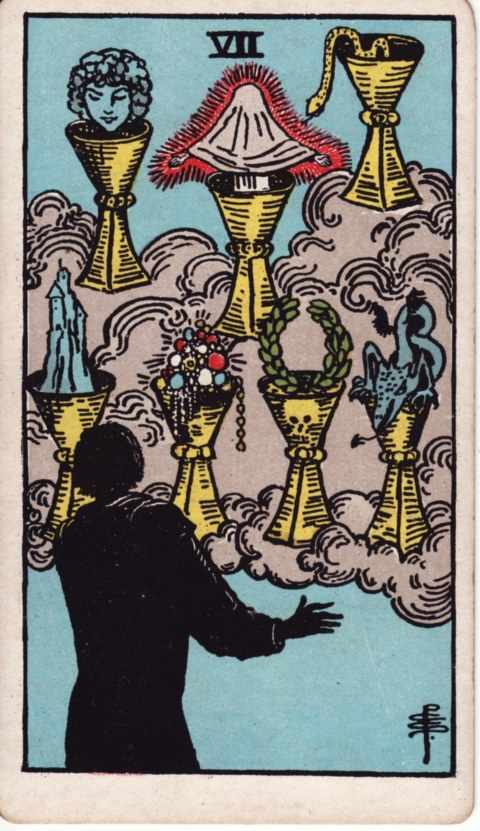
What does the Seven of Cups mean when you must choose?
Bad card? It is a warning with some pleasure in it. Nothing has gone wrong yet. The danger is that nothing will be done. The cups float in the air, so you can enjoy the display, but none of it is on the table. Waite's list says exactly that: "Fairy favours, images of reflection, sentiment, imagination, things seen in the glass of contemplation; some attainment in these degrees, but nothing permanent or substantial is suggested."
Labyrinthos reads the card as "imagination, choice, wishful thinking, illusion and fantasy," and notes it "may imply that you have a number of options to choose from." We would add that the options are not equal. A cup that holds a wreath and a cup that holds a snake look alike from a distance, because every cup is only a picture until someone reaches in.
Think of someone with a spreadsheet of apartments, a tab for each city, three job offers in draft and a plan to "decide Sunday" for the fourth Sunday running. The card does not scold. It names the stage. Biddy Tarot puts the remedy briefly: choose "just one thing" and make it happen.
Seven of Cups reversed: clarity, or paralysis?
Reversed, the card goes two ways, and the second is easy to miss. In the first, the fog lifts: you drop the fantasy that no longer fits, narrow the list, and commit. Tarot.com reads it as "narrowing your options, committing to one path." In the second, you have so many cups in view that you refuse them all, and the pause turns into a way of life.
Waite's reversed list is short: "Desire, will, determination, project." The words describe someone who has stopped looking at the cloud and started pulling a project toward the ground. His §4 line for the reversed card is "Success, if accompanied by the Three of Cups," which hints that success needs company, a person or a group, rather than solo daydreaming.
To tell the two apart with one card, try this. Write down your options and pick the one you would regret dropping most, then do one small, real step for it within two days: send the email, book the visit, pay the deposit. If the step felt like relief, you are in the first reading. If you invented a reason it could not be done this week, you are in the second, and the next card is a smaller step.
If you are asking about a former partner, the card does not decide it. The fantasy cup is a real part of this picture: the version of them you remember is a cup, and the person is somebody else. Reversed, it often says to look at the actual person and the actual facts before you answer.
Is the Seven of Cups a yes or no card?
| Position | Answer |
|---|---|
| Upright | Not yet, check what is real |
| Reversed | Yes, to one chosen thing |
Upright, the Seven of Cups is a not yet. Waite's own list says "nothing permanent or substantial is suggested." Ask again once you have checked what is actually on offer, who benefits, and what the plain facts say. A question about whether a glossy opportunity is real is usually answered by one unflattering detail.
Reversed it turns toward yes, but only for one thing, the one you commit to. Neither classic source speaks to yes or no. These answers are ours and modern.
Seven of Cups in love and friendship: choices, crush, feelings
In a relationship
Inside a couple, the card suggests a daydream competing with the real person: "what if" about an ex, about someone at work, or about the partner you wish you had. Labyrinthos gives the love meaning as "choosing between lovers." Ask which picture you are loyal to, the person or the fantasy.
Single
For someone single, the card describes a crowded field: several people, several possible lives, none yet tested. It can also describe falling for the idea of someone met twice. Spend an ordinary afternoon with the real person before you rank anyone.
As feelings
As someone's feelings, expect mixed signals: real warmth and a head full of other possibilities. They may be idealizing you, or comparing you with a picture. The card calls the feeling unfinished.
Friends who keep promising a trip nobody books
Years of talk about Portugal and no tickets. The Seven of Cups shows a cloud of lovely options with nothing on the table. Book T lists "promises unfulfilled" under it, which describes a habit more than a lie. Upright, you or your friend enjoys the plan more than the trip, so the cloud never has to land on a date.
Reversed, the card turns toward will and a project. The cloud gets a date, or the idea quietly dies. Who is stalling is not shown. Send the group one date and a deposit amount, and see who answers.
Reversed in love
When it comes up reversed about a partner, it can mean a crush or illusion ending and someone choosing a partner on plain terms. It can also mean a person who will not choose at all. If you are the one who keeps everyone waiting, tell them so, and give a date.
Seven of Cups at work and with money
At work the card shows a table full of options: offers, side projects, a new field every month. Biddy Tarot names the habit: "shiny object syndrome." The advice is to pick the one with a deadline and a person waiting on it, and park the rest in a list.
With money the card warns against schemes that sound like a sure thing. Book T adds "promises unfulfilled" to this card, so ask anyone offering you an easy gain to put it in writing. This is not financial advice. Check an offer with a professional.
Seven of Cups as advice and as a person
As advice, the card says look inside the cups. Take the most attractive option and write the cost of it on paper: hours, money, who else is affected. Then do the same for the dull option. The comparison usually makes the choice.
As a person, the Seven of Cups is the friend who always has a plan that is nearly ready. Picture an imaginary woman named Priya with a bakery idea, a coaching idea and a plan to move to Lisbon. All three are good. None has a first customer. The kindest question is "which one starts on Monday?"
How to read the Seven of Cups in a spread
Read by position, the card looks back to a time when options felt endless and nothing was decided. Placed now, it says you are choosing, or dodging the choice. As the outcome it warns of a result that looks bigger than it is, and as advice it asks you to list what is real.
Neighbors tilt the dream. More Cups make it louder. Wands beside it, which Book T labels "inimical to Cups," read as energy that cuts the daydream short and demands action. Swords are friendly to both suits in Book T, so a Swords card brings a clear head to the fog. Pentacles beside it ground the fantasy in a price tag.
Beside the Eight of Cups the dream ends. Someone walks. With the Six of Cups, the fantasy is a memory. With Death, which Book T assigns to Scorpio, an illusion is ending whether you like it or not.
The Seven of Cups among the Cups
In Book T the numbered Cups run through the water signs. The Six, "The Lord of Pleasure," shows lotuses filling the cups with water "not yet full." In the Seven, the lotuses hang over the cups and "no water falls from these into any of the cups, which are all quite empty." So the story of the suit goes from a fountain that has started to a fountain that has stopped.
The Eight picks the thread up: lotuses pour into two cups and the water runs over. Book T makes this the "Lord of Abandoned Success." The Seven sits between: full of promise, with nothing yet poured. Pamela Colman Smith drew visions in the cups instead of empty ones, but the idea stays the same: the cup shows what is hoped for, and the next card says what was done.
- Ace of Cups
- Two of Cups · Love
- Three of Cups · Abundance
- Four of Cups · Blended Pleasure
- Five of Cups · Loss in Pleasure
- Six of Cups · Pleasure
- Seven of Cups · Illusionary Success
- Eight of Cups · Abandoned Success
- Nine of Cups · Material Happiness
- Ten of Cups · Perfected Success
- Page of Cups
- Knight of Cups
- Queen of Cups
- King of Cups
Titles after the numbered cards are the Golden Dawn's names for them in Book T.
Symbolism of the Rider–Waite–Smith card
- The silhouette. A dark figure seen from behind faces the cups. We read it as you at the point of choosing, with nothing yet decided.
- The seven cups in clouds. Waite calls them "Strange chalices of vision." Labyrinthos reads clouds as "dreams, illusions, thoughts and imagination."
- Snake and dragon. Biddy Tarot reads them as gifts that "are not gifts at all; instead, they are curses." Our reading: the danger is in the same row as the prize, and looks alike.
- Jewels, wreath and castle. Our reading: wealth, victory and security. A tidy set, which should make you ask who chose the options.
- The shrouded figure and the head. A covered, glowing figure and a head. Waite offers nothing on them; we read them as the unknown and the person you love or fear.
What the oldest sources say
“Fairy favours, images of reflection, sentiment, imagination, things seen in the glass of contemplation; some attainment in these degrees, but nothing permanent or substantial is suggested. Reversed: Desire, will, determination, project.”
“Fair child; idea, design, resolve, movement. Reversed: Success, if accompanied by the Three of Cups.”
“Possible victory, but neutralized by the supineness of the person: illusionary success, deception in the moment of apparent victory. Lying, error, promises unfulfilled. Drunkenness, wrath, vanity. Lust, fornication, violence against women, selfish dissipation, deception in love and friendship. Often success gained, but not followed up. Modified as usual by dignity.”
Waite wrote two lists. The longer one, in the card's main entry, is about illusion: "images of reflection," "nothing permanent or substantial." The §4 list is brisk by comparison: "Fair child; idea, design, resolve, movement." Together they describe a thought that can still become a plan, which is our best reading of the card.
Book T calls it "The Lord of Illusionary Success" and spells out the weak point: "Possible victory, but neutralized by the supineness of the person." The trouble here is that you do not follow through: "Often success gained, but not followed up." Its list also carries harsher words, among them "Lying, error, promises unfulfilled" and "deception in love and friendship." The modern card is about choosing. Book T's is about winning and then wasting it, which is a different warning.
Seven of Cups and Venus in Scorpio: the card's decan
| Suit and element | Cups, Water (Major Arcana card of water: The Hanged Man) |
|---|---|
| Decan | 20° to 30° ♏︎ Scorpio, the third ten degrees of the sign |
| Planet of the decan | Venus (Major Arcana: The Empress) |
| Major Arcana card of Scorpio | Death |
| Golden Dawn title | The Lord of Illusionary Success |
| Place on the Tree of Life | Netzach (Book T: “Lying, promises unfulfilled; illusion, deception, error; slight success at outset, not retained”) |
Attributions from Book T (Golden Dawn, c. 1892; printed 1912).
Book T gives the Seven of Cups the third decan of Scorpio, 20° to 30°, with Venus as the decan ruler, and its drawing carries the signs of Venus and Scorpio, one above the cups and one below. Scorpio shares its element, water, with the suit. In the Major Arcana, Death goes with Scorpio and The Empress with Venus.
Venus is the planet of wanting, and Scorpio is the sign of intensity and secrets. Our reading is that the pairing fits a card of strong, hidden wishes, with Venus giving the appeal and Scorpio the pull that is hard to admit. Book T says nothing of the kind. The link is ours.
When the Sun is in the Seven of Cups stretch
| Year | Sun enters 20° | Sun leaves (reaches 30° Scorpio) |
|---|---|---|
| 2026 | Nov 12 | Nov 22 |
| 2027 | Nov 12 | Nov 22 |
| 2028 | Nov 11 | Nov 21 |
| 2029 | Nov 11 | Nov 21 |
This year the Sun crosses the Seven of Cups stretch of the zodiac (20° to 30° Scorpio) from November 12 to November 22, 2026 (US Eastern dates).
Dates are US Eastern, from the astronomy-engine ephemeris. Across 35,064 dates from 1930 to 2025, the Sun is in this stretch on 2.7% of them, and at least one of the ten planets is on 27.6%.
The Sun crosses this decan from about November 12 to November 22. By our calculation Neptune, the planet of fog and ideals, stood here from late 1965 to late 1970, with short breaks, and Pluto spent late 1991 to late 1995 here. Saturn last crossed it in 2013 to 2015 and returns in 2043 to 2044.
Is the Seven of Cups in your birth chart?
Enter your birth date. We show which of the ten planets stood between 20° and 30° Scorpio that day, the slice of sky Book T gives this card; add the time if a planet was near the edge.
Enter your birth date above to see your result.
Every planet, angle and house from your birth time: birth chart calculator.
Questions about the Seven of Cups
Is the Seven of Cups a bad card?
Not bad, but a caution. It shows options and wishes that have not yet become anything. Book T calls it the Lord of Illusionary Success, and Waite says "nothing permanent or substantial is suggested."
What does the Seven of Cups mean for choices?
There is a lot on offer and not all of it is real. List what each option costs, then pick one and take a small real step on it.
Does the Seven of Cups mean cheating?
It can describe temptation and fantasy about other people. Book T lists "deception in love and friendship," though a single card proves nothing.
What does the Seven of Cups mean as feelings?
Mixed feelings and an idealized picture. The person may like you and also be imagining other lives.
Is the Seven of Cups yes or no?
Not yet when upright, since the offer needs checking. Reversed it is a yes to one thing. The old sources give cards no such values, so these are modern answers.
What zodiac sign is the Seven of Cups?
Scorpio, in the last ten degrees of the sign, 20° to 30°, ruled by Venus in Book T. The Sun moves through it between about November 12 and 22.
When will it happen, if I draw the Seven of Cups?
Nothing on the card fixes a time. The site borrows the Sun's stay in the decan, November 12 to 22, as a rough window that forecasts nothing.
Sources
- Astronomy Engine: the open-source ephemeris library behind our planet positions, dates and statistics
- A. E. Waite, The Pictorial Key to the Tarot (1911), Wikisource: the divinatory meanings we quote, upright and reversed
- Book T (Golden Dawn), as printed in The Equinox I:8, 1912: the zodiac sign, Hebrew letter, title and short meaning of each card
- Wikimedia Commons: Rider–Waite–Smith tarot deck: Pamela Colman Smith's 1910 card drawings, public domain
- How we create our readings: our own calculation of sign dates, positions and the 1930 to 2025 statistics
Next to the Seven of Cups
In the suit of Cups: Six of Cups ← Seven of Cups → Eight of Cups.
Scorpio on this site: Scorpio zodiac sign · Death, the card of Scorpio · your full birth chart.
All 22 Major Arcana with their signs and planets, and the minor cards written so far: tarot card meanings.
Written by The Zodiac Atlas editorial team with the help of AI and edited by a person. Quotations are from Waite's Pictorial Key to the Tarot and the Golden Dawn's Book T, both in the public domain; the card picture is a 1910 printing of Pamela Colman Smith's drawing for the 1909 deck. Sun dates and planet positions come from the astronomy-engine ephemeris (tropical zodiac). Tarot and astrology are symbolic traditions; they do not predict events.