Four of Cups upright: bored, or just full?
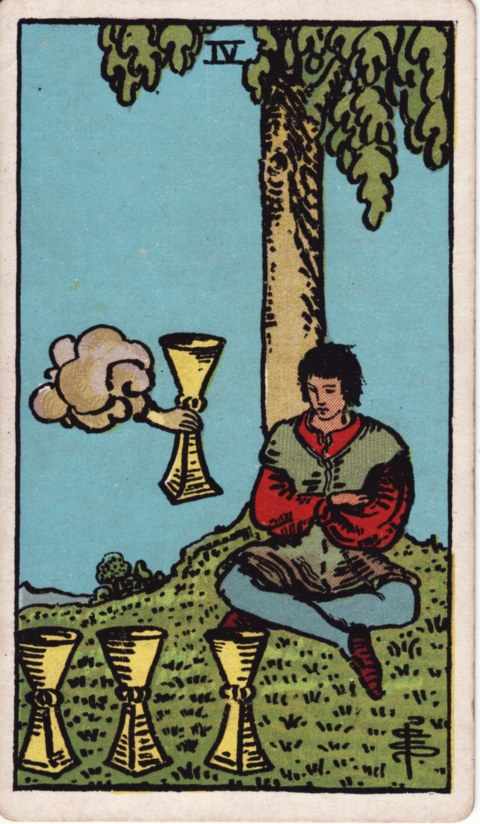
Waite's picture line is exact about the mood: "A young man is seated under a tree and contemplates three cups set on the grass before him; an arm issuing from a cloud offers him another cup. His expression notwithstanding is one of discontent with his environment." He has three cups and a fourth is on offer. The card asks why that is not enough. Labyrinthos puts the usual modern answer as our "tendency to take for granted the things that we have." For work or money, take the offer or invitation you have not answered, write down what it would cost and give, and send a yes or a no by Friday.
Waite's own explanation is different. His upright entry begins "Weariness, disgust, aversion, imaginary vexations, as if the wine of this world had caused satiety only." The man is full; nobody has wounded him. He has had a lot, and he calls the figure "the wastrel," someone who has spent his pleasures. The new cup is "as if a fairy gift," and "he sees no consolation therein." Waite adds that it is "also a card of blended pleasure," a line that sits nearer Book T than any blog: good things with some discomfort in them.
So the question under this card is which kind of bored you are. If you have had plenty and nothing tastes, that is Waite's satiety, and the fix is rest or a different kind of cup. If you got hurt once and closed up, that is the modern reading, and the fix is a slow, small step toward the open hand. The card does not say which. You do.
Four of Cups reversed: looking up, or hiding for good?
Reversed, Waite gives a plain turn: "Novelty, presage, new instruction, new relations." The man looks up. Something new reaches him, a lesson or a person, and the bored mood breaks. Labyrinthos gives the same direction. For work and money, when the card comes up reversed, check whether an offer you wrote off has a deadline you missed, and make one call about it this week.
To tell new interest from a retreat that has become a habit, run the Tuesday test. Think of the last three evenings and write, for each one, what you did and whether anything in it was a choice. If nothing is on the list, or every line says "scrolling" or "nothing," you are in the withdrawn side of the card. If one line holds something unplanned that pleased you, a call, a walk to a new place or a book you picked up, that is the novelty in Waite's line, and it is worth repeating on Thursday. Either result is only a reading of this week.
Waite's second pass has a single word for the reversed card, "Presentiment." It is an odd word to attach to a card of boredom: a feeling that something is about to happen before it does. Take it as a mood and nothing more. It gives no event and no date.
Asking about an ex, or about someone who has gone quiet? The card says nothing about them. It describes where your own attention is: on what is in your hands, or on what has been offered. Their decision is not in the picture.
Is the Four of Cups a yes or no card?
| Position | Answer |
|---|---|
| Upright | Not yet |
| Reversed | Yes, after a look |
Upright, we read the Four of Cups as not yet. The man has not accepted the fourth cup, and a yes given from boredom tends to go sour. Labyrinthos is blunter, saying the card "leans towards a no response." That is modern habit, since no old text gives a verdict.
Reversed, the answer turns to yes once you look up. Waite's "new relations" and "new instruction" point toward taking what is offered. Check the offer for yourself first, since a refusal that has lasted three weeks tends to need a reason said out loud.
Four of Cups in love and friendship: cold feelings or a missed offer?
In a relationship
For a pair, the card is flatness. Nothing is wrong, and nothing feels new. Book T's line fits: "It does not mean love and marriage so much as the previous symbol." The previous symbol is the Three of Cups, full of abundance, so this card is the morning after the party. Before deciding anything big, ask whether you are bored of the person or of the routine, and try changing one thing together.
Single
Single, the card describes someone who is not dating because nothing appeals, or because an earlier hurt made folding the arms easier. The fourth cup stands for an invitation, a friend's introduction or an old acquaintance who is still there. Accept one, for an hour, and see whether the boredom was real or a habit.
As feelings
When it stands for a partner's mood, the Four of Cups is disinterest or distance. They may be tired, discontented, or busy with their own head. Tarot.com is careful about it: it is "overwhelm disguised as apathy." That fits the picture of a man full of cups, and nothing says he is cold toward you. Ask directly and leave space for a reply.
A friend who has declined four invitations in a row
Your friend has turned down your last four invitations, and you are starting to take it personally. The Four of Cups shows a man with folded arms and a cup held out to him. Upright, it reads as weariness: he is full or low, and the offer lands on the wrong day. Reversed, the arms unfold, or the withdrawal outlasts everyone's patience.
Which side your friend is on, the card cannot say. Book T's own phrase is "a stationary period in happiness, which may, or may not, continue." Send one line saying the offer stands for Saturday and needs no answer. Then do not count replies.
Reversed in love
Upside down, the card can mean the mood is lifting: new interest in a partner, or in someone new. It can also mean withdrawal that has gone on long enough that the other person has started to feel it. Whether an old partner returns is their call, and the card shows only your side of the tree.
Four of Cups at work and with money
Inside a career, the card fits someone who has had the job long enough to be bored by it, or who is being offered new projects and cannot get interested. Waite's "satiety" is the careful word: the man has had enough of this particular cup, and that is a different thing from failure. Ask whether you need a different role, a rest, or only a different task inside the same job. On money, the card suits a pause on new spending and a look at what is already owned. It makes no promise about income.
Reversed at work, the stale mood lifts: a task, a colleague or a course gets your interest back. If you are the one refusing, check the deadline on the offer you ignored. Do not leave a job during the week the card shows boredom; wait until the answer survives a good night's sleep.
Four of Cups as advice and as a person
Taken plainly, look up before you decide. Sit with the dull mood for a set time, then look at the cup in front of you and ask what it would cost to say yes. Set a limit of one day. Book T's "stationary period in happiness, which may, or may not, continue" is a fair account of how long the stall can run.
As a person, the Four of Cups is the one who has enough and is not impressed. Here is an invented case: Dev has a stable job, a flat and friends who keep asking him out, and he answers every invitation with "maybe." He is full, and slow to reach. Reversed as advice: say yes to one small thing this week, such as a dinner or a class, and see whether you still feel flat afterward.
How to read the Four of Cups in a spread
With one card, the Four of Cups says you are looking at what you have and ignoring what is offered. Ask what the fourth cup is in your life, and whether you have really looked at it.
Drawn for the past, it marks a stretch of boredom or withdrawal that colored the question. Placed in the present, you are in the pause. As the outcome, it points to a stall and to an offer that waits. A Wand beside it jars the pause and makes the mood restless, as Book T's "Wands are inimical to Cups" would predict. A Sword brings the facts and a Pentacle the practical side of the offer. After the Three of Cups the party is over; before the Five of Cups the dullness is about to turn into loss. Beside The Chariot, the trump for Cancer, the stall gets a driver.
The Four of Cups among the Cups
In Book T the Cups tell a story in water. In the Three "All the cups overflow," and the water falls from the top cup to the lower ones. In the Four, "the two upper overflowing into the two lower, which do not overflow." The water still runs, but it stops short. The Five goes dry: "neither is there water in any of the cups."
That makes the Four the point where the flow thins: the Three is full, the Five is dry, and the Four is a stall with some water left, "Success or pleasure approaching their end." Smith's picture shifts the story to a man who is not pouring at all. Where Book T draws a fountain slowing, Smith draws a person who has stopped drinking. That shift is ours to point out, since neither source says it.
- Ace of Cups
- Two of Cups · Love
- Three of Cups · Abundance
- Four of Cups · Blended Pleasure
- Five of Cups · Loss in Pleasure
- Six of Cups · Pleasure
- Seven of Cups · Illusionary Success
- Eight of Cups · Abandoned Success
- Nine of Cups · Material Happiness
- Ten of Cups · Perfected Success
- Page of Cups
- Knight of Cups
- Queen of Cups
- King of Cups
Titles after the numbered cards are the Golden Dawn's names for them in Book T.
Symbolism of the Rider–Waite–Smith card
- The folded arms. The young man sits with his arms folded across his chest and his head bowed. Waite's picture line gives "discontent with his environment" and does not mention the arms. The arms read as a shut door.
- Three cups on the grass. Three gold cups stand in a row on the grass in front of him. Waite says he "contemplates three cups set on the grass." These are what he has already. Book T has four cups and no figure, so the three-and-one split comes from Waite and Smith.
- The hand and the fourth cup. A hand reaches out of a cloud with a fourth cup. Waite calls it "an arm issuing from a cloud." He is not looking at it. The same cloud-hand holds the cup in the Ace of Cups, which is our observation.
- The tree. He sits under a tree whose leaves hang over him like a roof. Waite names the tree and nothing else about it. Shelter is the plain sense of it, and shelter can turn into hiding.
- The empty hillside. Behind him the grass slopes away to a sliver of distant hills at the left edge, with no road and no other person. Nobody else is in the scene, which suits a card about attention.
What the oldest sources say
“Weariness, disgust, aversion, imaginary vexations, as if the wine of this world had caused satiety only; another wine, as if a fairy gift, is now offered the wastrel, but he sees no consolation therein. This is also a card of blended pleasure. Reversed: Novelty, presage, new instruction, new relations.”
“Contrarieties. Reversed: Presentiment.”
“Success or pleasure approaching their end. A stationary period in happiness, which may, or may not, continue. It does not mean love and marriage so much as the previous symbol. It is too passive a symbol to represent perfectly complete happiness. Swiftness, hunting and pursuing. Acquisition by contention: injustice sometimes; some drawbacks to pleasure implied.”
Waite's lists for this card point in two directions. The main entry is a mood: "Weariness, disgust, aversion, imaginary vexations." The word "imaginary" matters, since he says the troubles are not real ones. The reversed line is hopeful, "Novelty, presage, new instruction, new relations." The second pass is two words, "Contrarieties" upright and "Presentiment" reversed. Put together, Waite sees a man whose complaint is of his own making, and a card that turns when something new reaches him.
Book T draws no man. It draws four cups, a lotus branch and a white water that flows into the top two. The meaning list opens on "Success or pleasure approaching their end," then calls the symbol "too passive" for "perfectly complete happiness." Then it adds "Swiftness, hunting and pursuing. Acquisition by contention: injustice sometimes." Those last lines have no counterpart in the picture or in modern guides. The Golden Dawn text is about pleasure that has stalled, and the folded arms are Smith's.
Four of Cups and Moon in Cancer: the card's decan
| Suit and element | Cups, Water (Major Arcana card of water: The Hanged Man) |
|---|---|
| Decan | 20° to 30° ♋︎ Cancer, the third ten degrees of the sign |
| Planet of the decan | Moon (Major Arcana: The High Priestess) |
| Major Arcana card of Cancer | The Chariot |
| Golden Dawn title | The Lord of Blended Pleasure |
| Place on the Tree of Life | Chesed (Book T: “Receiving pleasure or kindness from others, but some discomfort therewith”) |
Attributions from Book T (Golden Dawn, c. 1892; printed 1912).
The last ten degrees of Cancer, 20° to 30°, go to the Four of Cups in Book T, with the Moon in charge: "Above and below are the symbols Moon and Cancer for the Decan." Cancer and Cups both belong to water. Tradition gives the Moon rule over Cancer, so it holds its home sign here; Book T leaves that unsaid. The Major Arcana card of the sign is The Chariot, of the Moon The High Priestess, and of water The Hanged Man.
Its sphere, Chesed, is glossed "Receiving pleasure or kindness from others, but some discomfort therewith." That is a closer description of the picture than "apathy": a cup is being offered by someone, and the receiver is uneasy. These ten degrees fall inside the King of Wands' stretch of sky, which opens at the end of Cancer. The Sun crosses it between about July 12 and July 22, the last days of Cancer.
When the Sun is in the Four of Cups stretch
| Year | Sun enters 20° | Sun leaves (reaches 30° Cancer) |
|---|---|---|
| 2026 | Jul 12 | Jul 22 |
| 2027 | Jul 12 | Jul 22 |
| 2028 | Jul 11 | Jul 22 |
| 2029 | Jul 11 | Jul 22 |
This year the Sun crossed the Four of Cups stretch of the zodiac (20° to 30° Cancer) from July 12 to July 22, 2026. Next time: July 12 to July 22, 2027 (US Eastern dates).
Dates are US Eastern, from the astronomy-engine ephemeris. Across 35,064 dates from 1930 to 2025, the Sun is in this stretch on 2.9% of them, and at least one of the ten planets is on 25.3%.
Saturn's earlier stays here ran 1975 to 1976 and 2004 to 2005 by our ephemeris, and it comes back in 2033 to 2035, with breaks. Uranus was there from 1953 to 1956 and comes back from 2037 to 2040. Jupiter was in it from May 10 to July 1, 2026, and returns in 2037 and 2038. None of this predicts anything.
Is the Four of Cups in your birth chart?
Enter your birth date. We show which of the ten planets stood between 20° and 30° Cancer that day, the slice of sky Book T gives this card; add the time if a planet was near the edge.
Enter your birth date above to see your result.
Every planet, angle and house from your birth time: birth chart calculator.
Questions about the Four of Cups
Is the Four of Cups a bad card?
The Four of Cups meaning is closer to flat than bad. Waite lists "Weariness, disgust, aversion," but also calls it "a card of blended pleasure." Book T says "some drawbacks to pleasure implied." The mood is the warning, and the fourth cup is the way out.
What does the Four of Cups mean as feelings?
Boredom, distance or discontent. The person may be tired or full of their own thoughts. It does not say they dislike you. Ask them, and leave room for the answer.
Is the Four of Cups a yes?
Upright, it leans to not yet. Reversed, it says yes, once you look at the offer. No verdict comes from the old texts, so this is a modern convention.
What does the Four of Cups reversed mean?
Waite's list is "Novelty, presage, new instruction, new relations," so interest returns. It can also be a long withdrawal. Write down what you chose in the last three evenings and see which one fits.
Can the Four of Cups say whether an ex will return?
No. The card describes your attention and mood, and no one else is in the picture. Whether anyone returns is up to them.
What zodiac sign is the Four of Cups?
Cancer, at 20° to 30°, with the Moon in charge. The Sun sits in that span between about July 12 and July 22.
When will the mood lift after the Four of Cups?
The card names no day. For a calendar, the Sun crosses its decan around July 12 to 22 each year, a convention that is no measure of your own timing. Book T calls the state "a stationary period in happiness, which may, or may not, continue," which suggests it ends when you look up.
Sources
- Astronomy Engine: the open-source ephemeris library behind our planet positions, dates and statistics
- A. E. Waite, The Pictorial Key to the Tarot (1911), Wikisource: the divinatory meanings we quote, upright and reversed
- Book T (Golden Dawn), as printed in The Equinox I:8, 1912: the zodiac sign, Hebrew letter, title and short meaning of each card
- Wikimedia Commons: Rider–Waite–Smith tarot deck: Pamela Colman Smith's 1910 card drawings, public domain
- How we create our readings: our own calculation of sign dates, positions and the 1930 to 2025 statistics
Next to the Four of Cups
In the suit of Cups: Three of Cups ← Four of Cups → Five of Cups.
Cancer on this site: Cancer zodiac sign · The Chariot, the card of Cancer · your full birth chart.
All 22 Major Arcana with their signs and planets, and the minor cards written so far: tarot card meanings.
Written by The Zodiac Atlas editorial team with the help of AI and edited by a person. Quotations are from Waite's Pictorial Key to the Tarot and the Golden Dawn's Book T, both in the public domain; the card picture is a 1910 printing of Pamela Colman Smith's drawing for the 1909 deck. Sun dates and planet positions come from the astronomy-engine ephemeris (tropical zodiac). Tarot and astrology are symbolic traditions; they do not predict events.