What does the Ace of Swords mean when you must decide?
Upright, the Ace of Swords marks the moment a matter stops being fog. Waite's list opens with "Triumph, the excessive degree in everything, conquest, triumph of force," and then tells you where the weight lies: "It is a card of great force, in love as well as in hatred." Nothing in that list is mild. The sword can finish a quarrel or start one, and it does so quickly.
The crown is the part to watch. Waite adds that it "may carry a much higher significance than comes usually within the sphere of fortune-telling," which tells you he thought of this Ace as more than a sharp idea. Labyrinthos gives the everyday version, that this sword "has the ability to cut through deception and find truth." Put plainly: decide the thing and say it.
Book T pairs the force with a condition. Its sword is raised toward "the Divine crown of Spiritual Brightness," and the card is "the affirmation of Justice upholding Divine Authority." So the upright reading carries a standard. A clear mind is worth the most when it cuts toward something fair, and the same blade swung for pride is a different card.
Ace of Swords reversed: fog, or a blade pointed the wrong way?
Reversed, the sources split into two readings. Waite's is short: "The same, but the results are disastrous." He then adds another account of births and increase, "conception, childbirth, augmentation, multiplicity," which has little to do with the first half. Book T goes further. Raised upward, the sword invokes the Divine crown, "but reversed it is the Invocation of Demonic Force; and becomes a fearfully evil symbol." Reading "reversed" as a sword held point down is our inference, but it is the plainest one.
The modern pages mostly read it as fog. Tarot.com warns of tangled words and a brilliant idea that "might come out sounding more like a rant." The two readings fit together: a blade pointed the wrong way, or swung too soon, produces the damage and the tangle. The reversed Ace keeps its force and loses its target.
One test fits a single-card pull. Finish the sentence "I am about to cut ___." Whatever fills the blank is the target, and the test is whether it is the problem or a person near the problem. If you wrote a thing, such as a plan, a habit or a clause in a contract, the blade is aimed well and you can wait for a calmer hour to use it. If you wrote a name, hold the message you were about to send until tomorrow and check what you know against what you assume.
Asking about pregnancy? Waite's "conception, childbirth" sits in the reversed line, and a card cannot say whether it applies to you. Only a test or a clinic visit settles it. If the question is an ex or an apology, the card speaks for your own sharpness and says nothing about his choices.
Is the Ace of Swords a yes or no card?
| Position | Answer |
|---|---|
| Upright | Yes, decisively |
| Reversed | Not yet, check your aim |
Upright, yes, for questions about deciding, speaking up or starting something that needs a clear head. Tarot.com is blunt: "the answer is YES." That yes covers the cut; where it lands depends on who holds the blade.
Reversed, not yet. Either the aim is off or the truth is being avoided. Neither old source pairs this card with an answer, which makes both of these modern habit and worth holding loosely.
Ace of Swords in love and friendship: the honest talk, their feelings, single
In a relationship
In a couple, the Ace of Swords points to the conversation that has been put off. It favors plain statements over hints: what you want, what bothers you, what you will no longer do. Waite's "great force, in love as well as in hatred" is the caution. A true thing said in anger lands as a blow, so pick the hour and keep it to one subject.
Single
Single, the card shows a clear idea of what you want and what you will not accept, often after a muddled stretch. It suits honest profiles, direct invitations and ending a thing that has been dragging. No person arrives with it. It marks the day you stop guessing and start choosing.
As feelings
As someone's feelings, it describes a person who has made up their mind and is not hiding it. That may be warm, or it may be a decision to end something. The card shows sharp clarity and says nothing about which way it points. Ask, and weigh what they say against what they do.
A friend who takes and never gives
This Ace is the sentence you have been putting off. Waite puts it as "great force, in love as well as in hatred," and a friend who always borrows, cancels or leaves the planning to you is where that force belongs. Say the plain version once, without a speech: what has to change, and what you still want from them.
Reversed, the blade swings wrong. You send a cutting text at midnight, or you hint forever and never make the actual request. Write your one sentence and read it twice for tone. Send it after a night's sleep.
Reversed in love: when words cut
Reversed in love, words are the risk: a cold message, a remark made to win, a truth used as a weapon. Book T's "Sword of Wrath, Punishment, and Affliction" is the old name for a blade put to that use. It can also be the opposite, a clarity you know you need and keep postponing. Ask which of the two is yours before you speak.
Ace of Swords at work and with money
At work the Ace is a decision, a diagnosis or a clean first draft. It favors writing, analysis, law, medicine, code and any job where precision counts. Bring the one fact that settles the question into the room. Cut a plan down to what it must do.
On money, it means look at the figures and decide. Remove one cost, challenge one line in a contract, or say a number aloud in a negotiation. A decision made from the statement, not from the mood, is the kind this card backs.
Reversed at work, the idea is sound and the delivery is wrong, or a rash email is waiting to be sent. Reread before sending. Reversed on money, check the document you were about to sign for the clause you did not read, and do not act on a half-understood number.
Ace of Swords as advice and as a person
As advice, the card says decide, then say it plainly. Pick the single matter you have been circling, write the decision in one sentence and act on it within the day, while the picture is clear.
As a person, it is the straight talker: the editor who cuts a chapter to its core, or the friend who tells you what you already know. Our invented example: Priya, a project manager who ends a stalled project in a ten-minute call and is thanked for it a month later. Reversed as advice, put the blade down for a day. Reread the message before it goes out, and ask whether the point can be made without a wound. At work, that means drafting the reply and sending it tomorrow.
How to read the Ace of Swords in a spread
With one card, the Ace of Swords says the matter needs a clear cut: decide, and say the plain version of it. Behind you, it marks the day a truth came out or a decision was made. In the middle, the blade is in your hand. At the end of a spread it promises a decisive moment, hard or welcome, without saying which.
Book T's dignity rules favor Cups and Wands here: Cups give the truth some warmth, and Wands push the decision into action. Pentacles are the awkward neighbor, and a Pentacles card nearby suggests the cost of the cut in money, work or home. Beside the Ace of Wands, Book T's pair is invoked and natural force: the decision you make against the impulse that arrived on its own. With the Three of Swords, a truth that hurts. With the Two, a decision that ends a standoff.
The Ace of Swords among the Swords
The Ace opens the suit, and its Book T title differs in kind from the numbered cards. Those are Lords of a quality; this one is the root of all air. What follows is the working out of a single blade. The Two holds peace with swords drawn, the Three cuts a rose, and the Five and Six carry Defeat and then Earned Success.
Seen from the Ace, the Swords tell one story: a clean decision at the start, and then what thinking costs when it has to live in the world. Some of that cost is sorrow, some is despair, and the Ten is ruin. The Ace is the only Sword that has not yet struck anything.
- Ace of Swords
- Two of Swords · Peace Restored
- Three of Swords · Sorrow
- Four of Swords · Rest from Strife
- Five of Swords · Defeat
- Six of Swords · Earned Success
- Seven of Swords · Unstable Effort
- Eight of Swords · Shortened Force
- Nine of Swords · Despair and Cruelty
- Ten of Swords · Ruin
- Page of Swords
- Knight of Swords
- Queen of Swords
- King of Swords
Titles after the numbered cards are the Golden Dawn's names for them in Book T.
Symbolism of the Rider–Waite–Smith card
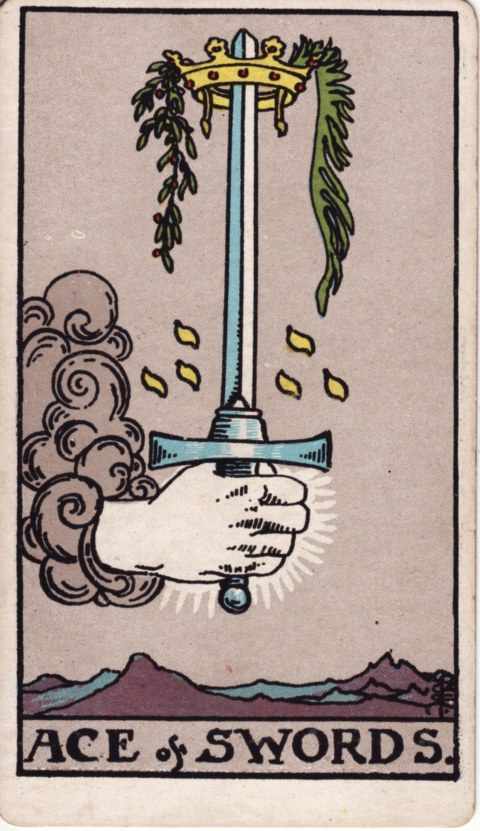
- The fist and the cloud. A hand comes out of a cloud on the left and grips the hilt, with the back of the fist toward you. Book T calls it "A WHITE Radiating Angelic Hand." It is a gift of force that no named person hands over.
- The crown on the point. Waite says "the point of which is encircled by a crown." Book T calls it a "White Radiant Celestial Crown" and gives the raised sword a goal: "the Divine crown of Spiritual Brightness." The blade is lifted toward something above itself.
- Olive and palm. On Smith's card the olive branch hangs on the left side as you look at it and the palm on the right. Book T names them "the olive branch of Peace; and ... the palm branch of suffering," and puts them on the right and left. The sides are swapped from the viewer's view, so Book T may be describing the card's own sides. Suffering beside peace is a stricter pairing than the usual victory reading.
- The six drops. Six yellow drops fall beside the blade, three on each side. Book T writes "Six Vaus fall from its point." Waite does not mention them. Whatever they stand for, they show something descending from the blade.
- The bare purple mountains. A strip of jagged purple mountains lies below the sword. Biddy Tarot reads such peaks as a hard road ahead, but Waite and Book T say nothing of them. The sword rises from empty ground, a plain stage for one act.
What the oldest sources say
“Triumph, the excessive degree in everything, conquest, triumph of force. It is a card of great force, in love as well as in hatred. The crown may carry a much higher significance than comes usually within the sphere of fortune-telling. Reversed: The same, but the results are disastrous; another account says—conception, childbirth, augmentation, multiplicity.”
“Great prosperity or great misery. Reversed: Marriage broken off, for a woman, through her own imprudence.”
Waite's upright list reads as a single idea: force, in every degree. "The excessive degree in everything" is a strange phrase for a good card, and he leaves it unexplained. The short list is more direct, "Great prosperity or great misery," and nothing in the picture decides between the two. Reversed, "Marriage broken off, for a woman, through her own imprudence" is a period remark about rash words. We would read it as a warning about speaking before thinking and leave the marriage and the gender out.
Book T is the richer source here, and the template does not print its paragraph for an Ace. It says the card symbolizes "Invoked," as contrasted with Natural Force: "for it is the Invocation of the Sword." It also gives "whirling Force, and strength through trouble." Leaders skip the palm of suffering, and it makes the Ace stricter than a bright idea, since the breakthrough carries a price from the start.
Ace of Swords and Air
| Suit and element | Swords, Air (Major Arcana card of air: The Fool) |
|---|
Attributions from Book T (Golden Dawn, c. 1892; printed 1912).
No sign or decan belongs to the Ace of Swords. In Book T the numbered cards get ten degrees each, and the Aces are kept apart: "The Ace of Swords is called the Root of the Powers of Air." Book T puts all four Aces "on the North Pole of the Universe" and has them turn as the sky turns. Air is the element, and The Fool is the Major Arcana card for air.
Book T makes the Princess of Swords the throne of this Ace (the Equinox printing misreads it as the Ace of Wands) and sets the Princesses over the four quarters of the heavens around the pole. On this site she is the Page of Swords, so the youngest court card holds the seat under the sword. The Ace is the source from which the numbered Swords draw their edge.
Air stands for mind and speech in the Golden Dawn scheme, and the numbered Swords share it out among Libra, Aquarius and Gemini, three cards each. The Ace stands under all nine as the common source. For a tie to the sky, it suits any air-sign birthday, though that link is ours and Book T never draws it.
Questions about the Ace of Swords
Is the Ace of Swords a good card?
Mostly yes, for clarity and decisions. The Ace of Swords meaning is power with a condition. Waite's short list says "Great prosperity or great misery," and Book T calls the sword power for "good or evil." It depends on how the blade is used.
What does the Ace of Swords mean as feelings?
A person who is clear about what they feel and ready to say it. It may be warm or it may be a decision to end something. Reversed, the words may come out harsh or confused.
Will the Ace of Swords give me a yes?
Upright, for deciding and speaking up, yes. Reversed, not yet. Waite and Book T give it no verdict, so the pairing is modern habit.
Does the Ace of Swords mean pregnancy?
Waite's reversed line includes "conception, childbirth, augmentation, multiplicity," so the idea has an old source. Whether you are pregnant is something only a test or a clinic visit can settle.
Does the Ace of Swords reversed mean a lie is coming out?
It can describe a truth that has been dodged, and the card is quiet about who is hiding it. The better use is to ask what you have avoided saying or reading yourself.
Which sign does the Ace of Swords belong to?
None. Book T keeps the Ace outside the zodiac, as the source of every air card. Air is its element, which points loosely at Gemini, Libra and Aquarius.
How soon does the Ace of Swords take effect?
Tarot gives no dates for it. The decision it describes is one you can make now.
Sources
- Astronomy Engine: the open-source ephemeris library behind our planet positions, dates and statistics
- A. E. Waite, The Pictorial Key to the Tarot (1911), Wikisource: the divinatory meanings we quote, upright and reversed
- Book T (Golden Dawn), as printed in The Equinox I:8, 1912: the zodiac sign, Hebrew letter, title and short meaning of each card
- Wikimedia Commons: Rider–Waite–Smith tarot deck: Pamela Colman Smith's 1910 card drawings, public domain
- How we create our readings: our own calculation of sign dates, positions and the 1930 to 2025 statistics
Next to the Ace of Swords
In the suit of Swords: Ace of Swords → Two of Swords.
All 22 Major Arcana with their signs and planets, and the minor cards written so far: tarot card meanings.
Written by The Zodiac Atlas editorial team with the help of AI and edited by a person. Quotations are from Waite's Pictorial Key to the Tarot and the Golden Dawn's Book T, both in the public domain; the card picture is a 1910 printing of Pamela Colman Smith's drawing for the 1909 deck. Sun dates and planet positions come from the astronomy-engine ephemeris (tropical zodiac). Tarot and astrology are symbolic traditions; they do not predict events.