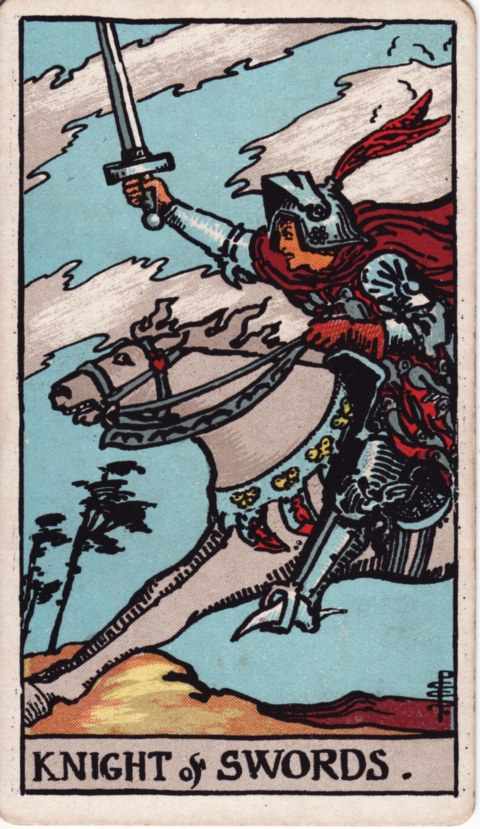
Knight of Swords upright: bold, or just in a hurry?
Is the Knight of Swords a good card? It is a strong one, and strong cuts both ways. Waite draws him "riding in full course, as if scattering his enemies" and then says "He might almost be Galahad, whose sword is swift and sure because he is clean of heart." Skill and bravery lead his list: "Skill, bravery, capacity, defence, address." The rest of the list is darker: "enmity, wrath, war, destruction, opposition, resistance, ruin."
That split is the card. In a good week it is the person who says the hard thing clearly, sends the application, finishes the argument and acts while others are still discussing. Biddy Tarot compresses it to "once he has his mind set on something, nothing is stopping him." Tarot.com is blunter: speed without strategy turns a mission into a mess. Both describe a rider who has chosen a direction and has no brakes.
Waite adds a line that surprises people: the card "signifies death" only "in its proximity to other cards of fatality." Alone it does not. It means an attack, a defence, a quarrel taken to the end, or a rush at a goal, and the question to ask is what is in front of the horse.
Knight of Swords reversed: what is the card telling you to stop?
Knight of Swords reversed has three readings, and a one-card pull does not say which one applies. Waite's short list is "Imprudence, incapacity, extravagance": a charge made without the skill or the means to finish it. Labyrinthos reads it as the knight who has "a lot of energy but lacks any kind of direction." The third is the hard-edged one. The same site lists "rude, tactless, forceful, bully" among its reversed keywords. Sort yourself into one of these before you act on the card.
The first reading is scattered aim. Biddy Tarot gives the picture: "Your thoughts are scattered, and you are constantly changing your mind." Three projects started, none finished, the group chat full of plans. The second is blocked energy, also from Biddy Tarot: you are "growing restless and frustrated because you want to take action, but something is holding you back." The horse is saddled, the road is closed. The third is the sharp tongue: winning the argument at the price of the person. The extra line in Waite's second list for the reversed card, "Dispute with an imbecile person; for a woman, struggle with a rival, who will be conquered," is a period phrase. It means a quarrel with someone you judge beneath you, and the promise that the rival "will be conquered" is a period phrase, so nobody should take it as a forecast.
A self-test with one card and a pen: finish two sentences in one line each. "I am riding at ..." and "The person this will land on is ..." If you cannot finish the first, the card is scattered aim, and the fix is to pick a single target and drop the rest for a week. If the first comes at once and the second takes you a long time, or names someone you would rather not name, the card is the sharp-tongue reading, and the remedy is to reword it before you say it. If both answers come quickly and the road is simply shut, the card is blocked energy: move the push into something physical or into a plan, and wait for the opening.
People often bring this card reversed to questions about an ex or a decision someone else has to make. The card cannot say whether a person will come back, reply or apologize. It describes your speed and your temper in the situation. If you are drafting a long message at midnight, that is the reversed knight in the room. Another rider's intentions are outside the picture, and the useful move is to ask what you would do if no answer came.
Is the Knight of Swords a yes or no card?
| Position | Answer |
|---|---|
| Upright | Yes, fast |
| Reversed | Slow down first |
Yes and no come from modern practice, and neither Waite nor Book T offers a ruling. Upright, the Knight of Swords leans yes, with a catch: yes when the matter is acting, speaking or deciding now, and a loud "check first" when the matter needs patience. Tarot.com also gives YES.
Reversed, the answer is slow down first. It is rarely a flat no. The plan may be fine while the pace or the manner is wrong. Ask again once you have a single target and have eaten something.
Knight of Swords in love and friendship: passion or a fight?
In a relationship
In a couple, the card brings quick speech: the overdue conversation, a direct question, a decision that has waited too long. Tarot.com's line applies: "Talk to each other, not at each other." Waite's list has "opposition" and "resistance," so arguments are part of the package. Heat is fine; bring the point and leave the sword at the door.
Single
For a single person this is the fast start: a message answered within the hour, a date arranged for tomorrow, an intense few weeks. It tends to run on a shared idea or a running argument before anything slower forms. Enjoy the pace and watch whether the second month looks like the first.
As feelings
Seen as the other person's feelings, the card means interest that is direct, quick and mental. They want to talk to you, to argue, to impress. Labyrinthos warns the type can get bored fast and finds closeness hard. So the feeling is real while it lasts, and it is hard to say for how long. If you need constancy, ask about the plan beyond next weekend.
The friend who books the trip before asking
The trip is booked, the restaurant is chosen, and the group chat has one answer from one person. The Knight of Swords rides in fast, and Book T has him "inclined to domineer". With friends he decides first and asks afterwards. He can be you as easily as them. He is often right, and often brisk.
Reversed, Waite's list opens with imprudence: a rushed plan, an overspent budget, a sharp remark that cost more than it won. If it is their pace, tell them to ask you before they book. If it is yours, hold your next suggestion for a day.
Reversed in love: ex, anger or rush?
Reversed in love, the card covers three situations: a relationship rushed past its foundations, a flare of anger that said what it did not mean, and a partner who wins arguments by force. For the last, Labyrinthos says the person "may be aggressive, controlling and perhaps even a bully," and adds that when such fights become routine, parting ways may be the better choice. Doubt about a past relationship belongs here too. The card shows how fast and how hard you are pushing, and says nothing about whether the other person is moving.
Knight of Swords at work and with money
At work the Knight of Swords is the green light for a bold move that has been prepared: pitching the idea, taking the hard call, making the case in the meeting. Tarot.com also asks for homework first. Book T lists him as active, clever and skilful, which is a fair résumé for negotiation, law or any job built on words. For money, he is the quick decision: a fast sale, a rushed purchase. Waite's "extravagance" sits on the reversed side for a reason.
If it came up reversed, look at three things: the email that went out too hot, the project started on Monday and abandoned by Thursday, the colleague treated as an obstacle. The card then names a reputation risk more than a lack of talent. On money, reversed means the fast decision is the expensive one. Sleep on any purchase or contract that you feel you must sign today.
Knight of Swords as advice and as a person
As advice, the card says act, and keep the aim narrow. Choose the one thing to do this week that you could describe in a sentence, and do it at full speed. After that, stop and look around before the next charge.
If it came up reversed, brake before anything else. Write the angry message and keep it in drafts. Cancel one of your three projects. If energy has nowhere to go, give it somewhere physical to go, a run or a clean-out of the garage, so it stops going into conversations.
Imagine a colleague, Dmitri, who answers every email within minutes, wins the meeting and has no patience for a slow reply. On a good day he is the upright knight and the team is glad of him. After a bad night he sends a sharp reply to everyone, and by afternoon three people have stopped answering.
How to read the Knight of Swords in a spread
When this knight lands in the past, he marks a rush or a decisive act that set what you now face in motion. Landing in the present, he names the pace you are working at, or the person pushing it. In the outcome slot he points to a quick resolution, which may be a good one or just a quick one. Book T gives four knights together "Swiftness, rapidity."
Book T says "Swords are friendly with Cups and Wands." A Wands card beside him feeds the charge with energy and purpose, and a Cups card gives the words some feeling. Book T's table also includes "Swords are inimical to Pentacles"; on his flank that usually means a fast mind meeting slow matter, a deadline against a budget. The Knight of Pentacles beside him is that clash in person.
Next to the Three of Swords, the charge arrives in a sore place. Next to the Eight of Swords, the rider is bound by something he cannot cut. Next to the Page of Swords, a message is coming that wants an answer.
The Knight of Swords among the Swords
Inside Swords the Knight is the suit's first fully active court card. The Page of Swords watches the wind. This one rides into it, and the Queen after him sits still and judges. The order runs as in life: first the idea of a conflict, then the conflict.
His Book T zone puts him next to three of the harder numbered Swords and Pentacles cards, which fits a suit of words and edges. Most Swords cards describe pain after the fact, such as the Three or the Ten; the Knight is still on the move and has not been hurt yet.
- Ace of Swords
- Two of Swords · Peace Restored
- Three of Swords · Sorrow
- Four of Swords · Rest from Strife
- Five of Swords · Defeat
- Six of Swords · Earned Success
- Seven of Swords · Unstable Effort
- Eight of Swords · Shortened Force
- Nine of Swords · Despair and Cruelty
- Ten of Swords · Ruin
- Page of Swords
- Knight of Swords
- Queen of Swords
- King of Swords
Titles after the numbered cards are the Golden Dawn's names for them in Book T.
Symbolism of the Rider–Waite–Smith card
- The raised sword. The blade points almost straight up, tilted a little forward, held high. It shows intent before contact: he has not struck, he is charging. Waite compares him to Galahad, whose sword is "swift and sure." Swords belong to air, which is the element of speech and thought.
- The galloping white horse. A white horse runs at full stretch toward the left of the card, mouth open, mane flying. Biddy Tarot says the white horse stands for the purity of the intellectual energy behind him. We add that a horse at this speed is hard to steer, which is the reversed card in one image.
- Butterflies on the harness. The trappings carry butterflies. Next to armor and a sword they look strangely light. Butterflies are an old image of the mind and of air. Our reading is that the thinking is quick, fluttering and easy to scatter. The picture does not say so outright.
- Bent trees and torn clouds. The wind is the second figure in the picture. The trees lean, and the clouds are ripped into strips. He rides into a gale rather than across calm ground. Book T draws "dark-driving stratus clouds" under the horse's feet.
- The star on the crest (Book T). Book T gives him "a winged six-pointed star, similar to those represented on the heads of Castor and Pollux the Dioscuri." The Smith card has a red plume instead. The twins tie him to Gemini, one of the two signs in his zone.
What the oldest sources say
“Skill, bravery, capacity, defence, address, enmity, wrath, war, destruction, opposition, resistance, ruin. There is therefore a sense in which the card signifies death, but it carries this meaning only in its proximity to other cards of fatality. Reversed: Imprudence, incapacity, extravagance.”
“A soldier, man of arms, satellite, stipendiary; heroic action predicted for soldier. Reversed: Dispute with an imbecile person; for a woman, struggle with a rival, who will be conquered.”
The two lists Waite gives for this card disagree about whether he is a hero. The picture text ("He might almost be Galahad") is generous, while the upright list is full of war words: "enmity, wrath, war, destruction, opposition, resistance, ruin." Modern pages such as Tarot.com and Biddy Tarot keep the energy and drop most of the ruin. The reversed list is short and plain, "Imprudence, incapacity, extravagance," and the §4 lines are stranger. "A soldier, man of arms, satellite, stipendiary" is a job description. "Dispute with an imbecile person" is a bit of dated tact that needs rewording for anyone reading it now.
Book T's own heading is "The Lord of the Wind and the Breezes: the King of the Spirits of Air" and it adds a short temperament list: "active, clever, subtle, fierce, delicate, courageous, skilful, but inclined to domineer." Ill dignified, he is "deceitful, tyrannical and crafty." Reading the two together, the modern reversed knight (a bully, scattered, restless) already sits in Book T's ill-dignified half. The old sources say the same thing as the new ones, a few steps earlier.
Knight of Swords in the zodiac: Taurus to Gemini
| Suit and element | Swords, Air (Major Arcana card of air: The Fool) |
|---|---|
| Part of the zodiac | 20° Taurus to 20° Gemini |
| Book T | Fire of Air |
Attributions from Book T (Golden Dawn, c. 1892; printed 1912).
Book T leaves decans to the numbered cards and hands each court card a span of sky. This knight "Rules from 20 Degree Taurus to 20 Degree Gemini," with the elemental label Fire of Air, so fire is moving through air. The span begins in an earth sign and ends in an air sign. The Hierophant belongs to Taurus among the Major Arcana, The Lovers to Gemini, and The Fool to the element air. Book T also says the twins of Gemini are "a part of which constellation is included in his rule."
Three numbered cards lie inside that span when you apply Book T's decan list, a count we made ourselves. Late Taurus gives the Seven of Pentacles, "Lord of Success Unfulfilled," ruled by Saturn. Early Gemini gives the Eight of Swords, "Lord of Shortened Force," with Jupiter, and middle Gemini the Nine of Swords, "Lord of Despair and Cruelty," with Mars. Read in a row, the titles sound like a charge that falls short and ends in despair, which matches the reversed knight closely. That match is our observation; Book T never makes it.
When the Sun is in the Knight of Swords stretch
| Year | Sun enters 20° Taurus | Sun leaves (reaches 20° Gemini) |
|---|---|---|
| 2026 | May 10 | Jun 10 |
| 2027 | May 10 | Jun 10 |
| 2028 | May 9 | Jun 10 |
| 2029 | May 10 | Jun 10 |
This year the Sun crossed the Knight of Swords stretch of the zodiac (20° Taurus to 20° Gemini) from May 10 to June 10, 2026. Next time: May 10 to June 10, 2027 (US Eastern dates).
Dates are US Eastern, from the astronomy-engine ephemeris. Across 35,064 dates from 1930 to 2025, the Sun is in this stretch on 8.6% of them, and at least one of the ten planets is on 43.5%.
Between roughly May 10 and June 10 the Sun is inside the span. Since it covers a whole month, it says little about any one birthday, and it suits a chart reading better than a personality label. By our calculation Uranus has been in the span since March 2024, after a short stay in 2023, and leaves in July 2030, with a brief return in 2031. Neptune first touches it in 2047.
Is the Knight of Swords in your birth chart?
Enter your birth date. We show which of the ten planets stood between 20° Taurus and 20° Gemini that day, the slice of sky Book T gives this card; add the time if a planet was near the edge.
Enter your birth date above to see your result.
Every planet, angle and house from your birth time: birth chart calculator.
Questions about the Knight of Swords
Is the Knight of Swords a good or bad card?
Upright it is strong for action, speech and decision, but Waite lists "skill, bravery" and also "enmity, wrath." It goes bad when speed replaces aim.
What does the Knight of Swords mean as feelings?
Direct, quick, mental interest: they want to talk, argue and act. It can burn out as fast as it started, so ask what the plan is past the next few weeks. Reversed, the feeling is mixed up or aggressive.
Who is the Knight of Swords in a reading?
A quick, articulate, driven person who says what they think and moves first. Book T adds "inclined to domineer." Reversed, someone who rushes, bulldozes or cannot settle on a target.
What does the Knight of Swords mean in a conflict?
Upright, a fight that is already on and being fought hard, or a position you can defend. Reversed, a quarrel pushed too far. Waite's reversed line in the second list, a dispute and a "struggle with a rival," is a period phrase that promises nothing.
Does the Knight of Swords mean yes or no?
Yes when the matter is acting now. Reversed, slow down first and ask again. Waite and Book T never ruled on yes or no; that layer is modern. Tarot.com also says YES upright.
Which zodiac sign fits the Knight of Swords?
Gemini and the end of Taurus. Book T rules him from 20° Taurus to 20° Gemini and calls him Fire of Air; the Sun is there from about May 10 to June 10.
How fast does the Knight of Swords deliver?
Speed is his reputation, but no calendar comes with the card. May 10 to June 10 only marks the Sun inside his stretch of sky: dates, with no prophecy attached.
Sources
- Astronomy Engine: the open-source ephemeris library behind our planet positions, dates and statistics
- A. E. Waite, The Pictorial Key to the Tarot (1911), Wikisource: the divinatory meanings we quote, upright and reversed
- Book T (Golden Dawn), as printed in The Equinox I:8, 1912: the zodiac sign, Hebrew letter, title and short meaning of each card
- Wikimedia Commons: Rider–Waite–Smith tarot deck: Pamela Colman Smith's 1910 card drawings, public domain
- How we create our readings: our own calculation of sign dates, positions and the 1930 to 2025 statistics
Next to the Knight of Swords
In the suit of Swords: Page of Swords ← Knight of Swords → Queen of Swords.
Taurus on this site: Taurus zodiac sign · The Hierophant, the card of Taurus · your full birth chart.
All 22 Major Arcana with their signs and planets, and the minor cards written so far: tarot card meanings.
Written by The Zodiac Atlas editorial team with the help of AI and edited by a person. Quotations are from Waite's Pictorial Key to the Tarot and the Golden Dawn's Book T, both in the public domain; the card picture is a 1910 printing of Pamela Colman Smith's drawing for the 1909 deck. Sun dates and planet positions come from the astronomy-engine ephemeris (tropical zodiac). Tarot and astrology are symbolic traditions; they do not predict events.