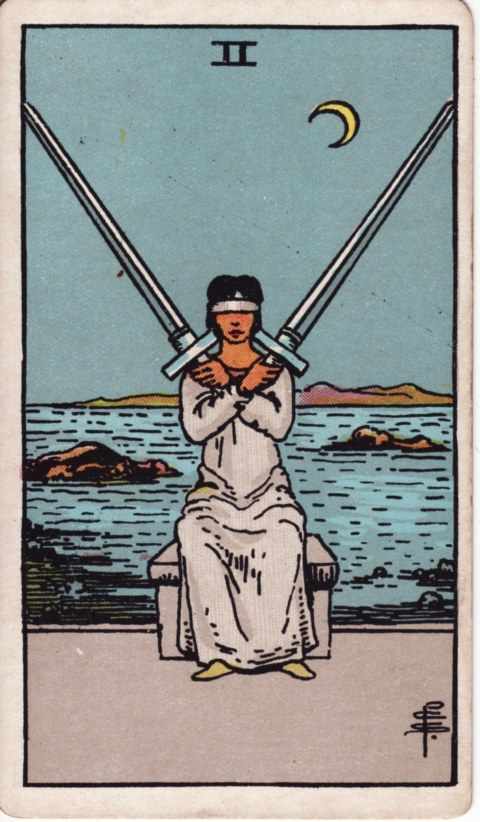
Two of Swords upright: a standoff or a truce?
Most sites call this card indecision. Labyrinthos opens with "stalemate, difficult choices, stuck in the middle," and Tarot.com says "it's a standoff." The old sources lean another way. Waite lists "Conformity and the equipoise which it suggests, courage, friendship, concord in a state of arms," and Book T calls it "Peace Restored" and its meaning includes "truce." Both describe a peace kept with weapons held up.
That changes the question to ask. Ask who has stopped fighting and what each side is still holding, as well as what you cannot decide. Waite himself warns that "The suggestion of harmony and other favourable readings must be considered in a qualified manner, as Swords generally are not symbolical of beneficent forces in human affairs." The calm is real and it is guarded. Book T's one-line summary agrees: "Quarrel made up, yet still some tension in relations."
On the job and money side, the upright card says the facts are not all on the table yet. Wait for the one missing figure, the reply or the signed terms before committing. Waiting works if you use the time and turns into avoidance if you do not.
Two of Swords reversed: is the blindfold coming off?
Reversed, the readings spread out. Waite's list is about trust: "Imposture, falsehood, duplicity, disloyalty." Biddy Tarot reads the reversal as indecision, confusion and information overload. Tarot.com says the stalemate has gone on too long and the decision may be made for you because you waited. So the blindfold is either removed by a fact you did not want, or the delay has run out.
Waite's second list is shorter and sharper: "Dealings with rogues." Read plainly, the reversed card asks you to check whether someone in the truce has stopped keeping to it; it does not say there is a rogue.
If this is your only card, try this: write the two options as two lines, then next to each write one thing you have actually verified, not heard or assumed. Then add the date by which you will decide. If one side has a verified fact and the other has only a feeling, the blindfold is partly off already, and you may be choosing before you admit it. If both sides are blank, the task is to find out more, and the date should be the day you ask by.
If you asked whether an ex or a friend will reply, or whether someone will decide in your favor, the card is silent. What it shows is the standoff you are in and your part in keeping it. If the truce is a day-to-day strain with someone, a mediator or counselor can do more than a card.
Is the Two of Swords a yes or no card?
| Position | Answer |
|---|---|
| Upright | Not yet, facts first |
| Reversed | Decide soon, the wait is ending |
Upright, the Two of Swords is a not yet. Tarot.com answers NO outright, which is too hard a verdict for a card that is a pause with a purpose. If the question is whether to sign, confront or commit today, wait for the missing fact.
Reversed, it leans toward deciding soon, because the delay is running out or the blindfold is slipping. Neither old source assigns a verdict; the answer above comes from how readers use the card today.
Two of Swords in love and friendship: peace or just quiet?
Already together
Between partners, the card often marks a quarrel that is settled in words and still hangs in the air. Book T's phrase fits: "Quarrel made up, yet still some tension in relations." Both of you have put the swords down halfway. One conversation that names what is still sore will do more than another week of careful politeness.
Single
Alone, it can be two possible people, or one person and the wish to stay free. Labyrinthos reads it as a choice between two lovers. The card does not tell you which, but it suggests finding out what each option is like on an ordinary Tuesday before you decide on the feeling.
As feelings
If the question is how they feel, the Two of Swords means guarded warmth. They want peace, are not ready to be open, and are watching what you do. Waite's alternate reading gives "tenderness, affection, intimacy," so the care can be real. Look at whether they step toward you when it costs them something.
After the fight, are you actually friends again?
Waite's list for the Two of Swords includes "friendship" itself, next to courage and balance. The scene is a quarrel patched up and still guarded: you talk, you joke a little, and neither of you mentions the thing. Each of you keeps one sword up.
Reversed, the truce slips. Something kept back comes out, or a friend you were polite to stops pretending. This week, ask them one open question about the fight, such as what they wish you had done differently, and listen to the whole answer before you reply.
Reversed in love
Reversed, a truce breaks or a choice you have delayed gets made by events. It can be the moment an unspoken thing is said, or a partner who stopped pretending to agree. Waite's "duplicity" is a caution to look for what is being kept back; it charges no one. With an ex, it speaks of your own stance and says nothing of their plans.
Two of Swords at work and with money
On the job it shows the standoff: two colleagues who both expect you to take their side, a pair of offers, or a negotiation where neither party has moved. With money it says to hold the signature until the missing number arrives. Book T lists the card's mild side too, "justice, unselfishness," so a fair compromise is a possible outcome.
Reversed, the delay has a price. A deadline passes, or the decision is taken by someone else. With a reversed pull and a job at stake, write down what you would need to know to decide and ask for it this week.
Two of Swords as advice and as a person
As advice, keep the peace and keep your eyes open. Take the blindfold off for one hour: sort the facts into seen and merely reported. Then choose a day to decide and keep to it.
To see it in a person, imagine a mediator named Dev, who works in a small company between two founders who have stopped arguing and started avoiding each other. He is polite to both and takes no side. He is doing what the card shows, holding the balance. The risk is that he never says what he thinks. Reversed as advice: the balance is slipping, so name your own view before someone names it for you.
How to read the Two of Swords in a spread
Alone, it describes a pause with weapons still raised, and the job is to learn what the pause is for. Laid out in a line, it is an early conflict settled halfway, a balance you are holding now, or a peace that will need upkeep.
In Book T's dignity rules, Swords are "friendly with Cups and Wands." Cups beside it warm the truce and Wands energize it. Swords on both sides make the tension louder. If the Three of Swords lies beside it, the peace breaks, as Book T draws it, and beside the Queen of Swords it is a truce kept by someone with a clear head. Next to Justice, the card for Libra, the settlement becomes formal.
The Two of Swords among the Swords
The Two of Swords comes right after the Ace, the raised sword, and before the Three. In Book T the roses tell the story. The Two holds a rose of five petals on the crossing point, with white rays. The Three cuts it and the Four brings it back. The Three of Swords page covers the rupture; here the thing to see is that the Two is the last moment the rose is whole.
That makes the Two the quietest card of a hard suit. Nothing has been lost or resolved yet. The suit's later cards show what happens when the standoff is not used.
- Ace of Swords
- Two of Swords · Peace Restored
- Three of Swords · Sorrow
- Four of Swords · Rest from Strife
- Five of Swords · Defeat
- Six of Swords · Earned Success
- Seven of Swords · Unstable Effort
- Eight of Swords · Shortened Force
- Nine of Swords · Despair and Cruelty
- Ten of Swords · Ruin
- Page of Swords
- Knight of Swords
- Queen of Swords
- King of Swords
Titles after the numbered cards are the Golden Dawn's names for them in Book T.
Symbolism of the Rider–Waite–Smith card
- The blindfold. A pale band covers her eyes. Book T has no person at all, only two hands and two swords, so the blindfold comes from Waite's "hoodwinked" figure and Smith's card. Biddy Tarot reads it as not seeing the whole of her situation. It can also be a chosen quiet: she cannot be swayed by what she sees.
- The crossed swords. She holds each long blade by the hilt, arms crossed over her chest, the points rising to the corners. Waite says she "balances two swords upon her shoulders." Book T's card shows "Two crossed swords" and a rose where they meet. The balance is the point: neither blade drops.
- The still water and rocks. Calm water spreads behind her, with rocky outcrops at both edges and low land on the horizon. Labyrinthos reads the rocks as obstacles. Our reading is that the stillness is what the truce looks like from outside: nothing moves, and there are hazards underneath.
- The crescent moon. A gold crescent hangs at the upper right. Book T assigns the card to the Moon, with a crescent "horns upward" on the dagger at the top. Smith's crescent opens upward, tilted slightly to the right. The Moon is the decan's planet, so it is the card's astronomical signature.
- The stone bench. She sits square on a plain block of stone with her back to the water. It is a seat for waiting rather than travel, and Smith gives it no cushion. The pose is that of a person who has chosen to stay put.
What the oldest sources say
“Conformity and the equipoise which it suggests, courage, friendship, concord in a state of arms; another reading gives tenderness, affection, intimacy. The suggestion of harmony and other favourable readings must be considered in a qualified manner, as Swords generally are not symbolical of beneficent forces in human affairs. Reversed: Imposture, falsehood, duplicity, disloyalty.”
“Gifts for a lady, influential protection for a man in search of help. Reversed: Dealings with rogues.”
“Contradictory characters in the same nature, strength through suffering; pleasure after pain. Sacrifice and trouble, yet strength arising therefrom, symbolized by the position of the rose, as though the pain itself had brought forth beauty. Arrangement, peace restored; truce; truth and untruth; sorrow and sympathy. Aid to the weak; arrangement; justice, unselfishness; also a tendency to repetition of affronts on being pardoned; injury when meaning well; given to petitions; also a want of tact, and asking question of little moment; talkative.”
Waite's two lists mix hope and doubt. The first runs "Conformity... courage, friendship, concord in a state of arms; another reading gives tenderness, affection, intimacy," then the warning about Swords. The second adds "Gifts for a lady, influential protection for a man in search of help." Reversed gives "Imposture, falsehood, duplicity, disloyalty," then "Dealings with rogues." The gifts and protection are odd for a card that blogs read as paralysis. In our reading they fit a truce: someone with leverage is keeping you safe.
Book T is the most generous source and the most contradictory. It opens with "Contradictory characters in the same nature, strength through suffering; pleasure after pain," says the rose is placed "as though the pain itself had brought forth beauty," and then lists "truth and untruth; sorrow and sympathy." Its person is "given to petitions" and "talkative," with "a want of tact." Together that is a mixed, talkative peace, far from paralysis.
Two of Swords and Moon in Libra: the card's decan
| Suit and element | Swords, Air (Major Arcana card of air: The Fool) |
|---|---|
| Decan | 0° to 10° ♎︎ Libra, the first ten degrees of the sign |
| Planet of the decan | Moon (Major Arcana: The High Priestess) |
| Major Arcana card of Libra | Justice |
| Golden Dawn title | The Lord of Peace Restored |
| Place on the Tree of Life | Chokmah (Book T: “Quarrel made up, yet still some tension in relations: actions sometimes selfish, sometimes unselfish”) |
Attributions from Book T (Golden Dawn, c. 1892; printed 1912).
In Book T the Two of Swords rules the first decan of Libra, 0° to 10°, ruled by the Moon: the dagger at the top carries the crescent and the one at the bottom carries Libra. Its title is "Peace Restored," and it belongs to Chokmah on the Tree of Life. Among the trumps, Justice belongs to Libra, The High Priestess to the Moon and The Fool to air. Scales and a lunar mood both fit a card of balance.
The Queen of Swords' zone swallows this decan whole, so her page and this one overlap. In sequence the Two sits between a wealth and a sorrow, which suits a card of uneasy peace, though the source itself is silent on it. The decan begins on the September equinox.
When the Sun is in the Two of Swords stretch
| Year | Sun enters 0° | Sun leaves (reaches 10° Libra) |
|---|---|---|
| 2026 | Sep 22 | Oct 3 |
| 2027 | Sep 23 | Oct 3 |
| 2028 | Sep 22 | Oct 2 |
| 2029 | Sep 22 | Oct 2 |
This year the Sun crossed the Two of Swords stretch of the zodiac (0° to 10° Libra) from September 22 to October 3, 2026. Next time: September 23 to October 3, 2027 (US Eastern dates).
Dates are US Eastern, from the astronomy-engine ephemeris. Across 35,064 dates from 1930 to 2025, the Sun is in this stretch on 2.8% of them, and at least one of the ten planets is on 26%.
Saturn crossed this decan in 1950 to 1952, 1980 to 1981 and 2009 to 2010, and returns in 2039 and 2040. Pluto was here in 1971 to 1976 and Uranus in 1968 to 1971, with Uranus back in 2051 to 2054, by our ephemeris. The Sun is in it between about September 22 and October 3, a calendar note with no forecast in it. Enter a birth date in the tool below to see your own planets.
Is the Two of Swords in your birth chart?
Enter your birth date. We show which of the ten planets stood between 0° and 10° Libra that day, the slice of sky Book T gives this card; add the time if a planet was near the edge.
Enter your birth date above to see your result.
Every planet, angle and house from your birth time: birth chart calculator.
Questions about the Two of Swords
Does the Two of Swords bring good news or bad?
Neither outright. Upright it is a pause or a tense truce; Waite says the favorable readings are "qualified." Reversed, it warns of hidden facts or a delay that has run out.
What does the Two of Swords mean as feelings?
Guarded care. The person wants peace and is not ready to open up. Reversed, they hide it, waver, or have the choice taken from them.
Is the Two of Swords about a decision?
Often, but the old sources are about a truce. Biddy Tarot and Labyrinthos read a choice between two things. Ask what each side is still holding.
Does the Two of Swords answer yes or no?
Upright, not yet, though Tarot.com says NO; reversed, decide soon. Neither Waite nor Book T rules on it.
What does the Two of Swords reversed mean?
Information surfacing, a truce failing, or a choice made by events. Waite lists "Imposture, falsehood, duplicity, disloyalty."
Which part of the zodiac holds the Two of Swords?
The start of Libra. In Book T it rules 0° to 10°, under the Moon, and the Sun crosses that slice around September 22 to October 3.
When will the standoff end?
A card gives no dates. September 22 to October 3 is the Sun's passage through the decan, a calendar convention only.
Sources
- Astronomy Engine: the open-source ephemeris library behind our planet positions, dates and statistics
- A. E. Waite, The Pictorial Key to the Tarot (1911), Wikisource: the divinatory meanings we quote, upright and reversed
- Book T (Golden Dawn), as printed in The Equinox I:8, 1912: the zodiac sign, Hebrew letter, title and short meaning of each card
- Wikimedia Commons: Rider–Waite–Smith tarot deck: Pamela Colman Smith's 1910 card drawings, public domain
- How we create our readings: our own calculation of sign dates, positions and the 1930 to 2025 statistics
Next to the Two of Swords
In the suit of Swords: Ace of Swords ← Two of Swords → Three of Swords.
Libra on this site: Libra zodiac sign · Justice, the card of Libra · your full birth chart.
All 22 Major Arcana with their signs and planets, and the minor cards written so far: tarot card meanings.
Written by The Zodiac Atlas editorial team with the help of AI and edited by a person. Quotations are from Waite's Pictorial Key to the Tarot and the Golden Dawn's Book T, both in the public domain; the card picture is a 1910 printing of Pamela Colman Smith's drawing for the 1909 deck. Sun dates and planet positions come from the astronomy-engine ephemeris (tropical zodiac). Tarot and astrology are symbolic traditions; they do not predict events.